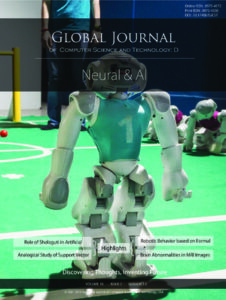
Robotic Behavior based on Formal Grammars

1
J.L. Briseno
J.L. Briseno
2
M.A. Jimnez
M.A. Jimnez
3
G. Olague
G. Olague
1 Center for Scientific Research and Higher Education of Ensenada

Send Message

To: Author

GJCST Volume 18 Issue D2

Article Fingerprint

ReserarchID

E23ZD

Robotic Behavior based on Formal Grammars Banner

AI TAKEAWAY

The objective of our study was to evaluate, in a population of Togolese People Living With HIV(PLWHIV), the agreement between three scores derived from the general population namely the Framingham score, the Systematic Coronary Risk Evaluation (SCORE), the evaluation of the cardiovascular risk (CVR) according to the World Health Organization.
  • English
  • Afrikaans
  • Albanian
  • Amharic
  • Arabic
  • Armenian
  • Azerbaijani
  • Basque
  • Belarusian
  • Bengali
  • Bosnian
  • Bulgarian
  • Catalan
  • Cebuano
  • Chichewa
  • Chinese (Simplified)
  • Chinese (Traditional)
  • Corsican
  • Croatian
  • Czech
  • Danish
  • Dutch
  • Esperanto
  • Estonian
  • Filipino
  • Finnish
  • French
  • Frisian
  • Galician
  • Georgian
  • German
  • Greek
  • Gujarati
  • Haitian Creole
  • Hausa
  • Hawaiian
  • Hebrew
  • Hindi
  • Hmong
  • Hungarian
  • Icelandic
  • Igbo
  • Indonesian
  • Irish
  • Italian
  • Japanese
  • Javanese
  • Kannada
  • Kazakh
  • Khmer
  • Korean
  • Kurdish (Kurmanji)
  • Kyrgyz
  • Lao
  • Latin
  • Latvian
  • Lithuanian
  • Luxembourgish
  • Macedonian
  • Malagasy
  • Malay
  • Malayalam
  • Maltese
  • Maori
  • Marathi
  • Mongolian
  • Myanmar (Burmese)
  • Nepali
  • Norwegian
  • Pashto
  • Persian
  • Polish
  • Portuguese
  • Punjabi
  • Romanian
  • Russian
  • Samoan
  • Scots Gaelic
  • Serbian
  • Sesotho
  • Shona
  • Sindhi
  • Sinhala
  • Slovak
  • Slovenian
  • Somali
  • Spanish
  • Sundanese
  • Swahili
  • Swedish
  • Tajik
  • Tamil
  • Telugu
  • Thai
  • Turkish
  • Ukrainian
  • Urdu
  • Uzbek
  • Vietnamese
  • Welsh
  • Xhosa
  • Yiddish
  • Yoruba
  • Zulu

Formal grammars, studied by N. Chomsky for the definition of equivalence with languages and models of computing, have been a useful tool in the development of compilers, programming languages, natural language processing, automata theory, etc. The words or symbols of these formal languages can denote deduced actions that correspond to specific behaviors of a robotic entity or agent that interacts with an environment. The primary objective of this paper pretend to represent and generate simple behaviors of artificial agents. Reinforcement learning techniques, grammars, and languages, as defined based on the model of the proposed system were applied to the typical case of the ideal route on the problem of artificial ant. The application of such techniques proofs the viability of building robots that might learn through interaction with the environment.

Article content is being processed or not available yet.

13 Cites in Articles

References

  1. S Russell,P Norvig (2009). Artificial Intelligence: A Modern Approach.
  2. Johnr. Koza (1992). Genetic programming as a means for programming computers by natural selection.
  3. D Gamez,Z Fountas,A Fidjeland (2013). A neuronal controlled computer game avatar with humanlike behavior.
  4. J Briseño (2007). Learning human behavior from analyzing activities in virtual environments.
  5. Todd Hester,Michael Quinlan,Peter Stone (2010). Generalized model learning for Reinforcement Learning on a humanoid robot.
  6. Lizhong Gu,Jianbo Su (2006). Humanoid Robot Behavior Learning Based on ART Neural Network and Cross-Modality Learning.
  7. T Ogura,K Okada,M Inaba,H Inoue (2003). Behavior network acquisition in multisensory space for whole-body humanoid.
  8. John Anderson,Daniel Bothell,Michael Byrne,Scott Douglass,Christian Lebiere,Yulin Qin (2004). An Integrated Theory of the Mind..
  9. F Martın,J Canas,C Agüero,E Perdices (2010). Behavior-based iterative component architecture for robotic applications with the NAO humanoid.
  10. V Manikonda,P Krishnaprasad,J Hendler (1995). A motion description language and a hybrid architecture for motion planning with nonholonomic robots.
  11. Neil Dantam,Mike Stilman (2013). The Motion Grammar: Analysis of a Linguistic Method for Robot Control.
  12. J Hopcroft,J Ullman (1979). Introduction to Automata theory, Languages, and Computation.
  13. T Mitchell (1997). Molten carbonate fuel cell product development test. Final report, September 30, 1992--March 31, 1997.

Funding

No external funding was declared for this work.

Conflict of Interest

The authors declare no conflict of interest.

Ethical Approval

No ethics committee approval was required for this article type.

Data Availability

Not applicable for this article.

J.L. Briseno. 2018. \u201cRobotic Behavior based on Formal Grammars\u201d. Global Journal of Computer Science and Technology - D: Neural & AI GJCST-D Volume 18 (GJCST Volume 18 Issue D2): .

Download Citation

Journal Specifications

Crossref Journal DOI 10.17406/gjcst

Print ISSN 0975-4350

e-ISSN 0975-4172

Keywords
Classification
GJCST-D Classification: I.2.9
Version of record

v1.2

Issue date

September 29, 2018

Language

English

Experiance in AR

The methods for personal identification and authentication are no exception.

Read in 3D

The methods for personal identification and authentication are no exception.

Article Matrices
Total Views: 5755
Total Downloads: 1485
2026 Trends
Research Identity (RIN)
Related Research
Our website is actively being updated, and changes may occur frequently. Please clear your browser cache if needed. For feedback or error reporting, please email [email protected]
×

This Page is Under Development

We are currently updating this article page for a better experience.

Request Access

Please fill out the form below to request access to this research paper. Your request will be reviewed by the editorial or author team.
X

Quote and Order Details

Contact Person

Invoice Address

Notes or Comments

This is the heading

Lorem ipsum dolor sit amet, consectetur adipiscing elit. Ut elit tellus, luctus nec ullamcorper mattis, pulvinar dapibus leo.

High-quality academic research articles on global topics and journals.

Robotic Behavior based on Formal Grammars

J.L. Briseno
J.L. Briseno Center for Scientific Research and Higher Education of Ensenada
M.A. Jimnez
M.A. Jimnez
G. Olague
G. Olague

Research Journals