## INTRODUCTION
Military decision makers have been considering terrain in their military action plans for thousands of years. By terrain herein is the very broad, detailed, local, and real-time consideration of: water, oil and gas, rock, mineral, forest and other resources; land suitable for tunnels, trenches, and rock walls; topography and landforms in the interest of mobility and ground control; access to safe and protective shelter, stable transportation routes; and other issues. It's clear to the everyday observer that: water is vital; excavatable rocks are easier for tunneling, diggable soils are suitable for trenching, and large rocks are suitable for wall-making than otherwise; flat open or valley lands are easier to conquer than hills or rugged mountains; high ground capture can control surrounding low ground; sand dunes and mud are more difficult to travel over than hard ground; safety behind high, leafy, and dense vegetation is more secure than an open meadow; and seasons and weather may make terrain conditions more or less favorable.
Modern military geology is credited to Napoleon Bonaparte whose geologists and engineers left a legacy of maps detailing military advantages and disadvantages of specific terrains in areas of his interest. He also procured the new decision-making mathematicians to develop systems analysis, also called operations research, to optimize military field logistics. Our Civil War and World War military leaders, and more current modern leaders were and are cognizant of the terrain to fight within and to defend. In the age of satellites, remote sensing, geographic information systems, and computer assisted design, intercontinental missiles, and drones, our knowledge of real-time terrain is rapidly increasingly accurate and useful.
Ukraine has come into the attention for the much of the world since the Russian 2014 invasion and consequent annexation of Ukraine's Crimea, incorporation of Russian-proxy, self-proclaimed, separatist Donetsk and Luhansk Provinces in eastern Ukraine and Russian-invaded Zaporizhzhia and Kherson regions in southeastern Ukraine in 2022, and invasion of Ukraine and annexation of eastern and southeastern Ukraine in 2022.
Location: Ukraine is located in Eastern Europe, surrounded by seven countries and two seas as shown in Figure 1. Note its major rivers and mountains which have military impacts.
Ukraine's complex history is summarized by U.S. CIA Facts (November 2022) and elsewhere, and not needed to be elaborated in this article. The country covers about 603,550 sq km, about 96 percent is land and four percent is water. Ukraine is slightly larger than Texas, or over 3.2 times the size of New England. Its land boundaries border Belarus, Russia, Moldova, Romania, Hungary, Slovakia, and Poland.
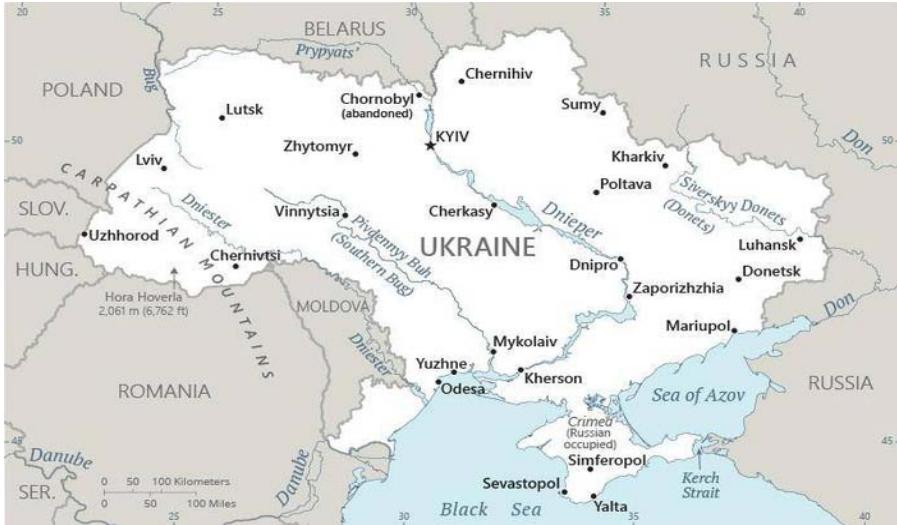 Figure 1: Ukraine map showing major cities, parts of the surrounding countries, the Black Sea, and the Sea of Azov (U.S. CIA World Facts, Ukraine, November 2022)
Climate: Ukraine's generally temperate continental climate is broken by Mediterranean climate on its southern Crimean coast. Precipitation is highest in the west and north, and lesser in the east and southeast of the country. Winters range from cool along the Black Sea to cold inland. Summers are warm throughout the country and hot in the south. The country experiences occasional floods and droughts. Sea levels appear to be currently rising at about 2-3 mm annually.
Terrain: Ukraine is mostly fertile steppes (or plains) with the Carpathian Mountains in the west and mountains on the extreme south of Crimea. Figure 2 is a shaded relief map of Ukraine. Note its highlands, lowlands, marshes, and drainages which have military consequences.
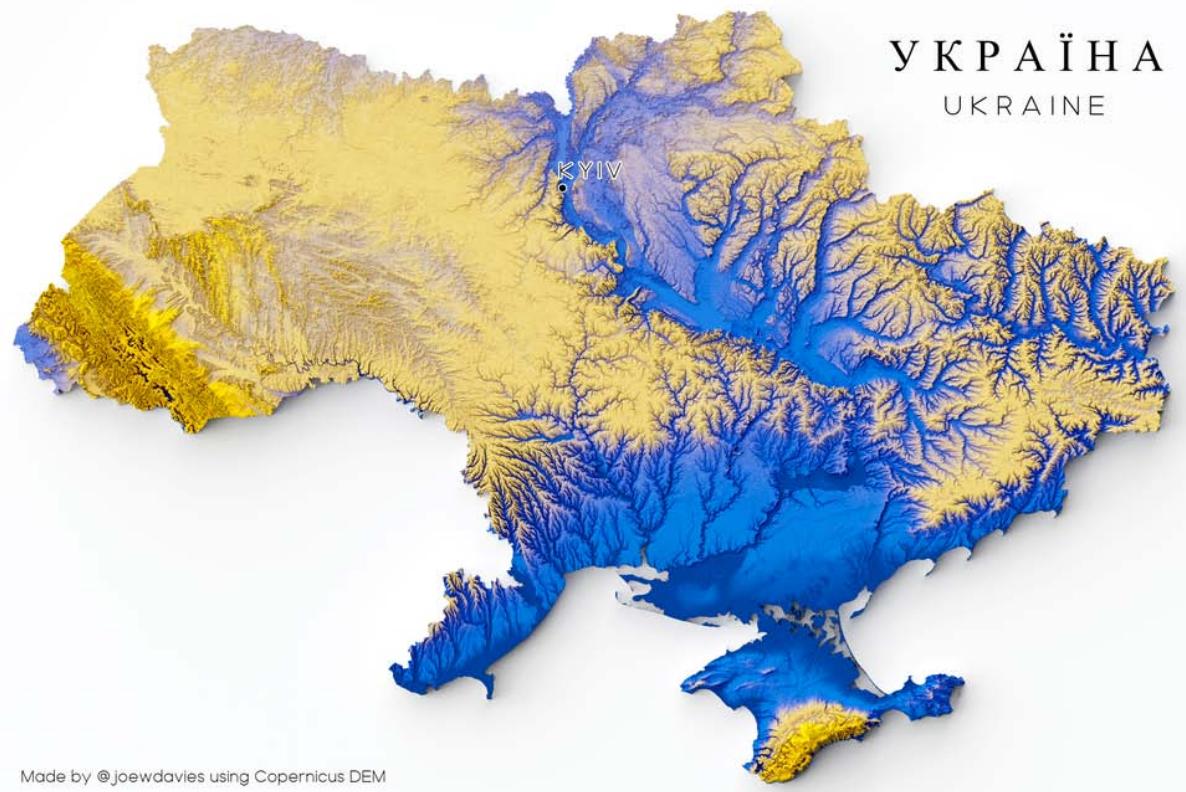 Figure 2: Shaded relief map of Ukraine (Datais Beautiful, 2022)
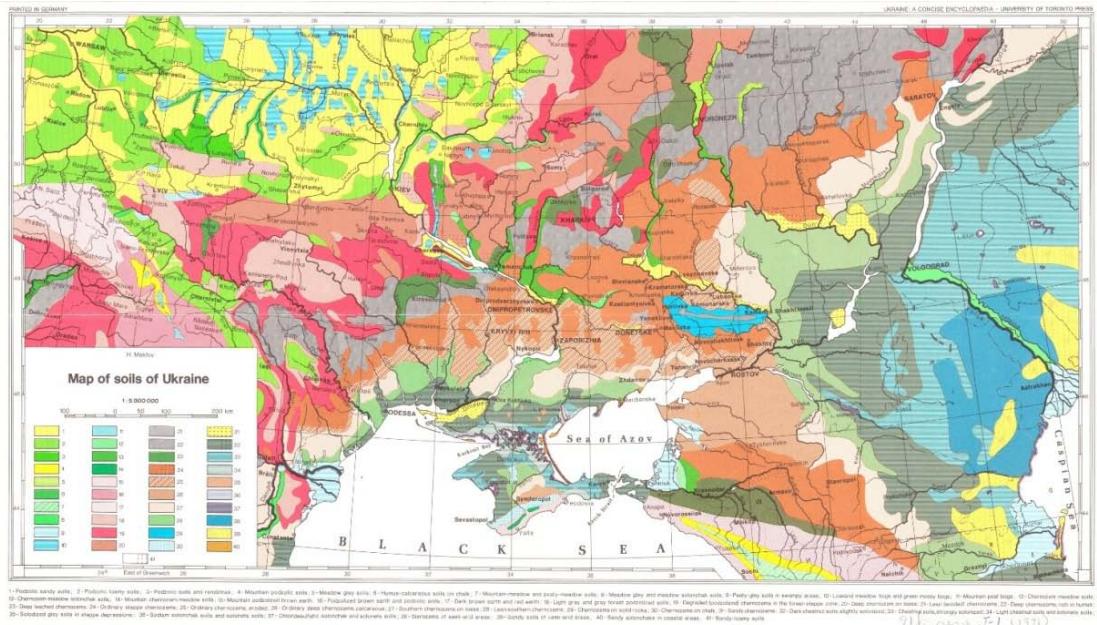 Figure 3 shows the soils of Ukraine. Figure 3: Soil map of Ukraine (Archive, 1971)
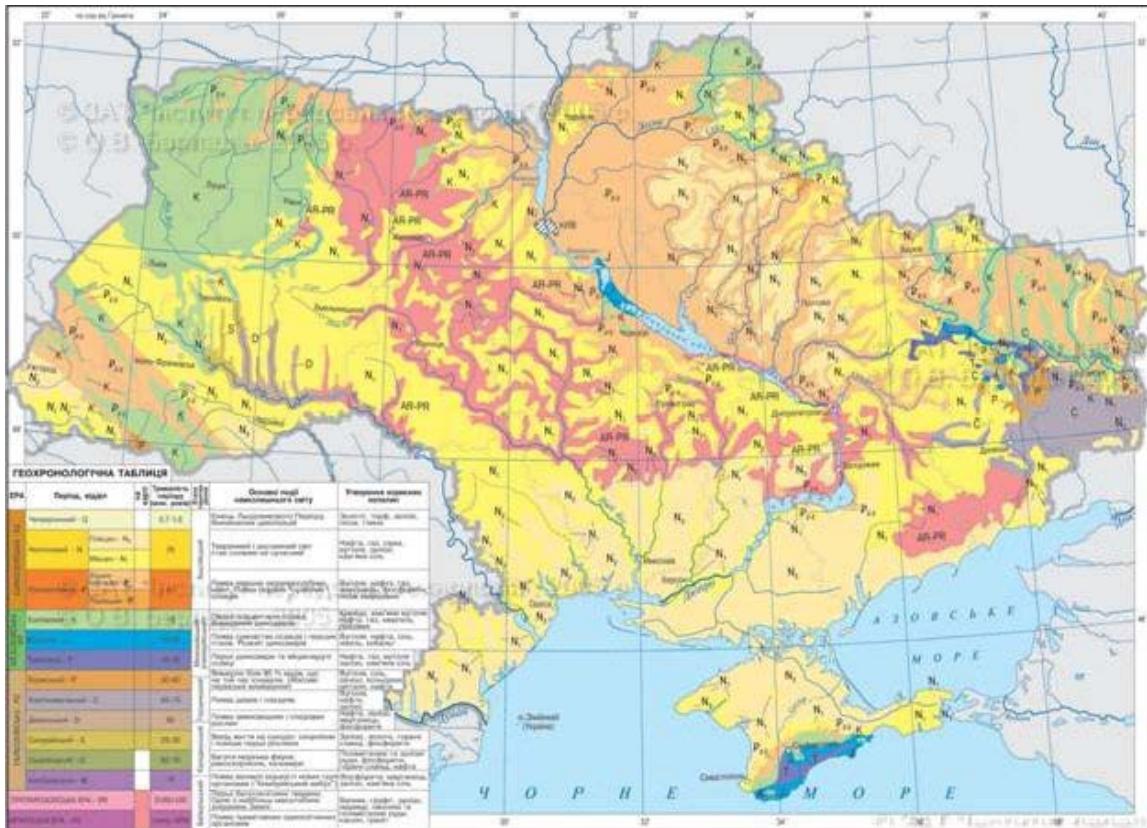 Figure 4 shows a geologic structure map of Ukraine. According to GeoMap (no date), the most common in the geological structure of Ukraine is Precambrian, Paleozoic (especially coal-period), Mesozoic (Including the Cretaceous period), and particularly Cenozoic sediments. Among anthropogenic deposits are glacial sediments, water-glacial, aeolian, and alluvial materials. Figure 4: Geologic structure of Ukraine (no date)
Natural Resources: Ukraine's natural resources include abundant fresh water, navigable rivers, river ports, iron and manganese ores, anthracite and bituminous coal, lignite (brown coal), natural gas, oil, uranium, salt, sulfur, graphite, titanium, magnesium, kaolin, nickel, mercury, rare earth minerals and gold, limestone and aggregates, timber and non-timber forest products (Christmas trees, Pine needle extracts, mushrooms, berries, birch syrup), arable land, maritime routes, and deep natural ports.
Military Geology: Some of the salient military geology aspects of Ukraine include its radioactive soils and potential releases, tunnels, marshes, rivers and dams, and bridges.
Radioactive Soils: Ukraine's radioactive soils and potential radioactive releases from and around its nuclear plants pose a Ukrainian and regional risk, but a potential Russian advantage.
According to the Encyclopedia Britannica (no date), from northwest to southeast, the soils of Ukraine consist of: 1. A zone of sandy podzolized soils;
2. A central belt of black, extremely fertile chernozems; and 3. Chestnut and salinized soils.
Tunnels: Limestone tunnels as much as ten stories deep and over 15 miles long at Odesa in the south, as well as rock tunnels at its capitol Kyiv in the north and industrial Mariopol in the east, provide military and civilian refuge areas. They pose a hazard to the Russians.
The average and maximum depths of the Neogene unconsolidated rock cover are about 25 and 100 meters, respectively, indicating that hard rock is available below these depths for deep tunnels and underground subway train corridors. To refresh, the Neogene Period was a time of big changes in the earth when the climate became cooler and drier, grasslands replaced forests, and animals adapted or became extinct.
The Pinsk Marshes: Per Ledur et al (2022), "To Ukraine's north span roughly 100,000 square miles of wetlands known as the Pinsk Marshes. Here is one place the cold could really play a role. During the winter, these mucky flatlands freeze over, providing a more stable terrain for heavy military vehicles that would otherwise get stuck in the mud." There are similar marshes along the Belarus border in northern Ukraine.
The Dnieper River: The north-south flowing Dnieper River in central Ukraine, with its critical dams, divides Ukraine into east and west. It's difficult to cross and destruction of its dams and hydropower facilities would lead to catastrophic flooding and loss of electricity.
The Bridge over the Kerch Straits: In 2018, Russia completed this 12-km, $4 billion bridge connecting Russia with its conquered Crimea. It's a very vulnerable linkage for a determined force.
Table 1 summarizes selected natural and anthropogenic situations which are favor offensive and defensive military positions. There are many others, many of which are documented in readily available books and articles available through internet searches. Of course, local and instant conditions may vary from the table.
Table 1: Summary of selected favorable offensive and defensive situations
<table><tr><td>Situation</td><td>Favors Offense</td><td>Favors Defense</td></tr><tr><td>Radioactive soil</td><td>▲</td><td>▼</td></tr><tr><td>Rivers</td><td>▼</td><td>▲</td></tr><tr><td>Dams and bridges</td><td>▲</td><td>▼</td></tr><tr><td>Hills, uplands, mountains</td><td>▼</td><td>▲</td></tr><tr><td>Valleys and lowlands</td><td>▲</td><td>▼</td></tr><tr><td>Grottos, catacombs, caves</td><td>▼</td><td>▲</td></tr><tr><td>Islands, coasts, open seas, marshes</td><td>▲</td><td>▼</td></tr><tr><td>Forests, tunnels, trenches</td><td>▼</td><td>▲</td></tr><tr><td>Open pastures and fields</td><td>▲</td><td>▼</td></tr><tr><td>Missile and done defenses</td><td>▼</td><td>▲</td></tr><tr><td>Bomb shelters, hospitals, rest and recovery centers</td><td>▼</td><td>▲</td></tr><tr><td>Early warning and alarm systems</td><td>▼</td><td>▲</td></tr><tr><td>Evacuation and resettlement plans</td><td>▼</td><td>▲</td></tr></table>
Final Thoughts: A professional military forces as well as ad hoc resisters, militias, insurgents are wise to utilize the advantages of geologic factors. Yet there is much more than that to winning and losing battles and wars. Forces who command higher communication information and intelligence technology, morals, flexibility, staying power, surprise elements, veteran troops, initiative, troop rotations, field health, advanced scouting and technology, and other factors are more likely to succeed in their objectives.
AUTHOR AND ACKNOWLEDGEMENTS
Mr. Popkin is a geologist, soil scientist, hydrologist, environmental engineer, and water and waste manager. He has over 50 years of experience in more than 30 U.S. states and as many countries, including Bashkiria, Georgia, Kosovo, and Tajikistan. His grandparents immigrated to the U.S. from Eastern Europe over 100 years ago. Mr. Popkin is grateful to Dr. Chisholm at NYU, Mr. Summers at NMT, and Dr. Holmes at Missouri S&T for sharing their insights to military geology.
Generating HTML Viewer...
References
6 Cites in Article
Vitalii Kugai (1971). THE HOLODOMOR OF 1932-1933 IN UKRAINE (ACCORDING TO THE DOCUMENTS OF SKOROPADSKYI’S ARCHIVE IN THE CENTRAL STATE HISTORICAL ARCHIVE OF UKRAINE).
Dataisbeautiful (2022). Shaded relief and surface markings map, shaded relief map, and controlled photomosaic of Io.
Explore published articles in an immersive Augmented Reality environment. Our platform converts research papers into interactive 3D books, allowing readers to view and interact with content using AR and VR compatible devices.
Your published article is automatically converted into a realistic 3D book. Flip through pages and read research papers in a more engaging and interactive format.
Our website is actively being updated, and changes may occur frequently. Please clear your browser cache if needed. For feedback or error reporting, please email [email protected]
Thank you for connecting with us. We will respond to you shortly.