
Loading menu…

Solution of Integral Equation in Two-Dimensional using Spectral Relationships

§ Umm Al-Quraa University

Send Message

To: Author

Solution of Integral Equation in Two-Dimensional using Spectral Relationships

Article Fingerprint

ReserarchID

3CRI9

Solution of Integral Equation in Two-Dimensional using Spectral Relationships Banner

Key Research Insights

Synthesized scholarly intelligence & interactive research assistant
  • English
  • Afrikaans
  • Albanian
  • Amharic
  • Arabic
  • Armenian
  • Azerbaijani
  • Basque
  • Belarusian
  • Bengali
  • Bosnian
  • Bulgarian
  • Catalan
  • Cebuano
  • Chichewa
  • Chinese (Simplified)
  • Chinese (Traditional)
  • Corsican
  • Croatian
  • Czech
  • Danish
  • Dutch
  • Esperanto
  • Estonian
  • Filipino
  • Finnish
  • French
  • Frisian
  • Galician
  • Georgian
  • German
  • Greek
  • Gujarati
  • Haitian Creole
  • Hausa
  • Hawaiian
  • Hebrew
  • Hindi
  • Hmong
  • Hungarian
  • Icelandic
  • Igbo
  • Indonesian
  • Irish
  • Italian
  • Japanese
  • Javanese
  • Kannada
  • Kazakh
  • Khmer
  • Korean
  • Kurdish (Kurmanji)
  • Kyrgyz
  • Lao
  • Latin
  • Latvian
  • Lithuanian
  • Luxembourgish
  • Macedonian
  • Malagasy
  • Malay
  • Malayalam
  • Maltese
  • Maori
  • Marathi
  • Mongolian
  • Myanmar (Burmese)
  • Nepali
  • Norwegian
  • Pashto
  • Persian
  • Polish
  • Portuguese
  • Punjabi
  • Romanian
  • Russian
  • Samoan
  • Scots Gaelic
  • Serbian
  • Sesotho
  • Shona
  • Sindhi
  • Sinhala
  • Slovak
  • Slovenian
  • Somali
  • Spanish
  • Sundanese
  • Swahili
  • Swedish
  • Tajik
  • Tamil
  • Telugu
  • Thai
  • Turkish
  • Ukrainian
  • Urdu
  • Uzbek
  • Vietnamese
  • Welsh
  • Xhosa
  • Yiddish
  • Yoruba
  • Zulu
Reading Preferences
Font Size
Line Spacing
Background
This converted HTML version may contain rendering inconsistencies. Please refer to the PDF for the authoritative version, or click here to provide feedback.

Abstract

This paper concerned using spectral relationships in the solution of the integral equation (IE) in two-dimensional. To discuss that, the (IE) in two-dimensional under certain conditions was considered. The existence of at least one solution of the (IE) was discussed by proving the continuity and compactness of an integral operators. Chebyshev polynomials of the first kind were used to transform the (IE) to a linear algebraic system. Many numerical results and estimating errors were calculated and plotted by the Maple program in different cases.

I. INTRODUCTION

In recent years, the main theorem of spectral relationships plays an important role in many applications in various areas, including models of nanotechnology particles, genetic engineering, medicine, mathematical chemistry, heat condition and physical phenomena, see [1−4].

On the other side, many problems of mathematical physics, contact problems in elastic media, many applications in electronic engineering applications, and mathematical biology models lead to an (IEs) in smooth or singular forms. The references [5−7] discuss the methods for solving the (IEs) in smooth form antically. While the singular forms take a large aria in types of researches, see [8−11]. In [10], a spectral technique for solving two-dimensional fractional integral equations with singular kernel was discussed by using Legendre and Chebyshev polynomials. Abdou and Salama in [12] obtained the spectral relationships for the Volterra-Fredholm integral equation (V-FIE) of the first kind. Abdou [13] discussed the spectral relationships that have many important applications in astrophysics, for the (F-VIE) of the first kind, when the kernel of position takes a generalized potential form. The relation between the contact problems and the (F-VIE) in three dimensions were obtained by Abdou and Moustafa in [14]. Abdou and Nasr in [15] used Chebyshev polynomial to obtain the solution of (F-VIE) when the kernel takes a logarithmic form. The application of Orthogonal polynomials in spectral relationships of some kinds of singular contact problems is discussed by Alharbi in [16]. Abdou and Basseem in [17] used Chyebyshev polynomial, the main theorem of spectral relationships of (FIE) to obtain the solution of (F-VIE) of the second kind numerically. Abdou and Alharbi in [18] derived a general main theorem of spectral relationships for a mixed integral equation of the first kind (MIE) in the space L2[−1,1]×C[0,T].

Consider the integral equation,

(1)ϕ(x,y)=f(x,y)+λ∫−11∫−11k(x,u,y,v)ϕ(u,v)dudv,

Ref

Under the following conditions:

i. [∫−11∫−11k2(x,u,y,v)dxdudydv]1/2≤c,c is constant.

ii. The function f(x,y) with its partial derivatives with respect to x and y are continuous in L2[−1,1]×[−1,1] and its norm can be defined as,

‖f(x,y)‖=[∫−11∫−11f2(x,y)dxdy]1/2≤M,M is constant. 

iii. The unknown function ϕ(x,y) in the space L2[−1,1]×[−1,1] behaves as the given function f(x,y).

II. THE EXISTENCE OF AT LEAST ONE SOLUTION OF A TWO DIMENSIONAL IE

Theorem 1

The integral equation (1) has at least one solution under the previous condition(i)-(iii). Define the integral operator forms:

(2)Wϕ=λ∫−11∫−11k(x,u,y,v)ϕ(u,v)dudv

Eq. (1) can be written in operator form as:

(3)W¯ϕ=f+Wϕ.

The proof of theorem1 can be obtained automatically from the proofs of following lemmas.

Lemma1

The integral operator (3) under the conditions (i)-(iii) is bounded in the space L2[−1,1]×[−1,1].

Taking the norm of Eq.(3) we get

(4)‖W―ϕ‖≤‖f(x,y)‖+|λ|‖∫−11∫−11k(x,u,y,v)ϕ(u,v)dudv‖

Notes

Applying the Cauchy-Schwarz inequality, then using conditions (i)-(iii) to have

(5)‖W¯ϕ(x,y)‖≤M+|λ|C.

Eq.(5) means that the integral operator \bar{W} maps the ball \bar{S}{\alpha} into itself, where \alpha = M + |\lambda|C. Also, in the second term of inequality (5), we deduce that the integral operator W\phi(x,y) is bounded in the space L{2}([-1,1] \times [-1,1]). Therefore, \bar{W}\phi(x,y) is also bounded.

Lemma 2

The integral operator (3) under the conditions (i)-(iii) is continuous in the space L2[−1,1]×[−1,1].

Proof:

Let ϕ1(x,y),ϕ2(x,y) be any two functions in the space L2[−1,1]×[−1,1] then,

‖W―ϕ1(x,y)−W―ϕ2(x,y)‖≤|λ|‖∫−11∫−11|k(x,u,y,v)||ϕ1(x,y)−ϕ2(x,y)|‖

After applying Cauchy-Shwarz inequality then using the conditions(i)-(iii), the previous inequality becomes,

‖W¯ϕ1(x,y)−W¯ϕ2(x,y)‖≤|λ|c‖ϕ1(x,y)−ϕ2(x,y)‖

So,

(6)‖W―‖≤|λ|c

Inequality (6) implies the continuity of W― in the space L2[−1,1]×[−1,1].

Lemma 3

Suppose that a sequence of continuous functions {kn,m(x,u,y,v)} such that,

(7)limn,m→∞[∫−11∫−11∫−11∫−11|kn,m(x,u,y,v)−k(x,u,y,v)|2dxdudydv]1/2=0.

Then, there exist positive integers n0, m0, such that, for n>n0, m>m0, in general n≠m, after neglecting the very small constants, we have

(8)[∫−11∫−11∫−11∫−11|kn,m(x,u,y,v)|2dxdudydv]1/2≤c

Proof:

[∫−11∫−11∫−11∫−11|kn,m(x,u,y,v)|2dxdudydv]1/2≤[∫−11∫−11∫−11∫−11|kn,m(x,u,y,v)−k(x,u,y,v)|2+2|kn,m(x,u,y,v)−k(x,u,y,v)||k(x,u,y,v)|+|k(x,u,y,v)|2]1/2

Notes

Hence, for each n>n0,m>m0 using Eq.(7) and conditions(i), formula (8) is verified after neglected a small constant.

Lemma 4

Suppose that {W―n,m(x,y)} is a sequence of integral operators where the conditions(i)-(iii) are satisfied, then the sequence of operators

(9)W―n,m(x,y)=f(x,y)+λ∫−11∫−11kn,m(x,u,y,v)ϕ(u,v)dudv

is the bounded and continuous sequence.

Taking the norm of Eq.(9) then using the conditions (i)-(iii) to get

(10)‖W¯n,m(x,y)‖≤α,α=M+|λ|c

Therefore W¯n,m maps the largest ball Sα into itself.

Also to prove the continuity of W―n,m we choose any two functions ϕ1(x,y),ϕ2(x,y) in Sα then applying Cauchy-Schwarz inequality and the conditions (i)-(iii) we get

(11)‖W―n,mϕ1(x,y)−W―n,mϕ2(x,y)‖≤|λ|c∀n>n0,m>m0

Lemma 5

If conditions (i)-(iii) are verified then the W¯(Sα) is compact.

Proof:

|λ|‖∫−11∫−11(kn,m(x,u,y,v)−k(x,u,y,v))ϕ(u,v)dudv‖.

Hence, using condition(iii) yields

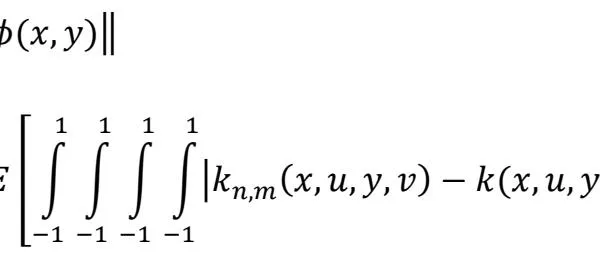
‖W―n,mϕ(x,y)−W―ϕ(x,y)‖≤|λ|E[∫−11∫−11∫−11∫−11|kn,m(x,u,y,v)−k(x,u,y,v)|2dxdudydv]1/2

Also, from Eq.(7) we have the following condition:

‖W―n,mϕ(x,y)−W―ϕ(x,y)‖=0,asn,m→∞.

To prove the compactness of W―, we let {ϕn,m(x,y)} be any sequence in Sα. Then we can choose a subsequence {ϕn1,m(x,y)} such that {W―n1,mϕn1,m(x,y)} converges. From that subsequence, we can extract a new subsequence {ϕn1,m1(x,y)} in which {W―n1,m1ϕn1,m1(x,y)} converges, and so on. Thus, we obtain a chain of subsequences,

{ϕn,m(x,y)}⊃{ϕn1,m(x,y)}⊃{ϕn1,m1(x,y)}⊃⋯⊃{ϕni,mj(x,y)}⊃…

Such that the sequence {W―ni,mkϕnj,ml(x,y)} converges for all i=1,2,…,j and k=1,2,…,l. Finally, we pick the sequence {ϕnn,mm(x,y)} which is a subsequence of every ϕni,mk except for a finite number of elements, and clearly {W―ni,mkϕnn,mm(x,y)} converges for every i,k. Now, since

‖W―ni,mkϕnn,mm−W―ni,mkϕpp,qq‖→0asm,n,p,q→0.

For large j, k, and from(), we get

‖W¯ϕnn,mm−W¯ϕpp,qq‖≤2σ,∀n,p>n0(σ),m,q>m0(σ).

Hence, {W―ϕn,m} is a Cauchy sequence, so W―(Sα) is compact.

According to the previous lemmas, by Schauder fixed point theorem, see [19-20], W― has at least one fixed point in Sα, and Theorem 1 is proved.

III. CHEBYSHEV POLYNOMIALS AND THE SYSTEM OF THE INTEGRAL EQUATION

Suppose the approximate kernel kn,m(x,u,y,v) in the continuous case as,

(12)kn,m(x,u,y,v)=∑n=0N∑m=0Mψn(x)χn(u)ωm(y)ηm(v)

where it satisfies the condition in Eq.(7).

Ref

Therefore Eq.(1) reduce to the algebraic system form as,

(13)ϕn,m(x,y)=fn,m(x,y)−λ∫−11∫−11kn,m(x,u,y,v)ϕn,m(u,v)dudv+Rn,m

where,

(14)Rn,m=|ϕ−ϕn,m|→0asn,m→∞

is the approximate error.

To use the spectral relationships, we write the kernel of Eq.(12) in the form

(15)kn,m(x,u,y,v)=∑n=0N∑m=0MTn(x)Tn(u)Tm(y)Tm(v)

where Tl(z) is the Chybeshev polynomials of first kind and degree l.

Then Eq.(13) reduces to

(16)ϕn,m(x,y)−λ∑n=0N∑m=0MTn(x)Tm(y)∫−11∫−11Tn(u)Tm(v)ϕ(u,v)dudv=fn,m(x,y)

Such that,

(17)ϕn,m(x,y)=∑n=0N∑m=0Man,mTn(x)Tm(y)

Since,

(18)∫−11∫−11kn,m(x,u,y,v)ϕn,m(u,v)dudv=Tn(x)Tm(y)∫−11∫−11Tn(u)Tm(v)Ti(u)Tj(v)dudv

then by using the relation, see [21]

(19)Tn(u)Ti(u)=12[Tn+i(u)+T|n−i|(u)]

and,

(20)∫−11Tn(u)du={21−n2,n=0,2,4,…0,n=1,3,5,…

Eq.(18) reduce to

Notes

(21)Tn(x)Tm(y)∫−11∫−11Tn(u)Tm(v)Ti(u)Tj(v)dudv=[11−(n+i)2+11−|n−i|2][11−(m+j)2+11−|m−j|2]Tn(x)Tm(y)

Then, Eq.(13) reduce to obtaining the following algebraic system,

(22)(I−λμn,m,i,j)an,m=bn,m

where,

(23)μn,m,i,j=[11−(n+i)2+11−|n−i|2][11−(m+j)2+11−|m−j|2]
(24)bn,m=∫−11∫−11f(x,y)Tn(x)Tm(y)dxdy

IV. APPLICATION AND NUMERICAL DISCUSSION

Consider the IE

(25)ϕ(x,y)=f(x,y)+λ∫−11∫−11(x+u2)y2vϕ(u,v)dudv

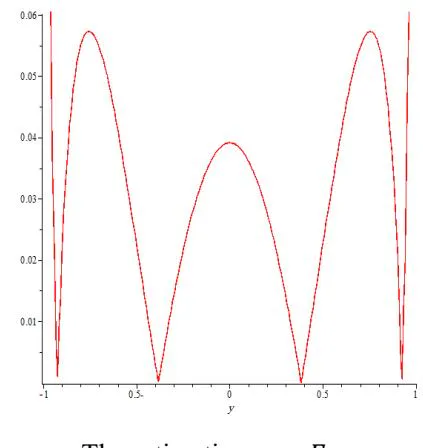
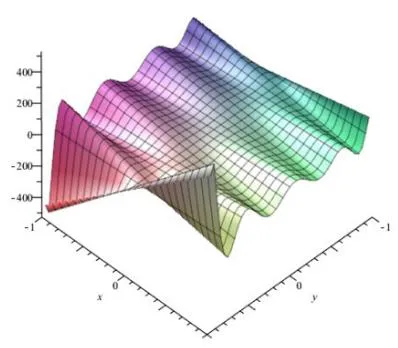
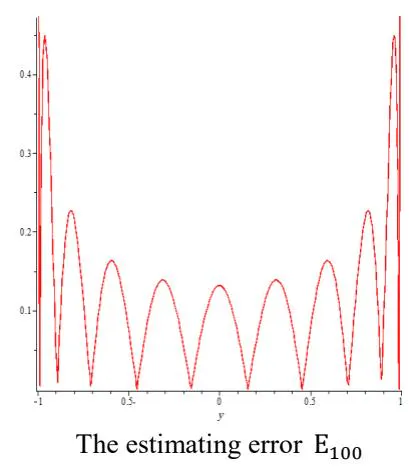
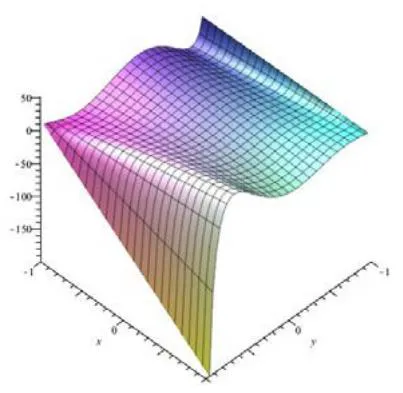
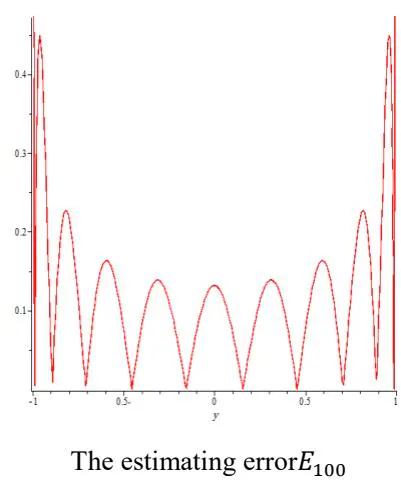
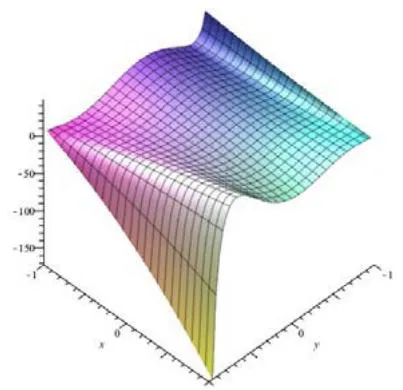
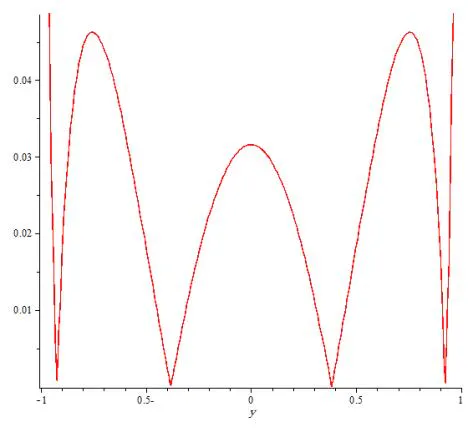
For fixed values of N = M = 100, we can graph the solution ϕ(x,y) at different values of λ, and different shapes of surfaces f(x,y), then we can graph the estimating errors
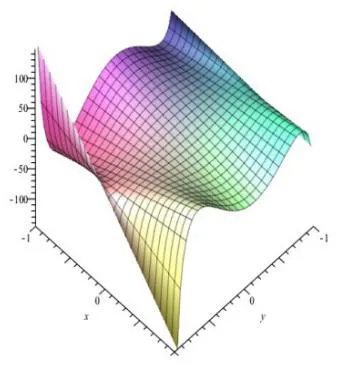
f(x,y)=xy,λ=0.04

The solution ϕn,m(x,y)

Figure(1) The estimating error E100

f(x,y)=xy,λ=0.1 The solution ϕn,m(x,y)

Figure(2)
f(x,y)=x+y,λ=0.04

The solution ϕn,m(x,y)

Figure(3)

Notes

The solution ϕn,m(x,y)
f(x,y)=x+y,λ=0.1

The estimating error E100

Figure(4)

References

21 Cites in Article
  1. 1. Abdul-Majid Wazwaz (2011). Applications of Integral Equations. Linear and Nonlinear Integral Equations, 569-595.
  2. 2. Richard Magin (2006). Fractional calculus in bioengineering: A tool to model complex dynamics. Proceedings of the 13th International Carpathian Control Conference (ICCC), 464-469.
  3. 3. R Hilfer (2000). Applications of Fractional Calculus in Physics. Applications of Fractional Calculus in Physics
  4. 4. M Kolev (2003). Mathematical modelling of the competition between tumors and immune system considering the role of the antibodies. Mathematical and Computer Modelling, 37(11), 1121-1252.
  5. 5. F Tricomi (1985). Integral equations. Integral equations
  6. 6. H Hochstadt (1971). Integral equations. Integral equations
  7. 7. G Anastasias,A (2009). Generalized Picard singular integrals. Computers & Mathematics with Applications, 57, 821-830.
  8. 8. Raul Kangro,Peeter Oja (2008). Convergence of spline collocation for Volterra integral equations. Applied Numerical Mathematics, 58(10), 1434-1447.
  9. 9. Teresa Diogo,Pedro Lima (2008). Superconvergence of collocation methods for a class of weakly singular Volterra integral equations. Journal of Computational and Applied Mathematics, 218(2), 307-316.
  10. 10. F Alharbi (2018). Boundary and Initial Value problems and Integral operator. Computational and Applied Mathematics, 19(4), 391-404.
  11. 11. F Alharbi (2019). Numerical Solutions of an integro-differentail equation with smooth and singular kernels. Journal of Research and Reviews in Applied Sciences, 13(12), 573-586.
  12. 12. M Abdou,F Salama (2004). Volterra–Fredholm integral equation of the first kind and spectral relationships. Applied Mathematics and Computation, 153(1), 141-153.
  13. 13. M Abdou (2002). Fredholm–Volterra integral equation and generalized potential kernel. Applied Mathematics and Computation, 131(1), 81-94.
  14. 14. M Abdou,A Nasr (2003). On the numerical treatment of the singular integral equation of the second kind. Journal of Computational and Applied Mathematics, 146(2), 373-380.
  15. 15. M Abdou,Osama Moustafa (2003). Fredholm–Volterra integral equation in contact problem. Applied Mathematics and Computation, 138(2-3), 199-215.
  16. 16. F Alharbi (2017). Application of Orthogonal Polynomial in Spectral Relationships of Contact Problem with Singular Kernel. Far East Journal of Mathematical Sciences, 102(9), 1881-1905.
  17. 17. M Abdou,M Basseem (2017). Solution of mixed integral equation in position and time using spectral relationships. Journal of the Association of Arab Universities for Basic and Applied Sciences, 23(1), 52-56.
  18. 18. M Abdou,F Alharbi (2019). Generalized Main Theorem of Spectral Relationships for Logarithmic Kernel and Its Applications. Journal of Computational and Theoretical Nanoscience, 16(7), 2704-2711.
  19. 19. Stanisław Brzychczy,Roman Poznanski (2013). Truncation Method. Mathematical Neuroscience, 89-101.
  20. 20. Gábor Kassay,Vicenţiu Rădulescu (2019). Acknowledgments. Equilibrium Problems and Applications, xix-xx.
  21. 21. I Gradshteyn,I,Ryzhik (1994). Tables of Integrals. Tables of Integrals

Funding

No external funding was declared for this work.

Conflict of Interest

The authors declare no conflict of interest.

Ethical Approval

No ethics committee approval was required for this article type.

Data Availability

Not applicable for this article.

How to Cite This Article

Faizah Alharbi. 2020. "Solution of Integral Equation in Two-Dimensional using Spectral Relationships". Global Journal of Science Frontier Research - F: Mathematics & Decision GJSFR-F Volume 20 (GJSFR Volume 20 Issue F2).

More Citation Formats

Download Citation

Journal Specifications

Crossref Journal DOI 10.17406/GJSFR

Print ISSN 0975-5896

e-ISSN 2249-4626

Keywords
Classification
GJSFR-F Classification MSC 2010: 31A10
Version of record
v1.2

Issue date
March 23, 2020

Language
English
Order Article Reprint
Experience in AR

Explore published articles in an immersive Augmented Reality environment. Our platform converts research papers into interactive 3D books, allowing readers to view and interact with content using AR and VR compatible devices.

Read in 3D

Your published article is automatically converted into a realistic 3D book. Flip through pages and read research papers in a more engaging and interactive format.

Article Matrices
Total Views: 551
Total Downloads: 46
All Trends

Request Access

Please fill out the form below to request access to this research paper. Your request will be reviewed by the editorial or author team.
X

This is the heading

Lorem ipsum dolor sit amet, consectetur adipiscing elit. Ut elit tellus, luctus nec ullamcorper mattis, pulvinar dapibus leo.

High-quality academic research articles on global topics and journals.

Solution of Integral Equation in Two-Dimensional using Spectral Relationships

Faizah Alharbi
Faizah Alharbi Umm Al-Quraa University