The 3x + 1 problem is the following: Suppose we start with a positive integer, and if it is odd then multiply it by 3 and add 1, and if it is even, divide it by 2. Then repeat this process as long as you can. Will you eventually reach the integer 1, no matter what you started with? Collatz conjecture (or 3n + 1 problem) has been explored for about 85 years. In this paper, we convert an integer number from decimal to binary and convert the Collatz function to a binary function, which involves the multiplication and division of two binary numbers. Finally, by iterating the Collatz function, we eventually reach the integer number 1.
## I. INTRODUCTION
The $3x + 1$ problem, also known as the Collatz conjecture, $3x + 1$ mapping, Ulam conjecture, Kakutani's problem, Thwaites conjecture, Hasse's algorithm, or Syracuse problem [1], is one of the unsolved problems in mathematics. Paul Erdos (1913-1996) commented on the intractability of the $3x + 1$ problem [2], stating that "Mathematics is not ready for those problems yet".
The $2x + 1$ problem states that, for any positive integer $x$, if $x$ is even, divide it by 2; if $x$ is odd, multiply it by 3 and add 1. Repeating this process continuously leads to the conjecture that no matter which number is initially chosen, the result will always reach 1 eventually.
We use the notations as in [4,7], and describe a Collatz function as follows:
$$
T (n) = \left\{ \begin{array}{ll} 3 n + 1, & \text{if } n \text{ is odd number,} \\ \frac{n}{2}, & \text{if } n \text{ is even number.} \end{array} \right. \tag{1}
$$
Let $N$ denote the set of positive integers. For $n \in N$, and $k = 0,1,2,3,\dots, T^0(n)$ and $T^{k+1}(n)$ denote $n$ and $T(T^k(n))$, respectively. Concerning the behavior of the iteration of the Collatz function, for any integer $n$, there must exist an integer $r$ so that
$$
T ^ {r} (n) = 1. \tag {2}
$$
# a) The
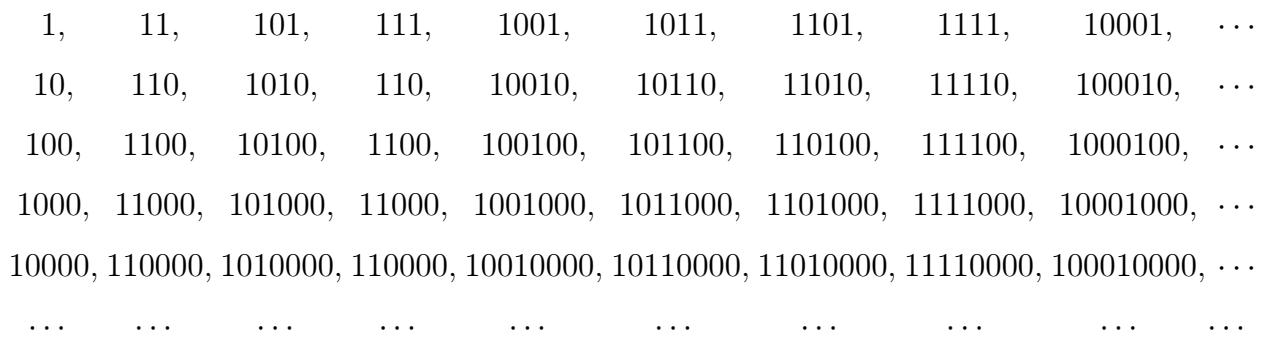
We convert the last row of numbers into the first column to get a modified Sarkovskii ordered integer lattice[6] as the following,
- 1, 3, 5, 7, 9, 11, 13, 15, 17, 19,
- 2, 2·3, 2·5, 2·7, 2·9, 2·11, 2·13, 2·15, 2·17, 2·19,...
- $2^{2}, 2^{2} \cdot 3,2^{2} \cdot 5,2^{2} \cdot 7,2^{2} \cdot 9,2^{2} \cdot 11,2^{2} \cdot 13,2^{2} \cdot 15,2^{2} \cdot 17,2^{2} \cdot 19, \dots$
- $2^{3}, 2^{3} \cdot 3,2^{3} \cdot 5,2^{3} \cdot 7,2^{3} \cdot 9,2^{3} \cdot 11,2^{3} \cdot 13,2^{3} \cdot 15,2^{3} \cdot 17,2^{3} \cdot 19, \dots$
- $2^{4}, 2^{4} \cdot 3,2^{4} \cdot 5,2^{4} \cdot 7,2^{4} \cdot 9,2^{4} \cdot 11,2^{4} \cdot 13,2^{4} \cdot 15,2^{4} \cdot 17,2^{4} \cdot 19, \dots$
...
In the first row, they are odd numbers from left to right, that are 1, 3, 5, 7, 9, 11, 13, $\cdots$. From the second row, each number is two times the number in its previous row, and so on.
# b) The
If we draw a line segment with an arrow between two digits in the lattice of integers in the modified Sarkovskii ordering, one being the original value $x$ and the other being its value of the Collatz function $T(x)$, and then connect $T(x)$ to $T^2(x)$, and so on $T^2(x)$ to $T^3(x), \dots$, we get a graph which can be called a Collatz graph.
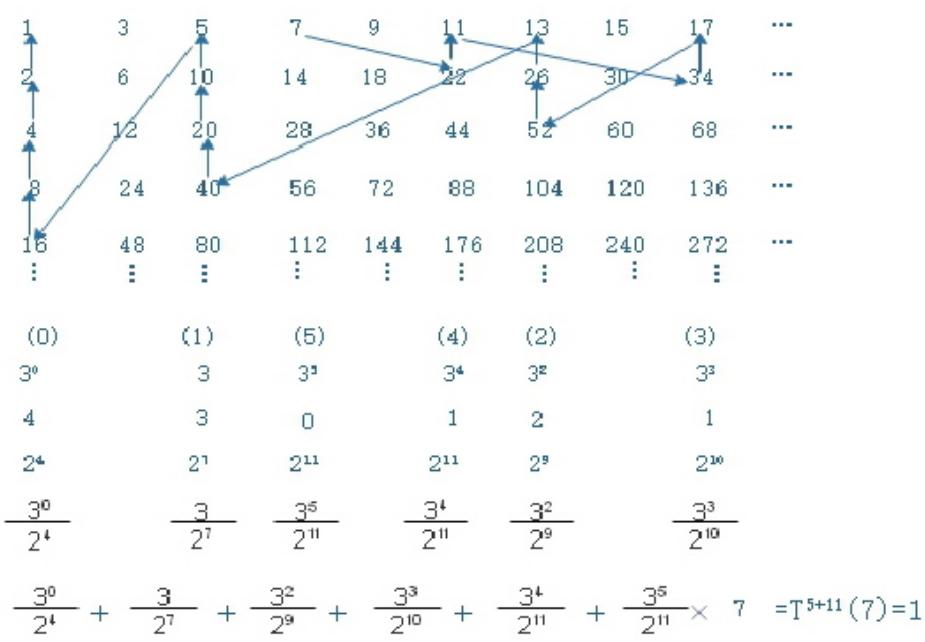 Fig. 1: The Collatz graph of $T^{16}(7) = T(5,11,7) = 1$ in the lattice of integers in the modified Sarkovskii ordering and the algebraic formula.
For different integers $k$ and $l$, if there is a common vertex in their Collatz graphs, their graphs will overlap from that point onwards until they reach the minimum value of 1. Using the Collatz function $T(x)$, we can obtain an algebraic formula of $\frac{1}{2^4}, \frac{3}{2^7}, \frac{3^2}{2^9}, \dots, \frac{3^m}{2^r} \cdot x$, where $r$ is the number of vertical segments and $m$ is the number of oblique segments in the Collatz graph,
$$
T ^ {m + r} (n) = T (m, r, n) = \frac {1}{2 ^ {4}} + \frac {3}{2 ^ {7}} + \frac {3 ^ {2}}{2 ^ {9}} + \dots + \frac {3 ^ {m}}{2 ^ {r}} \cdot x = 1. \tag {3}
$$
For example, $n = 7$, $7 \to 22 \to 11 \to 34 \to 17 \to 52 \to 26 \to 13 \to 40 \to 20 \to 10 \to 5 \to 16 \to 8 \to 4 \to 2 \to 1 \to \dots$, the algebraic formula is
$$
T ^ {1 6} (7) = T (5, 1 1, 7) = \frac {1}{2 ^ {4}} + \frac {3}{2 ^ {7}} + \frac {3 ^ {2}}{2 ^ {9}} + \frac {3 ^ {3}}{2 ^ {1 0}} + \frac {3 ^ {4}}{2 ^ {1 1}} + \frac {3 ^ {5}}{2 ^ {1 1}} \cdot 7 = 1,
$$
and the Collatz graph is Fig.
1.
And $n = 36$, $36 \to 18 \to 9 \to 28 \to 14 \to 7 \to 22 \to 11 \to 34 \to 17 \to 52 \to 26 \to 13 \to 40 \to 20 \to 10 \to 5 \to 16 \to 8 \to 4 \to 2 \to 1 \to \dots$, the algebraic formula is
$$
T ^ {2 1} (3 6) = T (6, 1 5, 3 6) = \frac {1}{2 ^ {4}} + \frac {3}{2 ^ {7}} + \frac {3 ^ {2}}{2 ^ {9}} + \frac {3 ^ {3}}{2 ^ {1 0}} + \frac {3 ^ {4}}{2 ^ {1 1}} + \frac {3 ^ {5}}{2 ^ {1 3}} + \frac {3 ^ {6}}{2 ^ {1 5}} \cdot 3 6 = 1
$$
and the Collatz graph is Fig. 2.
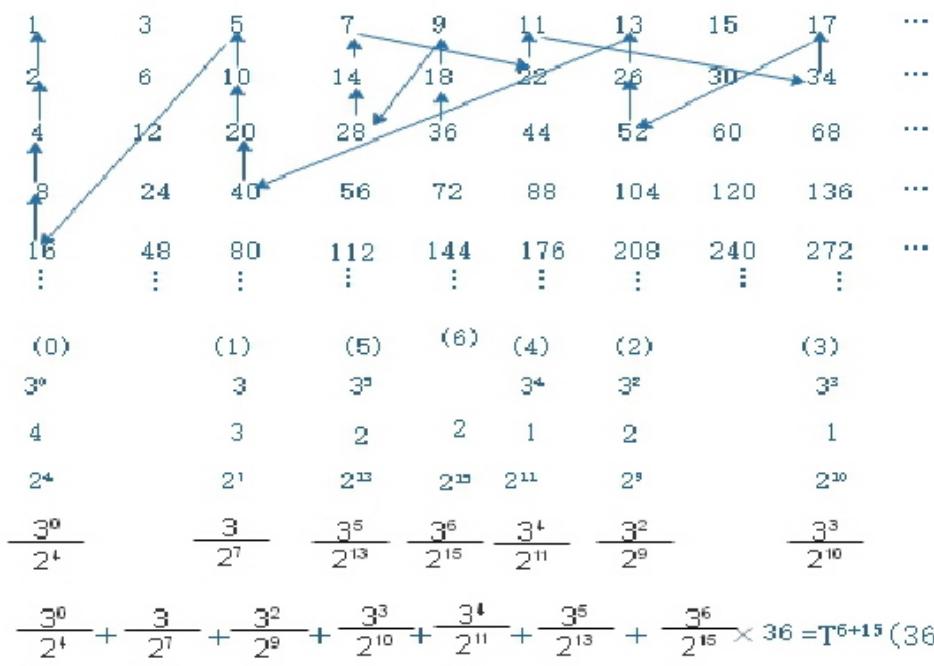 Fig. 2: The Collatz graph of $T^{21}(36) = T(6,15,36) = 1$ in the lattice of integers in the modified Sarkovskii ordering and the algebraic formula.
We observe that there is a property present,
Proposition 1 For positive integers $i, j, k, l$, and $l_k, l_{k-1}, \dots, l_1$, if $i > j$, then there is a recurrence relation
$$
T ^ {i} (n) = \frac {3 ^ {k}}{2 ^ {l}} T ^ {j} (n) + \frac {3 ^ {k - 1}}{2 ^ {l _ {k}}} + \dots + \frac {3 ^ {2}}{2 ^ {l _ {3}}} + \frac {3}{2 ^ {l _ {2}}} + \frac {1}{2 ^ {l _ {1}}}
$$
where $k + l = i - j$, and $l \geq l_k \geq l_{k-1} \geq \dots \geq l_1$.
For example, there are
$$
T ^ {3} (9 7) = \frac {3}{2 ^ {2}} \cdot 9 7 + \frac {1}{2 ^ {2}} = 7 3
$$
$$
T ^ {1 8} (9 7) = \frac {3 ^ {7}}{2 ^ {1 1}} \cdot 9 7 + \frac {3 ^ {6}}{2 ^ {1 1}} + \frac {3 ^ {5}}{2 ^ {9}} + \frac {3 ^ {4}}{2 ^ {7}} + \frac {3 ^ {3}}{2 ^ {6}} + \frac {3 ^ {2}}{2 ^ {5}} + \frac {3}{2 ^ {2}} + \frac {1}{2} = 1 0 7
$$
We can get the recurrence formula about the Collatz function,
$$
T^{26}(97) = \frac{3^{3}}{2^{5}} \cdot T^{18}(97) + \frac{3^{2}}{2^{5}} + \frac{3}{2^{4}} + \frac{1}{2^{2}} \\= \frac{3^{10}}{2^{16}} \cdot 97 + \frac{3^{9}}{2^{16}} + \frac{3^{8}}{2^{14}} + \frac{3^{7}}{2^{12}} + \frac{3^{6}}{2^{11}} + \frac{3^{5}}{2^{10}} + \frac{3^{4}}{2^{7}} + \frac{3^{3}}{2^{6}} + \frac{3^{2}}{2^{5}} + \frac{3}{2^{4}} + \frac{1}{2^{2}} \\= 91,
$$
## II. NUMERICAL EXAMPLE
Using the above Collatz graphs of the integer lattice of the modified Sarkovskii ordering, we give the following algebraic formulas,
$$
T ^ {1 9} (9) = T (6, 1 3, 9) = \frac {1}{2 ^ {4}} + \frac {3}{2 ^ {7}} + \frac {3 ^ {2}}{2 ^ {9}} + \frac {3 ^ {3}}{2 ^ {1 0}} + \frac {3 ^ {4}}{2 ^ {1 1}} + \frac {3 ^ {5}}{2 ^ {1 3}} + \frac {3 ^ {6}}{2 ^ {1 3}} \cdot 9 = 1, \tag {4}
$$
$$
T ^ {1 5} (2 3) = T (4, 1 1, 2 3) = \frac {1}{2 ^ {4}} + \frac {3}{2 ^ {9}} + \frac {3 ^ {2}}{2 ^ {1 0}} + \frac {3 ^ {3}}{2 ^ {1 1}} + \frac {3 ^ {4}}{2 ^ {1 1}} \cdot 2 3 = 1, \tag {5}
$$
$$
\begin{array}{l} T ^ {1 7} (1 5) = T (5, 1 2, 1 5) = \frac {1}{2 ^ {4}} + \frac {3}{2 ^ {9}} + \frac {3 ^ {2}}{2 ^ {1 0}} + \frac {3 ^ {3}}{2 ^ {1 1}} + \frac {3 ^ {4}}{2 ^ {1 2}} + \frac {3 ^ {5}}{2 ^ {1 2}} \cdot 1 5 = 1, (6) \\T ^ {1 2} (1 7) = T (3, 9, 1 7) = \frac {1}{2 ^ {4}} + \frac {3}{2 ^ {7}} + \frac {3 ^ {2}}{2 ^ {9}} + \frac {3 ^ {3}}{2 ^ {9}} \cdot 1 7 = 1, (7) \\\end{array}
$$
$$
T ^ {1 9} (6 1) = T (5, 1 4, 6 1) = \frac {1}{2 ^ {4}} + \frac {3}{2 ^ {9}} + \frac {3 ^ {2}}{2 ^ {1 0}} + \frac {3 ^ {3}}{2 ^ {1 1}} + \frac {3 ^ {4}}{2 ^ {1 4}} + \frac {3 ^ {5}}{2 ^ {1 4}} \cdot 6 1 = 1. \tag {8}
$$
$$
T ^ {1 6} (3 9 7) = T (5, 1 1, 3 9 7) = \frac {1}{2 ^ {4}} + \frac {3}{2 ^ {7}} + \frac {3 ^ {2}}{2 ^ {9}} + \frac {3 ^ {3}}{2 ^ {1 0}} + \frac {3 ^ {4}}{2 ^ {1 1}} + \frac {3 ^ {5}}{2 ^ {1 7}} + \frac {3 ^ {6}}{2 ^ {2 0}} + \frac {3 ^ {7}}{2 ^ {2 0}} \cdot 3 9 7 = 1, \tag {9}
$$
Example 2 For the formula
$$
T (6, 1 4, 1 8) = \frac {1}{2 ^ {4}} + \frac {3}{2 ^ {7}} + \frac {3 ^ {2}}{2 ^ {9}} + \frac {3 ^ {3}}{2 ^ {1 0}} + \frac {3 ^ {4}}{2 ^ {1 1}} + \frac {3 ^ {5}}{2 ^ {1 3}} + \frac {3 ^ {6}}{2 ^ {1 4}} \cdot 1 8 = 1,
$$
we rewrite it as an integer equation,
$$
3 ^ {6} \cdot 1 8 + 3 ^ {5} \cdot 2 + 3 ^ {4} \cdot 2 ^ {3} + 3 ^ {3} \cdot 2 ^ {4} + 3 ^ {2} \cdot 2 ^ {5} + 3 \cdot 2 ^ {7} + 2 ^ {1 0} = 2 ^ {1 4}.
$$
Proof. To calculate the power of 3 and the value of 18 using powers of 2,
$$
3 = 2 + 1
$$
$$
3 ^ {2} = 2 ^ {3} + 1
$$
$$
3 ^ {3} = 2 ^ {4} + 2 ^ {3} + 2 + 1
$$
$$
3 ^ {4} = 2 ^ {6} + 2 ^ {4} + 1
$$
$$
3^{5}=2^{7}+2^{6}+2^{5}+2^{4}+2+1
$$
$$
3 ^ {6} = 2 ^ {9} + 2 ^ {7} + 2 ^ {6} + 2 ^ {4} + 2 ^ {3} + 1
$$
$$
1 8 = 2 ^ {4} + 2
$$
substituting these expressions into the left-hand side of the above equation, one obtains,
$$
\begin{array}{l} 3 ^ {6} \cdot 1 8 + 3 ^ {5} \cdot 2 + 3 ^ {4} \cdot 2 ^ {3} + 3 ^ {3} \cdot 2 ^ {4} + 3 ^ {2} \cdot 2 ^ {5} + 3 \cdot 2 ^ {7} + 2 ^ {1 0} \\= \left(2 ^ {9} + 2 ^ {7} + 2 ^ {6} + 2 ^ {4} + 2 ^ {3} + 1\right) \cdot \left(2 ^ {4} + 2\right) + \left(2 ^ {7} + 2 ^ {6} + 2 ^ {5} + 2 ^ {4} + 2 + 1\right) \cdot 2 \\+ (2 ^ {6} + 2 ^ {4} + 1) \cdot 2 ^ {3} + (2 ^ {4} + 2 ^ {3} + 2 + 1) \cdot 2 ^ {4} + (2 ^ {3} + 1) \cdot 2 ^ {5} + (2 + 1) \cdot 2 ^ {7} + 2 ^ {1 0}, \\\end{array}
$$
and get the value $2^{14}$ which is equal to the right value of the equation.
## III. CONVERT THE INTEGER NUMBER FROM DECIMAL TO BINARY
Be inspired by the above, we use binary to rewrite the Collatz function (1) as the following formulas (2) and (3). We denote a binary number, which is a string of 0s and 1s, as $n = (1 \times \dots \times)_2$, where $\times$ is either 1 or 0, e.g. $3 = (11)_2$,
$$
T (n) = T \left(\left(1 \times \dots \times\right)_{2}\right) = \left\{
\begin{array}{l l}
(1 1)_{2} \cdot \left(1 \times \dots \times 1\right)_{2} + 1, & \text{if n is odd number}, \\
\frac{(1 \times \cdots \times 1 0 \cdots 0 0)_{2}}{(1 0)_{2}}, & \text{if n is even number}.
\end{array} \tag{10}
\right.
$$
The result is
$$
T (n) = T \left(\left(1 \times \dots \times\right) _ {2}\right) = \left\{
\begin{array}{l}
\left(1 \times \times \times 1 0 \dots 0\right) _ {2}, \text{if } n \text{ is odd number,} \\
\left(1 \times \dots \times 1 0 \dots 0\right) _ {2}, \text{if } n \text{ is even number.}
\end{array} \right.
\tag{11}
$$
Namely, when $n$ is an odd number, we multiply it with $(11)_2$ and add 1 to the end of the binary number. For example, $T(97) = T(1100001)$ in Fig. 3. When $n$ is an even number, the division is equal to deleting the zero at the end in the binary number. We give the iteration of the Collatz function for 1, 5, 7, 9, 97 in binary as the following five tables.
We convert the modified Sarkovskii ordered integer lattice[6] from decimal to binary as the follows,
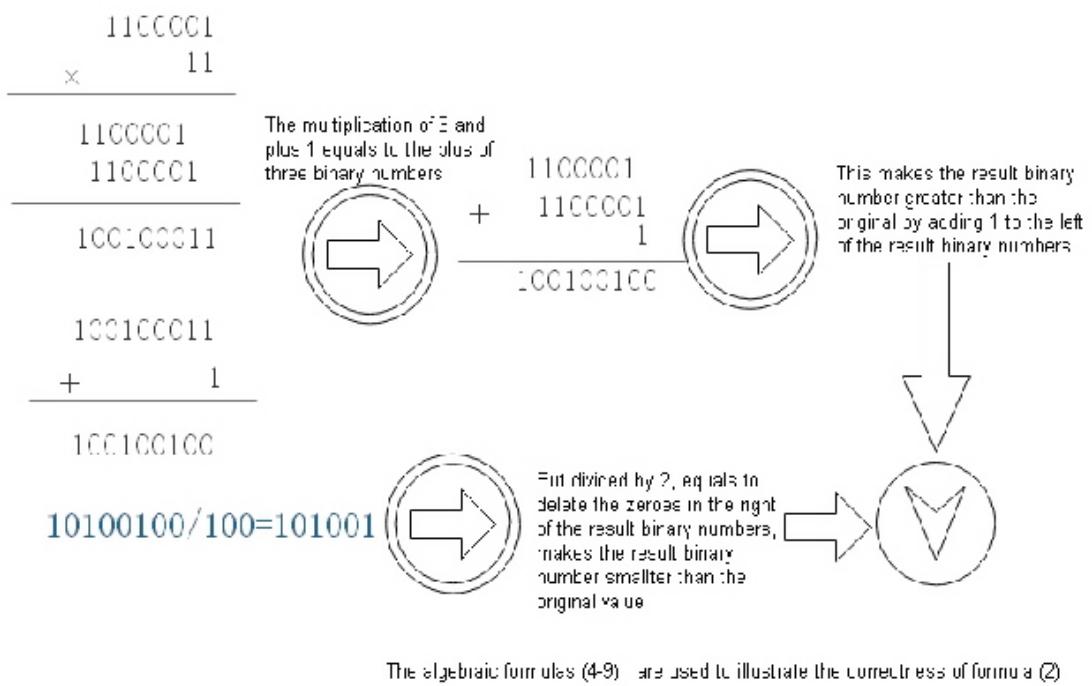 Fig. 3: For the Collatz function $T(97)$ in binary, the first step is the multiplication in left, the second step is division in the right bottom.
Example 3 For positive integer 1, we manipulate the iteration of the Collatz function in both decimal and binary numbers,
<table><tr><td>1,</td><td>11,</td><td>101,</td><td>111,</td><td>1001,</td><td>1011,</td><td>1101,</td><td>1111,</td><td>10001,</td><td>···</td></tr><tr><td>10,</td><td>110,</td><td>1010,</td><td>110,</td><td>10010,</td><td>10110,</td><td>11010,</td><td>11110,</td><td>100010,</td><td>···</td></tr><tr><td>100,</td><td>1100,</td><td>10100,</td><td>1100,</td><td>100100,</td><td>101100,</td><td>110100,</td><td>111100,</td><td>1000100,</td><td>···</td></tr><tr><td>1000,</td><td>11000,</td><td>101000,</td><td>11000,</td><td>1001000,</td><td>1011000,</td><td>1101000,</td><td>1111000,</td><td>10001000,</td><td>···</td></tr><tr><td>10000,</td><td>110000,</td><td>1010000,</td><td>110000,</td><td>10010000,</td><td>10110000,</td><td>11010000,</td><td>11110000,</td><td>100010000,</td><td>···</td></tr><tr><td>···</td><td>···</td><td>···</td><td>···</td><td>···</td><td>···</td><td>···</td><td>···</td><td>···</td><td>···</td></tr></table>
<table><tr><td>ith</td><td>0</td><td>1</td><td>2</td><td>3</td></tr><tr><td>decimal</td><td>1</td><td>4</td><td>2</td><td>1</td></tr><tr><td>binary</td><td>1</td><td>100</td><td>10</td><td>1</td></tr></table>
Example 4 For positive integer $5 = (101)_2$, we manipulate the iteration of the Collatz function in both decimal and binary numbers,
<table><tr><td>ith</td><td>0</td><td>1</td><td>2</td><td>3</td><td>4</td><td>5</td></tr><tr><td>decimal</td><td>5</td><td>16</td><td>8</td><td>4</td><td>2</td><td>1</td></tr><tr><td>binary</td><td>101</td><td>10000</td><td>1000</td><td>100</td><td>10</td><td>1</td></tr></table>
Example 5 For $7 = (111)_2$, we manipulate the iteration of the Collatz function in both decimal and binary numbers.
<table><tr><td>ith</td><td>0</td><td>1</td><td>2</td><td>3</td><td>4</td><td>5</td><td>7</td><td>8</td><td>11</td><td>12</td><td>16</td></tr><tr><td>decimal</td><td>7</td><td>22</td><td>11</td><td>34</td><td>17</td><td>52</td><td>13</td><td>40</td><td>5</td><td>16</td><td>1</td></tr><tr><td>binary</td><td>111</td><td>10110</td><td>1011</td><td>100010</td><td>10001</td><td>110100</td><td>1101</td><td>101000</td><td>101</td><td>10000</td><td>1</td></tr></table>
Example 6 For $9 = (1001)_2$, we manipulate the iteration of the Collatz function in both decimal and binary numbers.
<table><tr><td>ith</td><td>0</td><td>1</td><td>2</td><td>3</td><td>4</td><td>5</td><td>6</td><td>7</td><td>14</td><td>15</td><td>19</td></tr><tr><td>decimal</td><td>9</td><td>28</td><td>14</td><td>7</td><td>22</td><td>11</td><td>34</td><td>17</td><td>5</td><td>16</td><td>1</td></tr><tr><td>binary</td><td>1001</td><td>11100</td><td>1110</td><td>111</td><td>10110</td><td>1011</td><td>100010</td><td>10001</td><td>101</td><td>10000</td><td>1</td></tr></table>
Example 7 For $97 = (1100001)_2$, we manipulate the iteration of the Collatz function in binary as the following table,
<table><tr><td>97</td><td>1100001</td><td>206</td><td>11001110</td><td>425</td><td>110101001</td><td>866</td><td>1101100010</td></tr><tr><td>292</td><td>100100100</td><td>103</td><td>1100111</td><td>1276</td><td>1001111100</td><td>433</td><td>110110001</td></tr><tr><td>146</td><td>10010010</td><td>310</td><td>100110110</td><td>638</td><td>100111110</td><td>1300</td><td>10100010100</td></tr><tr><td>73</td><td>1001001</td><td>155</td><td>10011011</td><td>319</td><td>100111111</td><td>650</td><td>1010001010</td></tr><tr><td>220</td><td>11011100</td><td>466</td><td>111010010</td><td>958</td><td>111011110</td><td>325</td><td>101000101</td></tr><tr><td>110</td><td>1101110</td><td>233</td><td>11101001</td><td>479</td><td>11101111</td><td>976</td><td>1111010000</td></tr><tr><td>55</td><td>110111</td><td>700</td><td>1010111100</td><td>1438</td><td>1011001110</td><td>488</td><td>111101000</td></tr><tr><td>166</td><td>10100110</td><td>350</td><td>101011110</td><td>719</td><td>101100111</td><td>244</td><td>11110100</td></tr><tr><td>83</td><td>1010011</td><td>175</td><td>10101111</td><td>2158</td><td>100001101110</td><td>122</td><td>1111010</td></tr><tr><td>250</td><td>11111010</td><td>526</td><td>1000001110</td><td>1079</td><td>10000110111</td><td>61</td><td>111101</td></tr><tr><td>125</td><td>1111101</td><td>263</td><td>100000111</td><td>3238</td><td>110010100110</td><td>184</td><td>10111000</td></tr><tr><td>376</td><td>10111000</td><td>790</td><td>1100010110</td><td>1619</td><td>11001010011</td><td>92</td><td>1011100</td></tr><tr><td>188</td><td>1011100</td><td>395</td><td>110001011</td><td>4858</td><td>100101111010</td><td>46</td><td>101110</td></tr><tr><td>94</td><td>101110</td><td>1186</td><td>10010100010</td><td>2429</td><td>100101111101</td><td>23</td><td>10111</td></tr><tr><td>47</td><td>101111</td><td>593</td><td>1001010001</td><td>7288</td><td>1110001111000</td><td>70</td><td>1000110</td></tr><tr><td>142</td><td>10001110</td><td>1780</td><td>11011110100</td><td>3644</td><td>111000111100</td><td>35</td><td>100011</td></tr><tr><td>71</td><td>1000111</td><td>890</td><td>1101111010</td><td>1822</td><td>11100011110</td><td>106</td><td>1101010</td></tr><tr><td>214</td><td>11010110</td><td>445</td><td>110111101</td><td>911</td><td>1110001111</td><td>53</td><td>110101</td></tr><tr><td>107</td><td>1101011</td><td>1336</td><td>10100111000</td><td>2734</td><td>101010101110</td><td>160</td><td>10100000</td></tr><tr><td>322</td><td>101000010</td><td>668</td><td>1010011100</td><td>1367</td><td>10101010111</td><td>80</td><td>1010000</td></tr><tr><td>161</td><td>10100001</td><td>334</td><td>101001110</td><td>4102</td><td>1000000000110</td><td>40</td><td>101000</td></tr><tr><td>484</td><td>111100100</td><td>167</td><td>10100111</td><td>2051</td><td>100000000011</td><td>20</td><td>10100</td></tr><tr><td>242</td><td>11110010</td><td>502</td><td>111110110</td><td>6154</td><td>1100000001010</td><td>10</td><td>1010</td></tr><tr><td>121</td><td>1111001</td><td>251</td><td>11111011</td><td>3077</td><td>110000000101</td><td>5</td><td>101</td></tr><tr><td>364</td><td>101101100</td><td>754</td><td>1011110010</td><td>9232</td><td>10010000010000</td><td>16</td><td>10000</td></tr><tr><td>182</td><td>10110110</td><td>377</td><td>101111001</td><td>4616</td><td>1001000001000</td><td>8</td><td>1000</td></tr><tr><td>91</td><td>1011011</td><td>1132</td><td>10001101100</td><td>2308</td><td>100100000100</td><td>4</td><td>100</td></tr><tr><td>274</td><td>100010010</td><td>566</td><td>1000110110</td><td>1154</td><td>10010000010</td><td>2</td><td>10</td></tr><tr><td>137</td><td>10001001</td><td>283</td><td>100011011</td><td>577</td><td>1001000001</td><td>1</td><td>1</td></tr><tr><td>412</td><td>110011100</td><td>850</td><td>1101010010</td><td>1732</td><td>11011000100</td><td></td><td></td></tr></table>
Corollary 8 The Collatz function makes an odd integer number in binary bigger by adding 1 or 2 bits to the left of the sequence of $1s$ and $0s$, and an even integer number in binary smaller by deleting all zeros at the end of the sequence of $1s$ and $0s$. Thus, although in some cases the value of The Collatz function $T(x)$ may be bigger than $x$ in decimal, in general, the iteration of the Collatz function will make an integer number smaller and smaller, eventually reaching the smallest positive integer number 1.
We can rewrite the Collatz conjecture in binary, which makes it an easier problem to solve, thus allowing us to completely solve the Collatz conjecture.
Fact 9 For any positive integer, under the Collatz function, the sequence of integer numbers in binary will eventually reach 1.
Proof. For an odd binary integer, we multiply it by $(11)_2$ and add 1 in the last bit, the result number must be an even number in binary which at least one zero at the end. We delete all these zeros, namely it is the division. This is the above corollary 8. Thus, we repeat this process as long as we can, because the bits of the sequence in binary of a positive integer number is finite. Eventually, we must in finitely steps reach the smallest positive integer number 1.
Remark 10 We can say that the $3x + 1$ problem is a converse proposition of "period three implies chaos" [4], and it is also an example of any one positive integer number having a period of 3 in the Collatz function.
## IV. CONCLUSIONS
We rewrite the Collatz function in binary, which makes the $3x + 1$ problem easier. The multiplications of $(11)_2$ and divisions of $(10)_2$ make the positive integer number smaller and smaller with the iterations of the Collatz function. In some cases, the value of the Collatz function $T(x)$ may be bigger than $x$, thus allowing us to completely solve the Collatz conjecture.
Generating HTML Viewer...
References
7 Cites in Article
Jeffrey Lagarias (1985). The 3x + 1 Problem and Its Generalizations.
Jeffrey Lagarias The 3x+1 Problem: An Overview.
P Stefan (1977). A theorem of Šarkovskii on the existence of periodic orbits of continuous endomorphisms of the real line.
T Li,J Yorke (1975). Period three implies chaos.
Terence Tao (2022). Almost all orbits of the Collatz map attain almost bounded values.
Feng Jishe,Wang Xiaomeng,Gao Xiaolu,Pan Zhuo (2022). The research and progress of the enumeration of lattice paths.
Alf Kimms (2021). The structure of the 3x + 1 problem.
No ethics committee approval was required for this article type.
Data Availability
Not applicable for this article.
How to Cite This Article
Jishe Feng. 2026. \u201cSolve the 3x+1 Problem by the Multiplication and Division of Binary Numbers\u201d. Global Journal of Science Frontier Research - F: Mathematics & Decision GJSFR-F Volume 23 (GJSFR Volume 23 Issue F3): .
Explore published articles in an immersive Augmented Reality environment. Our platform converts research papers into interactive 3D books, allowing readers to view and interact with content using AR and VR compatible devices.
Your published article is automatically converted into a realistic 3D book. Flip through pages and read research papers in a more engaging and interactive format.
The 3x + 1 problem is the following: Suppose we start with a positive integer, and if it is odd then multiply it by 3 and add 1, and if it is even, divide it by 2. Then repeat this process as long as you can. Will you eventually reach the integer 1, no matter what you started with? Collatz conjecture (or 3n + 1 problem) has been explored for about 85 years. In this paper, we convert an integer number from decimal to binary and convert the Collatz function to a binary function, which involves the multiplication and division of two binary numbers. Finally, by iterating the Collatz function, we eventually reach the integer number 1.
Our website is actively being updated, and changes may occur frequently. Please clear your browser cache if needed. For feedback or error reporting, please email [email protected]
Thank you for connecting with us. We will respond to you shortly.