To: Author
Article Fingerprint
ReserarchID
0B650
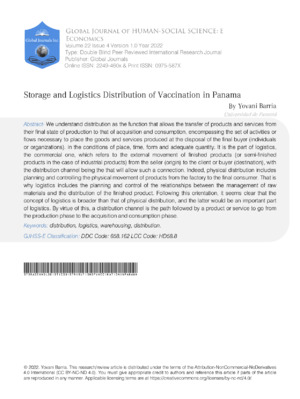
We understand distribution as the function that allows the transfer of products and services from their final state of production to that of acquisition and consumption, encompassing the set of activities or flows necessary to place the goods and services produced at the disposal of the final buyer (individuals or organizations). in the conditions of place, time, form and adequate quantity. It is the part of logistics, the commercial one, which refers to the external movement of finished products (or semi-finished products in the case of industrial products) from the seller (origin) to the client or buyer (destination), with the distribution channel being the that will allow such a connection. Indeed, physical distribution includes planning and controlling the physical movement of products from the factory to the final consumer. That is why logistics includes the planning and control of the relationships between the management of raw materials and the distribution of the finished product. Following this orientation, it seems clear that the concept of logistics is broader than that of physical distribution, and the latter would be an important part of logistics. By virtue of this, a distribution channel is the path followed by a product or service to go from the production phase to the acquisition and consumption phase.
Yovani Barría. 2026. \u201cStorage and Logistics Distribution of Vaccination in Panama\u201d. Global Journal of Human-Social Science - E: Economics GJHSS-E Volume 22 (GJHSS Volume 22 Issue E4): .
Crossref Journal DOI 10.17406/GJHSS
Print ISSN 0975-587X
e-ISSN 2249-460X
Explore published articles in an immersive Augmented Reality environment. Our platform converts research papers into interactive 3D books, allowing readers to view and interact with content using AR and VR compatible devices.
Your published article is automatically converted into a realistic 3D book. Flip through pages and read research papers in a more engaging and interactive format.
Total Score: 101
Country: Panama
Subject: Global Journal of Human-Social Science - E: Economics
Authors: Yovani Barría (PhD/Dr. count: 0)
View Count (all-time): 167
Total Views (Real + Logic): 1825

Total Downloads (simulated): 50
Publish Date: 2026 01, Fri
Monthly Totals (Real + Logic):
This paper attempted to assess the attitudes of students in
Advances in technology have created the potential for a new
Inclusion has become a priority on the global educational agenda,
We understand distribution as the function that allows the transfer of products and services from their final state of production to that of acquisition and consumption, encompassing the set of activities or flows necessary to place the goods and services produced at the disposal of the final buyer (individuals or organizations). in the conditions of place, time, form and adequate quantity. It is the part of logistics, the commercial one, which refers to the external movement of finished products (or semi-finished products in the case of industrial products) from the seller (origin) to the client or buyer (destination), with the distribution channel being the that will allow such a connection. Indeed, physical distribution includes planning and controlling the physical movement of products from the factory to the final consumer. That is why logistics includes the planning and control of the relationships between the management of raw materials and the distribution of the finished product. Following this orientation, it seems clear that the concept of logistics is broader than that of physical distribution, and the latter would be an important part of logistics. By virtue of this, a distribution channel is the path followed by a product or service to go from the production phase to the acquisition and consumption phase.


Lorem ipsum dolor sit amet, consectetur adipiscing elit. Ut elit tellus, luctus nec ullamcorper mattis, pulvinar dapibus leo.