Survival of Plants Seeds and Bacteria in a Picosatellite Sent to the Stratosphere

α
García Hernández David
σ
Juan Manuel Sanchez-Yañez
ρ
Christam Omar Martinez-Camara
Ѡ
Edgar Cárdenas-  Escamilla
Edgar Cárdenas- Escamilla

Send Message

To: Author

Survival of Plants Seeds and Bacteria in a Picosatellite Sent to the Stratosphere

Article Fingerprint

ReserarchID

CU97R

Survival of Plants Seeds and Bacteria in a Picosatellite Sent to the Stratosphere Banner

AI TAKEAWAY

Connecting with the Eternal Ground
  • English
  • Afrikaans
  • Albanian
  • Amharic
  • Arabic
  • Armenian
  • Azerbaijani
  • Basque
  • Belarusian
  • Bengali
  • Bosnian
  • Bulgarian
  • Catalan
  • Cebuano
  • Chichewa
  • Chinese (Simplified)
  • Chinese (Traditional)
  • Corsican
  • Croatian
  • Czech
  • Danish
  • Dutch
  • Esperanto
  • Estonian
  • Filipino
  • Finnish
  • French
  • Frisian
  • Galician
  • Georgian
  • German
  • Greek
  • Gujarati
  • Haitian Creole
  • Hausa
  • Hawaiian
  • Hebrew
  • Hindi
  • Hmong
  • Hungarian
  • Icelandic
  • Igbo
  • Indonesian
  • Irish
  • Italian
  • Japanese
  • Javanese
  • Kannada
  • Kazakh
  • Khmer
  • Korean
  • Kurdish (Kurmanji)
  • Kyrgyz
  • Lao
  • Latin
  • Latvian
  • Lithuanian
  • Luxembourgish
  • Macedonian
  • Malagasy
  • Malay
  • Malayalam
  • Maltese
  • Maori
  • Marathi
  • Mongolian
  • Myanmar (Burmese)
  • Nepali
  • Norwegian
  • Pashto
  • Persian
  • Polish
  • Portuguese
  • Punjabi
  • Romanian
  • Russian
  • Samoan
  • Scots Gaelic
  • Serbian
  • Sesotho
  • Shona
  • Sindhi
  • Sinhala
  • Slovak
  • Slovenian
  • Somali
  • Spanish
  • Sundanese
  • Swahili
  • Swedish
  • Tajik
  • Tamil
  • Telugu
  • Thai
  • Turkish
  • Ukrainian
  • Urdu
  • Uzbek
  • Vietnamese
  • Welsh
  • Xhosa
  • Yiddish
  • Yoruba
  • Zulu

Abstract

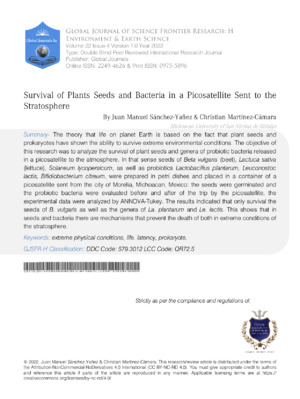
The theory that life on planet Earth is based on the fact that plant seeds and prokaryotes have shown the ability to survive extreme environmental conditions. The objective of this research was to analyze the survival of plant seeds and genera of probiotic bacteria released in a picosatellite to the atmosphere. In that sense seeds of Beta vulgaris (beet), Lactuca sativa (lettuce), Solaneum lycopersicum, as well as probiotics Lactobacillus plantarum, Leuconostoc lactis, Bifidiobacterium citreum, were prepared in petri dishes and placed in a container of a picosatellite sent from the city of Morelia, Michoacan, Mexico: the seeds were germinated and the probiotic bacteria were evaluated before and after of the trip by the picosatellite, the experimental data were analyzed by ANNOVA-Tukey. The results indicated that only survival the seeds of B. vulgaris as well as the genera of La. plantarum and Le. lactis. This shows that in seeds and bacteria there are mechanisms that prevent the death of both in extreme conditions of the stratosphere.


References

13 Cites in Article
  1. L Rothschild,R Mancinelli (2001). Life in extreme environments.
  2. Bernhard Beck-Winchatz,Judith Bramble (2014). High-Altitude Ballooning Student Research with Yeast and Plant Seeds.
  3. Jill Coleman,Melissa Mitchell (2014). Active Learning in the Atmospheric Science Classroom and Beyond Through High-Altitude Ballooning.
  4. T Caro,M Wendeln,M Freeland,N Bryan,S Waters,A Mcintyre (2019). Ultraviolet light measurements (280-400 nm) acquired from stratospheric balloon flight to assess influence on bio aerosols.
  5. A Antunes (2020). Astrobiology: Current, Evolving and Emerging Perspectives.
  6. Priya Dassarma,André Antunes,Marta Simões,Shiladitya Dassarma (2020). Earth's Stratosphere and Microbial Life.
  7. J Díez,G Moreno,L Delperal,J Adams,M Rodríguez Frías,J Manjón (2020). Fuligo septica spores on board a stratospheric NASAballoon and Its Complete In Vitro Life Cycle.
  8. B Berry,D Jenkins,A Schuerger (2010). Effects of simulated Marsconditions on the survival and growth of Escherichia coli and Serratialiquefaciens.
  9. D Murcray,T Kyle,J Kosters,P Gast (1969). Themeasurement of the solar constant from high altitude balloons.
  10. D Smith,M Sowa (2017). Ballooning for Biologists: Mission essentials f or flying life science experiments to near space.
  11. David Smith,Marianne Sowa (2014). Ballooning for Biologists: Mission Essentials for Flying Life Science Experiments to Near Space on NASA Large Scientific Balloons.
  12. Haruo Saruyama,Masatoshi Tanida (1995). Effect of chilling on activated oxygen-scavenging enzymes in low temperature-sensitive and -tolerant cultivars of rice (Oryza sativa L.).
  13. Li-Jun Wang,Ping Zhang,Ruo-Nan Wang,Pu Wang,Shou-Bing Huang (2018). Effects of variety and chemical regulators on cold tolerance during maize germination.

Funding

No external funding was declared for this work.

Conflict of Interest

The authors declare no conflict of interest.

Ethical Approval

No ethics committee approval was required for this article type.

Data Availability

Not applicable for this article.

How to Cite This Article

García Hernández David. 2026. \u201cSurvival of Plants Seeds and Bacteria in a Picosatellite Sent to the Stratosphere\u201d. Global Journal of Science Frontier Research - H: Environment & Environmental geology GJSFR-H Volume 22 (GJSFR Volume 22 Issue H4): .

Download Citation

High-resolution microscopic view of plant seeds and bacteria in soil.
Issue Cover
GJSFR Volume 22 Issue H4
Pg. 17- 19
Journal Specifications

Crossref Journal DOI 10.17406/GJSFR

Print ISSN 0975-5896

e-ISSN 2249-4626

Keywords
Classification
GJSFR-H Classification: DDC Code: 579.3012 LCC Code: QR72.5
Version of record

v1.2

Issue date

August 8, 2022

Language
en
Experiance in AR

Explore published articles in an immersive Augmented Reality environment. Our platform converts research papers into interactive 3D books, allowing readers to view and interact with content using AR and VR compatible devices.

Read in 3D

Your published article is automatically converted into a realistic 3D book. Flip through pages and read research papers in a more engaging and interactive format.

Article Matrices
Total Views: 1598
Total Downloads: 47
2026 Trends
Related Research

Published Article

The theory that life on planet Earth is based on the fact that plant seeds and prokaryotes have shown the ability to survive extreme environmental conditions. The objective of this research was to analyze the survival of plant seeds and genera of probiotic bacteria released in a picosatellite to the atmosphere. In that sense seeds of Beta vulgaris (beet), Lactuca sativa (lettuce), Solaneum lycopersicum, as well as probiotics Lactobacillus plantarum, Leuconostoc lactis, Bifidiobacterium citreum, were prepared in petri dishes and placed in a container of a picosatellite sent from the city of Morelia, Michoacan, Mexico: the seeds were germinated and the probiotic bacteria were evaluated before and after of the trip by the picosatellite, the experimental data were analyzed by ANNOVA-Tukey. The results indicated that only survival the seeds of B. vulgaris as well as the genera of La. plantarum and Le. lactis. This shows that in seeds and bacteria there are mechanisms that prevent the death of both in extreme conditions of the stratosphere.

Our website is actively being updated, and changes may occur frequently. Please clear your browser cache if needed. For feedback or error reporting, please email [email protected]

Request Access

Please fill out the form below to request access to this research paper. Your request will be reviewed by the editorial or author team.
X

Quote and Order Details

Contact Person

Invoice Address

Notes or Comments

This is the heading

Lorem ipsum dolor sit amet, consectetur adipiscing elit. Ut elit tellus, luctus nec ullamcorper mattis, pulvinar dapibus leo.

High-quality academic research articles on global topics and journals.

Survival of Plants Seeds and Bacteria in a Picosatellite Sent to the Stratosphere

Juan Manuel Sanchez-Yañez
Christam Omar Martinez-Camara
Edgar Cárdenas-  Escamilla
Edgar Cárdenas- Escamilla

Research Journals