

1. Introduction
Customers generate future revenues and cash flows, yet their economic contribution is only indirectly visible in conventional accounting measures. Customer lifetime value (CLV) addresses this issue by estimating the present value of future customer profits, while customer equity aggregates those values across the customer base. Customer-based corporate valuation (CBCV) extends this logic to firm valuation by using customer acquisition, retention, purchasing, and spending behavior to forecast the cash flows underlying enterprise or shareholder value (Gupta & Lehmann, 2003; McCarthy & Fader, 2018).
CBCV is most naturally integrated with conventional discounted cash-flow (DCF) valuation. Customer models supply a behavioral basis for revenue and operating-cash-flow forecasts, while corporate-finance principles determine how those forecasts are converted into present value. McCarthy et al. (2017) argue that customer-based and conventional DCF approaches should converge when they use the same underlying cash flows and accounting assumptions. CBCV’s contribution is greater visibility into the customer processes behind the financial forecast.
Despite that, generalizing CBCV beyond the settings in which it was developed poses several related problems. Contractual and noncontractual firms require different behavioral models because customer loss is observable in subscription relationships but latent in many transaction-based businesses (McCarthy & Fader, 2018). Risk treatment also varies across studies, which use weighted average cost of capital (WACC), fixed or hurdle rates, and customer-specific adjustments without a common rule for separating behavioral uncertainty from systematic corporate risk. External valuation introduces a final issue: customer information is often incomplete, aggregated, or inconsistently defined. Because of this, business-model structure determines what must be modeled, disclosure determines what can be estimated, and financial assumptions determine how the resulting cash flows are valued.
Firm maturity and customer concentration introduce additional boundary conditions that cut across contractual and noncontractual settings. Early-stage firms may have limited customer histories and acquisition patterns that change as the business expands, whereas mature firms may have more established customer cohorts but face saturation or changing acquisition opportunities. Contractual status determines whether customer departure is observable; firm maturity affects whether historical acquisition and retention patterns provide a credible basis for forecasting. Customer concentration introduces a separate concern because the loss of a major account may materially affect firm-level cash flows even when contractual status is observable. The B2B studies of Ryals and Knox (2005, 2007) provide a basis for examining relationship-specific risk, but the extent to which CBCV findings generalize across stages of firm maturity and levels of customer concentration requires explicit consideration.
Over time, the field has moved from conceptual links between customers and shareholder value to behavioral forecasting, public-data applications, finance-consistent valuation structures, and more demanding validation, but that progress has been uneven. Evidence still comes from relatively few firms and settings, and Zhang (2016) shows how quickly model performance can deteriorate when the business model changes. Model credibility ultimately depends on whether its behavioral, financial, and information assumptions hold in the setting being valued.
This study systematically reviews the peer-reviewed literature connecting CLV, customer equity, customer assets, and related customer-level economic measures with corporate, enterprise, equity, market, or shareholder value. The synthesis treats these issues as parts of the same valuation problem rather than as separate research streams. Additionally, it identifies where current evidence is strong enough to inform valuation practice, where support remains narrow, and which extensions would provide the most informative tests of CBCV.
2. Conceptual Background and Development of Customer-Based Corporate Valuation
2.1. From Customer Lifetime Value to Corporate Value
Customer lifetime value (CLV) provides the starting point for CBCV by treating customer relationships as assets that generate future economic returns. Gupta and Lehmann (2003) define CLV as the present value of future profits generated by a customer, shifting attention from current-period sales toward the cash flows expected from acquisition, retention, purchasing, and serving behavior. Hogan et al. (2002) extend this asset perspective by arguing that marketing investments should be evaluated according to the value created through customer relationships rather than simply through short-term program outcomes.
At the portfolio level, customer equity (CE) aggregates this logic across the customer base: Bayón et al. (2002) describe customer equity as the economic value associated with current and future customer relationships, while Stahl et al. (2003) connect customer value more directly with shareholder value through the magnitude, timing, risk, and persistence of future cash flows. Aggregating CLV, however, does not produce corporate or shareholder value. Firm value also reflects taxation, capital structure, nonoperating assets, systematic risk, and expectations concerning future opportunities.
Berger et al. (2006) formalize the customer-to-shareholder-value relationship as a chain in which managerial actions affect customer behavior, customer behavior affects CLV, and customer value contributes to shareholder value. Their concept of prescient CLV further emphasizes that valuation must be forward-looking because competitive responses, strategic change, and changes in the business model may alter future customer economics. Gupta and Lehmann (2003) similarly show that customer-derived estimates can approximate market value for some firms while substantially understating others, illustrating that customer value is an important component of firm value rather than a complete substitute for corporate valuation.
2.2. CBCV as an Integrated Valuation Framework
CBCV extends CLV and customer equity by incorporating customer-behavior forecasts explicitly into firm valuation. McCarthy and Fader (2018) describe CBCV as valuing a firm using customer information together with traditional financial data and its distinctive contribution lies in forecasting the operating activity underlying valuation: customer acquisition, retention or continued activity, purchasing, and spending generate expected revenues and cash flows, while corporate-finance principles determine how those cash flows are converted into enterprise and shareholder value.
McCarthy et al. (2017) show that customer-based and conventional DCF estimates should converge when they use the same underlying cash flows and accounting assumptions; the difference lies in how those cash flows are forecast. Customer forecasts come first. Forecasts of customer acquisition, retention or continued activity, purchase frequency, spending, and margins determine expected revenues and contribution from the customer base. Those operating forecasts are then translated into firm-level cash flows after incorporating the costs required to acquire and serve customers, other operating expenses, and taxation. Discounting the resulting expected operating cash flows produces an estimate of operating or enterprise value, after which debt, nonoperating assets, and other financial claims are incorporated to derive equity or shareholder value. Bauer and Hammerschmidt (2005) make this distinction explicit by integrating customer equity with continuing value and other components of corporate valuation, while Schulze et al. (2012) show why customer-derived value must be reconciled with the firm’s broader financial structure.
It must be noted that customer equity and corporate value are not interchangeable: Customer equity captures the value associated with expected customer-generated economics, but shareholders hold claims on the firm as a whole. Thus, the translation from customer value to shareholder value requires consistency between the operating assumptions embedded in the customer model and the financial assumptions used in valuation. McCarthy et al. (2017) make this architecture particularly explicit by deriving customer-related forecasts first and then incorporating those forecasts into a conventional DCF framework. The resulting valuation depends on consistency between the customer forecasts and the financial adjustments applied after those forecasts are generated.
That sequence also reveals where a valuation can go wrong. A valuation discrepancy may originate in the behavioral layer, such as inaccurate assumptions about acquisition, retention, purchasing, or spending, or in the financial layer through assumptions about margins, taxation, capital costs, debt, or nonoperating assets. Treating CBCV as a sequence of linked forecasts rather than as a single valuation equation allows the analyst to ask both whether an estimated firm value is accurate and which stage of the customer-to-value process is responsible when it is not.
The empirical review that follows examines where this valuation sequence holds and where it breaks down.
3. Methodology
3.1. Review Design and Research Questions
A systematic literature review was used to identify and synthesize research connecting customer-level economic measures with firm-level valuation. This approach was appropriate because CBCV research spans multiple terms, methods, data sources, and valuation outcomes across marketing and finance (Tranfield et al., 2003; Snyder, 2019). Study identification and selection were documented using the Preferred Reporting Items for Systematic Reviews and Meta-Analyses (PRISMA) 2020 framework (Page et al., 2021).
The review addressed four questions:
*RQ1. How has CBCV evolved across contractual, noncontractual, and other business-model contexts?*
*RQ2. How does CBCV incorporate discounting, risk, capital structure, and cost of capital?*
*RQ3. How do customer-data availability and disclosure affect CBCV feasibility and accuracy?*
RQ4. How has CBCV been validated, and what theoretical, methodological, and contextual gaps remain?
3.2. Database Selection and Search Strategy
The review searched Business Source Premier and Academic Search Complete through EBSCO and ABI/INFORM Complete and ProQuest Research Library through ProQuest. Two complementary strategies were used: Search A targeted explicit customer-based valuation terminology, whereas Search B identified studies connecting customer-level economic measures with firm or shareholder value. Database selection was guided by disciplinary relevance and institutional subscription availability. The search used four databases available through the author’s university library: Business Source Premier, Academic Search Complete, ABI/INFORM Complete, and ProQuest Research Library. Scopus and Web of Science were outside the library’s subscription coverage and were therefore not cross-searched. Appendix Table 3 reports the exact database search strategies and fields used for each search. Searches were restricted to peer-reviewed scholarly journals with no publication-date limit.
3.3. Eligibility and Screening
Studies were eligible for the primary corpus when they used, developed, evaluated, or substantively discussed a customer-level or customer-base economic measure in relation to corporate, enterprise, equity, shareholder, or market value. Eligible measures included CLV, customer equity, customer assets, customer-base value, residual lifetime value, and related customer-derived measures. Studies that focused on churn, customer relationship management (CRM), satisfaction, loyalty, customer profitability, brand equity, or other marketing variables were excluded unless a customer-based economic valuation mechanism was central to the firm-level outcome. Prior reviews and conceptual or managerial articles not meeting this criterion were retained only as background sources.
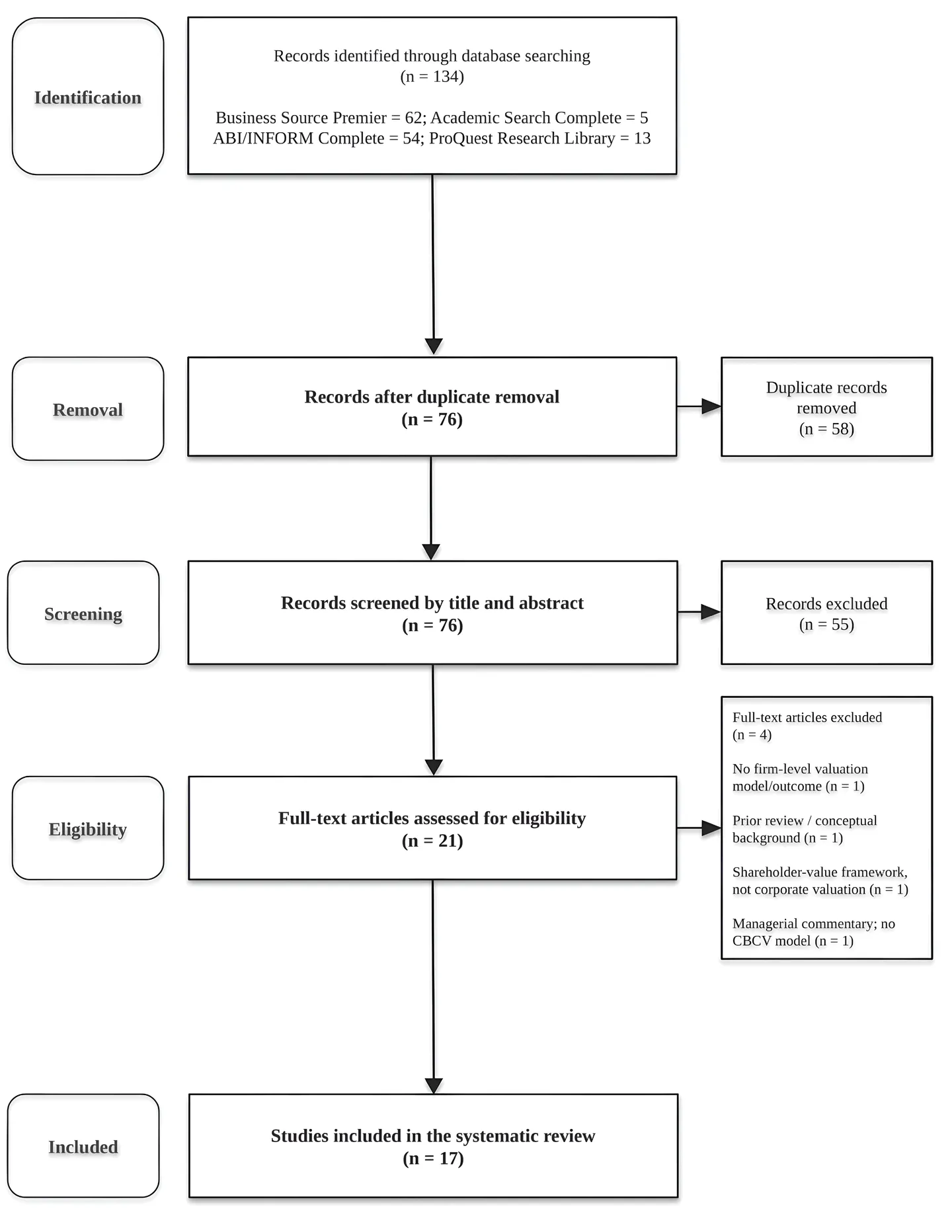
The searches identified 134 records: 62 from Business Source Premier, 5 from Academic Search Complete, 54 from ABI/INFORM Complete, and 13 from ProQuest Research Library with deduplication producing 76 unique records. Fifty-five were excluded during title and abstract screening, leaving 21 articles for full-text assessment. Four articles were excluded following full-text assessment, resulting in a final analytic corpus of 17 studies. Appendix Table 4 identifies these articles and reports the specific rationale recorded for each exclusion. Figure 1 summarizes the selection process.
3.4. Data Extraction and Synthesis
The 17 included studies were coded for study type and context; customer measures; valuation approach; discount-rate and risk treatment; data and disclosure basis; validation method; principal findings; and methodological or contextual limitations. Comparative coding focused on contractual versus noncontractual relationships, risk and discounting, and customer-data availability and disclosure. Validation was treated as a cross-cutting dimension encompassing market-value comparisons, conventional financial benchmarks, subsequent outcomes, and out-of-sample forecasting.
Because the studies differed substantially in research design, business context, customer measures, valuation methods, and financial outcomes, statistical meta-analysis was not appropriate. The evidence was therefore synthesized thematically (Snyder, 2019), first by tracing the development of CBCV and then by comparing evidence across business-model structure, risk and discounting, information availability, and validation.
4. Findings
4.1. Development of CBCV
The 17 included studies span 2002–2020 and show a progression from treating customers as financial assets toward models that incorporate customer forecasts directly into corporate valuation. Early studies established the economic connection among CLV, customer equity, and shareholder value, while subsequent research increasingly integrated customer measures with DCF, risk, capital structure, and market-based validation. Below, Table 1 summarizes the included studies.
Table 1. Studies Included in the CBCV Review
| Study | Setting | Contribution |
|---|---|---|
| Bayón et al. (2002) | General | CE–shareholder value link |
| Hogan et al. (2002) | General | Customers as financial assets |
| Gupta & Lehmann (2003) | Public/mixed | Customer value vs. market value |
| Stahl et al. (2003) | General | CLV–shareholder value link |
| Bauer & Hammerschmidt (2005) | Corporate valuation | CE integrated with DCF |
| Ryals & Knox (2005) | Business-to-business (B2B) | Risk-adjusted CLV |
| Berger et al. (2006) | General | CLV–shareholder value framework |
| Ryals & Knox (2007) | B2B | Customer-specific risk |
| Kumar & Shah (2009) | Noncontractual | CE and market capitalization |
| Fader & Hardie (2010) | Contractual | Retention heterogeneity |
| Li (2010) | Contractual | CLV and economic value added (EVA) |
| Lim & Lusch (2011) | Public firms | Top-down CE valuation |
| Schulze et al. (2012) | Largely contractual | CBCV + finance adjustments |
| Zhang (2016) | Contractual | Longitudinal validation |
| McCarthy et al. (2017) | Contractual | Public-data CBCV |
| McCarthy & Fader (2018) | Noncontractual | Latent-activity CBCV |
| Schneider & Imai (2020) | Contractual | Stochastic user valuation |
The earliest studies included in this review were concerned mainly with establishing the customer–firm value connection: Bayón et al. (2002), Hogan et al. (2002), Gupta and Lehmann (2003), and Stahl et al. (2003) all conceptualized customer relationships as assets whose future cash flows contribute to shareholder value. Bauer and Hammerschmidt (2005) moved closer to corporate valuation by integrating customer equity with continuing value, capital costs, debt, and nonoperating assets, while Ryals and Knox (2005, 2007) introduced explicit treatment of customer risk. Berger et al. (2006) further emphasized the forward-looking nature of the customer-to-shareholder-value relationship.
By the next stage, the question had shifted from whether customers carry financial value to whether customer information could support an actual firm valuation. For example, Kumar and Shah (2009) linked customer equity with market capitalization; Fader and Hardie (2010) demonstrated the valuation consequences of retention heterogeneity; and Schulze et al. (2012) more explicitly integrated customer equity with corporate-finance adjustments. Public-data models then extended CBCV toward outside investors by deriving customer forecasts from aggregated disclosures and embedding them in conventional DCF structures (McCarthy et al., 2017; McCarthy & Fader, 2018; Schneider & Imai, 2020). The literature evolved from demonstrating that customers have financial value toward identifying the conditions under which customer information can improve firm valuation.
4.2. Business-Model Structure
The sharpest divide in the evidence is between contractual and noncontractual businesses. Six of the 17 included studies directly examine contractual or subscription relationships, whereas only two directly examine noncontractual valuation. That imbalance has a direct modeling consequence: contractual status changes the information available to the valuation model. In subscription relationships, customer termination is generally observable through their cancellation or nonrenewal of the service. However, the absence of a purchase does not reveal whether a customer has permanently defected or simply has not yet returned in a noncontractual setting. This makes analysis more challenging, as the analyst must infer latent customer activity while also forecasting irregular purchase timing and spending (Fader & Hardie, 2010; McCarthy & Fader, 2018).
The contractual literature demonstrates that observability does not eliminate model risk. Fader and Hardie (2010) show that using an aggregate retention rate can materially understate customer-base value when retention propensities differ across customers; in their illustration, ignoring this heterogeneity reduced residual customer-base value by 38%. For corporate valuation, small differences in assumptions about customer survival can compound over the forecast horizon and materially alter the cash flows attributed to the existing customer base. Later contractual approaches expand on this and incorporate more flexible acquisition, churn, duration, and spending processes rather than treating customers as behaviorally homogeneous (McCarthy et al., 2017; Schneider & Imai, 2020).
The contractual models are also vulnerable to changes in the economic process that generates customer behavior. As an example, Zhang (2016) provides longitudinal evidence that a valuation model can perform credibly under one business regime and become less informative when the underlying customer economics change. In addition, Zhang’s study separates parameter estimation from model validity. However, a well-estimated retention or spending process may still produce poor valuation forecasts when changes in technology, product architecture, pricing, or customer behavior alter the relationship between historical customer activity and future cash flows. In short, contractual status improves observability, but it does not guarantee structural stability.
The reviewed evidence supports reassessment and recalibration more clearly than it establishes a preferred estimation-window adjustment. Rolling predictive validation in McCarthy et al. (2017) and McCarthy and Fader (2018) provides a basis for evaluating forecasts over successive periods, but should not be interpreted as evidence that a particular rolling estimation window corrects structural instability. As a practical implication, analysts could compare forecasts estimated from the full history, a recent rolling window, and observations following an identifiable business change, selecting among these alternatives using subsequent customer-level and revenue forecast performance. Shorter windows reduce reliance on potentially outdated observations but provide less information for estimation. This trade-off may be especially consequential for noncontractual models such as Pareto/NBD or BG/NBD: a truncated window may contain fewer customer histories and repeat purchases, making latent attrition and long-term purchasing or spending parameters less stable. If the change affects the underlying behavioral process, revising the model specification may be necessary in addition to changing the window. The present synthesis does not establish Bayesian parameter updating or explicit regime-switching formulations as validated remedies for CBCV structural instability; their comparative effectiveness remains a research question.
Noncontractual firms pose a harder identification problem. In McCarthy and Fader’s (2018) research, acquisition, purchasing, spending, and latent attrition are modeled jointly because observed inactivity cannot itself be interpreted as churn. Their approach illustrates why metrics that appear similar across contractual and noncontractual firms may have different economic meanings. More specifically, a reported subscriber cancellation represents a relatively clear change in customer state, whereas an “active customer” measure in retail or e-commerce depends on the firm’s chosen activity window and does not directly reveal whether an inactive customer has permanently left. Thus, noncontractual CBCV requires both a richer behavioral model and stronger assumptions about the relationship between observed transactions and unobserved customer status.
It should also be noted that evidence beyond these settings remains limited. Kumar and Shah (2009) provide additional noncontractual evidence linking customer equity with market capitalization, while Ryals and Knox (2005, 2007) show that B2B customer relationships can differ substantially in risk, retention probability, and economic contribution. However, the B2B studies focus more directly on customer or relationship value than on complete enterprise valuation. Contractual status is better treated as a valuation-model boundary than as a descriptive industry characteristic as it determines which customer states are directly observable, which must be inferred, and which behavioral assumptions ultimately feed into the revenue and cash-flow forecasts used in corporate valuation.
The contractual–noncontractual distinction does not fully capture these differences in valuation conditions. The present synthesis does not establish whether CBCV performance varies systematically between early-stage and mature firms. Evidence that a model performs well in a particular firm or period does not establish its transferability across lifecycle stages, especially when acquisition rates, customer mix, or cohort economics are changing. Zhang’s (2016) evidence of declining model performance following business-model change reinforces the importance of examining stability, although business-model change is not itself a direct test of firm maturity. Customer concentration is more explicitly addressed through the relationship-risk perspective of Ryals and Knox (2005, 2007), but its implications for complete firm valuation remain less extensively tested. Firm maturity therefore remains an insufficiently resolved boundary condition in this synthesis, while customer concentration has a clearer conceptual foundation than a broad corporate-level validation base.
4.3. Risk, Discounting, and Information Availability
The financial treatment of CBCV is less standardized than its behavioral logic. Seven studies in the final corpus use WACC directly in valuation or customer-value discounting, while five employ fixed, generic, or hurdle rates. Other studies address risk through expected customer cash flows, alternative financial measures, or conceptual adjustments. This variation is economically important because identical forecasts of customer acquisition, retention, purchasing, and spending can produce different estimates of value depending on how uncertainty and discounting are incorporated.
Earlier customer-valuation approaches often focused primarily on demonstrating the economic consequences of customer behavior rather than deriving discount rates from a complete corporate-finance framework. Later CBCV studies move more explicitly toward conventional DCF architecture by incorporating company-specific cost of capital, taxes, debt, and nonoperating assets (Schulze et al., 2012; McCarthy et al., 2017; McCarthy & Fader, 2018; Schneider & Imai, 2020). More recent studies, however, go beyond discounting customer equity by placing customer-generated operating cash flows inside a broader firm-valuation process.
Additionally, customer-specific uncertainty can enter either expected cash flows or the discount rate, and the literature offers no settled rule for choosing between them: Corporate-finance discount rates are intended to compensate investors for systematic risk, while uncertainty about an individual customer’s retention, purchasing, or payment behavior may be diversifiable or already reflected in the expected cash-flow forecast. Ryals and Knox (2005, 2007) make this distinction clear by separating the firm’s cost of capital from relationship-specific customer risk and their work shows that customer uncertainty can be incorporated through probability-adjusted expected cash flows rather than simply by increasing the discount rate.
It should be noted that the choice is essentially a numerator-versus-denominator problem. Uncertainty about whether a customer will remain, purchase, or generate a particular margin can change the expected cash flows in the numerator of a valuation model. Systematic exposure to market risk, on the other hand, affects the rate used to discount those expected cash flows in the denominator. If the same customer uncertainty is reflected both in reduced expected cash flows and in an additional discount-rate premium, it may be counted twice. This means that if neither adjustment captures it adequately, the model may understate risk. The reviewed literature does not yet provide a common rule for determining when firm-level WACC is sufficient, when customer uncertainty should alter expected cash flows, or when an additional risk adjustment is economically justified.
The distinction concerns how uncertainty enters expected cash flows and the discount rate. Retention, purchasing, and payment probabilities determine expected customer cash flows, while the discount rate reflects the required return for the relevant systematic risk. Using probability-weighted cash flows together with a risk-adjusted discount rate does not, by itself, constitute double-counting. Duplication arises only when adjustments in both components compensate for the same risk in an economically overlapping manner. The review did not identify an empirical test that isolates and quantifies the valuation distortion attributable specifically to such duplication across the 17 included studies. Related sensitivity evidence is available: Schneider and Imai (2020) examine how valuation changes with WACC and other model inputs. However, sensitivity to the discount rate does not establish that risk has been counted twice or measure the resulting bias. Double-counting is therefore treated here as an unquantified conceptual concern within the reviewed corpus, rather than as an empirically demonstrated source of valuation error. In practice, analysts should document which risks are reflected in churn-adjusted expected cash flows and which justify any hurdle-rate adjustment, then check that the same risk is not penalized in both places.
While corporate-valuation mechanics are now relatively settled, customer-risk treatment is not and portfolio concentration makes that choice more consequential. A diversified consumer firm with thousands of relatively small customer relationships may have customer-level uncertainty that largely averages out, whereas a B2B firm dependent on a small number of major accounts may face economically material relationship risk. The B2B work of Ryals and Knox (2005, 2007) suggests that customer concentration and relationship-specific survival can affect value, but the corpus contains relatively little corporate-level evidence testing how such portfolio characteristics should interact with conventional measures of firm risk.
External implementation faces a different obstacle: the analyst may not have the customer information the model requires. Only five included studies directly combine publicly disclosed customer metrics with financial information in firm- or market-value applications. Public customer data can make CBCV feasible for outside investors, but the information is often incomplete, aggregated, unavailable for portions of a firm’s history, or defined differently across companies (McCarthy et al., 2017; McCarthy & Fader, 2018). These limitations matter because customer variables are not simply descriptive inputs. Instead, definitions of active customers, churn, acquisition, or average revenue determine which underlying behavioral states the model is attempting to estimate.
This review also revealed a clear information hierarchy across the research. Internal customer records can provide detailed observations on acquisition, transactions, margins, retention, and costs to serve, but they offer limited external replicability. Conventional financial statements are widely available and standardized, but reveal relatively little about the customer processes producing reported revenues. Public customer disclosures occupy the middle ground: they increase behavioral visibility but remain less standardized than financial-statement measures. The differences in information available mean that a model that is feasible with internal customer records may be impossible for an outside investor to reproduce.
The limitation noted above is particularly important for private-company valuation. None of the 17 included studies empirically validates a standardized customer-disclosure framework specifically for private-company CBCV. This means that private firms might possess rich internal customer information, but external appraisers, lenders, or investors may receive only selected metrics and lack a continuously observed market capitalization against which any valuation estimates can be compared. Information availability is part of the valuation problem, not merely an implementation inconvenience, because the credibility and external reproducibility of CBCV depend on whether the customer states required by the model can be observed, consistently defined, and independently evaluated.
4.4. Validation and Remaining Gaps
Validation has become more demanding, but its meaning varies across the literature. Early research largely examined whether customer-based measures were associated with or broadly consistent with shareholder or market value. Gupta and Lehmann (2003), for example, compared customer-derived valuations with observed firm values and found relatively close correspondence for some companies but substantial underestimation for others. Li (2010) tested whether CLV was positively related to an EVA-based shareholder-value measure. These studies established that customer economics can be financially relevant, but association or point-in-time correspondence does not by itself demonstrate that a CBCV model can forecast firm value accurately.
Longitudinal tests ask whether the customer–value relationship survives over time. Zhang (2016) shows that a customer-equity model can correspond reasonably well with market capitalization during one period yet become less informative when the firm’s business model changes. Temporal stability is crucial because CBCV uses historical customer behavior to forecast future economics. Because of this, a model can be statistically well estimated and still become economically misspecified when changes in technology, pricing, product delivery, competition, or customer behavior alter the process generating future cash flows.
Later studies increasingly test the behavioral forecasts that precede the final valuation. McCarthy et al. (2017) use out-of-sample tests of customer additions, losses, and counts before relying on those projections within the valuation model. McCarthy and Fader (2018) extend this logic to noncontractual firms by evaluating forecasts of acquisitions, active customers, orders, and revenues through rolling holdouts and comparison with alternative specifications. This is valuable because out-of-sample testing sets a higher standard: the customer processes generating value must be forecast accurately before the final equity-value estimate can be considered persuasive.
Testing the intermediate forecasts is necessary because an apparently accurate valuation can result from offsetting errors. A model might overestimate customer acquisition while underestimating spending, or underestimate attrition while overstating margins, and still arrive near the observed market value. Validation of the intermediate behavioral forecasts makes these errors visible. Thus, a test of the intermediate forecasts provides stronger evidence about whether a CBCV model captures the economic mechanism it claims to represent.
Market-value comparisons remain useful, but it should be noted that they require careful interpretation. McCarthy and Fader’s (2018) results illustrate this problem: their Overstock valuation was relatively close to the observed market value, whereas the Wayfair estimate differed substantially from the prevailing market price. In addition, such divergence cannot automatically identify which estimate is “wrong.” It may reflect misspecification of customer behavior, omitted growth opportunities, changing competitive expectations, market mispricing, or assumptions about future economics that are not represented in the current customer base. A market-price comparison provides an important external benchmark but cannot uniquely diagnose the source of disagreement.
Schneider and Imai (2020) broaden the validation evidence by applying user-based valuation across multiple firms and periods. Together with Zhang (2016), McCarthy et al. (2017), and McCarthy and Fader (2018), this work shows a progression toward validation that is longitudinal, predictive, comparative, and increasingly attentive to uncertainty. However, the empirical base remains narrow. Most of the strongest validation evidence comes from a relatively small group of public, digital, and subscription-oriented firms.
The methodological depth of CBCV validation has increased more rapidly than its breadth. More specifically, the literature now contains evidence based on market-value correspondence, longitudinal performance, behavioral holdouts, competing specifications, and multi-period comparisons, but these approaches have not yet been applied consistently across industries, ownership structures, or customer relationships. Table 2 summarizes this limitation alongside the remaining gaps in business-model transferability, risk and discounting, and disclosure.
Table 2. Principal CBCV Gaps and Research Priorities
| Gap | Evidence from review | Research priority |
|---|---|---|
| Business-model transferability | 6 direct contractual vs. 2 direct noncontractual studies | Test noncontractual, B2B, platform, and mixed models |
| Risk and discounting | WACC and customer-specific risk are treated inconsistently | Separate systematic risk from behavioral/customer uncertainty |
| Disclosure | Public customer metrics are incomplete and inconsistently defined | Identify minimum standardized customer disclosures |
| Validation | Stronger recent validation remains concentrated in few firms | Conduct multi-firm, out-of-sample and structural-change tests |
It must be noted that the evidence does not support treating these four problems as equivalent: The narrow evidence base outside contractual settings is the most immediate obstacle to generalizing CBCV across firms. In addition, the inconsistent treatment of customer uncertainty is the most important unresolved conceptual issue because it affects how customer-generated cash flows are translated into economic value. Further, disclosure is primarily an implementation constraint as even a well-specified model cannot be reproduced externally when the relevant customer states are unavailable or inconsistently defined. Validation cuts across all three problems because stronger forecasting and valuation tests are needed to determine whether proposed solutions actually improve performance. These priorities define the research agenda that follows.
5. Future Research Agenda
Future work should begin in noncontractual, B2B, platform, and freemium settings, where the evidence base remains thin and customer behavior poses different identification problems. Noncontractual models must infer latent customer activity and irregular purchasing, while B2B valuation may require explicit treatment of customer concentration, contract renewal, negotiated pricing, and account-specific margins (Ryals & Knox, 2005, 2007; McCarthy & Fader, 2018). A useful test would compare business-model-specific CBCV approaches against common forecasting and valuation benchmarks instead of assuming that subscription-based specifications transfer across settings.
Future research should explicitly test firm maturity and customer concentration as boundary conditions within contractual and noncontractual settings. Comparisons of early-stage, growth-stage, and mature firms should examine whether acquisition, retention, and spending models retain their forecasting accuracy as customer histories lengthen and growth opportunities change. Firm maturity should be defined using explicit indicators, such as operating history, customer-base growth, or cohort stability. Studies should also examine whether valuation errors vary with the share of revenue attributable to major customers and whether explicitly modeling major-account renewal or loss improves forecasts. Testing these dimensions jointly would help distinguish limitations arising from customer-state observability from those arising from lifecycle dynamics or concentrated customer exposure.
Risk treatment requires a different kind of empirical test. Existing studies variously employ WACC, fixed or hurdle rates, customer-specific adjustments, and probability-adjusted expected cash flows. Future research should compare these treatments directly and distinguish systematic corporate risk from uncertainty already reflected in expected retention, spending, margins, or customer survival. Ryals and Knox (2007) provide an important precedent by separating WACC from customer-specific probability adjustments. Testing alternative specifications on common datasets would help determine whether customer uncertainty belongs in expected cash flows, discount rates, or both. Such comparisons should distinguish ordinary discount-rate sensitivity from distortion caused by overlapping risk adjustments. To quantify double-counting, a study would need an explicitly specified risk-consistent benchmark and alternative valuations that deliberately duplicate the same risk adjustment, allowing the resulting valuation difference to be isolated.
Disclosure research should determine the minimum customer information required for credible external valuation. Public-data studies demonstrate the usefulness of customer disclosures but also reveal inconsistent definitions, missing observations, and aggregation (McCarthy et al., 2017; McCarthy & Fader, 2018). Studies using progressively restricted information sets could identify whether customer counts, churn, acquisition costs, average revenue per user (ARPU), cohort measures, or customer concentration provide incremental valuation value. Private firms are especially important because none of the included studies empirically validates a standardized customer-disclosure framework specifically for private-company CBCV. Acquisition prices, financing valuations, realized cash flows, transaction multiples, or subsequent initial public offering (IPO) values could provide alternative benchmarks where public market prices are unavailable.
For private-company CBCV to inform transaction pricing and deal structuring, future research must also address the governance and independent verifiability of customer data. A proposed verification framework could require documented definitions of customers, cohorts, acquisition, churn, and revenue; reconciliation of cohort-level totals to underlying transaction records and financial accounts; and traceable records of exclusions, restatements, and changes in measurement. Independent reviewers could test samples against contracts, invoices, payment records, and customer-system logs, with particular attention to duplicate accounts, refunds, reactivations, and changes in cohort membership. Governance arrangements should specify responsibility for metric preparation, approval of definition changes, and controlled access to supporting records while protecting customer confidentiality. Research could then examine whether independently verified inputs improve forecast accuracy, reduce disagreement between buyers and sellers, and increase the usefulness of CBCV alongside earnings before interest, taxes, depreciation, and amortization (EBITDA) multiples or other transaction benchmarks. Any claim that CBCV could replace established valuation benchmarks would require additional comparative evidence on both data reliability and valuation performance.
Validation also needs to extend across firms and changing business conditions. Recent studies increasingly use holdouts, competing models, longitudinal tests, and market comparisons, but evidence remains concentrated in relatively few firms (McCarthy et al., 2017; McCarthy & Fader, 2018). Zhang (2016) also shows that model performance can deteriorate following structural change. Both intermediate customer forecasts and final firm valuations need testing across industries, ownership structures, and business regimes. The objective should not be a universal customer-equity formula, but a valuation architecture whose behavioral model, risk treatment, information requirements, and validation approach are appropriate to the setting in which it is used. Studies addressing structural instability should compare expanding and rolling estimation windows, post-change recalibration, Bayesian updating, and explicit regime-switching formulations under common forecasting benchmarks. Such comparisons should distinguish changes in parameter values from changes in the underlying model structure and evaluate both customer forecasts and resulting valuations.
The next studies would be more informative if they compared competing behavioral and financial specifications on the same datasets and reported performance at multiple stages of the valuation process. For example, contractual and noncontractual customer models could be compared using common forecast-error measures; alternative treatments of customer uncertainty could be evaluated using identical cash-flow forecasts; and customer-disclosure experiments could test how valuation accuracy changes as information is progressively restricted. Multi-period designs could then examine whether the preferred specification remains stable after changes in pricing, technology, customer acquisition strategy, or business model. Such designs would make it easier to determine whether improvements in CBCV arise from better customer modeling, more appropriate financial assumptions, richer information, or simply better fit to a particular firm or period.
6. Discussion and Implications
Throughout this review, two asymmetries dominate the reviewed evidence. CBCV has been tested much more extensively in contractual public firms than in noncontractual, B2B, or private settings, and the literature is less settled on customer-risk treatment than on firm-level valuation mechanics. Disclosure and validation compound those weaknesses by limiting external replication and tests across changing business conditions. These asymmetries shape the theoretical and practical implications that follow.
6.1. Theoretical Implications
CBCV can fail at several points in the valuation chain. Errors may arise in the customer-behavior forecast, in the translation of customer outcomes into operating cash flows, or in the financial assumptions used to convert those cash flows into value. Those failures should not be treated as equivalent. Poor acquisition, retention, purchasing, or spending forecasts challenge the behavioral specification; accurate customer forecasts paired with poor firm-value estimates instead point toward margins, cost structure, growth assumptions, capital costs, or other financial components. This makes validation of intermediate forecasts theoretically important rather than merely a technical refinement.
Risk treatment remains the least settled part of this architecture. The evidence supports separating customer-specific uncertainty from systematic corporate risk, but it does not establish a single prescription for where customer uncertainty should enter valuation. Ryals and Knox (2005, 2007) show that relationship-specific uncertainty can be reflected in expected customer economics while retaining a corporate cost-of-capital benchmark. The unresolved theoretical task is to specify when uncertainty belongs in expected cash flows, when it warrants an adjustment to the discount rate, and how customer concentration changes that choice.
6.2. Managerial and Valuation Implications
For managers, CBCV is more useful as a diagnostic system for value creation than as a single-number valuation exercise. Aggregate revenue growth can arise from very different combinations of customer acquisition, retention, purchasing, spending, margins, and customer mix, and those combinations need not create equivalent economic value. Customer-based decomposition makes it possible to identify which operating processes are actually driving changes in expected cash flows.
It also changes how acquisition and retention spending can be evaluated. Acquisition spending creates value only when the expected future contribution from newly acquired customers exceeds the resources required to obtain them. Retention investment similarly creates value only when the incremental cash flows generated by improved customer survival justify the expenditure. The customer-as-asset logic developed by Gupta and Lehmann (2003) becomes especially useful here because it allows marketing decisions to be evaluated using the same investment logic applied to other uses of corporate resources.
For investors and valuation professionals, the main value of CBCV is that it is diagnostic. Customer disclosures make the behavioral assumptions embedded in revenue forecasts visible and allow analysts to test whether projected growth is supported by plausible acquisition, retention, spending, and margin dynamics. This is particularly useful for firms whose current accounting earnings may provide an incomplete picture of future economics because substantial value depends on continued customer growth or monetization.
CBCV can also function as a reverse-valuation or scenario-analysis framework. A difference between a customer-based estimate and observed market value need not be classified immediately as model failure. Instead, analysts can ask what acquisition rates, retention levels, spending growth, margins, or strategic opportunities would be required to reconcile the two values. The large valuation divergence reported for Wayfair by McCarthy and Fader (2018), for example, illustrates how CBCV can reveal the operating assumptions embedded implicitly in market expectations. Used in this way, disagreement becomes analytically informative rather than merely an error to be minimized.
6.3. Financial Reporting Implications
The usefulness of external CBCV depends heavily on disclosure quality. Public customer metrics can improve valuation analysis, but their usefulness declines when measures such as active customers, churn, ARPU, or acquisition costs are incomplete, inconsistently defined, or reported over different periods (McCarthy et al., 2017; McCarthy & Fader, 2018). Comparability matters at least as much as the quantity of customer information disclosed.
The evidence favors disclosure of underlying customer-value drivers rather than a company-generated customer-equity estimate. A reported customer-equity number would depend on assumptions concerning retention, margins, growth, risk, and discounting that external users might reasonably dispute. Consistently defined measures of customer acquisition, retention or churn, customer counts, spending or revenue per customer, acquisition costs, and relevant cohort information would instead allow investors to construct and challenge their own forecasts.
Finally, standardization would improve comparability across firms. An “active customer” defined as someone purchasing within three months is not economically identical to one defined over twelve months, even if both firms report the same label. Similar problems arise when companies change the definitions of churn, subscriber additions, or acquisition costs through time. More stable definitions, clearer measurement windows, and reconciliation of changes in reported customer metrics would make customer disclosures more useful as valuation inputs.
Customer disclosure sits directly at the intersection of marketing, finance, and accounting. Marketing research can identify which customer measures best explain future economic behavior; finance can determine how customer-generated cash flows should enter corporate valuation; and accounting can evaluate which customer disclosures provide decision-useful and comparable information to external users. Persson and Ryals (2010) similarly emphasize the usefulness of customer-equity drivers in management reporting. Further model refinement will have limited external value unless customer reporting becomes more credible and comparable.
7. Limitations
Two limitations are especially important. First, the boundary of CBCV is inherently interpretive because related research spans CLV, customer equity, customer assets, marketing productivity, shareholder value, and corporate valuation. Inclusion required a substantive connection between a customer-level economic measure and firm-level value. This criterion improved conceptual focus but may have excluded adjacent studies using different terminology. The search was limited to Business Source Premier, Academic Search Complete, ABI/INFORM Complete, and ProQuest Research Library and did not include cross-searching in Scopus or Web of Science. Relevant finance and accounting studies examining customer intangibles may therefore have been missed if they were not indexed in the selected collections or did not use the terminology captured by the search strategy. Further, bibliographic coverage was constrained by institutional subscription availability, which precluded cross-searching in Scopus and Web of Science. Future reviews could use open bibliographic repositories such as OpenAlex and Crossref to cross-check the completeness of the retrieved corpus, particularly for relevant studies in multidisciplinary accounting and finance journals. The findings and identified research gaps should consequently be interpreted within the retrieved corpus rather than as an exhaustive account of all relevant scholarship. Restricting eligibility to peer-reviewed journal articles also excluded books, conference proceedings, working papers, and practitioner sources.
The composition of the evidence base poses a larger constraint. The 17 included studies are fairly heterogeneous in research design, business context, customer measures, valuation methods, data sources, and validation benchmarks. These differences make statistical meta-analysis inappropriate and limit the generalizability of the synthesis. Additionally, evidence is particularly concentrated in public, digital, and contractual settings. The review identifies recurring patterns in CBCV development, but it cannot establish that a single customer-based valuation approach performs consistently across industries, countries, private firms, B2B markets, or noncontractual relationships.
8. Conclusion
Across the 17 studies, the strongest empirical support for CBCV comes from public, digital, and contractual settings. The harder test is whether customer-based forecasts remain informative when churn is latent, disclosures are incomplete, and no public market benchmark is available. Comparative, out-of-sample studies in noncontractual, B2B, platform, and private-company settings can show whether current results generalize and which customer disclosures and risk treatments add predictive value. Evidence from those settings, rather than another refinement of a single-firm model, would mark the next substantive advance in CBCV.
Note: References marked with an asterisk indicate studies included in the systematic review corpus.
Appendix
Table 3. Exact Database Search Strategies
| Platform / Databases | Search | Field | Exact Search Strategy |
|---|---|---|---|
| EBSCO - Business Source Premier; Academic Search Complete | A | All Fields | (“customer-based corporate valuation” OR “customer based corporate valuation” OR “customer-based valuation” OR “customer based valuation” OR “customer equity valuation” OR “customer-base valuation” OR “customer base valuation”) AND (customer* OR firm* OR corporate OR enterprise OR equity OR shareholder*) |
| EBSCO - Business Source Premier; Academic Search Complete | B | Abstract | (“customer lifetime value” OR “customer equity” OR “customer value equity” OR “customer-base value” OR “customer base value” OR “value of customers”) AND (“shareholder value” OR “firm value” OR “firm valuation” OR “corporate value” OR “corporate valuation” OR “enterprise value” OR “equity value” OR “market capitalization” OR “market capitalisation”) |
| ProQuest - ABI/INFORM Complete; ProQuest Research Library | A | Anywhere except full text | (“customer-based corporate valuation” OR “customer based corporate valuation” OR “customer-based valuation” OR “customer based valuation” OR “customer equity valuation” OR “customer-base valuation” OR “customer base valuation”) |
| ProQuest - ABI/INFORM Complete; ProQuest Research Library | B | Abstract | (“customer lifetime value” OR “customer equity” OR “customer value equity” OR “customer-base value” OR “customer base value” OR “value of customers”) AND (“shareholder value” OR “firm value” OR “firm valuation” OR “corporate value” OR “corporate valuation” OR “enterprise value” OR “equity value” OR “market capitalization” OR “market capitalisation”) |
Table 4. Articles Excluded Following Full-Text Assessment
| Article | Rationale for exclusion from the analytic corpus |
|---|---|
| Ryals (2006), “Profitable relationships with key customers: how suppliers manage pricing and customer risk” | Focuses on managing key-account profitability, pricing, costs to serve, and customer risk. Although it discusses CLV, customer equity, and shareholder value, the screening assessment identified no developed or evaluated customer-based firm-valuation model or firm-level valuation outcome. |
| Persson and Ryals (2010), “Customer assets and customer equity: Management and measurement issues” | Reviews and clarifies customer assets and customer equity, including their management and reporting implications. Classified as a prior review and conceptual background source rather than a primary CBCV valuation contribution; retained as background literature. |
| Nenonen and Storbacka (2016), “Driving shareholder value with customer asset management: Moving beyond customer lifetime value” | Uses longitudinal B2B case studies to develop a customer-asset-management framework organized around revenue, costs, asset utilization, and risk. Classified as a managerial value-creation framework rather than an approach estimating corporate, enterprise, equity, or market value from customer economics. |
| Peppers (2015), “Dealing with the ‘alignment problem’ ” | Provides managerial discussion of the alignment between customer-centric and conventional financial metrics. Recommends CLV and customer analytics as supplementary measures but does not develop or test a customer-based firm-valuation model or firm-level valuation outcome. |