Based on general systems theory, in Optical Chaos Theory and aided by the Systems Engineering has developed an ecological model system for the environmental recovery treating the area as a complex dynamic system, hypersensitive to initial conditions to prepare the ground. Assuming that the degraded areas are hypersensitive to the initial conditions of soil preparation, we applied the technique to trigger the roughness over time emergent properties that speed up the process of environmental recovery. Was evaluated in the process of the evolution of environmental restoration components, soil, vegetation, wildlife, water and microclimate under the effect of roughness, as auxiliary components in the internalization of matter and energy in the degraded area. We compared the evolution of biotic and abiotic environmental variables in the model preparation of rugged terrain with the conventional model, consisting of flat surfaces and more regular. It was confirmed that the roughness behave as gravitational attractor generated islands of diversity, the system incorporates a dynamic hypersensitive to these initial conditions and act as nucleation triggering effect amplified by the feedback, which increase and accelerate the recovery environment.
## I. INTRODUÇÃO
s fenômenos naturais, em sua maioria, constituem-se em sistemas dinâmicos complexos que apresentam dinâmica evolutiva determinada pela sua estrutura e pelos fatores externos, principalmente energéticos (radiação solar, luminosidade), materiais (precipitação e CO2 $\mathsf { C O } _ { 2 }$ entre outros) e causas endógenas (MACIEL, 1974; BERTALANFFY, 1975; ODUM, 1988; MATURANA;VARELA, 1997; SOUZA; BUCKERIDGE, 2004).
Para Odum (1988), a análise ecológica de um ecossistema passa necessariamente pelo uso de modelos que são versões simplificadas do mundo real. Os modelos são formulações que imitam um fenômeno real e permitem fazer predições quantitativas, por isso devem ser estatísticos e matemáticos (formais). No entanto, cabe destacar que os modelos podem também ser apenas conceituais. Nesse caso, utiliza-se um modelo gráfico constituído pelos círculos de causalidade para descrever o comportamento e as interações entre as variáveis bióticas e abióticas do sistema em recuperação (GRIFFITH; TOY, 2005).
Os sistemas ambientais são sistemas dinâmicos complexos, formados por grande número de elementosinterligados, com capacidade de troca de informações com seu ambiente condicionante e capacidade de adaptarsua estrutura interna como consequência das interações entre seus elementos. De sua complexidade resulta a necessidade de uso de modelos para análise e interpretaçãO (CRISTOFOLETTI, 2004).
Considerar um sistema como constituído de subsistemas e estes, por sua vez, pertencentes a um subsistema maior, na literatura da Teoria Geral de Sistemas ele é denominado ordem hierárquica (BERTALLANFFY, 1975). A modelagem começa com a construção de um diagrama. Para um modelo funcional de uma situação ecológica existem no mínimo quatro ingredientes: uma fonte de energia; propriedades, chamadas de variáveis de estado; vias de fluxo; e as interações ou funções interativas, em que as forças e as propriedades interagem para alterar, amplificar ou controlar os fluxos ou criar novas "propriedades emergentes" (ODUM, 1988).
Daenzer e Huber (1994) recomendaram a Engenharia de Sistemas (Systems Engineering) como modelo para análise e interpretação de sistemas complexos. De acordo com esses autores, é necessário que se identifiquem quais as entradas ou efeitos (inputs) e quais as saídas (outputs) relevantes do ambiente que geram influências sobre o sistema. Deve haver concentração especial orientada para a estrutura de fluxos do sistema, estruturas de processos e mecanismos. Tal enfoque é útil para interpretar e explicar como o output decorre do input ou como o input deve ser transformado no output desejado. É ainda relevante no procedimento de análisepartir do geral para o detalhe (top-down), o que permite deslocar-se ora no âmbito do sistema mais abrangente, ora no âmbito de um subsistema, sem perder de vista o conjunto das inter-relações.
Griffith e Toy (2005), considerando que todo movimento de desencadeamento é sistêmico, recomendaram usar os círculos de causalidade para modelar processos de recuperação ambiental. Esses círculos se constituem na ferramenta principal do pensamento sistêmico e mostram a relação de causalidade e retroalimentação entre variáveis por meio de sequência cíclica. Para esses autores, o conjunto dos círculos de causalidade pode ser chamado de "diagrama de influências". Essa forma de modelagem ajuda entender os ecossistemas, porque geralmente seguem padrões circulares e não modelos lineares (ODUM, 1988).
Os círculos de causalidade consistem de variáveis interligadas por conectores, representados por arcos com setas. O feedback de reforço corresponde a pequenas ações que podem evoluir, transformando-se em grandes consequências positivas (círculos virtuosos) ou negativas (círculos viciosos), e o feedback de equilíbrio (círculos de balanceamento) é mecanismo para se atingir a homeostase (SENGE, 1999).[^5]
Entre as principais características dos sistemas dinâmicos complexos (sistemas caóticos) está o processode retroalimentação (feedback), em que pequenas mudanças podem ocasionar efeitos dramáticos, pois podem ser amplificadas pela realimentação. A segunda propriedade é a existência de níveis críticos, ou patamares, a partir dos quais o sistema se desequilibra. Essa mudança de estado geralmente é causada por pequeno aumento no fluxo de matéria e energia (GLEICK, 1989; SOUZA; BUCKERIDGE, 2004).
ATeoria do Caos e a "matemática da complexidade", também denominada "Teoria dos Sistemas Dinâmicos", são ferramentas importantes para análises dos fenômenos naturais (GLEICK, 1989; SOUZA; BUCKERIDGE, 2004). Os sistemas caóticos se afastam da previsibilidade inicial, e o acaso é característicachave (GLEICK, 1989; RUELLE, 1993; CAPRA, 1996; LORENS, 1996; SOUZA; BUCKERIDGE, 2004; CAMARGO, 2005). De acordo com esses autores, as principais características dos eventos caóticos são: hipersensibilidade às suas condições iniciais; só ocorrem com mais de três variáveis e, quanto mais complexo for o sistema, maior será sua possibilidade de caos; em seu estado inicial, os sistemas caóticos possuem previsibilidade zero e ocorrem sempre em espaçolimitado. A Teoria do Caos é um caminho para se entenderem os fenômenos naturais que apresentam comportamento aparentemente aleatório, mas que, analisados estatisticamente, são, na realidade, geradospor sistemas estocásticos.
Estudos realizados por Anand e Desrochers (2004) utilizando modelos e conceitos de sistemas complexos para avaliar o processo de restauração ambiental sugerem a validação da teoria do caos (sistemas dinâmicos complexos) para compreender e quantificar os processos de recuperação ambiental. Consideram conceitos de atratores e padrões de comportamento das comunidades no lugar de focalizar medidas de espécies bióticas individuais. A análise dos componentes principais, embora seja técnica linear, pode ajudar a detectar trajetórias não lineares da recuperação ambiental. Com base na teoria do caos, duas fases na recuperação foram detectadas: uma fase linear inicial com a evolução da comunidade e a consequente redução da área desmatada e uma segunda fase na qual a restauração evolui em resposta a um atrator estranho, e o seu estado final é de difícil previsão, mas representa as circunstâncias necessárias para que o sistema ecológico\_ siga suacomplexa trajetória natural.
Entre os vetores que têm gerado significativa degradação ambiental na esfera global estão a mineração, a agricultura, a urbanização e a pecuária. As principais alterações ambientais provocadas pela mineração são a supressão da vegetação, a mudança da superfície topográfica, O impacto visual, a indução de escorregamentos, a destruição da fauna, a aceleração dos processos erosivos, O assoreamento e entulhamentode cursos d'água e a mudança no nível freático, entre outros (GRIFFITH, 1980; BITAR, 1997; ZIMMERMANN; TREBIEN, 2001).
Os avanços das técnicas de recuperação, conseguidos isoladamente, ainda carecem de modelo ecológico integrador, e, para que esses avanços ainda circunscritos nas várias áreas do conhecimento possam somar esforços, é necessária uma abordagem sistêmica.
Considerando a área degradada como um sistema dinâmico complexo, hipersensível às condições iniciais de preparação do terreno, o objetivo deste trabalho foi avaliar os componentes solo, rugosidades (pequenas variações do relevo alternando superfícies côncavas e convexas), vegetação (Mimosa scabrella, herbáceas e arbustivas), fauna (invertebrados), água e microclima (radiação) no processo de recuperação ambiental em uma área de mineração de argila.
## II. MATERIALE MÉTODOS
A área objeto deste estudo situa-se no Município de Doutor Pedrinho, SC, na localidade de Campo Formoso, encravada no Médio Vale do Itajaí, com predomínio de Cambissolos Húmicos Alumínicos (UBERTI, 2005). As coordenadas geográficas da área são: latitude sul (26° 39' 15") e longitude oeste $49 ^ { \circ }$ 29' 15"). De acordo com Köppen (1948), o clima é classificado como mesotérmico úmido (Cfb), sem estação seca definida, apresentando temperatura média anual de $19,7 ~ ^ { \mathrm { { o } } } \mathrm { { C } }$ e precipitação total anual entre 1.600 e 1.700 mm (ATLAS DE SANTA CATARINA, 1986). A área é formada por altiplanos sedimentares com vegetação rasteira e fragmentos de Floresta Ombrófila Mista, ladeados inferiormente por escarpas abruptas de arenitos que circundam vales, onde se desenvolvem fragmentos de Floresta Ombrófila Densa (AUMOND, 2007).
Os principais componentes de um ecossistema eleitos para o experimento, baseados na literatura (ODUM, 1988; VIVAN, 1998; KHATOUNIAN, 1999; AUMOND, 2003; RICKLEFS, 2010), que integram o modelo de sistema para a recuperação da área degradada, incluem solo, água, vegetação, fauna (invertebrados), microclima e rugosidades do terreno. As rugosidades são pequenas variações do relevo com profundidades variando de 40 a 75 cm e largura de 100 a 500 cm, as quais foram executadas com o auxílio de uma escavadeira hidráulica. Vale salientar que, na mineração, as rugosidades do terreno − são consequências da própria explotação mineral e da regularização topográfica com máquinas, que é rotina na mineração e provoca a compactação do solo, com consequente aumento da densidade e diminuição da infiltração da água, retardando a recuperação desse solo.
As rugosidades são constituídas por superfícies convexas propícias ao processo erosivo, estando associadas a superfícies côncavas que constituem pequenas depressões que auxiliam na internalização da matéria e energia no próprio sistema. São variáveis do relevo (AUMoND, 2003) que influenciam a água, a vegetação, a fauna e o solo, além de representarem as irregularidades da superfície do terreno, a que Guerra (1999) denominou microtopografias. As rugosidades influenciam o microclima, que é expresso pela radiação, temperatura ambiente, temperatura do solo e umidaderelativa do ar.
No diagrama simplificado da Figura 1, estruturado para avaliar a evolução do experimento, estão representados, no nível A, o sistema ambiente (vizinhança) com seus componentes e o sistema degradado com os componentes selecionados, que estão representados no nível B. A organização dos componentes do modelo (Figura 2), representados hierarquicamente no diagramasimplificado (Figura 1), permite o pesquisador deslocar-se de um nível para outro sem perder de vista o conjunto. Os componentes selecionados dispostos em ordem hierárquica, ao serem analisados no nível B, são os subsistemas da área degradada e constituem nodos inter-relacionados, formando uma rede. As linhas representam as interações e as setas, o sentido das interações entre duas variáveis (e.g. água e solo), podendo indicar se o efeito é no mesmo sentido ou em sentido oposto. Assim, por exemplo, mais água escoando pela superfície pode representar mais erosão no subsistema solo. Maior cobertura vegetal significa maior amenização ambiental microclimática devido à menor radiação solar que resulta em temperaturas menores do ambiente e do solo e maior umidade relativa do ar.
As rugosidades como variações do relevo podem significar mais água, sedimentos (solo) e propágulos retidos no sistemadegradado.
Considerando a eleição dos seis componentes no sistema área degradada, para determinar a intensidade das relações entre si e com o ambiente do entorno e o grau de importância oS componentes foram representados numa matriz, em que os elementos foram ordenados em linhas e colunas (Tabela 1). Para determinar
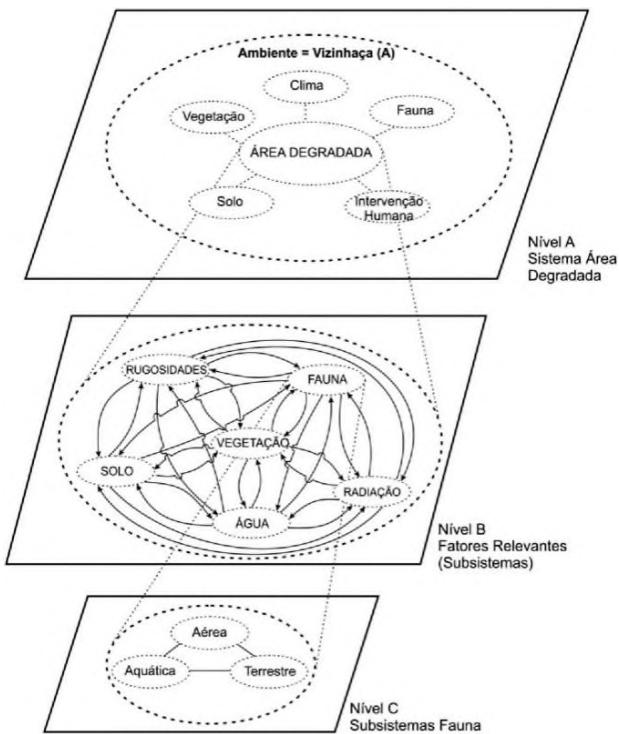 Figure 1: Simplified diagram of the system with degraded components of the environment (level A). At level Bare represented elements (subsystems) of the degraded area and level C are represented constituents in the fauna Figura 1: Diagrama simplificado do sistema degradado com os componentes do ambiente (nível A). No nível B estão representados os elementos (subsistemas) da área degradada e no nível C estão representadosos componentes do subsistema da fauna a intensidade das relações entre os componentes do sistema e o ambiente, optou-se por aplicar quatro graus de intensidade, variando de 0 a 3, que representam: $0 = \mathtt { a }$ intensidade da relação é nula; $\texttt { 1 } = \mathtt { a }$ intensidade da relação é fraca; $2 = \mathtt { a }$ intensidade da relação é média; e $\begin{array} { r l r l } { { 3 } } & { { } = } & { { } a } \end{array}$ intensidade da relação é intensa (forte).
A determinação das intensidades das relações foi definida empiricamente através das observações de campo, avaliando-se sempre as quatro alternativas degraus de intensidades.
Partindo da análise da matriz, pode-se estruturar a concepção do modelo do sistema ecológico para recuperação da área degradada, evidenciando graficamente as principais relações e intensidades, existentes entre os subsistemas que o compõem (Figura 2).
A abordagem sistêmica com enfoque mais geral considera a teia complexa das interações de todos os elementos e fatores determinantes do processo e evita a sobrevalorização de um fator específico em detrimento de outros. A recuperação ambiental de uma área não pode ser avaliada apenas pela quantificação biométrica. São das medidas e da análise da interação de todos os elementos e fatores ecológicos que se podem avaliar comparativamente as áreas em processo de recuperação. Nesse projeto, fez-se a análise integrada das inter-relações dos elementos bióticos e abióticos, bem como sua evolução com o auxílio do modelo ecológico para recuperação da área degradada.
Para a pesquisa foram utilizadas mudas de Mimosa scabrella que provieram de um mesmo lote de sementes adquiridas de um viveiro localizado em condições ambientais semelhantes às da área do experimento. Para garantir o rigor da metodologia científica, antes do plantio foram realizadas as medidas das alturas das mudas de M. scabrella, separando-as por classe de altura, de forma a permitir distribuição de mesma proporção em todas as parcelas.
Devido às condições extremamente adversas do substrato, optou-se por uma densidade de 4.501 mudas de M. scabrella por hectare, portanto superior ao recomendado na literatura, que é de $2 \textrm { m } \times 2 \textrm { m }$, correspondendo a 2.500 mudas por hectare. Por não se tratar de áreas planas e niveladas, não se aplicou a metodologia dos módulos com linhas regulares em forma de quincôncio nas parcelas irregulares. Primeiro foram implantadas nas parcelas irregulares as mudas com espaçamento variável entre si, adaptando-se sua distribuição de acordo com as rugosidades. Após conhecidas as densidades de mudas, isto é, o número de mudas, repetiu-se a mesma densidade nas parcelas planas regulares, porém espacejadas em linhas e comdistribuição espacial em quincôncio. Em razão da dimensão e superfície da área de pesquisa, foram plantadas 1.738 mudas de M. scabrella em todas as parcelas do experimento. A abertura das covas foi realizadacom escavadeira manual com 15 cm de diâmetro por 25 cm de profundidade.
Baseado em análises de solos, foram adicionados os nutrientes superfosfato triplo, cloreto de potássio e ureia. A adubação química foi realizada com base no Sistema de Recomendação de Adubação e Calagem do RS e SC (ROLAS, 2004).
Foram monitoradas as seguintes variáveis abióticas: radiação solar (W/m2); temperatura ambiente $( ^ { \mathrm { o } } \mathrm { C } )$; umidade relativa do ar $( \% )$; oscilações do gradiente térmico do solo nos vários estádios da sucessão vegetal; variação da umidade, densidade e porosidade do solo; coeficiente de infiltração, coeficiente de Tabela 1: Representação do grau de intensidade das relações entre os componentes do sistema, representados em forma de matriz Table 1: Representation of the Intensity of the Relationship between System Components Represented in Matrix form
<table><tr><td colspan="8">Componente Que Exercé Influição Componente Influícido</td></tr><tr><td></td><td>Solo</td><td>Água</td><td>Vegetação</td><td>Radiação</td><td>Rugosidade</td><td>Fauna</td><td>Ambiente</td></tr><tr><td>Solo</td><td>0</td><td>2</td><td>3</td><td>1</td><td>2</td><td>1</td><td>1</td></tr><tr><td>Água</td><td>3</td><td>0</td><td>3</td><td>3</td><td>1</td><td>3</td><td>1</td></tr><tr><td>Vegetação</td><td>3</td><td>3</td><td>3</td><td>3</td><td>1</td><td>3</td><td>1</td></tr><tr><td>Radiação</td><td>2</td><td>2</td><td>2</td><td>0</td><td>0</td><td>2</td><td>1</td></tr><tr><td>Rugosidade</td><td>2</td><td>3</td><td>3</td><td>2</td><td>0</td><td>2</td><td>0</td></tr><tr><td>Fauna</td><td>2</td><td>0</td><td>3</td><td>0</td><td>0</td><td>3</td><td>2</td></tr><tr><td>Ambiente</td><td>2</td><td>2</td><td>3</td><td>3</td><td>0</td><td>3</td><td>0</td></tr></table>
escoamento superficial e conservação da água; e perdas do solo e evolução das características químicas do solo.
Para as medições da temperatura do solo $( ^ { \mathrm { o } } \mathrm { C } )$, umidade relativa do ar $( \% )$ e radiação solar $( \mathsf { W } / \mathsf { m } ^ { 2 } )$, foi instalado um sistema de aquisição de sinais acoplados a um computador tipo notebook. As medidas de temperatura do solo foram realizadas com 16 sensores do tipo termistores - NTC, com incerteza da medida de $0 {, } 2 \ ^ { \circ } \mathsf { C }$. As medidas do sistema de aquisição cobriram um período de dois anos.
A umidade do ar foi medida, no mesmo sistema com sensores de umidade do tipo capacitivo, com incerteza de $0 {, } 5\%$, instalados a $^ { 1,3 \textrm { m } }$ de altura.
O sistema de aquisição de sinais que registra a radiação solar de todo o espectro eletromagnético foi medido por sensores do tipo termo-elementos com incerteza de $5\%$. Esses termoelementos foram inseridos próximos dos sensores da umidade do ar e realizaram as medidas contínuas automaticamente em $\mathsf { W } / \mathsf { m } ^ { 2 }$.
As temperaturas foram tomadas por quatro termômetros de máximas e mínimas, colocados nas quatro parcelas na altura de $^ { 1,3 \textrm { m } }$ da superfície do terreno. As medidas, em graus centígrados, foram registradas manualmente com o auxílio de termômetros da Incoterm, que mediram as temperaturas máximas e mínimas do ambiente (ar) a cada $^ { 24 \mathrm { ~ h ~ } }$, nas quatro parcelas.
Para avaliar a conservação da água e perdas do solo (erosão), foram instaladas canaletas de concreto semicirculares com diâmetro de 30 cm, numa extensão de 15m cada. Na base dessas canaletas foram instalados sistemas coletores de água e solo erodido. Os coletores consistem de quatro tanques pré-fabricados de concreto com 80 cm de diâmetro, o primeiro funcionando como decantador das partículas maiores. O excesso de escoamento passava por divisores Geib de alumínio, cujafunção era dividir o fluxo do escoamento e obter apenas uma fração; por isso possuíam número ímpar de janelasverticais. A água que passava pela janela central era conduzida para o tanque seguinte para ser coletada, e as demais janelas conduziam a água para um sistema de deságue (BERTONI; LOMBARDI, 1985). EsSes equipamentos permitiram a determinação da concentração dos sedimentos, as análises granulométricas do solo e o tratamento estatístico com a série de dados da precipitação.
Para avaliar a capacidade de infiltração do solo, aplicou-se o teste de infiltração de água no solo de acordo com a norma NBR-7229, da Associação Brasileira de Normas Técnicas (ABNT).
Para monitorar a evolução química e física do solo, foram programadas três fases de coletas de amostras para análises de solo dos primeiros 15 cm de cada parcela. As análises químicas foram efetuadas de acordo com a metodologia descrita por Tedesco et al. (1995). Nos componentes físicos, determinaram-se a densidade aparente, a porosidade total (VTP), a umidade gravimétrica e a temperatura do solo.
As medidas de biometria abrangeram a totalidadedos indivíduos plantados de M. scabrella (1.738 indivíduos). As variáveis monitoradas foram: taxa de sobrevivência das mudas; desenvolvimento das mudas (o diâmetro do caule a uma alturapadrão de 5 cm do solo; as medidas do diâmetro à altura do peito - DAP; a altura total dos indivíduos, medida da base até o limite superior do último meristema apical; e a área da copa em sua porção mais desenvolvida). Foram também monitorados os índices de cobertura do solo e a caracterização da composição florística (biodiversidade vegetal: ervas, arbustos e arbóreas que se instalaram espontaneamente). Para obtenção do índice de cobertura do solo, foi utilizado o método de quadrantes.
Para avaliar diferenças significativas de tamanhos (diâmetro, altura e diâmetro de copa) e número de espécies espontâneas colonizadoras, foi utilizado o teste t nas amostras independentes com nível de significância de $5\%$, conforme Beiguelman (2002).
A caracterização da composição florística foi realizada através da elaboração de uma lista das espécies encontradas no local de estudo, comparando-se o número de espécies (herbáceas, arbustivas e arbóreas) entreas parcelas regulares e irregulares. Foram calculados os índices de similaridade de SΦrensen (MULLER- DOMBOIS; ELLEMBERG, 1974) e de Jaccard (MAGURRAN, 1988).
O subsistema fauna de invertebrados é composto pelos seguintes elementos: fauna aérea, fauna terrestre e fauna aquática. Para caracterização do subsistema fauna de invertebrados, foram instaladas armadilhas, os quais, posteriormente, foram triados em laboratório com o auxílio de microscópio estetoscópio para classificação da fauna aérea e da fauna terrestre. Nesta pesquisa não foi avaliada a fauna aquática de invertebrados. As variáveis medidas nos dois componentes do subsistema fauna foram: riqueza, diversidade, similaridade, dominância, equidade e rarefação. A diversidade faunística foi medida com baseno número de ordens e número de indivíduos por ordensidentificados nas parcelas.
As análises foram realizadas usando-se o pacote estatístico PAST (HAMMER et al., 2001) e incluíram a diversidade (índice de Shannon), dominância e equidade. Os índices de Shannon foram comparados através do teste t modificado (MAGURRAN, 1988). Para avaliar a variabilidade da riqueza em função das coletas (riqueza x amostras), foram construídos gráficos de rarefação. A riqueza refere-se ao número de ordens identificadas em cada parcela. A abundânciarefere-se ao número de indivíduos por unidade de área avaliada e varia no espaço (área) de uma comunidade para outra e no tempo em função das flutuações populacionais. A diversidade determina a representação dos indivíduos de cada ordem nas comunidades. A equidade indica como os indivíduos
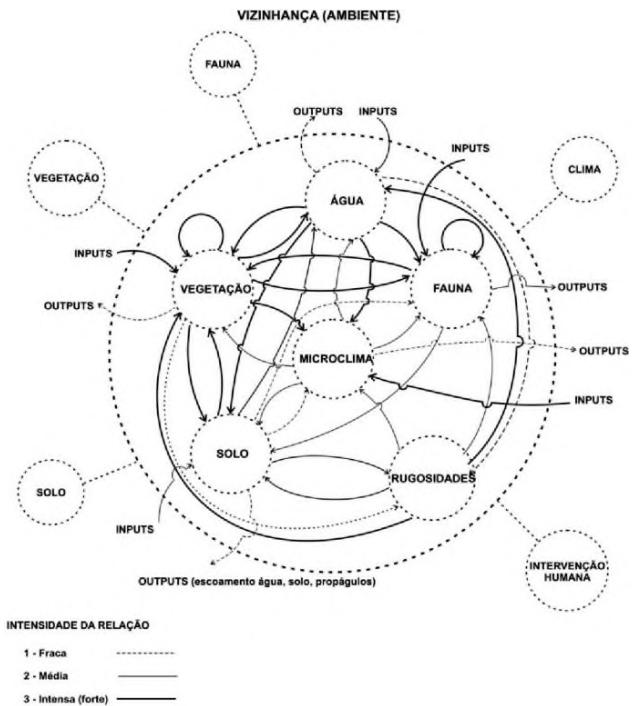 Figure 2: Design of the model system for ecological restorationof a degraded ecosystem Figura 2: Concepção do Modelo de Sistema Ecológico ParaRecuperação de um Ecossistema Degradado
estão distribuídos entre as ordens. A dominância é a proporção dos organismos mais abundantes de um talhão, calculada para cada ambiente.
## III. RESULTADOS
A análise dos dados da radiação solar evidenciou o efeito da vegetação na incidência da radiação nas duas áreas, a regular e a irregular (Figura 3a). Verificou- se, ao longo do tempo, aumento da diferença da radiação entre as duas áreas, que seguiu tendência definida pelo estabelecimento da vegetação. A radiação nas áreas irregulares foi menor desde o verão de 2005, apósum ano da implantação do experimento. Nesse período, a média da radiação nas áreas irregulares variou de 28,90 a 212,62 W/m2, enquanto nas áreas regulares, de 93,54 a 405,77 W/m2. No entanto, as diferenças tornaram-se estatisticamente significativas a partir dasmedidas efetuadas no inverno de 2005 e continuaram assim até as últimas medidas realizadas no verão de 2006.
Muitos dos atributos inerentes às funções dos ecossistemas podem ser afetados pela mudança da radiação solar, como produção de biomassa, flutuações nas populações das plantas e animais, mudanças no ciclo dos nutrientes, entre outros. Os estudos do efeito do aumento da radiação solar sobre os ecossistemas se iniciaram há poucos anos, e menos de $5\%$ desses estudos foram executados em condições de campo e, menos ainda, sobre as plantas das florestas (CALDWELL et al., 1998). Por isso a importância de se conhecerem melhor as interações entre a radiação solar e as plantas e como esses componentes interagem temporalmente no processo de recuperação ambiental.
A temperatura do solo é fator relevante do ponto de vista ecológico no processo de recuperação ambiental de áreas degradadas. Observaram-se diferenças significativas nos dois tratamentos, nas diferentes profundidades, após o segundo ano do experimento (Figura 3b).
A irregularidade da superfície (rugosidades) provocou maior reflexão difusa da radiação solar na ausência da vegetação. Assim, além de amenizar a temperatura do solo e do ar, criou micronichos diferenciados, estimulando o estabelecimento e produção vegetal, que por sua vez passou a ter efeito de feed- back no processo da sucessão vegetal. A temperatura ambiente máxima e a mínima sempre foram superiores nas áreas regulares, confirmando o efeito de amenização da temperatura ambiente provocado pelo estádio mais avançado da recuperação ambiental nas áreas irregulares(Figura 3c).
Na avaliação do diâmetro da M. scabrella, as parcelas irregulares apresentaram valores superiores e estatisticamente diferentes daqueles das parcelas regulares (Figura 3d).
A
<table><tr><td rowspan="2">Periodo</td><td colspan="2">Radiação Solar \(\left({\mathrm{W}/{\mathrm{m}}^{2}}\right) \)</td><td rowspan="2">\({\mathrm{P}}_{\text{Calc}} \)</td></tr><tr><td>Regular</td><td>Irregular</td></tr><tr><td>02 a 07/02/2005</td><td>170,60</td><td>150,02</td><td>0,1466</td></tr><tr><td>13 a 18/02/2005</td><td>243,22</td><td>212,05</td><td>0,0938</td></tr><tr><td>14/02/2005</td><td>248,13</td><td>212,62</td><td>0,4261</td></tr><tr><td>14 a 20/07/2005</td><td>93,54</td><td>28,90</td><td>\(5,{57} \times {10}^{-{25}} \)</td></tr><tr><td>02 a 08/11/2005</td><td>405,77</td><td>171,32</td><td>\(8,{37} \times {10}^{-{10}} \)</td></tr><tr><td>06/11/2005</td><td>336,84</td><td>120,19</td><td>\(1,{95} \times {10}^{-{06}} \)</td></tr><tr><td>22 a 26/02/2006</td><td>334,79</td><td>84,62</td><td>\(2,{74} \times {10}^{-{35}} \)</td></tr></table>
B
<table><tr><td rowspan="3">Período</td><td colspan="6">Temperatura do solo (°C)</td></tr><tr><td colspan="3">Profundidade 2,5 cm</td><td colspan="3">Profundidade 7,5 cm</td></tr><tr><td>Regular</td><td>Irregular</td><td>\(P_{calc} \)</td><td>Regular</td><td>Irregular</td><td>\(P_{calc} \)</td></tr><tr><td>02 a 07/02/2005</td><td>22,39</td><td>21,64</td><td>\(3,36x10^{-29} \)</td><td>22,52</td><td>21,58</td><td>\(1,83x10^{-29} \)</td></tr><tr><td>13 a 18/02/2005</td><td>22,70</td><td>23,11</td><td>\(9,14x10^{-13} \)</td><td>23,99</td><td>23,15</td><td>\(1,71x10^{-14} \)</td></tr><tr><td>14 a 20/07/2005</td><td>13,34</td><td>14,86</td><td>\(2,32x10^{-85} \)</td><td>13,30</td><td>14,50</td><td>\(1,74x10^{-40} \)</td></tr><tr><td>02 a 08/11/2005</td><td>20,68</td><td>19,92</td><td>\(7,15x10^{-36} \)</td><td>21,05</td><td>20,04</td><td>\(3,14x10^{-54} \)</td></tr><tr><td>22 a 26/02/2006</td><td>21,85</td><td>22,58</td><td>\(1,89x10^{-32} \)</td><td>22,51</td><td>22,79</td><td>\(3,80x10^{-05} \)</td></tr></table>
<table><tr><td rowspan="3">Periodo</td><td colspan="6">Temperatura Ambiente (°C)</td></tr><tr><td colspan="3">Máxima</td><td colspan="3">Mínima</td></tr><tr><td>Regular</td><td>Irregular</td><td>\(P_{calc} \)</td><td>Regular</td><td>Irregular</td><td>\(P_{calc} \)</td></tr><tr><td>19 a 29/11/2005</td><td>30,77</td><td>27,82</td><td>0,007</td><td>15,05</td><td>13,77</td><td>0,098</td></tr><tr><td>04 a 18/02/2006</td><td>29,17</td><td>26,27</td><td>0,036</td><td>18,90</td><td>18,27</td><td>0,258</td></tr></table>
D
<table><tr><td rowspan="3">Parceia</td><td colspan="9">Diámetro basal do caule (mm)</td></tr><tr><td colspan="3">Maio de 2004</td><td colspan="3">Dezembro de 2004</td><td colspan="3">Fevereiro de 2006</td></tr><tr><td>Regular</td><td>Irregular</td><td>\(P_{calc} \)</td><td>Regular</td><td>Irregular</td><td>\(P_{calc} \)</td><td>Regular</td><td>Irregular</td><td>\(P_{calc} \)</td></tr><tr><td>1110</td><td>9,39</td><td>14,48</td><td>\(1,69 \times 10^{-43} \)</td><td>27,53</td><td>35,72</td><td>\(3,47 \times 10^{-19} \)</td><td>43,74</td><td>56,19</td><td>\(2,51 \times 10^{21} \)</td></tr><tr><td>820</td><td>7,42</td><td>15,03</td><td>\(2,52 \times 10^{-72} \)</td><td>20,58</td><td>35,92</td><td>\(4,79 \times 10^{-72} \)</td><td>37,56</td><td>59,56</td><td>\(1,04 \times 10^{-64} \)</td></tr><tr><td>Média</td><td>8,51</td><td>14,73</td><td>\(1,2 \times 10^{-110} \)</td><td>24,45</td><td>35,81</td><td>\(3,53 \times 10^{-70} \)</td><td>40,65</td><td>57,73</td><td>\(5,4 \times 10^{-72} \)</td></tr></table>
Figure 3: Solar radiation (W/m2) of the Feb/2005 and Feb/2006 treatments regular and irregular (A) Soil temperature of the Feb/2005 and Feb/2006 treatments regular and irregular 2.5 and 7.5 cm depth (B), maximum and minimum temperature 19-29 Nov/2005 and Feb/2006 4-18 in regular and irregular treatments (C), basal diameter (mm)of the stem of M. scabrella in May 2004, Dec/2004 and in Feb/2006 irregular and regular treatments (D)
Figura 3: Radiação solar (W/m2) de fev/2005 a fev/2006 nos tratamentos regular e irregular (A); temperatura do solo de fev/2005 a fev/2006 nos tratamentos regular e irregular a 2,5 e a 7,5 cm de profundidade (B); temperatura ambiente máxima e mínima de 19 a 29 nov/2005 e 4 a 18 fev/2006, nos tratamentos irregular e regular (C) e; diâmetro basal (mm) do caule de M. scabrella em maio 2004, dez/2004 e fev/2006 nos tratamentos irregular e regular (D)
<table><tr><td rowspan="2">Parcela</td><td colspan="3">Fevereiro de 2006</td></tr><tr><td>Regular</td><td>Irregular</td><td>\(P_{Calc} \)</td></tr><tr><td>1110</td><td>22,04</td><td>34,13</td><td>\(1,21 \times 10^{-26} \)</td></tr><tr><td>820</td><td>15,9</td><td>38,52</td><td>\(2,5 \times 10^{-102} \)</td></tr><tr><td>Média</td><td>19,32</td><td>36,14</td><td>\(8,05 \times 10^{-101} \)</td></tr></table>
B
<table><tr><td rowspan="3">Parceia</td><td colspan="9">ÉPOCAS DE AVALIAÇÃO</td></tr><tr><td colspan="3">Maio de 2004</td><td colspan="3">Dezembro de 2004</td><td colspan="3">Fevereiro de 2006</td></tr><tr><td>Regular</td><td>Irregular</td><td>\(P_{Calc} \)</td><td>Regular</td><td>Irregular</td><td>\(P_{Calc} \)</td><td>Regular</td><td>Irregular</td><td>\(P_{Calc} \)</td></tr><tr><td>1110</td><td>59,5</td><td>104,82</td><td>\(1,9x10^{-54} \)</td><td>210,16</td><td>268,13</td><td>\(1,2x10^{-22} \)</td><td>327,64</td><td>453,57</td><td>\(1,4x10^{-41} \)</td></tr><tr><td>820</td><td>45,96</td><td>105,51</td><td>\(2,8x10^{-77} \)</td><td>163,25</td><td>293,09</td><td>\(3,1x10^{-95} \)</td><td>270,18</td><td>525,77</td><td>\(3,8x10^{-150} \)</td></tr><tr><td>Média</td><td>50,36</td><td>105,13</td><td>\(7,6x10^{-142} \)</td><td>176,54</td><td>279,43</td><td>\(3,9x10^{-124} \)</td><td>279,89</td><td>486,69</td><td>\(2,1x10^{-204} \)</td></tr></table>
C
<table><tr><td rowspan="3">Parceia</td><td colspan="9">ÉPOCAS DE AVALIÇÃO</td></tr><tr><td colspan="3">Maio de 2004</td><td colspan="3">Dezembro de 2004</td><td colspan="3">Fevereiro de 2006</td></tr><tr><td>Regular</td><td>Irregular</td><td>\(P_{Calc} \)</td><td>Regular</td><td>Irregular</td><td>\(P_{Calc} \)</td><td>Regular</td><td>Irregular</td><td>\(P_{Calc} \)</td></tr><tr><td>1110</td><td>0,09</td><td>0,25</td><td>\(2,12x10^{-50} \)</td><td>0,95</td><td>1,43</td><td>\(2,85x10^{-12} \)</td><td>1,83</td><td>3,13</td><td>\(4,03x10^{-24} \)</td></tr><tr><td>820</td><td>0,05</td><td>0,25</td><td>\(7,76x10^{-55} \)</td><td>0,52</td><td>1,67</td><td>\(6,52x10^{-75} \)</td><td>1,41</td><td>3,66</td><td>\(2,46x10^{-59} \)</td></tr><tr><td>Média</td><td>0,07</td><td>0,25</td><td>\(1,06x10^{-103} \)</td><td>0,76</td><td>1,54</td><td>\(2,10x10^{-61} \)</td><td>1,65</td><td>3,37</td><td>\(2,13x10^{-75} \)</td></tr></table>
D
<table><tr><td rowspan="3">Parceia</td><td colspan="9">ÉPOCAS DE AVALIÇÃO</td></tr><tr><td colspan="3">Maio de 2004</td><td colspan="3">Dezembro de 2004</td><td colspan="3">Fevereiro de 2006</td></tr><tr><td>Regular</td><td>Irregular</td><td>\(P_{Calc} \)</td><td>Regular</td><td>Irregular</td><td>\(P_{Calc} \)</td><td>Regular</td><td>Irregular</td><td>\(P_{Calc} \)</td></tr><tr><td>1110</td><td>18,18</td><td>25,74</td><td>0,15</td><td>19,74</td><td>59</td><td>0,0014</td><td>91,75</td><td>84,38</td><td>0,46</td></tr><tr><td>820</td><td>15,19</td><td>28,37</td><td>0,012</td><td>57,56</td><td>62,62</td><td>0,27</td><td>89</td><td>76,88</td><td>0,27</td></tr><tr><td>Média</td><td>16,68</td><td>27,06</td><td>0,004</td><td>38,65</td><td>64,31</td><td>0,004</td><td>90,38</td><td>80,63</td><td>0,179</td></tr></table>
Figure 4: Diameter at breast height (mm) in Feb/2006 irregular and regular treatments (A), overall height (mm) in Mayl 2004; Dec/2004 and Feb/2006, irregular and regular treatments (B); area canopy (m2) in May/2004; Dec/2004 andFeb/2006, iregular and regular treatments of M. scabrella (C); coverage ratio $( \% )$ of soil by spontaneous vegetation plots in regular and irregular in May/2004; Dec/2004 and Feb/2006, irregular and regular treatments (D)
Figura 4: Diâmetro à altura do peito (mm) em fev/2006 nos tratamentos irregular e regular (A); altura total (mm) em maio/2004; dez/2004 e fev/2006, nos tratamentos irregular e regular (B); área de copa $( \mathsf { m } ^ { 2 } )$ em maio/2004; dez/2004 e fev/2006, nos tratamentos irrgular e regular de M. scabrella (C) e; índice de cobertura $( \% )$ do solo pela vegetação espontânea nas parcelas regulares e irregulares em maio/2004; dez/2004 e fev/2006, nos tratamentosirregular e regular (D)
O DAP da M. scabrella após 26 meses da implantação do experimento foi significativamente maior nas áreas irregulares, em comparação com as áreas regulares (Figura 4a).
A análise da altura média da M. scabrella demonstrou crescimento contínuo tanto nas áreas irregulares quanto nas regulares. No entanto, ocorreu diferenciação crescente entre a altura dos indivíduos das áreas irregulares em relação às áreas regulares (Figura 4b). Os indivíduos de M. scabrella apresentaram maiores valores médios das áreas de copa nas parcelas com solo irregularizado (Figura 4c).
A análise do índice de cobertura do solo pela vegetação espontânea (herbáceas e arbustivas) no período de maio de 2004 a dezembro de 2004 demonstrou um índice de cobertura maior nas áreas irregulares (Figura4d). No entanto, nas medidas de fevereiro de 2006 houve inversão com maior cobertura nas áreas regulares. O maior índice de cobertura nas áreas regulares decorreu de várias razões ecológicas, entre elas o menor desenvolvimento da M. scabrella e maior radiação solar. Nas áreas irregulares, as gramíneas e herbáceas já tinham perecido e cumprido seu papel de pioneiras naquele estádio da recuperação ambiental, enquanto nas áreas regulares ainda cobriam o solo. Nas áreas irregulares, inúmeros fatores como menor irradiação solar, menor temperatura do ambiente, entre outros, resultantes do maior desenvolvimento da M. scabrella, provocaram progressivamente diminuição das condições ecológicaspropícias às gramíneas e herbáceas.
A elevada riqueza florística estabelecida espontâneamente (151 táxons entre espécies e morfoespécies), bem como a rapidez de colonização, evidencia o pool gênico na área de entorno, além da eficiência e eficácia dos mecanismos de dispersão e da capacidade de instalação das espécies em curto espaço de tempo. O destaque das famílias Asteraceae, Poaceae e Cyperaceae se deve, em grande parte, às estratégias de dispersão e capacidade de instalação que esses grupos de plantas possuem. Regensburguer (2004), em área próxima, após nove meses, constatou o estabelecimento expontâneo de 22 famílias com predominância das Asteráceas $( 35,7\% )$, seguidas das Ciperaceae e Poaceae, com $10,7\%$. Em menores proporções, registraram-se as Euphorbiaceae, Rubiaceae, Solanaceae $( 7,1\% )$, Commelinaceae, Myrsinaceae, Phytolaccacea e Polygonaceae, Solanaceae, Apiaceaee Lamiaceae, com $3,6\%$.
Para o componente fauna foram coletados nas armadilhas e triados um total de 8.715 indivíduos pertencentes a 12 ordens, dois pertencentes à classe Arachnida e 10 à classe Hexapoda. As ordens com maior abundância foram Diptera (3.004 indivíduos), Collembola (1.766),' Coleoptera (1.121), Thysanoptera (1.114) e Hemiptera (819).
A partir da análise do número de espécimes por ordem, constatou-se que, entre as áreas de $820 \ \mathsf { m } ^ { 2 }$, a parcela irregular apresentou maior diversidade $\left( \mathrm { t } = - 3,5337 \mathrm { ~ e ~ p ~ } = 0,0004 \right)$ ). A parcela regular obteve maiordominância $( \mathsf { p } = 0 )$. Os índices de riqueza $( \rho \ = \ 0,512 )$ que definem o número de ordens em cada parcela ea equidade $( \rho = 0,546 )$, que indica como os indivíduos estão distribuídos entre as ordens, não mostraram diferenças significativas entre as parcelas com 820 $\mathsf { m } ^ { 2 }$.
Pela análise da rarefação se confirmou a diferença entre as duas parcelas de 820 $\mathsf { m } ^ { 2 }$, evidenciando que, ao aumentar o número de amostragem, aumenta também a riqueza na área irregular. A diferença crescente da riqueza na área irregular $( 820 ~ \mathsf { \ m } ^ { 2 } )$, quando comparada com a regular $( 820 \ m ^ { 2 }$ ), sugere que nesta se chegoua um patamar de ordem mais cedo, com menor esforço de coleta, estabilizando-se mais rapidamente.
Quando se comparam, entre si, as parcelas regulares e irregulares de $1.110 ~ \mathsf { m } ^ { 2 }$, observa-se que a parcela irregular teve maior dominância $( \rho = 0 )$, no entanto a diversidade foi maior na parcela regular $( \mathrm { t } = 7,8277 \mathrm { e p } < 0,0001 )$ ). Não houve diferença significativa entre as áreas no índice de riqueza $( \mathsf { p } = 0,883 )$ e equidade $( \mathsf { p } = 0,168 )$ ).
O teste de rarefação evidênciou que as parcelas regulares e irregulares com 1.110 $\mathsf { m } ^ { 2 }$ são semelhantes entre si. Da análise comparativa entre as parcelas regulares $( 820 \ m ^ { 2 } + 1.110 \ m ^ { 2 } )$ ) e irregulares $( 820 \: \mathsf { m } ^ { 2 } \: + 1.110 \: \mathsf { m } ^ { 2 } )$ conclui-se que, as parcelas regulares apresentaram maior diversidade $\mathrm {? } = 4,1176$; $\mathsf { p } < 0,0001$ ). Os índices de riqueza $( \boldsymbol { \rho } =$ 1), dominância $( \rho = 0,102 ) \mathrm { e }$ equidade $( \rho = 0 {, } 507 )$ não apresentaram diferenças significativas. A curva de rarefação não aponta diferença entre os dois tratamentos.
## IV. DISCUSsÃo
As variáveis abióticas e bióticas avaliadas estatisticamente validaram o uso do modelo de sistema ecológico aplicado na recuperação ambiental. As parcelas irregulares com rugosidades se comportaram como sistemas dinâmicos complexos, hipersensíveis às condições iniciais de preparação do solo.
Todas as variáveis biométricas da espécie M. scabrella (altura, diâmetro do colo, DAP e área da copa) e altura da vegetação espontânea apresentaram crescimento mais acelerado nas parcelas irregulares, resultando em mudanças ambientais dos fatores abióticos.
A comparação da altura dos indivíduos das parcelas irregulares com as parcelas regulares evidenciou um crescimento expressivamente maior nas parcelas irregulares. Confirmouse nesta pesquisa a importância da M. scabrella na recuperação de áreas degradadas pela elevada produção de biomassa e por facilitar a sucessão secundária, por se desenvolver mesmo em condições edáficas adversas, conforme defendido por diversos autores (CARPANEZZI; CARPANEZZI, 1992; FRANCO et al., 1992; CALLAWAY, 1995; NAU; SEVEGNANI, 1997; REGENSBURGER, 2004; REGENSBURGER et al., 2008; REIS et al., 1999).
Guilherme (2000), analisando o efeito da cobertura do dossel da regeneração natural de plantas lenhosas em mata de galeria, constatou índices de cobertura que variaram de 57,7 a $77,3\%$, e a ocorrência de indivíduos da regeneração natural aumentou à medida que o índice de cobertura do dossel foi menor. Valores esses inferiores aos obtidos nesta pesquisa, tanto nas parcelas regulares quanto nas irregulares, após dois anos do plantio.
Como o objetivo prioritário da recuperação de áreas degradadas é' proteger o solo com vegetação a fim de interromper os processos erosiVOs (CAMPELLO, 1996; DIAS; GRIFFITH, 1998; REIS et al., 1999), o percentual de cobertura do solo obtido neste estudo foi elevado, alcançando esse objetivo em apenas um ano e dois meses.
A essência da abordagem sistêmica está em ver inter-relacionamentos em vez de cadeias lineares de causa- efeito, bem como processos de mudança no lugar de simples fatos instantâneos. A elaboração de diagramas ou círculos de causalidade, constituído pelo arranjo dos componentes, facilitou a identificação e análise de padrões de interações. Permitiu reconhecer, no processo de recuperação, os tipos de "estruturas" (padrões de comportamento chamados de arquétipos) continuamente recorrentes, conforme sugeriu Senge (1999).
Verificou-se que os componentes bióticos e abióticos interagiram espacial e temporalmente, gerando padrões e propriedades ambientais emergentes diferenciadas nos dois tratamentos, em função do estabelecimento e desenvolvimento da vegetação. O modelo de sistema ecológico para a recuperação ambiental, tratando a área como um sistema dinâmico complexo, hipersensível às condições iniciais de preparação do terreno, permitiu acompanhar a dinâmica evolutiva diferenciada que foi mais rápida e rica, no tratamento contendo rugosidades. As interações entre os componentes, previstas no modelo, se confirmaram, podendo variar em intensidade ao longo do tempo, como no caso da intensidade das interações entre as rugosidades e a fauna.
As rugosidades, como único diferencial entre os dois tratamentos, desencadearam temporalmente efeitosbenéficos para a recuperação ambiental, retendo água, sedimentos, matéria orgânica, nutrientes, sementese atraindo a fauna de invertebrados. A presença da fauna, por sua vez, retroagiu sobre a vegetação, polinizando-a, predando-a e ampliando as interações.
Nos ecossistemas mais quentes e úmidos, as sete ordens com maior número de espécies (Orthoptera, Homoptera, Hemiptera e Lepidoptera, Coleoptera, Diptera e Hymenoptera) são diversificadas e sensíveis a mudanças ambientais. Essas ordens são indicadores da riqueza e saúde dos ecossistemas, fiéis em acusar qualquer modificação de estrutura, diminuição de fluxo de matéria e energia, ou restrição de recursos, e rápidas em anunciar tendências de degradação, regeneração ou recuperação dos ambientes, em razão de sua grande mobilidade e curto ciclo de vida (BROWN-JUNIOR,2000).
A diversidade de um grupo indicador está relacionada com a diversidade dos seus recursos e ambiente (BROWN-JUNIOR, 1997). Nos sistemas florestais, a diversidade de nichos, recursos e espécies se expande por um volume multidimensional limitado apenas pela heterogeneidade topográfica, disponibilidade de radiação e água, frequência de perturbação branda ou imprevisível e controle pelos ocupantes de níveis tróficos superiores (BROWN- JUNIOR, 2000). Destaca-se que a única espécie arbórea desenvolvida até o final das medições era a Mimosa scabrella. As rugosidades (microtopografias) serviram como atrativo para a fauna, pelo acúmulo de água e nutrientes. No entanto, essas microtopografias, apesar de reterem água devido aos longos períodos de estiagem, secaram, diminuindo também o efeito positivo como atratores da fauna.
A radiação na área irregular de $820 ~ \mathsf { m } ^ { 2 }$ foi sistematicamente mais baixa e pode ter influenciado a maior diversidade. As médias das temperaturas máximas do ambiente também foram significativamente menores na área irregular de 820 $\mathsf { m } ^ { 2 }$. As rugosidades do terreno aumentaram a diversidade e heterogeneidade ambiental, que foram significativa para atração dos insetos nessa escala de tempo. Os resultados obtidos entre as parcelas de 1.110 $\mathsf { m } ^ { 2 }$ foram opostos aos das parcelas com $820 \ \mathsf { m } ^ { 2 }$. Na parcela irregular (1.110 $\mathsf { m } ^ { 2 } )$, a heterogeneidade não foi determinante em razão, provavelmente, da conexão estabelecida entre essa parcela e a irregular de $820 \mathsf { m } ^ { 2 }$ $\mathsf { m } ^ { 2 }$, em função da distribuiçãoespacial no campo.
Segundo Silveira (1976), a temperatura ideal para o desenvolvimento dos insetos é em média de 25 $^ \circ \mathsf { C }$,podendo alguns grupos suportar temperaturas que variam de $15 \mathrm { a } 38 ^ { \mathrm { o } } \mathrm { C }$. A umidade relativa do ar foi menor na área irregular de $820 ~ \mathrm { m } ^ { 2 }$; porém foi estatisticamente significativa apenas durante sete meses. A radiação e umidade são fatores que afetam diretamente a comunidade de artrópodes, principalmente para espécimes que necessitam de ambientes mais estáveis. Alguns organismos, como os artrópodes, são muito sensíveis mesmo a mínimas perturbações, mudando a composição da comunidade, diminuindo ou desaparecendo com qualquer modificação ambiental (BROWN-JUNIOR, 1997).
As ordens Collembola e Coleoptera responderammelhor às parcelas irregulares de 820 $\mathsf { m } ^ { 2 } \ \in \ \mathsf { 1 }. 110 \ \mathsf { m } ^ { 2 }$,que apresentaram umidade mais elevada, menor radiação solar e menor variação na temperatura, o que supõe que espécies dessas ordens não toleram ambientes instáveis, preferindo microclima mais constante.
A ordem Thysanoptera foi mais abundante nas parcelas regulares de 820 m2 e 1.110 m2. Possivelmente essa ordem responda melhor em ambientes com maiorradiação e menor umidade. Essa ordem geralmente é considerada praga, porém não há nenhuma informação a respeito das comunidades naturais no Sul do Brasil (PINENT, 2006).
Lazzari e Lazzarotto (2005) relataram que o maior número de espécies de hemípteros foi coletado nas armadilhas instaladas em local aberto, facilitando a sua atração. O mesmo ocorreu nesta pesquisa, em que a maior abundância de hemíptera foi coletadanas áreas regulares, onde as armadilhas ficavam mais expostas.
Os aracnídeos não foram muito abundantes e predominaram nas parcelas regulares. Possivelmente os indivíduos coletados respondam melhor a ambientesmais alterados.
A comparação entre os dois tratamentos de recuperação mostrou melhor estrutura vegetal e melhores condições microclimáticas nas parcelas irregulares, porém somente na parcela irregular (820 m2) é que se pode observar maior diversidade dos artrópodes. Como o processo de recuperação é lento e gradativo, a pesquisa com a comunidade de artrópodes foi exígua. Essa constatação evidenciou que o período de avaliação da fauna de invertebrados exige mais tempo de observação. Provavelmente a oferta de recursos não apresentasse ainda diferenças significativas, apesar do crescente desenvolvimento das arbóreas.
As variações do relevo, neste caso representadaspelas rugosidades, influenciaram as interações entre a radiação solar, a umidade e os nutrientes, criando oportunidades diferenciadas para as espécies vegetais e animais. A observação da dinâmica das comunidades confirma que as espécies se substituem ao longo do tempo, refletindo as variações ambientais de uma forma heterogênea e dinâmica, conforme sugeriram Griffithet al. (1994).
A evolução da vegetação desencadeou uma teia complexa de interações com as variáveis, radiação, temperatura do solo, temperatura do ambiente e umidade relativa do ar, que no processo sucessional se refletiram em maior variabilidade das condições microclimáticas. Nas parcelas com tratamento irregular, a mudança da estrutura da composição florística desencadeou alterações nas condições microclimáticas mais intensas e heterogêneas que nas parcelas com tratamento regular. Ao invés de relação linear de causa e efeito da vegetação sobre as condições microclimáticas, na qual o maior desenvolvimento da vegetação resultaria em amenização da radiação, temperatura do ambiente e do solo, o que se constatou foi a emergência de um padrão microclimático complexo de interações entre os componentes bióticos e abióticos. Essa complexidade crescente resultou de um processo de interação entre a vegetação e o microclima, formando um círculo de causalidade de ação e reação que resultou numa cumplicidade coevolutiva cada vez mais rica e variadaentre a vegetação e o meio abiótico.
A revegetação mais rica e acelerada nas parcelas com rugosidades não se refletiu linearmente, por exemplo, amenizando as condições microclimáticas, como sugeriramYarranton e Morrison (1974). No entanto, resultou em aumento da heterogeneidade ambiental, tanto da radiação, da umidade do ar e da temperatura do ambiente quanto do solo. As rugosidades dessas áreas se comportaram, ao longo do tempo, como centros do estabelecimento de Cyperaceae e Juncaceae e fauna aquática e se transformaram, em núcleos para o crescimento de espécies mais exigentes, num fenômeno de nucleação, como sugerido por Yarranton e Morrison (1974), análogo ao encontrado em Física, tal como o crescimento do granizo. A área degradada reagiu como sistema dinâmico complexo e interagiu com o ambiente, adaptando sua estrutura interna em razão dessas interações. Ao potencializar a heterogeneidade ambiental, ampliou ainda mais a diversidade.
Apesar da aparente aleatoriedade desses fenômenos de retroalimentação, evidencia-se certa ordem que emergiu de sua dinâmica evolutiva determinada pela sua estrutura, pelo ambiente e pelas causas endógenas, resultando numa recuperação mais acelerada, complexa e rica nas áreas irregulares. Ao longo do processo, a dinâmica da recuperação tendeu para um estado mais complexo de equilíbrio dinâmico através de mecanismos de autocontrole e autorregulação que entraram em ação como resposta às mudanças ambientais, que Braga et al. (2004) denominam homeostasia. A área degradada em processo de recuperação ambiental, analogamente aos sistemas naturais, se mantém a si própria, evoluindo com mudanças em resposta aos desafios do ambiente (VASCONCELLOS, 2003). Aautocriatividade é umaresposta do sistema às condições do ambiente que não podem ser enfrentadas com a estrutura existente. Os sistemas naturais se auto-organizam diante dos desafios do ambiente, tendendo à maior complexidade.
Ao aumentar a circulação interna de matéria (solo, água e nutrientes) pela criação das rugosidades e consequente incremento da superfície total da área, provocou-se dissipação diretamente proporcional de energia dentro do sistema degradado. Nas áreas irregulares houve tendência de redução do escoamento superficial. Parte da energia da água foi gasta na erosão das superfícies convexas com sedimentação proporcional nas superfícies côncavas, havendo dissipação diretamente proporcional da energia da água no próprio sistema. Essa internalização da energia e matéria no sistema resultou em enriquecimento ecológico notadamente maior nas microtopografias (concavidades), proporcionando maior variabilidade ambiental e aporte de matéria orgânica.
Ao provocar a erosão e lixiviação das formas convexas, aciona-se, na mesma proporção, a sedimentação nas concavidades, dissipando a energia do fluxo da água, criando-se, assim, a complementaridade no próprio sistema. O aumento da erosão tem correspondente direto de sedimentação e retenção nas concavidades da área. Nas superfícies convexas, os fluxos externos e internos de matéria e energia levam à dissipação de energia e perdas por erosão e por lixiviação. Nas superfícies côncavas, os fatores ecológicos estão voltados para dentro do sistema, levando a uma introspecção da matéria e energia tanto de origem externa quanto interna do sistema. Com a internalização da matéria e energia no sistema houve enriquecimento ecológico e maior variabilidade ambiental nas áreas com tratamento irregular. O fluxo de matéria e energia foi o mecanismo da sustentabilidade desse processo de enriquecimento e crescimento da heterogeneidade ambiental.
No processo de recuperação, as parcelas regulares se comportaram como superfícies dissipadoras, e as precipitações geraram mais escoamentos superficiais para fora do sistema, desencadeando mais degradação. O volume de água escoada para fora da parcela regular foi significativamente superior, correspondendo a 6,8 vezes ao da parcela irregular, e as perdas de solo na parcela regular foram 4,06 vezes superiores, evidenciando introspecção da matéria na parcela irregular prevista por Aumond (2003).
O coeficiente de escoamento médio da parcela regular foi de 0,133, contra os 0,03 da parcela irregular (AUMoND, 2007),que corresponde a um valor de $4,43\%$ vezes maior que na parcela irregular. O fluxo de matéria e energia na área degradada, como um sistema aberto, teve efeito negativo, tornando-se fonte de perdas irreversíveis e empobrecimento. Isso pode ser comprovado pela perda de solo na parcela irregular, que correspondeu a 0,87 Mg.ha1.ano-1 contra um total de 3,54 Mg.ha1.ano-1 na parcela regular.
Apesar da maior retenção de sedimentos nas parcelas irregulares, partindo da análise da estrutura do modelo do sistema ecológico proposto para recuperação da área degradada, não ficaram muito evidentes a priori a função e potencial de desdobramentos das rugosidades na recuperação. O componente rugosidade, representado no quadrante sudeste do modelo ecológico (Figura 2), apresenta apenas duas relações muito intensas, consideradas fortes e incluídas na categoria 3 (Tabela 1). A maior concentração das relações intensas entre os componentes do sistema ecológico mostram círculos de causalidade entre água, vegetação, solo, radiação e fauna e está representada graficamente a noroeste do componente rugosidade (Figura 2). Todavia, o modelo proposto não deve ser visto pelo observador como imagem estática, pois se trata de um modelo em que estão representadas as relações de causalidade e retroalimentação que evoluem temporalmente. Nos sistemas dinâmicos complexos surgem, ao longo do tempo, propriedades que emergem da interação de suas partes e só podem ser compreendidas em sua dinâmica como um todo integrado e não como coleção de partes dissociadas. Nesse caso, a área degradada se comportando como sistema dinâmico complexo incorporou uma dinâmica hipersensível às condições iniciais, em que as rugosidades desencadearam efeitos que foram amplificados espacial e temporalmente pela retroalimentação ao longo do processo de recuperação. Com o passar do tempo, as rugosidades desencadearam propriedades emergentes, aumentando as interações entre outros componentes do sistema. A intensidade das interações teve comportamento variável, podendo aumentar ou diminuir no tempo, como resposta da retroalimentação entreos componentes e também devido às propriedades emergentes.
As rugosidades, além de afetarem o microclima no primeiro estádio, pela retenção da água, amenização da temperatura e aumento da umidade, influenciaram beneficamente também a vegetação e a fauna pela criação de habitats diferenciados e variáveis no tempo. As relações intensas das rugosidades com a água e a vegetação previstas no modelo ecológico se confirmaram ao se transformarem em ilhas de diversidade que, por sua vez, desencadearam outros circuitos de realimentação com os demais componentes: fauna, solo e microclima. As relações das rugosidades com a fauna, previstas originalmente como de intensidade média 2, se mostraram mais efetivas na recuperação porque, ao reterem água e nutrientes, se transformaram em ilhas de diversidade, potencializando o efeito de atração da fauna pela amenização da temperatura e disponibilização de recursos. As interações entre a radiação e a fauna de invertebrados se mostraram variáveis, e sua intensidade dependeu da espécie, confirmando observações de Brown (1997) de que os artrópodes são sensíveis, As áreas em recuperação tiveram nas rugosidades seu diferencial por internalizar a matéria e a energia no sistema, potencializando e acelerando a recuperação ambiental. As entradas (inputs) no sistema (água, nutrientes e sementes) resultaram em enriquecimento ambiental, que propiciou o estabelecimento da vegetação e o aporte da fauna. As saídas (output) do sistema decorreram das entradas (input), sendo influenciadas pelas rugosidades, porque o input foi transformado no output desejado através da retenção\_ de matéria e energia, resultando em maior enriquecimento das áreasirregulares.
Em contraposição, as áreas regulares, por funcionarem como superfícies dissipativas; e as saídas(outputs), por levarem a uma degradação ambiental crescente pelo escoamento superficial e consequente erosão, dificultaram O estabelecimento da vegetação. As áreas regulares levaram à dispersão de energia e matéria para fora do sistema e, consequentemente, apresentaram empobrecimento devido ao baixo índice de retenção interno de matéria e energia.
Numa área degradada, o índice de retenção de matéria e energia interna é baixo. Analogamente, nos ecossistemas áridos e semiáridos também pouca energia solar é assimiladae pouco dióxido de carbono $( \mathsf { C O } _ { 2 } )$ do ar é retirado para formar os compostos orgânicos, via fotossíntese. Nos ecossistemas florestais, ao contrário, a energia solar é transformada em energia química, ficando assim armazenada na forma de substâncias orgânicas como carboidratos e proteínas (AUMoND, 2003).
Nessa abordagem a respeito da recuperação de áreas degradadas, os ecossistemas conservados podem ser entendidos como supersistemas do tipo estruturas dissipativas, em analogia às estruturas dissipativas de Prigogine e Stenger (1984) e Prigogine e Glansdorff (1997). Assim posto, os ecossistemas apresentam estrutura organizacional fechada com suas populações de animais e vegetais estabelecidas, estrutura que deve ser almejada nos processos de recuperação. No entanto, seus componentes estão em permanente estado de mudança, e o conjunto operacionaliza a cadeia alimentar cíclica com seus diferentes níveis tróficos, que são alimentados pelo fluxo externo de matéria e energia $\mathrm { C O } _ { 2 }$,água e radiação solar, entre outros).
A floresta é um supersistema dissipativo, estruturalmente aberto ao fluxo de matéria e energia, porém é fechado organizacionalmente. Todos os seus componentes plantas, animais, solo e macro, meso e microfauna-formam uma rede complexa de interações, caracterizando um conjunto de relações entre processos de produção que se mantêm dentro da cadeia alimentar, mantendo o conjunto afastado do estado de equilíbrio (AUMOND, 2003).
Nesse processo, fluem irreversível e continuamente matéria e energia, e a estrutura do ecossistema, como um todo, permanece afastada do estado de equilíbrio.' Analogamente em recuperação ambiental, a instabilidade desse processo, associada às técnicas que permitem internalizar parte do fluxo de matéria e energia, conduz à auto-organização resultante da emergência de novas estruturas que funcionam como atratores de uma complexidade crescente, advinda da não linearidade do sistema. As rugosidades, nesses casos, são componenteschave para desencadear a recuperação e acelerar a complexidade da cadeia alimentar (AUMoND, 2008).
A chave da compreensão do processo de recuperação/restauração ambiental de áreas degradadas está na perspectiva desenvolvida por Prigogine e Glansdorff (1997), partindo-se da concepção de Bertalanffy (1975), que sugeriu que os seres vivos se mantêm graças ao fluxo de matéria e energia num equilíbrio dinâmico e são mantidos pela instabilidade do sistema, à semelhança dos fragmentos florestais. Nessa perspectiva dos sistemas denominados dissipativos, na recuperação das áreas degradadas deve haver contínuo processo de incorporação de matéria e energia, fazendo emergir da instabilidade uma nova estabilidade fluente, da desordem uma nova ordem e do desequilíbrio um novo estado de equilíbrio dinâmico. Na ótica da teoria dos sistemas dissipativos, deve-se, então, ativar o desequilíbrio para reacender os fatores ecológicos e, consequentemente, as condições de instabilidade e o fluxo de matéria para recuperação da vida na área degradada.
Deve-se levar a área ao fechamento organizacional, mantendo a abertura ao fluxo de matéria e energia. A revegetação assim encontrará um estado ecologicamente ativo, estimulando todas as possibilidades e mecanismos para se instalar e criar um estado superior de organização ecológica. Provocando a desorganização espacial da Não se podem substituir os processos naturais, mas, sim, estimulá-los na busca de um novo estado. Com a desordem ambiental subjacentemente induzida, emerge mais rapidamente uma nova ordem natural interna, mais rica em micronichos, e com mais interações e nutrientes disponíveis, tornando-a mais dinâmica e produtiva.
A vegetação de determinada área em processo derecuperação deve ser consequência de todo um conjunto de procedimentos ecológicos adequados. Arevegetaçãoinstalar-se-á mais rapidamente com a sinergia humana, incluindo a irregularização morfológica do terreno, gerando diversidade física e variação dos demais fatores ecológicos, como consequência da maior variabilidade de micronichos disponíveis. Assim, aumentam-se as interações e inter- relações entre os elementos que compõem o ecossistemalocal.
Quanto maior o número de variáveis físicas, químicas e biológicas mantidas flutuando na área, mais dinâmico será o sistema. Quanto maior a diversidade de microtopografias, incluindo-se formas convexas e côncavas, maior será a erosão e a sedimentação, maior será a variabilidade do padrão de luminosidade e mais intensa será a circulação de nutrientes. Quanto maior a flexibilidade dos componentes do sistema, mais complexaa rede e os padrões de interconexões e, consequentemente, maior sua capacidade de buscade um novo equilíbrio dinâmico.
Nos sistemas degradados, as variáveis ecológicas (luminosidade, temperatura, escoamento de água e ciclagem de nutrientes, entre outros) dificultam o aparecimento e enriquecimento da vida, e o padrão de organização será aberto, com elevada entropia, resultando em perdas progressivamente maiores e irreversíveis. A água escoa para fora do sistema, erode e carreia matéria orgânica, macro e micronutrientes, empobrecendo ainda mais a área degradada. A retençãoda água será sempre menor nas áreas desmatadas do que nas áreas em que viceja a vegetação. A insolaçãodireta na superfície do solo provoca oscilações com extremos de temperatura. A transferência de calor solar para o meio via condução, radiação e convecção provoca grandes oscilações térmicas no solo, seguidas de enormesperdas para o espaço.
Nos sistemas organizacionalmente abertos, há grandes perdas de matéria e energia e, por isso, propõe-se internalizar os processos ecológicos. A estratégia adequada é levar o sistema, isto é, a área degradada ao fechamento organizacional, induzindo à introspecção das variáveis ecológicas, de forma a aumentar o fluxo de matéria e energia internamente no sistema. A internalização da matéria e da energia conduz à maior variabilidade ambiental, que facilita o estabelecimento e aumento da biodiversidade, a produção de biomassa e a autossustentabilidade.
Pelo exposto, considera-se que o modelo ecológico constituiu ferramenta importante para entender às relações de causalidade e retroalimentação entre as variáveis no processo de recuperação de área degradada.
## V. CONCLUSÕES
O arcabouço teórico e os resultados práticos obtidos nesta pesquisa validaram o modelo de sistema proposto para avaliar a recuperação da área degradada. A hipótesede que as áreas degradadas são sensíveis às condições iniciais de preparação do terreno e se comportam como sistemas dinâmicos complexos se confirmou.
Partindo de condições iniciais semelhantes, à exceção das rugosidades, as áreas irregulares evoluíram diferenciadamente nos dois tratamentos testados. As variáveis abióticas evoluíram, desencadeando melhoria ambiental para as variáveis bióticas e estas retroagiram influenciando as primeiras.
A amenização da radiação solar provocou reflexão difusa e diferenciada, minimizando as variações diárias da intensidade da luz, da temperatura ambiente e da temperatura do solo, que por sua vez exerceram efeito de retroalimentação sobre a vegetação, acelerando a recuperação da área.
A temperatura do solo foi, na maior parte do tempo, menor nas parcelas irregulares. Após o primeiro ano, o padrão de temperatura foi mais heterogêneo, enquanto no terceiro ano, devido ao efeito de proteção exercido pelas herbáceas e arbustivas, que ainda sobreviviam nas parcelas regulares, houve alteração desse padrão, ocorrendo as maiores temperaturas nas áreas irregulares.
As menores radiações e temperaturas nas parcelas irregulares provocaram tendência para maior umidaderelativa do ar. Enquanto a umidade do solo foi menor fora das irregularidades, as superfícies côncavas das rugosidades exerceram importante papel na retenção da água, resultando em maior umidade local no solo.
Em relação à densidade, o volume total de poros do solo e as análises químicas deste não foram significativamente diferentes no período analisado, provavelmente indicando que o tempo de avaliação aindanão foi suficiente para mostrar diferenças entre ostratamentos.
As rugosidades comportaram-se como atratores gravitacionais, gerando ilhas de diversidade que incorporaram ao sistema uma dinâmica hipersensível a essas condições iniciais. As rugosidades funcionaram como nucleadorasretendo água, nutrientes e sedimentos-, atraíram a fauna e desencadearam efeitos que foram amplificados pela realimentação, potencializando e acelerando a recuperação ambiental.
As parcelas regulares se comportaram, no entanto,como superfícies dissipadoras de matéria e energia, e as precipitações geraram mais escoamento para fora do sistema, desencadeando mais degradação. O volume de escoamento da água para fora do sistema foi 6,8 vezes maior, enquanto as perdas de solo foram 4,06 vezes maiores e o coeficiente de escoamento médio da água, 4,43 vezes maior na parcela regular, evidenciando maior internalização de matéria, na área irregular. As superfícies côncavas das rugosidades concentraram matéria e energia tanto de origem interna quanto externa do sistema degradado, tendendo à maior introspecção dos fatores ecológicos, que levaram a área à maior complexidade organizacional.
As variáveis altura, diâmetro do colo, diâmetro à altura do peito e área da copa de M. scabrella foram estatisticamente maiores nas parcelas irregulares. A vegetação espontânea, representada por herbáceas e arbustivas, permaneceu vigorando por mais tempo nas parcelas regulares em razão das condições favoráveis a essas espécies dos primeiros estádios da sucessão. Nas áreas irregulares, após o segundo ano, o maior desenvolvimento da coberturaarbórea induziu à eliminação de parte da vegetação rasteira, evidenciando estádio sucessional maisavançado.
A comparação entre os dois tratamentos de recuperação mostra a melhor estrutura vegetal e as melhores condições microclimáticas nas parcelas irregulares, porém somente em uma parcela irregular foi possível observar maior diversidade dos artrópodes, provavelmente porque a oferta de recursos não apresentava, ainda, diferenças significativas, apesar do crescente desenvolvimento das arbóreas. Comoo processo de recuperação é lento e gradativo, a pesquisa com a comunidade de artrópodes exige mais tempo de observação.
O modelo ecológico proposto, fundamentado numa metodologia integradora e baseado na inter-relação e interdependência essencial de todos os componentes; os fenômenos físicos, químicos e biológicos; e os resultados práticos validaram o diagrama de influênciacomo ferramenta importante para entender as relações de causalidade e retroalimentação das variáveis e sua evolução temporal no processo de recuperação ambiental.
[^5]: Equilíbrio fluente que expressa à coexistência de equilíbrio, de fluxo, de estrutura e de mudança. _(p.15)_
Generating HTML Viewer...
References
56 Cites in Article
Madhur Anand,Rachelle Desrochers (2004). Quantification of Restoration Success Using Complex Systems Concepts and Models.
Associação Brasileira De Normas Técnicas-Abnt (1999). NBR 13030: elaboração e apresentação de projeto de reabilitação de áreas degradadas pela mineração.
Isa Rocha (2019). Atlas Geográfico de Santa Catarina: população – fascículo 3.
J Aumond (2003). Teoria dos sistemas: uma nova abordagem para recuperação e restauração ambiental.
J Aumond (2007). Adoção de uma nova abordagem para a recuperação de área degradada por mineração.
Juarês Aumond,Carlos Loch,Jucinei Comin (2008). Abordagem sistêmica e o uso de modelos para recuperação de áreas degradadas.
B Beigelman (2002). Curso prático de bioestatística.
L Bertalanffy,Bertoni (1975). Teoria geral dos sistemas.
O Bitar (1997). Avaliação da recuperação de áre as degradadas por mineração na região metropolitana de São Paulo. 1997. 185f. Tese.
B Braga (2004). Introdução à engenharia ambiental.
K Brown-Junior (1997). Insetos como rápidos e sensíveis indicadores de uso sustentável de recursos naturais.
K Brown-Junior (2000). Insetos indicadores da história, composição, diversidade e integridade de matas ciliares.
M Caldwell (1998). Effetcs of increased solar ultraviolet radiation on terrestrial ecosystems.
Ragan Callaway (1995). Positive interactions among plants.
C Fraga,E Botelho (2005). Slow Travel: Uma análise da relação entre ferrovia, meio ambiente e turismo no Brasil.
E Campello Papel de leguminosas arbóreas noduladas e micorrizadas na recuperação de áreas degradadas -Parte II.
Curitiba Curso De Atualização,Anais (1996). Unknown Title.
Lucas De Ataide,Alvaro Neuenfeldt,Julio Siluk,Claudia Michelin,Matheus Francescatto (1992). Caminhos para smart grids: análise global do ponto de vista científico e intelectual.
A Cristofoletti (2004). Sistemas dinâmicos: as abordagens da teoria do caos e da geometria fractal em geografia.
W Daenzer,F Huber (1994). Systems Engineering-Methoden und Praxis. 8.
L Dias,J Griffith,L Dias (1998). Conceituação e caracterização de áreas degradadas.
A Franco,L Dias,S Faria,Eduardo Campello,E Silva (1992). USO DE LEGUMINOSAS FLORESTAIS NODULADAS E MICORRIZADAS COMO AGENTES DE RECUPERAÇÃO E MANUTENÇÃO DA VIDA DO SOLO: UM MODELO TECNOLÓGICO.
J Gleick (1989). Caos: a criação de uma nova ciência.
J Griffith,T Toy (2005). O modelo físicosocial da recuperação ambiental.
J Griffith (1994). Novas estratégias ecológicas para a revegetação de áreas mineradas no Brasil.
J Griffith Recuperação conservacionista da superfície de áreas mineradas: uma revisão da literatura.
Marcelo Costa,Julia Figueiredo,Maria Nunes (1980). POLIFENÓIS DE FIBRAS FLORESTAIS COM ATIVIDADE ANTIVIRAL CONTRA O VÍRUS SARS-COV-2: UMA REVISÃO.
O Hammer,D Harper,P Ryan (2001). Past-paleontological statistics, ver.1.34.
C Khatounian (1999). Aplicabilidade de Sedimentos Estuarinos em Solos com Baixa Aptidão Agrícola: Efeito na Fertilidade do Solo, Nutrição e Crescimento das Plantas.
Sonia Lazzari,Crisleide Lazzarotto (2005). Distribuição altitudinal e sazonal de afídeos (Hemiptera, Aphididae) na Serra do Mar, Paraná, Brasil.
J Maciel (1974). Elementos de teoria geral dos sistemas.
Anne Magurran (1988). Ecological Diversity and Its Measurement.
H Maturana,F Varela,De (1997). máquinas e seres vivos: autopoiese: a organização do vivo.
D Mueller-Dombois,H Ellenberg (1974). Aims and methods of vegetation ecology.
S Nau,L Sevegnani (1997). Vegetação recolonizadora em mina de argila e proposta de recuperação ambiental.
Rosana Mazzoni,Thiago Barros (1988). ECOLOGIA DO MOVIMENTO EM PEIXES DE RIACHO.
S Pinent,H Romanowski,L Redaelli,A Cavalleri (2006). Species composition and structure of Thysanoptera communities in different microhabitats at the Parque Estadual de Itapuã, Viamão, RS.
Ilya Prigogine,Isabelle Stengers,Heinz Pagels (1984). <i>Order out of Chaos</i>.
I Prigogine,P Glansdorff (1997). Thermo dynamic theory of structure, stability and fluctuations.
R Ricklefs (2010). A economia da natureza.
Manoel Alves (2004). Gestão da informação em recuperação de áreas degradadas : análise documental do Centro de Referência em Conservação da Natureza e Recuperação de Áreas Degradadas – CRAD/UnB.
Brigite Regensburger,Jucinei Comin,Juares Aumond (2008). Integração de técnicas de solo, plantas e animais para recuperar áreas degradadas.
A Reis (1999). Recuperação de áreas floresta is degradadas utilizando a sucessão e a interações planta animal.
Rolas Sociedade Brasileira de Ciência do Solo/Comissão de Química e Fertilidade do Solo.
(2004). Manual de adubação e calagem para os estados do Rio Grande do Sul e Santa Catarina.
D Ruelle,Acaso E Caos (1993). Unknown Title.
Peter Senge (1999). La Quinta Disciplina.
S Silveira-Neto (1976). Manual de ecologia dos insetos.
G Souza,M Buckeridge (2004). Sistemas complexos: novas formas de ver a Botânica.
M Tedesco (1995). Análises de solos, plantas e outros materiais.
Andrée Pimentel Coutinho,Aline Rodrigues Barbosa,Vandrize Meneghini,Júlia Pessini,Eleonora D´orsi (2005). Condições Crônicas de Saúde, Multimorbidade e Índice de Massa Corporal em Idosos.
M Vasconcellos (2003). Pensamento sistêmico: o novo paradigma da ciência.
J Vivan (1998). Agricultura e florestas: princípios de uma interação vital.
G Yarranton,R Morrison (1974). Spatial Dynamics of a Primary Succession: Nucleation.
D Zimmermann,D Trebien (2001). Solos construídos em áreas mineradas como fundamento para recuperar o ambiente.
No ethics committee approval was required for this article type.
Data Availability
Not applicable for this article.
How to Cite This Article
Juarês José Aumond. 2026. \u201cSystemic Approach and Use of Models for Rehabilitation of Degraded Areas\u201d. Global Journal of Science Frontier Research - H: Environment & Environmental geology GJSFR-H Volume 23 (GJSFR Volume 23 Issue H2): .
Explore published articles in an immersive Augmented Reality environment. Our platform converts research papers into interactive 3D books, allowing readers to view and interact with content using AR and VR compatible devices.
Your published article is automatically converted into a realistic 3D book. Flip through pages and read research papers in a more engaging and interactive format.
Based on general systems theory, in Optical Chaos Theory and aided by the Systems Engineering has developed an ecological model system for the environmental recovery treating the area as a complex dynamic system, hypersensitive to initial conditions to prepare the ground. Assuming that the degraded areas are hypersensitive to the initial conditions of soil preparation, we applied the technique to trigger the roughness over time emergent properties that speed up the process of environmental recovery. Was evaluated in the process of the evolution of environmental restoration components, soil, vegetation, wildlife, water and microclimate under the effect of roughness, as auxiliary components in the internalization of matter and energy in the degraded area. We compared the evolution of biotic and abiotic environmental variables in the model preparation of rugged terrain with the conventional model, consisting of flat surfaces and more regular. It was confirmed that the roughness behave as gravitational attractor generated islands of diversity, the system incorporates a dynamic hypersensitive to these initial conditions and act as nucleation triggering effect amplified by the feedback, which increase and accelerate the recovery environment.
Our website is actively being updated, and changes may occur frequently. Please clear your browser cache if needed. For feedback or error reporting, please email [email protected]
Thank you for connecting with us. We will respond to you shortly.