Objective: This study aims to investigate the influence of entrepreneurial orientation (innovativeness, pro-activeness, and risk-taking) on entrepreneurial intention through the mediating variables of family business involvement, personal attitudes, social norms, and perceived behavioral control. Design/methodology/approach: Primary data were collected using questionnaires. This study analyzed 445 valid responses from Egyptian enterprises. The hypotheses were analyzed through correlation and structural equation modeling. Findings: The results of the analysis fully support the relationship between entrepreneurial orientation and personal attitude, family business involvement and entrepreneurial intention, personal attitude and entrepreneurial intention, and social norms and entrepreneurial intention. In addition, the results partially support the relationship between entrepreneurial orientation, family business involvement, social norms, perceived behavioral control, and between entrepreneurial orientation and intention.
## I. INTRODUCTION
Entrepreneurship is expected to play a significant role in propelling economic growth in an unsteady industrial world. Entrepreneurship fosters knowledge sharing, the creation of new jobs, the provision of a wide range of innovative goods and services, and a rise in market competition (Selim, 2021). Therefore, investing in the education, coaching, and training of aspiring entrepreneurs is essential for fostering sustainable community development, job creation, and economic progress (Galvão et al., 2020). Similarly, young people are always interested in entrepreneurship as a professional path, but they still want education and practical skills to assist them in preparing for any obstacle (Efrata et al., 2021).
Advancements in technology, operations, and regulations impact corporate growth and competitiveness (Kubitskyi et al., 2024). Entrepreneurial Orientation, in particular, continues to find family-owned enterprises desirable, despite these shifts both domestically and internationally (Upadhyay et al., 2023). The impact of family company engagement on entrepreneurial inclinations has been the subject of several studies, as it is referred to as the nursery for future entrepreneurs (Wang et al., 2018). Arzubiaga et al. (2018) confirmed that the link between entrepreneurial orientation (EO) and performance is stronger in firms with lower levels of family involvement and higher levels of gender diversity by collecting data from 230 family firms in Spain using a questionnaire. Glowka et al. (2021) proved that CEO tenure and family involvement in Austrian Small and Medium Family Enterprises significantly mediate the relationship between risk management and performance. Similarly, Kalali (2022) found that long-term orientation positively influenced innovativeness and proactiveness, but negatively affected risk-taking, suggesting that a long-term perspective benefits EO in family businesses from a stewardship standpoint in Iran's science and technology parks. However, Dos Santos et al. (2022) proved EO's impact on family involvement through a literature review.
Moreno-Menéndez et al. (2022) examined whether family enterprises' EO remains unaltered, strengthens, or diminishes following a crisis. Based on an evaluation of a database of 151 family businesses gathered between 2004 and 2017, the findings show that compared to enterprises with higher pre-crisis EO levels, those with lower levels had greater growth post-crisis. In contrast to the latter group, the former could sustain pre-crisis levels, even after the crisis. Similarly, Jocic et al. (2023) discovered support for the mediated model, with the underlying characteristics of families varying in their effect on EO, which in turn influences a range of innovative outcomes, using a worldwide sample of family enterprises. Moreover, Keen et al. (2024) proved that family businesses with greater levels of entrepreneurship are more likely to recognize and seize international business prospects. The moderating influence of family social suggests that this relational family-specific asset promotes organizational performance and stability. In a similar context, Sultan et al. (2024) show that the performance of Palestinian family owned enterprises in 2022 is significantly improved by risk-taking, inventiveness, and proactiveness.
Other important factors that could affect entrepreneurial intention are personal attitude, social norms, and perceived behavioral control (Dinc and Budic, 2016). Several previous literature discussed the relationship between these variables in different contexts. Ekpe and Mat (2012) collected the primary data by surveying female students in the final year of three University Business Schools in Nigeria. The results indicate a significant positive relationship between EO and social norms, besides, the significance of social norms as moderators in this relationship. Conversely, Awang et al. (2016) proved that proactive personality and risk-taking have a significant impact on PBC and social norms among students at a public university in Malaysia. The results also showed that PBC and social norms can be used as moderators in the relationship between EO and EI. The survey conducted by Munir et al. (2019), to collect data from seven universities in China and nine universities in Pakistan, showed that the effect of TPB was positive in both countries. The results also showed a stronger influence of personality traits (risk-taking propensity, proactive personality, and internal locus of control) among Chinese students when personality traits were used as antecedents of TPB. Finally, the results proved that personality traits significantly impact entrepreneurial behavior.
Zollo et al. (2021) indicated that Entrepreneurial passion is a substantial predictor of EO, which has a considerable effect on strategic entrepreneurship behavior. Furthermore, entrepreneurs' linear thinking style moderates the association between EO and strategic entrepreneurship behavior, but not the link between passion and EO. However, a nonlinear thinking style positively moderates the association between passion and EO, but not between EO and strategic entrepreneurship activity. Similarly, Hwang et al. (2021) highlighted the significant positive effect of innovativeness on personal attitudes within the context of 321 food delivery service companies in Korea. By conducting a quantitative method, with questionnaires distributed to five universities in Indonesia, Bagis (2022) proved that a spiritual workplace might counter-productively regulate students' intentions to develop EO. Subjective standards appear to have the most significant impact on students' intentions. Furthermore, Perez et al. (2024) demonstrated that innovativeness, proactivity, and risk-taking were fostered by entrepreneurship education programs among 1,423 undergraduate students from Ecuador and Colombia.
Regarding the relationship between Family Involvement and Entrepreneurial Intentions, Wang et al. (2018) gathered secondary data from business family offspring businesses in China in 2010. The findings supported that perceived parental entrepreneurial rewards are positively related to EI, and this relationship is partially mediated by entrepreneurial self-efficacy and family business involvement weakens the positive impact of perceived parental entrepreneurial rewards on entrepreneurial intentions but strengthens the effect of entrepreneurial self-efficacy. On the contrary, Zaman et al. (2020) claim that family business involvement did not have a direct effect on EI by surveying 367 university students in Pakistan. Still, it had an indirect effect through the full mediating role of institutional forces between them.
Using the idea of planned behavior, Onjewu et al. (2022) analyzed several variables of family exposure on entrepreneurial implementation intention in Nigeria. Data were collected from five public Nigerian universities. The findings indicate that entrepreneurial exposure in the form of parents, family members, and job engagement has different and significant effects on implementation intention, to the degree that entrepreneurial self-efficacy, attitudes, and subjective norms are differentially influenced. Similarly, Xu et al. (2023) collected data from 202 business oriented students at a prominent institution in eastern China. Affective family-work enrichment is favorably associated with EI through the mediating influence of ESE. Individuals with lower degrees of work-home segmentation preferences have a substantially stronger link. Similarly, Chaudhuri et al. (2023) found that gender moderated the association between government assistance, technology use, and EI in family businesses by incorporating both the resource-based perspective and the dynamic capability view theory, as well as the literature on family business entrepreneurship.
Over the last decade, female entrepreneurship played an important role in economic growth. In this regard, Dinc and Budic (2016) showed a positive impact of perceived behavioral control and personal attitude on
EI of women in the Federation of Bosnia and Herzegovina by distributing a questionnaire to two large cities in Bosnia. By collecting the primary data using a questionnaire of participants from the region of Catalonia in northeastern Spain, Miralles et al. (2017) showed a positive relationship between entrepreneurial behavior and EI, but only when the individual's age was considered. Saeed et al. (2019) showed that both PBC and social norms had a statistically significant relationship with EI among undergraduate students in Yemen, however, Personal attitude had no significant relationship with entrepreneurial intention. Additionally, EI has a strong positive correlation with PA, PBC, and social norms. Similarly, Al-Jubari et al. (2019) investigated the relationship between entrepreneurial behavior (PA, social norms, and PBC) and EI by gathering primary data from 600 students from four public Malaysian universities. The findings show a significant relationship between entrepreneurial behavior and entrepreneurial intention. The findings also show that both TPB and SDT provide complementary explanations for entrepreneurial motivational processes.
Moreover, Gieure et al.(2020)gathered primary data by distributing questionnaires among 74 universities in 34 countries for fourth-year students with a master's degree in business and management. The results proved that there is a significant relationship between entrepreneurial behavior (PA and social norms) and EI. These results were consistent with the results of Jena(2020), which confirmed that PA has a positive effect on EI in 509 business management students in the higher education sector in India. Similarly, Zovko et al.(2020)surveyed 160 students at the Faculty of Economics, Business, and Tourism, University of Split, Croatia. The results showed that attitudes had a positive effect on EI. However, behavioral control and social norms failed to produce a significant effect on EI. Regarding university students in Indonesia, Kusumawardhany and Dwiarta(2020)proved that PA had a positive effect on EI and examined the impact of PA on EI. Additionally, Cynthia et al.(2020)revealed that PBC has a substantial influence on the intention to become an entrepreneur at selected postsecondary institutions in Kogi. Vamvaka et al.(2020), on the contrary, proved the link between attitude, perceived behavioral control, and EI using a cross-sectional investigation of 441 Greek tertiary education undergraduate computer technology students. The same results were concluded by Tausif et al.(2021)by conducting a comparative study between two countries: Saudi Arabia and India. The findings showed that attitude and PBC had a significant effect on EI in both countries. However, social norms were significant in explaining EI only in India.
Previous literature focused also on the relationship between entrepreneurial orientation and entrepreneurial intention. Mandongwe and Jaravaza In the Egyptian context, Hassan et al. (2021) confirm that entrepreneurship education promotes both individual EO and entrepreneurial motives, as well as has a favorable relationship with EI. Additionally, Efrata et al. (2021) surveyed 255 management and university business students who completed an entrepreneurship education program. The results found that only innovativeness significantly predicted EI, whereas personal pro-activeness and risk-taking showed no significant impact. However, Twum et al. (2021) conducted a study investigated how Entrepreneurial Orientation (EO) dimensions (innovativeness, pro-activeness, and risk-taking) affect Entrepreneurial Intention (EI) among students from private and public universities in Ghana. Using data collected through an online survey of 720 participants, they found significant influences of all three EO dimensions on EI. Singh and Mehdi (2022) surveyed students studying entrepreneurship in northern Indian academic institutions. The research focused on the interaction between openness to experience and EO, demonstrating significant impacts on EI.
Despite extensive research on the impact of entrepreneurial orientation on business outcomes, there is a notable gap in evaluating the relationship between Entrepreneurial Orientation elements on Entrepreneurial Intention through Family Business Involvement, Personal Attitude, Social Norms, and Perceived Behavioral Control in Egypt, as there is no model found to study these variables together in the previous studies. Therefore, the current study addresses these gaps by examining these relationships and mediations, focusing on how innovativeness, pro-activeness, and risk-taking influence these variables. The objectives include providing insights and recommendations for policymakers and educators to foster a robust entrepreneurial ecosystem in Egypt. Additionally, this study presents a comprehensive study of a group of the most important variables that affect the field of family business in Egypt, which has a great impact on the development of this sector in the Egyptian economy, as no previous study has examined these variables in the Arab Republic of Egypt.
## II. METHODS
The methodology of this study depends on positivism philosophy because positivism is based on evaluating assumed causal relationships in phenomena and utilizes a deductive method of research design. The main processes are precisely depicted in the observation and experimentation stages, followed by the formulation of hypotheses regarding various relationships. Accordingly, quantitative approaches are widely used in research. This technique uses numerical data collection and analysis to quantify relationships, patterns, and trends. Statistical techniques are often used to analyze data and draw conclusions. Collecting original data directly from the source is known as primary data collection. Surveys are often used to gather information from a large group of respondents (Smith, 2018). Therefore, quantitative data were collected through questionnaires to test the impact of innovativeness, pro-activeness, risk-taking and family business involvement, personal attitude, social norms, and perceived behavioral control on entrepreneurial intention as follows:
Dependent variable: Entrepreneurial Intention.
Independent variable: Entrepreneurial Orientation Dimensions.
Mediator: Family Business Involvement, Personal Attitude, Social Norm and Perceived Behavioral Control.
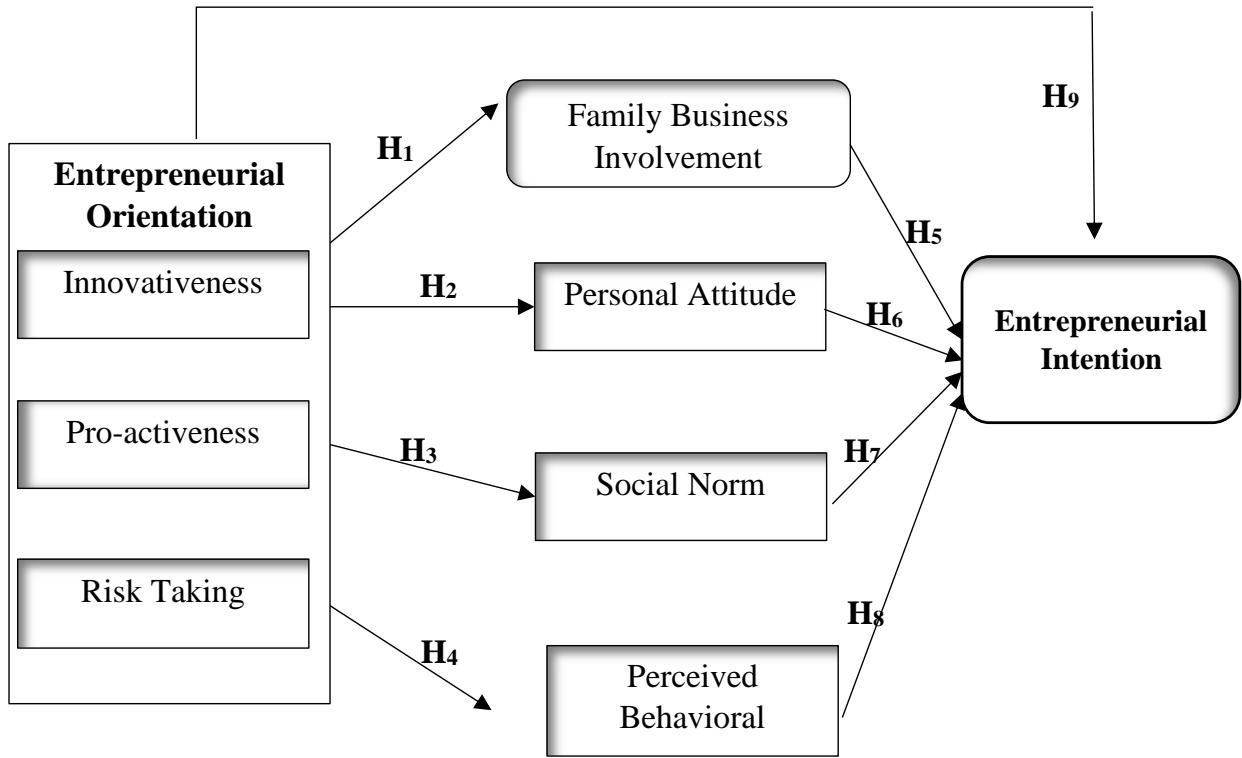
The current research conceptual framework is illustrated in Figure 1,
 Figure 1: Research Framework
According to Figure 1, the research hypotheses are stated as follows:
H1: There is a significant relationship between Entrepreneurial Orientation and Family Business Involvement.
H2: There is a significant relationship between Entrepreneurial Orientation and Personal Attitude.
H3: There is a significant relationship between Entrepreneurial Orientation and Social Norm.
H4: There is a significant relationship between Entrepreneurial Orientation and Perceived Behavioral Control.
H5: There is a significant relationship between Family Business Involvement and Entrepreneurial Intention.
H6: There is a significant relationship between Personal Attitude and Entrepreneurial Intention.
H7: There is a significant relationship between Social Norm and Entrepreneurial Intention.
H8: There is a significant relationship between Perceived Behavioral Control and Entrepreneurial Intention.
H9: There is a significant relationship between Entrepreneurial Orientation and Entrepreneurial Intention.
- H10: Family Business Involvement significantly mediates the relationship between Entrepreneurial Orientation and Entrepreneurial Intention.
- H11: Personal Attitude significantly mediates the relationship between Entrepreneurial Orientation and Entrepreneurial Intention.
- H12: Social Norm significantly mediates the relationship between Entrepreneurial Orientation and Entrepreneurial Intention.
H13: Perceived Behavior Control significantly mediates the relationship between Entrepreneurial Orientation and Entrepreneurial Intention.
According to the above research framework and hypotheses, the research variables were measured according to a questionnaire adopted from the studies of Miralles et al. (2016), Hooi et al. (2016), and Wang et al. (2018), using a 5-point Likert scale, where participants were asked to rate their agreement or disagreement with each statement using a five-point scale, as shown in Table 1.
Table 1: Research Variables Operationalization
<table><tr><td>Conceptual Definition</td><td>Operational Definition</td><td>Statements</td></tr><tr><td colspan="3">Innovativeness (Hooi et al., 2016)</td></tr><tr><td rowspan="3">The capacity of a company to promote novel concepts, try new things, launch novel goods, and engage in creative processes is referred to as innovative-ness (Hernández-Perlines et al., 2020).</td><td rowspan="3">It is measured by the levels of development in the company's products and services, as well as the levels of R&D and technology leadership within it.</td><td>My company has many new lines of products or services.</td></tr><tr><td>My company changes in product or service lines have usually been quite dramatic.</td></tr><tr><td>My company strong emphasis on R&D, technological leadership, and innovations.</td></tr><tr><td colspan="3">Pro-activeness (Hooi et al., 2016)</td></tr><tr><td rowspan="2">It is the capacity of businesses to devote resources to the introduction of new goods and services before rivals (Hernández-Perlines et al., 2020).</td><td rowspan="2">It is measured by the company's priority in introducing new products/services, management methods, and operating technologies, to ensure the company's competitive-ness.</td><td>My company is often the first business to introduce new products/services, administrative techniques, operating technologies, etc.</td></tr><tr><td>My company typically adopts a very competitive, "undo-the competitors" posture.</td></tr><tr><td colspan="3">Risk taking (Hooi et al., 2016)</td></tr><tr><td rowspan="2">Risk-taking entails the development of audacious acts employing significant resources that are most suitable (Hernández Perlines et al., 2020).</td><td rowspan="2">It is measured by how a company engages in new projects and bold, large-scale decisions in order to achieve its goals</td><td>My company has a strong proclivity for high-risk projects (with chances of very high returns).</td></tr><tr><td>My company believes that, owing to the nature of the environment, bold, wide-ranging acts are necessary to achieve the firm's objectives.</td></tr><tr><td colspan="3">Family Business Involvement (Wang et al., 2018)</td></tr><tr><td rowspan="2">In these studies, family involvement in the company is</td><td rowspan="2">It is measured by the levels of involvement of family</td><td>My family used to take me to work with them.</td></tr><tr><td>My family currently takes part in the management of the company.</td></tr></table>
Regarding the study population, the researcher targeted Egyptian enterprises, where the sample size was chosen according to the Saunders equation. The Saunders equation depends on a $95\%$ confidence level, in which the sample size should not be less than 385 respondents (Saunders et al., 2016). After developing the questionnaire, 800 questionnaires were distributed, and 520 respondents received a response rate of $65\%$. From the collected responses, only 445 completed questionnaires were valid for the analysis.
## III. RESULTS AND FINDINGS
The current section presents the empirical analysis and its main findings, which are presented in the following six sub-sections:
### a) Validity and Reliability Analysis
In the examination of the validity of this research, two pivotal metrics were considered. The first metric, Average Variance Extracted (AVE), serves as an indicator of the average shared variance among the latent factors. Meeting or exceeding the 0.5 threshold in AVE is considered acceptable validity (Hair et al., 2016). The second metric involves examining the factor loadings, with a minimum requirement of 0.4 or higher for adequate validity (Yong and Pearce, 2013). Conversely, the assessment of reliability relies on the evaluation of the stability and consistency of each factor by the application of Cronbach's alpha. Falling within a scale of 0 to 1, higher Cronbach's alpha coefficients signify a greater degree of reliability, with coefficients equal to or exceeding 0.7 indicating satisfactory reliability (Taber, 2018).
Table 2 illustrates the validity and reliability tests conducted for the research variables. According to the results, the research variables (innovativeness, pro-activeness, risk-taking, family business involvement, personal attitude, social norm, perceived behavioral control, and entrepreneurial intention) were demonstrated to be valid, as the AVE values were above $50\%$ (85.161, 87.097, 84.428, 84.989, 86.293, 82.402, 85.198, and 84.798 respectively). Regarding the KMO values are higher than 0.4 (0.759, 0.500, 0.757, 0.920, 0.761, 0.941, 0.870, and 0.756 respectively). Furthermore, the research variables were reliable as Cronbach's Alpha value exceeded 0.7 indicating satisfactory reliability (0.913, 0.852, 0.908, 0.956, 0.920, 0.957, 0.942, 0.910 respectively).
Table 2: Reliability and Validity Table
<table><tr><td>Variables</td><td>KMO</td><td>AVE%</td><td>Cronbach's α</td><td>Items</td><td>Factor Loading</td></tr><tr><td rowspan="3">Innovativeness</td><td rowspan="3">.759</td><td rowspan="3">85.161</td><td rowspan="3">.913</td><td>INN1</td><td>.849</td></tr><tr><td>INN2</td><td>.852</td></tr><tr><td>INN3</td><td>.854</td></tr><tr><td rowspan="2">Pro-activeness</td><td rowspan="2">.500</td><td rowspan="2">87.097</td><td rowspan="2">.852</td><td>PAC1</td><td>.871</td></tr><tr><td>PAC2</td><td>.871</td></tr><tr><td rowspan="3">Risk-taking</td><td rowspan="3">.757</td><td rowspan="3">84.428</td><td rowspan="3">.908</td><td>RT1</td><td>.841</td></tr><tr><td>RT2</td><td>.851</td></tr><tr><td>RT3</td><td>.841</td></tr><tr><td rowspan="5">Family Business Involvement</td><td rowspan="5">.920</td><td rowspan="5">84.989</td><td rowspan="5">.956</td><td>FBIN1</td><td>.858</td></tr><tr><td>FBIN2</td><td>.836</td></tr><tr><td>FBIN3</td><td>.850</td></tr><tr><td>FBIN4</td><td>.846</td></tr><tr><td>FBIN5</td><td>.860</td></tr><tr><td rowspan="3">Personal Attitude</td><td rowspan="3">.761</td><td rowspan="3">86.293</td><td rowspan="3">.920</td><td>PAT1</td><td>.876</td></tr><tr><td>PAT2</td><td>.859</td></tr><tr><td>PAT3</td><td>.854</td></tr><tr><td rowspan="6">Social Norm</td><td rowspan="6">.941</td><td rowspan="6">82.402</td><td rowspan="6">.957</td><td>SN1</td><td>.825</td></tr><tr><td>SN2</td><td>.809</td></tr><tr><td>SN3</td><td>.837</td></tr><tr><td>SN4</td><td>.833</td></tr><tr><td>SN5</td><td>.815</td></tr><tr><td>SN6</td><td>.825</td></tr><tr><td rowspan="4">Perceived Behavioral Control</td><td rowspan="4">.870</td><td rowspan="4">85.198</td><td rowspan="4">.942</td><td>PBC1</td><td>.851</td></tr><tr><td>PBC2</td><td>.854</td></tr><tr><td>PBC3</td><td>.847</td></tr><tr><td>PBC4</td><td>.856</td></tr><tr><td rowspan="3">Entrepreneurial Intention</td><td rowspan="3">.756</td><td rowspan="3">84.798</td><td rowspan="3">.910</td><td>EIN1</td><td>.845</td></tr><tr><td>EIN2</td><td>.864</td></tr><tr><td>EIN3</td><td>.835</td></tr></table>
 Figure 2 shows the Average Variance Extracted mentioned before, all the AVEs are more than $50\%$ and percentage of all research variables. As are considered to have acceptable validity.
### b) Confirmatory Factor Analysis
Confirmatory Factor Analysis (CFA) precedes the application of structural equation modeling (SEM), it is executed using AMOS 24 software, utilizing the Maximum Likelihood (ML) estimation method to determine factor loadings and assess the overall model fit. The fit indices provide a comprehensive assessment of how well the measurement model aligns with the observed data. The Chi-square/df ratio of 1.106 indicates that the model fits the data reasonably well, especially considering that values close to 1 are desirable. The associated p-value of 0.000 suggests that the model's fit is statistically significant. The Goodness-of-Fit Index (GFI) and Adjusted Goodness-of-Fit Index (AGFI) both exceeded 0.90, demonstrating that the model fits the data well, with a GFI of 0.944 and an AGFI of 0.930. These indices measure the proportion of variance in the observed data accounted for by a model.
The Normed Fit Index (NFI), Tucker-Lewis Index (TLI), and Comparative Fit Index (CFI) values, all above 0.90, signify excellent fit. These indices assessed how well the model reproduced the observed covariance structure, with NFI = 0.975, TLI = 0.997, and CFI = 0.998. The Root Mean Square Residual (RMR) of 0.020 indicates a small discrepancy between the observed and predicted covariance matrices, supporting the overall accuracy of the model. The Root Mean Square Error of Approximation (RMSEA) of 0.015, falling below the commonly accepted threshold of 0.05, indicates a close fit of the model to the population covariance matrix. In summary, these fit indices collectively suggest that the measurement model is well-suited to the observed data, demonstrating good overall fit, statistical significance, and accurate reproduction of the covariance structure. Table 3 in this study provides detailed insights.
Table 3: Thresholds and Fit Indices for the Measurement Model
<table><tr><td>Measure</td><td>Results</td><td>Threshold</td></tr><tr><td>Chi-square/df</td><td>1.106</td><td>< 2 excellent; < 3 good; < 5 sometimes permissible</td></tr><tr><td>P-value</td><td>0.000</td><td>> 0.05</td></tr><tr><td>GFI</td><td>0.944</td><td>> 0.90</td></tr><tr><td>AGFI</td><td>0.930</td><td>> 0.90</td></tr><tr><td>NFI</td><td>0.975</td><td>> 0.90</td></tr><tr><td>TLI</td><td>0.997</td><td>> 0.95</td></tr><tr><td>CFI</td><td>0.998</td><td>> 0.90</td></tr><tr><td>RMR</td><td>0.020</td><td>< 0.08</td></tr><tr><td>RMSEA</td><td>0.015</td><td>< 0.05</td></tr></table>
 Figure 3 shows the results of the Fit Indices for the Measurement Model, indicating that the measure ment model is well-suited to the observed data, demonstrating good overall. Results of Fit Indices For the Measurement Model Figure 3: The Results of Fit Indices for the Measurement Model
 Figure 4 illustrates the execution of the confirmatory factor analysis, portraying the factor loadings through prominent arrows. The arrows signify strong factor loadings, with values exceeding the 0.4 threshold. Figure 4: CFA for the Measurement Model
### c) Descriptive Analysis
Descriptive statistics is a tool that clarifies and provides a clear overview of the characteristics of a particular data collection by providing concise summaries of the samples and information on how to quantify the data (Vetter, 2017). This section presents a descriptive analysis of the respondents' profiles and research variables.
## i. Descriptive Analysis of Respondent Profile
The respondent profile provided valuable insights into the demographics and characteristics of the study participants (Table 5). The respondent profile provides insights into key demographic characteristics, with the results sorted from high to low percentages. In terms of company age, the majority of respondents had a business tenure of five to less than 10 years $(42.7\%)$, followed by 15 years or more $(18.9\%)$. The largest proportion of business volume operates in large companies (44.9%), followed by medium (37.3%), and small companies (17.8%). Employee count revealed a distribution with 1000 - Less than 3000 employees being the most dominant (41.3%), followed by Less than 1000 employees (18.7%).
In terms of age distribution, the largest group falls within the 40- less than 50 age range (32.4%), followed by 22- less than 30 (19.6%), and 50- less than 60 (19.6%). The gender distribution indicates a higher percentage of male respondents (58.0%) than female respondents (42.0%). In terms of education, a significant percentage held a bachelor's degree (49.7%), followed by a master's degree (32.1%), while individuals with a doctoral degree constituted a smaller proportion (7.0%). Those with "other" educational backgrounds comprised 11.2% of the respondents.
Table 4: Respondent Profile
<table><tr><td></td><td>Frequency (n=445)</td><td>Percent%</td></tr><tr><td colspan="3">Company Age</td></tr><tr><td>Less than one year</td><td>38</td><td>8.5</td></tr><tr><td>One – less than Five years</td><td>91</td><td>20.4</td></tr><tr><td>Five – less than 10 years</td><td>190</td><td>42.7</td></tr><tr><td>10 – less than 15 years</td><td>42</td><td>9.4</td></tr><tr><td>15 years or more</td><td>84</td><td>18.9</td></tr><tr><td colspan="3">Business Volume</td></tr><tr><td>Small</td><td>79</td><td>17.8</td></tr><tr><td>Medium</td><td>166</td><td>37.3</td></tr><tr><td>Large</td><td>200</td><td>44.9</td></tr><tr><td colspan="3">Employee Count</td></tr><tr><td>Less than 1000</td><td>83</td><td>18.7</td></tr><tr><td>1000 – Less than 3000</td><td>184</td><td>41.3</td></tr><tr><td>3000 – Less than 5000</td><td>92</td><td>20.7</td></tr><tr><td>5000 – Less than 10000</td><td>56</td><td>12.6</td></tr><tr><td>10000 or more</td><td>30</td><td>6.7</td></tr><tr><td colspan="3">Age</td></tr><tr><td>22 - Less than 30</td><td>87</td><td>19.6</td></tr><tr><td>30- Less than 40</td><td>83</td><td>18.7</td></tr><tr><td>40- Less than 50</td><td>144</td><td>32.4</td></tr><tr><td>50- Less than 60</td><td>87</td><td>19.6</td></tr><tr><td>60 or older</td><td>44</td><td>9.9</td></tr><tr><td colspan="3">Gender</td></tr><tr><td>Male</td><td>258</td><td>58.0</td></tr><tr><td></td><td>Frequency (n=445)</td><td>Percent%</td></tr><tr><td>Female</td><td>187</td><td>42.0</td></tr><tr><td colspan="3">Education</td></tr><tr><td>Bachelor's degree</td><td>221</td><td>49.7</td></tr><tr><td>Master's degree</td><td>143</td><td>32.1</td></tr><tr><td>Doctorate degree</td><td>31</td><td>7.0</td></tr><tr><td>Other</td><td>50</td><td>11.2</td></tr></table>
## ii. Descriptive Analysis of Research Variables
The descriptive results for the research variable offer valuable insights into the central tendencies and variations within the dataset, as shown in Table 6. For "innovativeness" the mean was 3.0854, with a standard deviation of 1.20318. "Pro-activeness" has a mean of 3.1551 and a standard deviation of 1.13731. Similarly, "Risk-taking" had a mean of 3.1236, with a standard deviation of 1.14903. "Family Business Involvement" has a mean of 3.3079 and a standard deviation of 1.30213. "Personal Attitude" shows a mean of 2.9933 with a standard deviation of 1.21827, while "Social Norm" had a mean of 3.0854 and a standard deviation of 1.31069. "Perceived Behavioral Control" has a mean of 2.9910 and a standard deviation of 1.27869. Lastly, "Entrepreneurial Intention" has a mean of 3.4584 with a standard deviation of 1.21411.
Table 5: Descriptive Analysis for the Research Variables
<table><tr><td rowspan="2">Research Variable</td><td rowspan="2">N</td><td rowspan="2">Mean</td><td rowspan="2">Std. Deviation</td><td colspan="5">Frequency</td></tr><tr><td>1</td><td>2</td><td>3</td><td>4</td><td>5</td></tr><tr><td>Innovativeness</td><td>445</td><td>3.0854</td><td>1.20318</td><td>60</td><td>79</td><td>114</td><td>147</td><td>45</td></tr><tr><td>Pro-activeness</td><td>445</td><td>3.1551</td><td>1.13731</td><td>48</td><td>73</td><td>127</td><td>156</td><td>41</td></tr><tr><td>Risk-taking</td><td>445</td><td>3.1236</td><td>1.14903</td><td>47</td><td>84</td><td>125</td><td>145</td><td>44</td></tr><tr><td>Family Business Involvement</td><td>445</td><td>3.3079</td><td>1.30213</td><td>51</td><td>88</td><td>67</td><td>151</td><td>88</td></tr><tr><td>Personal Attitude</td><td>445</td><td>2.9933</td><td>1.21827</td><td>67</td><td>84</td><td>125</td><td>123</td><td>46</td></tr><tr><td>Social Norm</td><td>445</td><td>3.0854</td><td>1.31069</td><td>58</td><td>115</td><td>78</td><td>119</td><td>75</td></tr><tr><td>Perceived Behavioral Control</td><td>445</td><td>2.9910</td><td>1.27869</td><td>74</td><td>96</td><td>82</td><td>146</td><td>47</td></tr><tr><td>Entrepreneurial Intention</td><td>445</td><td>3.4584</td><td>1.21411</td><td>13</td><td>121</td><td>72</td><td>127</td><td>112</td></tr></table>
Figure 5 shows the descriptive statistics for the research variables, represented as mean and standard deviation.
 Descriptive Analysis for the Research Variables Figure 5: Descriptive Statistics for he Research Variables
### d) Normality Testing for the Research Variables
Confirming the normality of the data is a prerequisite before conducting inferential analyses, influencing the choice between parametric and non-parametric tests for hypothesis testing (Demir, 2022). A widely employed method for assessing normality is the Kolmogorov-Smirnov test, which is especially suited for sample sizes exceeding 50 observations in Table 6. A P-value surpassing the 0.05 threshold indicates the dataset conforms to a normal distribution. This
meticulous evaluation of normalcy is a key aspect of the research process, steering the selection of appropriate statistical tests for hypothesis testing, thereby fortifying the reliability and validity of the research outcomes.
Table 6: Formal Testing of Normality
<table><tr><td rowspan="2">Research Variables</td><td colspan="3">Kolmogorov-Smirnova</td></tr><tr><td>Statistic</td><td>Df</td><td>Sig.</td></tr><tr><td>Innovativeness</td><td>.208</td><td>445</td><td>.000</td></tr><tr><td>Pro-activeness</td><td>.214</td><td>445</td><td>.000</td></tr><tr><td>Risk-taking</td><td>.202</td><td>445</td><td>.000</td></tr><tr><td>Family Business Involvement</td><td>.240</td><td>445</td><td>.000</td></tr><tr><td>Personal Attitude</td><td>.175</td><td>445</td><td>.000</td></tr><tr><td>Social Norm</td><td>.193</td><td>445</td><td>.000</td></tr><tr><td>Perceived Behavioral Control</td><td>.219</td><td>445</td><td>.000</td></tr><tr><td>Entrepreneurial Intention</td><td>.209</td><td>445</td><td>.000</td></tr></table>
Given the outcomes of the formal tests signaling a departure from a normal distribution in the dataset in Table 7, a supplementary informal assessment was employed to gauge the data's approximate normality. As illustrated in Table 7, this informal evaluation revealed that both the skewness and kurtosis values exceeded the acceptable range of $\pm 1$. Consequently, non-parametric tests are considered appropriate for elucidating the relationships among the research variables.
Table 1: Informal Testing of Normality
<table><tr><td rowspan="2"></td><td>N</td><td colspan="2">Skewness</td><td colspan="2">Kurtosis</td></tr><tr><td>Statistic</td><td>Statistic</td><td>Std. Error</td><td>Statistic</td><td>Std. Error</td></tr><tr><td>Innovativeness</td><td>445</td><td>-.282</td><td>.116</td><td>-.894</td><td>.231</td></tr><tr><td>Pro-activeness</td><td>445</td><td>-.372</td><td>.116</td><td>-.674</td><td>.231</td></tr><tr><td>Risk-taking</td><td>445</td><td>-.270</td><td>.116</td><td>-.767</td><td>.231</td></tr><tr><td>Family Business Involvement</td><td>445</td><td>-.358</td><td>.116</td><td>-1.066</td><td>.231</td></tr><tr><td>Personal Attitude</td><td>445</td><td>-.145</td><td>.116</td><td>-.936</td><td>.231</td></tr><tr><td>Social Norm</td><td>445</td><td>-.056</td><td>.116</td><td>-1.204</td><td>.231</td></tr><tr><td>Perceived Behavioral Control</td><td>445</td><td>-.158</td><td>.116</td><td>-1.165</td><td>.231</td></tr><tr><td>Entrepreneurial Intention</td><td>445</td><td>-.183</td><td>.116</td><td>-1.267</td><td>.231</td></tr></table>
### e) Testing Multicollinearity Assumption
The examination of Variance Inflation Factors (VIFs), detailed in Table 8, for the independent variables in the research model, yields crucial insights into the state of multicollinearity. The results revealed that all VIFs corresponding to the research variables remained below the predetermined threshold of 5. This observation indicates the absence of noticeable multicollinearity among the independent variables in this analysis, thereby reinforcing the robustness and reliability of the research model.
Table 2: VIF values for Research Variables
<table><tr><td>Independent Variables</td><td>VIF</td></tr><tr><td>Innovativeness</td><td>3.007</td></tr><tr><td>Pro-activeness</td><td>2.659</td></tr><tr><td>Risk-taking</td><td>2.985</td></tr></table>
### f) Testing Research Hypotheses
Within this segment, meticulous scrutiny of the research hypotheses transpires through the utilization of correlation analysis and path analysis within the structural equation modeling (SEM) framework. Given the non-normal distribution inherent in the dataset, the preferred analytical method was Spearman's correlation. Table 9 presents the correlation matrix for the variables examined in this study.
Innovativeness is strongly and positively correlated with Family Business Involvement ( $r = 0.850$, $p < 0.001$ ), Personal Attitude ( $r = 0.806$, $p < 0.001$ ), social norms ( $r = 0.862$, $p < 0.001$ ), Perceived Behavioral Control ( $r = 0.826$, $p < 0.001$ ), and Entrepreneurial Intention ( $r = 0.898$, $p < 0.001$ ). Similarly, pro-activeness showed a strong positive correlation with Family Business Involvement ( $r = 0.843$, $p < 0.001$ ), Personal Attitude ( $r = 0.781$, $p < 0.001$ ), social norms ( $r = 0.823$, $p < 0.001$ ), Perceived
Behavioral Control (r = 0.822, p < 0.001), and Entrepreneurial Intention (r = 0.880, p < 0.001). Moreover, risk taking was significantly positively correlated with Family Business Involvement (r = 0.829, p < 0.001), Personal Attitude (r = 0.804, p < 0.001), social norms (r = 0.827, p < 0.001), Perceived Behavioral Control (r = 0.827, p < 0.001), and Entrepreneurial Intention (r = 0.884, p < 0.001).
Family Business Involvement shows a strong positive correlation with Entrepreneurial Intention $(r = 0.943, p < 0.001)$. Moreover, Personal Attitude revealed a robust positive correlation with Entrepreneurial Intention $(r = 0.885, p < 0.001)$. Furthermore, social norms revealed robust positive correlations with Entrepreneurial Intention $(r = 0.927, p < 0.001)$. Additionally, Perceived Behavioral Control revealed a robust positive correlation with Entrepreneurial Intention $(r = 0.919, p < 0.001)$.
Table 3: Correlation Matrix for the Research Variables
<table><tr><td colspan="3"></td><td>1.</td><td>2.</td><td>3.</td><td>4.</td><td>5.</td><td>6.</td><td>7.</td><td>8.</td></tr><tr><td rowspan="24">Spearman's rho</td><td rowspan="3">1. Innovativeness</td><td>R</td><td>1.000</td><td></td><td></td><td></td><td></td><td></td><td></td><td></td></tr><tr><td>Sig.</td><td>.</td><td></td><td></td><td></td><td></td><td></td><td></td><td></td></tr><tr><td>N</td><td>445</td><td></td><td></td><td></td><td></td><td></td><td></td><td></td></tr><tr><td rowspan="2">1. Personal Attitude</td><td>Sig.</td><td>.000</td><td>.000</td><td>.000</td><td>.000</td><td>.</td><td></td><td></td><td></td></tr><tr><td>N</td><td>445</td><td>445</td><td>445</td><td>445</td><td>445</td><td></td><td></td><td></td></tr><tr><td rowspan="3">2. Social Norm</td><td>Sig.</td><td>.000</td><td>.000</td><td>.000</td><td>.000</td><td>.</td><td></td><td></td><td></td></tr><tr><td>N</td><td>445</td><td>445</td><td>445</td><td>445</td><td>445</td><td></td><td></td><td></td></tr>...</table>
 Figure 2: Average Variance Extracted Percentage of the Research Variables
Structural equation Modeling (SEM) analysis was used to evaluate the influence of the research variables in Table 10. The SEM results, outlined below, provide valuable insights into the relationships between the variables.
Hypothesis 1, which posits a relationship between Entrepreneurial Orientation and Family Business Involvement, Innovativeness (estimate $= 0.337$, $p < 0.000$ ), and pro-activeness (estimate $= 0.739$, $p < 0.000$ ), demonstrated a significant positive effect on Family Business Involvement as the P-values were less than 0.05, while, Risk Taking (estimate $= 0.053$, $p = 0.513$ ) showed an insignificant effect on Family Business Involvement as the P-value was more than 0.05. The coefficient of determination (R-square) for the dependent variable "Family Business Involvement" was 0.867. This value indicates that approximately $86.7\%$ of the variability in Family Business Involvement can be explained by independent variables in the model.
For Hypothesis 2, which posits a relationship between Entrepreneurial Orientation and Personal Attitude, Innovativeness (estimate $= 0.369$, $p < 0.000$ ), pro-activeness (estimate $= 0.497$, $p < 0.000$ ), and risk-taking (estimate $= 0.177$, $p < 0.036$ ) demonstrated a significant positive effect on Personal Attitude as the P-values were less than 0.05. The coefficient of determination (R square) for the dependent variable "Personal Attitude" was 0.807. This value indicates that approximately $80.7\%$ of the variability in personal attitudes can be explained by the independent variables in the model.
Hypothesis 3, which posits a relationship between entrepreneurial orientation and social norms, innovativeness (estimate $= 0.503$, $p < 0.000$ ), and proactiveness (estimate $= 0.562$, $p < 0.000$ ), demonstrates a significant positive effect on social norms as the P-values are less than 0.05, while, Risk Taking (estimate $= 0.083$, $p = 0.513$ ) shows an insignificant effect on social norms as the P-value is more than 0.05. The coefficient of determination (R-square) for the dependent variable "Social Norm" was 0.868. This value indicates that approximately $86.8\%$ of the variability in the Social Norm can be explained by the independent variables in the model.
Hypothesis 4, which posits a relationship between Entrepreneurial Orientation and Perceived Behavioral Control, Innovativeness (estimate $= 0.276$, p < 0.000), and pro-activeness (estimate $= 0.745$, p < 0.000), demonstrates a significant positive effect on Perceived Behavioral Control as the P-values are less than 0.05, while, Risk Taking (estimate $= 0.092$, p = 0.247) showed an insignificant effect on Perceived Behavioral Control as the P-value was more than 0.05. The coefficient of determination (R-square) for the dependent variable "Perceived Behavioral Control" was 0.878. This value indicates that approximately 87.8% of the variability in Perceived Behavioral Control can be explained by the independent variables in the model.
For Hypothesis 5, which posits a relationship between Family Business Involvement and Entrepreneurial Intention, it could be noted that Family Business Involvement (estimate $= 0.277$, $p < 0.000$ ), demonstrates a significant positive effect on Entrepreneurial Intention as the P-value is less than 0.05.
For Hypothesis 6, which posits a relationship between Personal Attitude and Entrepreneurial Intention, it can be noted that Personal Attitude (estimate $= 0.108$, $p < 0.011$ ), demonstrates a significant positive effect on Entrepreneurial Intention as the P-value is less than 0.05.
For Hypothesis 7, which posits a relationship between social norms and entrepreneurial intention, it could be noted that social norms (estimate $= 0.130$, p $< 0.009$ ), demonstrate a significant positive effect on Entrepreneurial Intention as the P-value is less than 0.05. For Hypothesis 8, which posits a relationship between Perceived Behavioral Control and Entrepreneurial Intention, it could be noted that Perceived Behavioral Control (estimate $= 0.107$, p $= 0.080$ ) shows an insignificant effect on Entrepreneurial Intention as the P-value is more than 0.05.
Hypothesis 9, which posits a relationship between Entrepreneurial Orientation and Entrepreneurial Intention, Innovativeness (estimate $= 0.503$, $p < 0.000$ ), and risk-taking (estimate $= 0.142$, $p < 0.022$ ), demonstrates a significant positive effect on Entrepreneurial Intention as the P-values are less than 0.05, while pro-activeness (estimate $= 0.181$, $p = 0.176$ ) shows an insignificant effect on Entrepreneurial Intention as the P-value is more than 0.05. The coefficient of determination (R-square) for the dependent variable "Entrepreneurial Intention" is 0.990. This value indicates that approximately $99\%$ of the variability in Entrepreneurial Intention can be explained by the independent variables in the model.
According to previous findings, family business involvement, social norms, and personal attitudes exert a substantial influence on Entrepreneurial Intention. This implies that family business involvement, social norms, and personal attitudes have a direct impact on entrepreneurial intention. On the other hand, there is a lack of a significant effect of Perceived Behavioral Control on Entrepreneurial Intention, indicating the absence of a direct relationship between behavioral control and Entrepreneurial Intention.
Hypothesis 10, Family Business Involvement mediates the relationship between entrepreneurial orientation and intention. Based on the previous results, it can be noted that there is a significant effect of Innovativeness, and Pro-activeness on Family Business Involvement, which means that Family Business Involvement could mediate the relationship between
Innovativeness, Pro-activeness, and Entrepreneurial Intention.
It could be observed that Family Business Involvement partially mediate the relationship between Innovativeness and Entrepreneurial Intention as the effect still significant at the presence of Family Business Involvement. Moreover, it could be observed that Family Business Involvement fully mediate the relationship between Pro-activeness and Entrepreneurial Intention as the effect turned to be insignificant at the presence of Family Business Involvement.
Hypothesis 11, Personal Attitude mediated the relationship between Entrepreneurial Orientation and Entrepreneurial Intention. Based on the previous results, it could be noted that there is a significant effect of Innovativeness, and Pro-activeness on Personal Attitude, which means that Personal Attitude could mediate the relationship between Innovativeness, Pro-activeness, and Entrepreneurial Intention.
It could be observed that Personal Attitude partially mediate the relationship between Innovativeness, Risk Taking, and Entrepreneurial Intention as the effect still significant at the presence of Personal Attitude. Moreover, it could be observed that Personal Attitude fully mediate the relationship between Proactiveness and Entrepreneurial Intention as the effect turned to be insignificant at the presence of Personal Attitude.
Hypothesis 12, social norms mediate the relationship between Entrepreneurial Orientation and Entrepreneurial Intention. Based on the previous results, it can be noted that there is a significant effect of innovativeness, and pro-activeness on social norms, which means that social norms could mediate the relationship between Innovativeness, Pro-activeness, and Entrepreneurial Intention.
It could be observed that Social Norm partially mediate the relationship between Innovativeness and Entrepreneurial Intention as the effect still significant at the presence of Social Norm. Moreover, it could be observed that Social Norm fully mediate the relationship between Pro-activeness and Entrepreneurial Intention as the effect turned to be insignificant at the presence of Social Norm.
For Hypothesis 12, Perceived Behavioral Control mediates the relationship between Entrepreneurial Orientation and Entrepreneurial Intention. Based on the previous results, it could be noted that there is no direct effect of Perceived Behavioral Control on entrepreneurial intention; therefore, Perceived Behavioral Control could not mediate the relationship between Entrepreneurial Orientation and Entrepreneurial Intention.
Table 4: SEM Analysis for the Research Variables
<table><tr><td></td><td></td><td></td><td>Estimate</td><td>P</td><td>R2</td></tr><tr><td>Family Business Involvement</td><td><---</td><td>Innovativeness</td><td>.337</td><td>***</td><td rowspan="3">.867</td></tr><tr><td>Family Business Involvement</td><td><---</td><td>Pro-activeness</td><td>.739</td><td>***</td></tr><tr><td>Family Business Involvement</td><td><---</td><td>Risk Taking</td><td>.053</td><td>.513</td></tr><tr><td>Social Norm</td><td><---</td><td>Innovativeness</td><td>.503</td><td>***</td><td rowspan="3">.868</td></tr><tr><td>Social Norm</td><td><---</td><td>Pro-activeness</td><td>.562</td><td>***</td></tr><tr><td>Social Norm</td><td><---</td><td>Risk Taking</td><td>.083</td><td>.282</td></tr><tr><td>Personal Attitude</td><td><---</td><td>Innovativeness</td><td>.369</td><td>***</td><td rowspan="3">.807</td></tr><tr><td>Personal Attitude</td><td><---</td><td>Pro-activeness</td><td>.497</td><td>***</td></tr><tr><td>Personal Attitude</td><td><---</td><td>Risk Taking</td><td>.177</td><td>.036</td></tr><tr><td>Perceived Behavioral Control</td><td><---</td><td>Innovativeness</td><td>.276</td><td>***</td><td rowspan="3">.878</td></tr><tr><td>Perceived Behavioral Control</td><td><---</td><td>Pro-activeness</td><td>.745</td><td>***</td></tr><tr><td>Perceived Behavioral Control</td><td><---</td><td>Risk Taking</td><td>.092</td><td>.247</td></tr><tr><td>Entrepreneurial Intention</td><td><---</td><td>Innovativeness</td><td>.142</td><td>.022</td><td rowspan="7">.990</td></tr><tr><td>Entrepreneurial Intention</td><td><---</td><td>Pro-activeness</td><td>.181</td><td>.176</td></tr><tr><td>Entrepreneurial Intention</td><td><---</td><td>Risk Taking</td><td>.162</td><td>***</td></tr><tr><td>Entrepreneurial Intention</td><td><---</td><td>Family Business Involvement</td><td>.277</td><td>***</td></tr><tr><td>Entrepreneurial Intention</td><td><---</td><td>Social Norm</td><td>.130</td><td>.009</td></tr><tr><td>Entrepreneurial Intention</td><td><---</td><td>Personal Attitude</td><td>.108</td><td>.011</td></tr><tr><td>Entrepreneurial Intention</td><td><---</td><td>Perceived Behavioral Control</td><td>.107</td><td>.080</td></tr></table>
 Figure 6: SEM for the Research Variables
## IV. RESEARCH DISCUSSION AND CONCLUSION
In this section, the results of the hypotheses tested using a correlation matrix and Structural Equation Modeling (SEM) are discussed.
### a) Research Discussion
The results of the first hypothesis reveal that innovativeness and pro-activeness have significant positive effects on family business involvement, therefore, the first hypothesis is partially supported. These results are consistent with those of Arzubiaga et al. (2018), Glowka et al. (2021), Dos Santos et al. (2022), Kalali (2022), Moreno-Menendez et al. (2022), and Jocic et al. (2023). Otherwise, the results of the second hypothesis proved that all three dimensions had significant positive effects on personal attitudes, therefore, the second hypothesis is fully supported. These results align with those of Zollo et al. (2021) and Hwang et al. (2021). The findings of the third hypothesis clarify that innovativeness and pro-activeness have significant positive effects on social norms, accordingly, the third hypothesis is partially supported. The results are consistent with those of Ekpe and Mat (2012) and Bagis (2022), but inconsistent with those of Awang et al. (2016).
Moreover, the results of the fourth hypothesis proved that innovativeness and pro activeness had significant positive effects on perceived behavioral control, therefore, the fourth hypothesis is partially supported. The results are consistent with Munir et al. (2019), but inconsistent with those of Awang et al. (2016). While the findings of the fifth hypothesis illustrate that family business involvement had a significant positive effect on entrepreneurial intention, hence, the fifth hypothesis is fully supported. The results align with those of Wang et al. (2018), Onjewu et al. (2022), Xu et al. (2022), and Chaudhuri et al. (2023), but are inconsistent with those of Zaman et al. (2020). By examining the sixth hypothesis, the results indicate that Personal attitude has a significant positive effect on entrepreneurial intention, therefore, the sixth hypothesis is fully supported. The results are consistent with those of Miralles et al. (2016), Dinc and Budic (2016), AlJubari et al. (2019), Gieure et al. (2020), Jena (2020), Zovko et al. (2020), Kusumawardhany and Dwiarta (2020), Vamvaka et al. (2020), and Tausif et al. (2021), but inconsistent with those of Saeed et al. (2019).
The results of the seventh hypothesis proved that social norms had a significant positive effect on entrepreneurial intention, hence, the seventh hypothesis is fully supported. The results are consistent with those of Al-Jubari et al. (2019), Saeed et al. (2019), Gieure et al. (2020), Vamvakata et al. (2020), and Tausif et al. (2021), but inconsistent with those of Zovko et al. (2020).
Regarding testing the eighth hypothesis, the results indicate that perceived behavioral control had an insignificant positive effect on entrepreneurial intention, therefore, the eighth hypothesis is not supported. The results are consistent with Zovko et al. (2020), but inconsistent with Miralles et al. (2016), Dinc and Budic (2016), Al-Jubari et al. (2019), Saeed et al. (2019), Cynthia (2020), and Tausif et al. (2021). On the other hand, the findings of the ninth hypothesis revealed that innovativeness and risk-taking had significant positive effects on entrepreneurial intention, hence, the ninth hypothesis is partially supported. The results are consistent with those of Mandongwe and Jaravaza (2020), Wathanakom et al. (2020), Chafloque-Cespedes et al. (2021), Hassan et al. (2021), and Singh and Mehdi (2022), but inconsistent with those of Efrata et al. (2021) and Twum et al. (2021).
The findings of the tenth hypothesis find that family business involvement partially mediates the relationship between innovativeness and entrepreneurial intention and fully mediates the relationship between pro-activeness and entrepreneurial intention, therefore, the tenth hypothesis is partially supported. The results of the eleventh hypothesis indicate that personal attitude partially mediates the relationship between innovativeness, risk-taking, and entrepreneurial intention, and fully mediates the relationship between pro-activeness and entrepreneurial intention. However, the findings of the twelfth hypothesis indicate that social norms partially mediate the relationship between innovativeness and entrepreneurial intention, and fully mediate the relationship between pro-activeness and entrepreneurial intention. Finally, testing the thirteenth hypothesis revealed that perceived behavioral control did not mediate the relationship between entrepreneurial orientation and entrepreneurial intention.
### b) Research Recommendations and Limitations
This research provides detailed recommendations for various stakeholders and future research. For decision-makers and enterprise owners, it is recommended to prioritize innovativeness and proactiveness, as these dimensions significantly influence family involvement within businesses, social norms, and perceived behavioral control. Additionally, focusing on all three dimensions of entrepreneurial orientation (including risk-taking) is crucial because they collectively have a strong impact on personal attitudes. To enhance entrepreneurial intentions among potential entrepreneurs, especially within family enterprises, these elements should be integrated into business strategies and organizational cultures.
Academic institutions and educators of entrepreneurship should develop clear and comprehensive curricula that thoroughly explain the concepts of family business involvement, personal attitudes, and social norms. These concepts are critical because they significantly affect entrepreneurial intention. Proper education on these variables equips students with the knowledge and skills needed to successfully engage in entrepreneurial activities and make informed decisions when starting their businesses.
This research suggests focusing more on the independent variables of EO (innovativeness, pro-activeness, and risk-taking) as key factors influencing entrepreneurial intention. Researchers should investigate additional EO dimensions of entrepreneurial orientation to provide a broader understanding of its impact. Future research should apply similar studies in other developing countries to compare results and gain a global perspective on the factors influencing entrepreneurial intention. Comparative studies between developed and developing countries are also recommended to understand the differences and similarities in entrepreneurial orientation and intention across different economic contexts. Extending the study duration and increasing the sample size will help obtain more generalized and robust results. Additionally, future research should explore other potential mediators and moderators that could influence the relationship between entrepreneurial orientation and entrepreneurial intention, such as cultural factors, economic conditions, and policy environments.
Several limitations were identified in this research. The timing of data collection was limited, suggesting that future research should include a longer period to capture more comprehensive data. The study sample, consisting of 445 respondents from Egypt, may not be representative of other contexts, indicating the need for a larger and more diverse sample in future studies. The focus on Egypt as the sole case study also limited the generalizability of the findings. Comparative studies involving multiple developing countries and those that compare developed and developing countries are recommended to provide a holistic understanding of the phenomena under investigation.
Generating HTML Viewer...
References
55 Cites in Article
Ibrahim Al-Jubari,Arif Hassan,Francisco Liñán (2019). Entrepreneurial intention among University students in Malaysia: integrating self-determination theory and the theory of planned behavior.
U Arzubiaga,T Iturralde,A Maseda,J Kotlar (2018). Entrepreneurial orientation and firm performance in family SMEs: the moderating effects of family, women, and strategic involvement in the board of directors.
A Awang,S Amran,M Nor,I Ibrahim,M Razali (2016). Individual entrepreneurial orientation impact on entrepreneurial intention: Intervening effect of PBC and subjective norm.
Abdul Bagis (2022). Building students’ entrepreneurial orientation through entrepreneurial intention and workplace spirituality.
S Chaudhuri,A Agrawal,S Chatterjee,Z Hussain (2023). Examining the role of gender on family business entrepreneurial intention: influence of government support and technology usage.
Cennet Çiriş Yildiz,Hülya Ulaşli Kaban,F Tanriverdi (2022). COVID-19 pandemic and personal protective equipment: Evaluation of equipment comfort and user attitude.
A Cynthia,A Ameh,J Alabi (2020). Perceived behavioural control and entrepreneurial intention: Empirical evidence from selected tertiary institutions in Kogi State.
Süleyman Demir (2022). Comparison of Normality Tests in Terms of Sample Sizes under Different Skewness and Kurtosis Coefficients.
M Dinc,Semira Budic (2016). The Impact of Personal Attitude, Subjective Norm, and Perceived Behavioural Control on Entrepreneurial Intentions of Women.
Ruan Santos,Ismael Santos,Alessandra Tutida (2022). Familiness and Entrepreneurial Orientation: An Epistemological Systematization of the Literature Review.
Tommy Efrata,Wirawan Radianto,Junko Effendy (2021). THE DYNAMICS OF INDIVIDUAL ENTREPRENEURIAL ORIENTATION IN THE RELATIONSHIP BETWEEN ENTREPRENEURSHIP EDUCATION AND ENTREPRENEURIAL INTENTION.
Isidore Ekpe,Norsiah Mat (2012). The Moderating Effect of Social Environment on the Relationship between Entrepreneurial Orientation and Entrepreneurial Intentions of Female Students at Nigerian Universities.
Anderson Galvão,Carla Marques,João Ferreira,Vitor Braga (2020). Stakeholders’ role in entrepreneurship education and training programmes with impacts on regional development.
Roberto Garcia-Castro,Ruth Aguilera (2014). Family involvement in business and financial performance: A set-theoretic cross-national inquiry.
Clara Gieure,María Benavides-Espinosa,Salvador Roig-Dobón (2020). The entrepreneurial process: The link between intentions and behavior.
Gundula Glowka,Andreas Kallmünzer,Anita Zehrer (2021). Enterprise risk management in small and medium family enterprises: the role of family involvement and CEO tenure.
Martin Hagger,Null- Cheung,Icek Ajzen,Kyra Hamilton (2022). Perceived behavioral control moderating effects in the theory of planned behavior: A meta-analysis..
J Hair,M Sarstedt,L Matthews,C Ringle (2016). Identifying and treating unobserved heterogeneity with FIMIX-PLS: part Imethod.
S Halizah,R Mardikaningsih (2022). The Role of Family Support, Learning Achievement and Student Entrepreneurial Intention.
Aamir Hassan,Imran Anwar,Imran Saleem,K Islam,Syed Hussain (2021). Individual entrepreneurial orientation, entrepreneurship education and entrepreneurial intention: The mediating role of entrepreneurial motivations.
Felipe Hernández-Perlines,Manuel Ibarra Cisneros,Domingo Ribeiro-Soriano,Helena Mogorrón-Guerrero (2020). Innovativeness as a determinant of entrepreneurial orientation: analysis of the hotel sector.
Ho Hooi,Noor Ahmad,Azlan Amran,Syed Rahman (2016). The functional role of entrepreneurial orientation and entrepreneurial bricolage in ensuring sustainable entrepreneurship.
Jinsoo Hwang,Jinkyung Kim,Kwang-Woo Lee (2021). Investigating consumer innovativeness in the context of drone food delivery services: Its impact on attitude and behavioral intentions.
R Jena (2020). Measuring the impact of business management Student's attitude towards entrepreneurship education on entrepreneurial intention: A case study.
Marko Jocic,Michael Morris,Donald Kuratko (2023). Familiness and innovation outcomes in family firms: The mediating role of entrepreneurial orientation.
Serhii Kubitskyi,Denys Yeremenko,Viktoriia Danylenko,Sergii Bataiev,Elena Varaksina (2024). Evaluating the impact of innovative technologies on global competitiveness through modelling.
P Kusumawardhany,I Dwiarta (2020). Entrepreneurial Intention Among Millennial Generation: Personal Attitude, Educational Support, and Social Media.
L Mandongwe,D Jaravaza (2020). Women entrepreneurial intentions in subsistence marketplaces: The role of entrepreneurial orientation and demographic profiles in Zimbabwe.
Francesc Miralles,Ferran Giones,Brian Gozun (2017). Does direct experience matter? Examining the consequences of current entrepreneurial behavior on entrepreneurial intention.
Ana Moreno-Menéndez,Unai Arzubiaga,Vanessa Díaz-Moriana,José Casillas (2022). The impact of a crisis on entrepreneurial orientation of family firms: The role of organisational decline and generational change.
Hina Munir,Cai Jianfeng,Sidra Ramzan (2019). Personality traits and theory of planned behavior comparison of entrepreneurial intentions between an emerging economy and a developing country.
Adah-Kole Emmanuel Onjewu,Mohamed Haddoud,Uchenna Tony-Okeke,Dongmei Cao,Witold Nowiński (2022). Dissecting the effect of family business exposure on entrepreneurial implementation intention.
A Saeed,Z Gongyi,T Charkos (2019). Entrepreneurial Intentions of Undergraduate Students in Yemen: Applying the Theory of Planned Behaviour.
M Saunders,P Lewis,A Thornhill (2016). Research methods for business students (Seventh).
Eman Selim (2021). The Role of Entrepreneurship in Economic Growth and Development Models.
Nader Seyed Kalali (2022). Entrepreneurial orientation in family firms: the effects of long-term orientation.
S Sinclair,J Agerström (2023). Do social norms influence young people's willingness to take the COVID-19 vaccine?.
Lata Singh,Syed Mehdi (2022). Entrepreneurial orientation & entrepreneurial intention: Role of openness to experience as a moderator.
J Smith (2018). The importance of research within the creative industries.
J Smith (2010). Interpretative Phenomenological Analysis: Theory, Method and Research.
Suhail Sultan,Monika Hudson,Nojoud Habash,Wasim Sultan,Naser Izhiman (2024). Entrepreneurial orientation and Palestinian family-owned businesses: does governance or geographic location make a difference?.
K Taber (2018). The use of Cronbach's alpha when developing and reporting research instruments in science education.
M Tausif,M Haque,M Rao,M Khan (2021). Antecedents of Entrepreneurial Intentions: A Comparative Study of Cultures.
Kojo Twum,Paul Kwakwa,Daniel Ofori,Atsu Nkukpornu (2021). The relationship between individual entrepreneurial orientation, network ties, and entrepreneurial intention of undergraduate students: implications on entrepreneurial education.
Nitin Upadhyay,Shalini Upadhyay,Mutaz Al-Debei,Abdullah Baabdullah,Yogesh Dwivedi (2023). The influence of digital entrepreneurship and entrepreneurial orientation on intention of family businesses to adopt artificial intelligence: examining the mediating role of business innovativeness.
T Vetter (2017). Descriptive statistics: reporting the answers to the 5 basic questions of who, what, why, when, where, and a sixth, so what?.
Dan Wang,Lili Wang,Ling Chen (2018). Unlocking the influence of family business exposure on entrepreneurial intentions.
Narubodee Wathanakom,Jintavee Khlaisang,Noawanit Songkram (2020). The study of the causal relationship between innovativeness and entrepreneurial intention among undergraduate students.
Zuhui Xu,Yan Zhou,Yue Zhang,Yingying Zhang,Zhe Ouyang (2023). Family–work enrichment and entrepreneurial intentions: a family affective support perspective.
A Yong,S Pearce (2013). A beginner's guide to factor analysis: Focusing on exploratory factor analysis.
Sarfraz Zaman,Muhammad Arshad,Naheed Sultana,Sharjeel Saleem (2020). The effect of family business exposure on individuals' entrepreneurial intentions: an institutional theory perspective.
Lamberto Zollo,Riccardo Rialti,Alberto Tron,Cristiano Ciappei (2021). Entrepreneurial passion, orientation and behavior: the moderating role of linear and nonlinear thinking styles.
Luka Zovko,Ivana Bilić,Želimir Dulčić (2020). Determinants of students’ entrepreneurial intention.
No ethics committee approval was required for this article type.
Data Availability
Not applicable for this article.
How to Cite This Article
Mohamed Farag. 2026. \u201cThe Effect of Entrepreneurial Orientation on Entrepreneurial Intention\u201d. Global Journal of Management and Business Research - B: Economic & Commerce GJMBR-B Volume 25 (GJMBR Volume 25 Issue B1): .
Explore published articles in an immersive Augmented Reality environment. Our platform converts research papers into interactive 3D books, allowing readers to view and interact with content using AR and VR compatible devices.
Your published article is automatically converted into a realistic 3D book. Flip through pages and read research papers in a more engaging and interactive format.
Objective: This study aims to investigate the influence of entrepreneurial orientation (innovativeness, pro-activeness, and risk-taking) on entrepreneurial intention through the mediating variables of family business involvement, personal attitudes, social norms, and perceived behavioral control. Design/methodology/approach: Primary data were collected using questionnaires. This study analyzed 445 valid responses from Egyptian enterprises. The hypotheses were analyzed through correlation and structural equation modeling. Findings: The results of the analysis fully support the relationship between entrepreneurial orientation and personal attitude, family business involvement and entrepreneurial intention, personal attitude and entrepreneurial intention, and social norms and entrepreneurial intention. In addition, the results partially support the relationship between entrepreneurial orientation, family business involvement, social norms, perceived behavioral control, and between entrepreneurial orientation and intention.
Our website is actively being updated, and changes may occur frequently. Please clear your browser cache if needed. For feedback or error reporting, please email [email protected]
Thank you for connecting with us. We will respond to you shortly.