
I. INTRODUCTION
Green Human Resources Management (GHRM) is a set of policies, practices, and systems that stimulate the green behaviour of a company's employees to create an environment-sensitive, resource-efficient, and socially responsible organization. The growing role of sustainable development in enhancing modern companies' competitive edge leads to the popularization of the question of how to incorporate ecological practices into the area of human resource policy - which is often referred to as Green Human Resources Management (GHRM).
Thousands of companies are implementing sustainability strategies as a response to the challenges and disasters that climate change has brought, and continues to threaten to bring into our world. The issues of corporate sustainability have been highlighted by businesses in the twenty-first century. For politicians and managers, environmental sustainability, equity, and social justice are becoming increasingly appealing societal goals (Howard-Grenville et al., 2014). For the last few decades, the preservation of the natural environment has been a major concern. Environmental protection methods have been adopted by nearly every business. Most industrial organizations have worked to reduce waste generated during product manufacture and disposal, resulting in enhanced corporate performance (Melnyk et al., 2003). The service industries' green efforts are reducing waste, energy and water conservation, and educating customers and employees (Bohdanowicz et al., 2011; Rahman et al., 2012). Environmental issues have heightened global concerns about corporate sustainability in recent years (Shen et al., 2018). A growing amount of studies has been shown persuasively that there is now evidence of a causal relationship between green HRM and company sustainability (Yong et al., 2020; Mousa & Othman, 2020). Despite the critical importance of employee behaviour in improving environmental outcomes, empirical studies linking human resource management to environmental performance through employee commitment and behaviour are lacking (Fernández et al., 2003; Paillé et al., 2014). Hiring and retaining environmentally friendly personnel, providing environmental training, and reflecting on employees' environmentally friendly contributions in employee performance reviews are all part of GHRM (Guest, 1997). With the primary focus of GHRM on the environmental management of business organizations, the GHRM is shape and boost worker's ecological conscious behaviour by mitigating organization's carbon footprint and contributing to its green credentials (Renwick et al., 2013).
The green HRM practices significantly enhanced workplace sustainability (Jeronimo et al., 2020; Jeronimo et al., 2020a). In general, only profit maximization is the main aspect and focus of all organizations leaving organizational sustainability, however, organizations did not exist without society and the environment. Employees' environmentally friendly behaviour is critical to a company's environmental management success since it enhances the company's overall environmental performance. (Daily et al., 2009). Organizational commitment functions as a mediator of GHRM on eco-friendly behaviour, and social identity theory provides a theoretical foundation for employees' psychological process of a firm's green initiatives. Employees are likely to integrate positive organizational ideals, according to social identity theory (Ashforth and Mael, 1989; Carmeli, 2005; Peterson, 2004). Employee attitude is influenced by organizational commitment because it leads to altruistic or prosocial behaviour, such as organizational citizenship behaviour (Balfour and Wechsler, 1996; Carmeli, 2005; O'Reilly and Chatman, 1986).
II. REVIEW OF LITERATURE
Shoaib et al., (2021) reported that green HRM practices promote organizational commitment through green human capital. Adoption of GHRM policies and practices promotes green behaviour in the workplace and enhances environmental performance (Yong and Yusoff, 2016). There is a research study reported on GHRM and organizational sustainability (Yong et al., 2020). The employees perceive that organizational sustainability will boost pro-sustainability behaviour for developing green workplace environments (Jeronimo et al., 2020). Amrutha and Geetha (2020) through their comprehensive analysis reported more research studies to understand the relationship between GHRM and organizational sustainability. Renwick et al. (2013) linked HRM with environmental management coining it as "green human resource management" or "environmental resource management".
According to social identity theory, people feel delighted when they join groups with great reputations since belonging helps to reinforce their self-concept concerning their relationship with the group (Ashforth and Mael, 1989; Tajfel and Turner, 2004). The relationship between a firm and its employees can be explained using social identity theory. Employees who incorporate their company's positive actions and beliefs, according to some researchers, display significant organizational commitment. (Ashforth and Mael, 1989; Peterson, 2004). Employees that have a positive attitude toward corporate social responsibility activities are more likely to be committed to the company (Brammer et al., 2007; Turker, 2009). Furthermore, according to social identity theory, employees' organizational commitment is linked to their conduct (Yen et al., 2013). Employees' organizational commitment accelerates their extra-role conduct, also known as organizational citizenship behaviour, beyond their responsibilities (O'Reilly and Chatman 1986).
The strategic HRM policies and practices influence employee commitment, and attitudes (Dominguez-Falcón et al., 2016; Gould-Williams and Davies, 2005; Takeuchi et al., 2009). The strategic HRM policies and procedures enhance employee performance by empowering employees to achieve the objectives of an organization (Gould-Williams and Davies, 2005). The GHRM in this empirical study attempted to address the environmental and organizational sustainability issues.
III. RESEARCH GAP
The rising social and environmental concerns are due to inadequate HR policies and there is a need to examine the organizational sustainability with green HRM to address social, economic and environmental issues in developing countries in general and Information technology industry in particular. Further Employees' eco-friendly behaviour has rarely been examined as an outcome variable of corporate commitment in prior studies. The study focuses on organizational sustainability concerning green HRM that has been not reported by earlier researchers (Ababneh, 2021; Shoaib et al, 2020). The green human resource management can provide organizational sustainability if applied correctly, and also motivate the employees. In conclusion, there has been a noteworthy dearth of research on how GHRM encourages staff engagement and environmentally beneficial behaviour, enabling hotels to improve their environmental performance. The primary goal of this study is to gain a better understanding of how GHRM practices improve environmental performance by increasing employee engagement and eco-friendly behaviour and enhancing organizational sustainability.
Green human resource management and organizational sustainability In the previous studies, practitioners and researchers are talking more about corporate sustainability. The researchers point out that to achieve economic, environmental, and social performance, stakeholders such as employees, top management, and managers would need to examine sub-dimensions of corporate sustainability (Hengst et al. 2020). Corporate sustainability goals have become the basis of and a component of many organizations' strategic goals. As a result, corporate sustainability is defined in terms of the triple bottom line, i.e., the organization's social, economic, and environmental goals, as well as its performance (Dyllick and Hockets, 2002). Organizations and society face a significant difficulty in achieving corporate sustainability goals (Hussain, Rigoni, and Orij, 2018).
Green human resource management (GHRM) is being regarded as a critical tool for developing individuals and organizations that are committed to corporate sustainability and triple-bottom-line results. The goal of the GHRM is to recruit, select, train, and evaluate employees to achieve organizational sustainability goals (Renwick, Redman, and Maguire, 2008). According to the literature, GHRM's outcome will be the development of individuals and the organization's thinking toward corporate sustainability. Furthermore, it motivates individuals and businesses to invest in the technology and innovation required to contribute to society's triple bottom line.
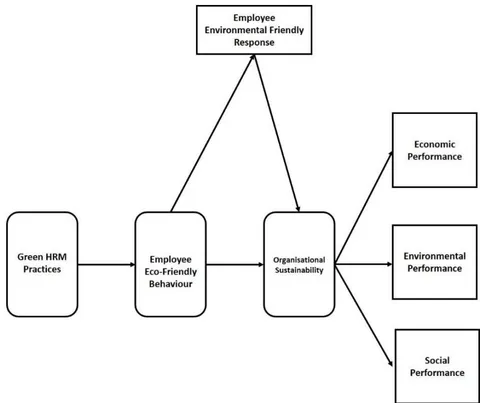
The concept of organizational citizenship behaviour for the environment (OCBE) has gotten a lot of attention in the environmental literature, and it appears to be a realistic method for understanding environmentally friendly conduct in the workplace (Daily et al., 2009; Paillé et al., 2013). Employees' OCBE has a good association with strategic human resource management, which is equal to green human resource management (Paillé et al. 2014). This study anticipates GHRM to have a considerable impact on employees' eco-friendly behaviour, based on the previous discussion and synthesis, hence the authors suggest the following hypothesis:
Green human resource management is positively related to employee eco-friendly behaviour
Except for the study, few empirical studies have verified the link between employees' OCBE and environmental performance (Paillé et al. 2014). Employee OCBE is a direct driver of environmental performance, according to their findings. Employee environmental initiatives, such as trash reduction, should assist companies in meeting their environmental goals and improving overall environmental performance (Daily et al. 2009). Environmental performance can be improved by combining environmental management systems with the spontaneity of eco-friendly behavior (Roy et al. 2013). As a result, the direct relationship between employees' eco-friendly conduct and hotel environmental performance is investigated in this study. Although current research suggests that green human resource management is a direct contributor to company sustainability, employee eco-friendly behaviour is just as important (Kim et al. 2019). In addition to GHRM, there is a need to theorize eco-friendly behaviour effects of corporate sustainability. Employee eco-friendly behaviour, according to current research, mediates the relationship between GHRM and business sustainability (Elshaer et al., 2021).
Employee environmental obligations are described as employees who voluntarily do duties targeted at environmental conservation that, if not performed, may result in a sense of guilt. Environmental obligations have been discussed as moral and ethical dilemmas in the literature on environmental science (Lenzen and Murray, 2010). Environmental obligations are concerned with determining what is right and wrong in terms of individual activities in terms of environmental sustainability. As a result, environmental responsibility would be discussed and evaluated more specifically in the context of individual employees rather than in a broad sense (Hameed et al., 2019). Because environmental responsibility is a direct effect of GHRM and can help with sustainability, it is a matter of personal morality. As a result, its role as a moderator would explain the link between GHRM and corporate social responsibility. The theoretical framework for the study is provided in the Figure 1.
Employee eco-friendly behaviour has a positive impact on employee environmental performance
Employee eco-friendly behaviour is positively associated with Organisational Sustainability (OS).
Employee environmental friendly response is positively associated with organizational sustainability
Employee eco-friendly behaviour mediates the link between green human resource management (GHRM) and Employee environment-friendly response
Employee eco-friendly behaviour mediates the link between GHRM and OS.
Employee eco-friendly behaviour mediates the link between Employee environment-friendly responsibility and organizational susceptibility.
Employee environmental responsibility moderates the link between Employee environment-friendly behaviour and GHRM and organizational susceptibility
IV. METHODOLOGY
a) Context of the study
Indian Metro Hyderabad with more than 10 million population hosts more than 500 information technology, Business Process Outsourcing (BPO), IT-enabled and E-commerce companies and about 1 million are employed in these companies. The information technology business exports nearing US $ 20 billion and contribute about 8% to Indian GDP (https://telanganatoday.com/telangana-it-exports-to-cross-rs-1-4-lakh-cr). Though some studies were carried out on green human resources management, the studies restricted employee environment performance and eco-friendly behaviour. There is scarce literature on organizational sustainability with green human resources management. The study was carried out the surveying Information Technology sector employee of Hyderabad.
b) Measurement
The data was gathered using a structured undisguised questionnaire using a Likert-type five-point scale. The Green HRM (GHRM, 6 items); Employee eco-friendly behavior (EEFB, 7 items); Employee environment-friendly response (EEFR, 7 items) following the model of Kim et al., (2019); whereas organizational sustainability is a multidimensional concept with three
factors social performance (SOCP, 6 items), economic performance (ECOP, 6 items) and environmental performance (ENVP, 10 items) using the model adopted from Chow and Chen (2012; Zhu et al., 2018; 2016).
c) Data collection
The research instrument, the survey questionnaire was published on google forms and the link was provided to about 5000 IT sector employees of various IT companies in the Hyderabad metro. Out of 5000 questionnaires we have received the responses from 984 employees, for data analysis, only 924 were considered, whereas the other 60 responses were incomplete and were not considered for the study. The estimated sample size (Cochran, 1977) for the unknown population is 385; however, the study used 924 responses. The demographic characteristics were presented in Table 1.
d) Results
The partial least squares structural equation modeling (PLS-SEM; SPSS ver 27) was used for data analysis. The PLS-SEM model estimates contingent variables to measure the effect of employee eco-friendly behaviour as a mediator between GHRM and organizational sustainability. The inner and outer models were examined using PLS-SEM (Hair et. al., 2017; Ringle et al., 2015).
| Variable | Category | Number | Percent |
| Gender | Male | 474 | 51.30 |
| Female | 450 | 48.70 | |
| Total | 924 | 100 | |
| Age | 20-30 | 447 | 48.37 |
| 30-40 | 311 | 33.65 | |
| 40-50 | 101 | 10.93 | |
| >50 | 65 | 7.05 |
e) Common method bias
In the survey research with behavioural sciences, the data collection is from various sources a procedure to avoid common method bias. However, this approach has some disadvantages. To assess the possible CMB, the researchers employed such as giving specific instructions to the participants, and avoiding vague and confusing terms to ensure that all the questions receive responses with an equal amount of work. Further, the assessed Harman single factor test's findings indicate approximately of the variation in the study data indicating no common method bias (Harman 1967).
Table 2 presents the results of reliability, convergent, and discriminant validity of the
measurements. The Cronbach alpha values ranged between 0.893 to 0.964 for the variables GHRM, EEB, and EEFR whereas for organizational sustainability ranged from 0.737 to 0.867 indicating high reliability of the research instrument. Similarly, the construct reliability values ranged from 0.698 to 0.899 for GHRM, EEB and EEFR variables whereas for organizational sustainability the values ranged from 0.826 to 0.921. For the convergent validity average variance extracted was assessed. The AVE values – GHRM 0.894; EEF 0.896, EEFR 0.965, SOCP 0.867, ECOP 0.814 and ENVP 0.764 indicated high convergent validity as all the variables were above the criterion of 0.50 according to (Fornell and Larcker, 1981).
| Variable | Cronbach Alpha | AVE | CR |
| Green human resource management (6 items) - GHRM | 0.894 | 0.894 | 0.738 |
| Employee eco-friendly behaviour (7 items) - EEFB | 0.893 | 0.896 | 0.698 |
| Employee Environment Friendly Response (7 items)-EEFR | 0.965 | 0.964 | 0.899 |
| Organizational sustainability | |||
| - Social performance (6 items) - SOCP | 0.864 | 0.867 | 0.874 |
| - Economic performance (6 items) - ECOP | 0.783 | 0.814 | 0.826 |
| - Environmental performance (10items) - ENVP | 0.737 | 0.764 | 0.921 |
| CR: Construct reliability; AVE: average variance extracted; Alpha: Cronbach alpha | |||
The discriminant validity is assessed by measuring Heterotrait-Monotrait (HTMT) were less than the threshold value of 0.9 which indicates appropriate
for the study (Henseler et al., 2015) and are indicated in Table 3.
| Variable | EEFB | EEFR | GHRM | Organizational sustainability |
| EEFB | ||||
| EEFR | 0.674 | |||
| GHRM | 0.513 | 0.513 | ||
| Organisational sustainability | 0.688 | 0.687 | 0.793 |
f) Higher-order constructs
All the measures suggested by Sarstedt et al. (2019) were followed to assess the higher-order construct. The VIF values in Table 4 presented indicated
that there is no collinearity issue. The outer weights were tested using bootstrapping protocol of 8000 samples, and outer weights values for all organizational sustainability factors are significant at level.
| Variable | Sub-factor | Outer Weights | T-values | VIF |
| Organizational sustainability | Social performance | 0.667** | 4.976 | 2.110 |
| Economic performance | 0.389** | 3.123 | 2.393 | |
| Environmental performance | 0.513** | 4.672 | 2.003 | |
| Note: **p<0.01; VIF=Variance inflationfactor | ||||
organizational sustainability factors are significant at level.
To eliminate the data point the blindfolding, a sample reuse strategy following the methodof Hair et al., (2017) was used. The values are greater than 0 indicating the predictive relevance for a model
dependent construct (Fornell and Cha, 1994). The values presented in Table 5 indicates the statistical relevance of the endogenous constructs.
| Predictor Variable | Target variable | R² | Predictive accuracy | Q² |
| GHRM, EEFR | Employee eco-friendly behaviour | 0.084 | High | 0.080 |
| GHRM, EEFB | Employee environmental friendly response | 0.309 | High | 0.308 |
| GHRM, EEFB, EEFR | Organizational sustainability | 0.366 | High | 0.336 |
g) Hypotheses testing - Structural model
To test the hypotheses authors subjected the data to PLS-SEM model for green human resource management and organizational sustainability. A consistent PLS bootstrapping algorithm, a resampling technique to test the path coefficients in a reflective PLS-SEM applied (Dijkstra and Heneseler, 2015).
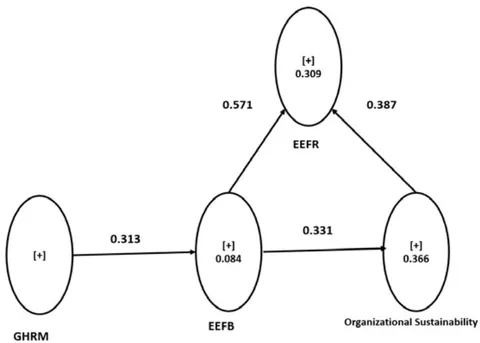
Using the structural model metrics including direction coefficients, coefficient of determinations , impact size , and predictive validity were assed (Hair et al., 2017). The is the model's total statistical accuracy (Hair et al., 2014). The Table 5 the values from PLS-SEM analysis, show a high (0.08) for employee eco-friendly behaviour, (0.309) for employee environment friend response (0.366) for organizational sustainability, indicating high predictive accuracy Cohen (1988) recommends values of 0.26 (large), 0.13 (medium), and 0.02 (small).
The effect size is measured to assess if the missing construct had a significant impact on the endogenous variable (Hair et al., 2017). Green human resource management and employee eco-friendlyly behaviour has a small impact on employee eco-friendly behaviour and organizational sustainability.
However, Employee environmental friendly response has a moderate effect on corporate sustainability . The employee eco-friendly behaviour has a large effect and statistically significantly impacts Employee environmental friendly response (Table 6). The values are according to Cohen (1988) are 0.02, 0.15, and 0.35 indicating small, medium, and large impact sizes, respectively.
| Predictor variable | Target variable | f² | Effect size |
| GHRM | EEFB | 0.087 | Small |
| EEFB | EEFR | 0.412 | Large |
| EEFB | Organizational sustainability | 0.141 | Small |
| EEFR | Organizational sustainability | 0.163 | Moderate |
The bootstrapping strategy (8,000 subsamples, with one-tailed significance) was applied to approximate the statistical importance of the parameter. The results in Table 7, green human resource management (H1, , , ) positively associated with employee eco-friendly behaviour (EEFB). The employee environmental friendly response (EEFR) is statistically significantly influenced by (H2) employee eco-friendly behaviour. The EEFB and EEFR were positively associated with organizational sustainability (H3 and H4, , , , , , ). The results from the mediation model to test the hypothesis (H5) indicate that employee eco-friendly behaviour positively impacts the GHRM and employee environmental friendly response. The indirect effects observation indicates that GHRM ( ,
, ) have statistically significant indirect effects on employee environmental friendly response by employee eco-friendly behaviour, and H5 was endorsed. Employee eco-friendly behaviour mediates the association between GHRM and Organizational sustainability (H6, , , ). The employee eco-friendly behaviour and organizational sustainability (H7, , , ) were statistically significantly moderated by their Employee environmental friendly response. At last, the employee eco-friendly behaviour with organizational sustainability mediates between GHRM and employee environmental friendly response (H8, , , (Table 7).
| Construct | Actual sample | Sample Mean | SD | t-value | p-value | Outcome |
| Direct effect | ||||||
| H1:GHRM→EEFB | 0.313 | 0.287 | 0.066 | 4.486 | 0.000 | Supported |
| H2:EEFB→EEFR | 0.571 | 0.574 | 0.060 | 9.634 | 0.000 | Supported |
| H3:EEFB→Organisational sustainability | 0.331 | 0.300 | 0.083 | 3.807 | 0.000 | Supported |
| H4:EEFR→Organisational sustainability | 0.387 | 0.313 | 0.080 | 4.571 | 0.000 | Supported |
| Indirect effect | ||||||
| H5: GHRM→EEFB→EEFR | 0.157 | 0.196 | 0.049 | 3.555 | 0.000 | Supported |
| H6:GHRM→EEFB→Organisational sustainability | 0.101 | 0.108 | 0.044 | 2.371 | 0.000 | Supported |
| H7:EEFB→EEFR→Organizational sustainability | 0.223 | 0.205 | 0.048 | 3.987 | 0.000 | Supported |
| H8:GHRM→EEFB→EEFR→Organizational sustainability | 0.091 | 0.090 | 0.021 | 3.365 | 0.000 | Supported |
V. DISCUSSION
This study investigates the association between information technology companies GHRM and environmental performance through employee eco-friendly behaviour. The GHRM effect on organizational sustainability is also assessed through mediating the role of employee eco-friendly behaviour and moderating the effect of employee environmental friendly response. H1 finding shows that GHRM has a significant impact on employee eco-friendly behaviour (EEFB) and the results are in line with the findings of Kim et al., (2019), which reported that employee eco-friendly behaviour enhanced environmental sustainability in the workplace. This means employee environmentally sustainable conduct focuses behaviours appropriate for IT companies related to energy use, water use, and waste reduction.
The finding of H2 indicates that employee eco-friendly behaviour is the most robust predictor of employee environmental friendly response, and this
outcome is in line with the prior research (Umrani et al., 2020; Kim et al., 2019), that reported that employee eco-friendly behaviour determinant to employee environmental friendly response and responsibility, on green activities. The employee eco-friendly behaviour allows employees to know about environmental systems, environmental conservation skills, and environmental concerns. The finding of H3 suggests that employee eco-friendly behaviour has a positive and statistically significant association with organizational sustainability at the workplace. Blok et al., 2015 reported similar results, and indicated that employee eco-friendly behaviour is an essential driving force for enhancing organizational sustainability. The employees play an important role in enhancing organizational sustainability by engaging in various eco-friendly activities (Yong et al., 2020). Employees may concentrate on resource conservation, sustainable employment, health and safety and influencing the staff members. The study reports that employee environmental friendly response has a statistically significant association with
organizational sustainability (H4), and this finding is in line with reported research of (Stanwick & Stanwick, 1998); The employees realize their responsibilities toward organizational sustainability to achieve environmental, economic, and social performance. The overall organizational sustainability, organizational practices, with a green emphasis on employees are critical to achieving long-term organizational sustainability. The organizations now look toward the growth that equally favors the economic, environmental, and social dimensions. The outcome of this empirical study indicated that employee eco-friendly behaviour is a significant mediator between GHRM and employee environmental friendly response to promote organizational sustainability (H5 and H6). The employee's eco-friendly behaviour promotes green practices and environmental responsibility culture in the workplaces of information technology. This includes water conservation, reducing carbon footprints, recycling the natural reserves, a paperless environment, less usage of plastic, and reduced wastage (Scherbaum et al., 2008).
The supported finding H7 indicates that employee environmental friendly response is a positive moderator among employee eco-friendly behaviour and organizational sustainability. This result confirms the earlier findings of (Baker et al., 2014), that responsible employees are actively involved in environmental and social issues and the conservation of resources to promote the culture of sustainable development. Umrani et al. (2020), opined that environmentally friendly responsibility and environmental performance are positively associated.
The employee eco-friendly behaviour is statistically significant and a mediator between GHRM, employee environmental friendly response and influences organizational sustainability (H8). This result confirms the findings of (Nortan et al., 2014), that organizations are implementing sustainability strategies to promote environmentally friendly behaviour. If employees are concerned with environmental problems, the employee contribute through environmental skills, abilities, and behaviours and have organizational citizenship behaviour (Kim et al., 2019). Employee eco-friendly behaviour is an upcoming area of research. This behaviour promotes the willingness or behaviour exhibited by an employee that protects the environment from the negative effect of human activities (Saeed et al., 2019). Organizational sustainability is measured in social, economic and environmental aspects (Gardberg & Fombrun, 2006).
VI. CONTRIBUTION TO THE NEW THEORIES
This research contributes to the academic conversation on GHRM and corporate sustainability in several ways, there is a strong association between
GHRM and employee environmental stewardship and organizational sustainability. The outcomes of this study add to the knowledge of how employees achieve organizational sustainability by using GHRM principles. Employee eco-friendly behaviour was used as a potential mediator between GHRM and organizational sustainability in this study. The study reports that employee environmental responsibility is a critical driving force for supporting GHRM practices and organizational sustainability, this study adds paradox theory to this line through achieving environmental, economic, and social performance. Evaluating GHRM and organizational sustainability through the mediating role of employee eco-friendly behaviour and the moderating effect of employee environmental friendly response promotes sustainability in the organization.
VII. PRACTICAL IMPLICATIONS
The empirical data from our study reveals that organizations that include organizational sustainability as part of their strategic goals and use GHRM to address and accomplish such goals will only exist within the organization and in people's minds. As a result, a virtuous circle will emerge in which participants in the GHRM program engage in creative conversation, generate fresh ideas, and respect the views of others. Such trends will help a business reach its objectives more effectively and efficiently. Second, our findings can assist researchers to focus their efforts on establishing organisational sustainability through environmental responsibility and environmentally friendly employee behaviour. According to our findings, GHRM practices will aid in the development of eco-friendly behaviour among employees, resulting in the achievement of organizational sustainability goals. Finally, the current study emphasizes the importance of environmentally conscious behaviour and environmental stewardship. Current research, on the other hand, has positioned GHRM as a direct contributor to environmentally conscious behaviour and an indirect contributor to environmental stewardship. Finally, the current study gives managers insight into how to build GHRM practices that encourage eco-friendly behaviour and environmental stewardship, which leads to the accomplishment of business sustainability goals.
VIII. LIMITATIONS AND FUTURE RESEARCH
Though study has applied several statistical methods do have some limitations, and can provide an insight for future studies the findings and the data collected are from a single industry, the information technology. Therefore, we encourage future researchers will revisit the model tested in this study by gathering data from multiple sources at different time of intervals. The reported empirical study was conducted in the
information technology sector in Hyderabad, an Indian Metro. We hope that researchers will carry out the studies with multi-sectors from across countries to understand better GHRM practices in developing and developed countries. However, this is a difficult task for the researchers on data collection. This study applied only eco-friendly employee behaviour as a mediator. However, future researchers may be examining parallel mediations such as top management commitment and organization green culture to view the role of top management and culture in corporate sustainability. This study also suggests that future researchers may examine the GHRM and corporate social responsibility through the mediation mechanism of green human capital, top management commitment, and employee commitment, especially in the service sector. Future research may look into the possible moderating effects of sustainable leadership, employee psychological wellbeing, and green employee engagement, which could impact the intensity of the direct and indirect effects reported in this study.
IX. CONCLUSION
The presented empirical study investigated the green HRM practices in associate with organizational sustainability in the information technology companies of Hyderabad Metro, India. This study discovered that green HRM practices can promote organizational sustainability through the mediation mechanism of employee eco-friendly behaviour in the workplace of the IT sector. The results also demonstrated that employee environmental friendly response is the main catalyst force for employees to engage in sustainability practices.
Green HRM
- My organization provides adequate training to promote environmental management as a core organizational value.
- My organization considers how well employee is doing at being ecofriendly as part of their performance appraisals.
- My organization relates employee's eco-friendly behavior to rewards and compensation.
- My organization considers personal identity-environmental management fit in recruitment and selection.
- Employees fully understand the extent of corporate environmental policy.
- Organization encourages employees to provide suggestions on environmental improvement. Employees' organizational commitment
Employee's Organizational Commitment
I talk up my firm to my friends as a great firm to work for.
I find that my values and the firm's values are very similar.
I am proud to tell others that I am a part of this firm.
I am willing to put in a great deal of effort beyond what the firm normally expects in order to help my firm be successful.
My firm really inspires the very best in me in the way of job performance.
I am extremely glad that I chose this firm to work for over the others I was considering at the time I joined.
I really care about the fate of this firm.
For me, this is the best of all possible firms for which to work.
Employees' eco-friendly behavior
- Before I get off work, I turn off the electric appliances, such as computers, TV monitor, etc.
- When I leave a room that is unoccupied, I turn off the light.
- I sort and recycle garbage in the workplace.
- I conserve materials at work
- I reuse materials at work
- I limit water use in toilet to save water.
- I pay close attention to water leak
Employee Environment Friendly Response
- Reduced wastes
- Conserved water usage
- Conserved energy usage
- Reduced purchases of non-renewable materials, chemicals, and components.
- Reduced overall costs
- Improved its position in the marketplace
- Helped enhance the reputation of our hotel
Sustainability is multidimensional concept with social performance, environmental performance and economic performance
Social development (7-point Likert scale; 1 = a small extent, 7 = a larger extent)
SOC1 Our firm improved employee or community health and safety
SOC2 Our firm recognized and acted on the need to fund local community initiatives
SOC3 Our firm protected claims and rights of aboriginal peoples or local community
SOC4 Our firm showed concern for the visual aspects of the firm's facilities and operations
SOC5 Our firm communicated the firm's environmental impacts and risks to the general public
SOC6 Our firm considered interests of stakeholders in investment decisions by creating a formal dialog
Economic development (7-point Likert scale; 1 = a small extent, 7 = a larger extent)
ECO1 Our firm sold waste product for revenue
ECO2 Our firm reduced costs of inputs for same level of outputs
ECO3 Our firm reduced costs for waste management for same level of outputs
ECO4 Our firm worked with government officials to protect the company's interest
ECO5 Our firm created spin-off technologies that could be profitably applied to other areas of the business
ECO6 Our firm differentiated the process/product based on the marketing efforts of the process/product's environmental performance
Environmental development (7-point Likert scale; small extent, larger extent)
ENV1 Our firm reduced energy consumption
ENV2 Our firm reduced wastes and emissions from operations
ENV3 Our firm reduced impact on animal species and natural habitats
ENV4 Our firm reduced the environmental impacts of its products/service
ENV5 Our firm reduced environmental impact by establishing partnerships
ENV6 Our firm reduced the risk of environmental accidents, spills, and releases
ENV7 Our firm reduced purchases of non-renewable materials, chemicals, and components
ENV8 Our firm reduced the use of traditional fuels by substituting some less polluting energy sources
ENV9 Our firm undertook voluntary actions (e.g., actions that are not required by regulations) for environmental restorations
ENV10 Our firm undertook actions for environmental audit, public disclosure, employee training and immunity