The Newly Discovered Topological Theory of Quantum Gravity(TTQG) ‐ A Multiblock Compatibilizer Cum Modifier of the Existing Theories of Physics, Cosmology, Quantum Mechanics and Quantum Computing
## I. INTRODUCTION
In recent times the 'Topological Theory of Quantum Gravity' (TTQG) [98-104] has been discovered and proposed to the world scientific community and is attracting world wide attention and gaining popularity. Like a 'Multi block Co polymer' in the field of polymer science, whose action is to compatibilize a multi component homogeneous mixture of other different polymers (called polymer blend), the said TTQG has tied up the existing theories of physics (the Newtonian Physics, Quantum Physics, the theories of relativity, thermodynamics, the string theories, quantum mechanics...etc...and other theories) to the same source by its versatile compatibilizing characteristics. The schematic presentation of a what a multi block co polymer is and how is it compatibilizing a mixture of other polymers is in Figure 1 below:
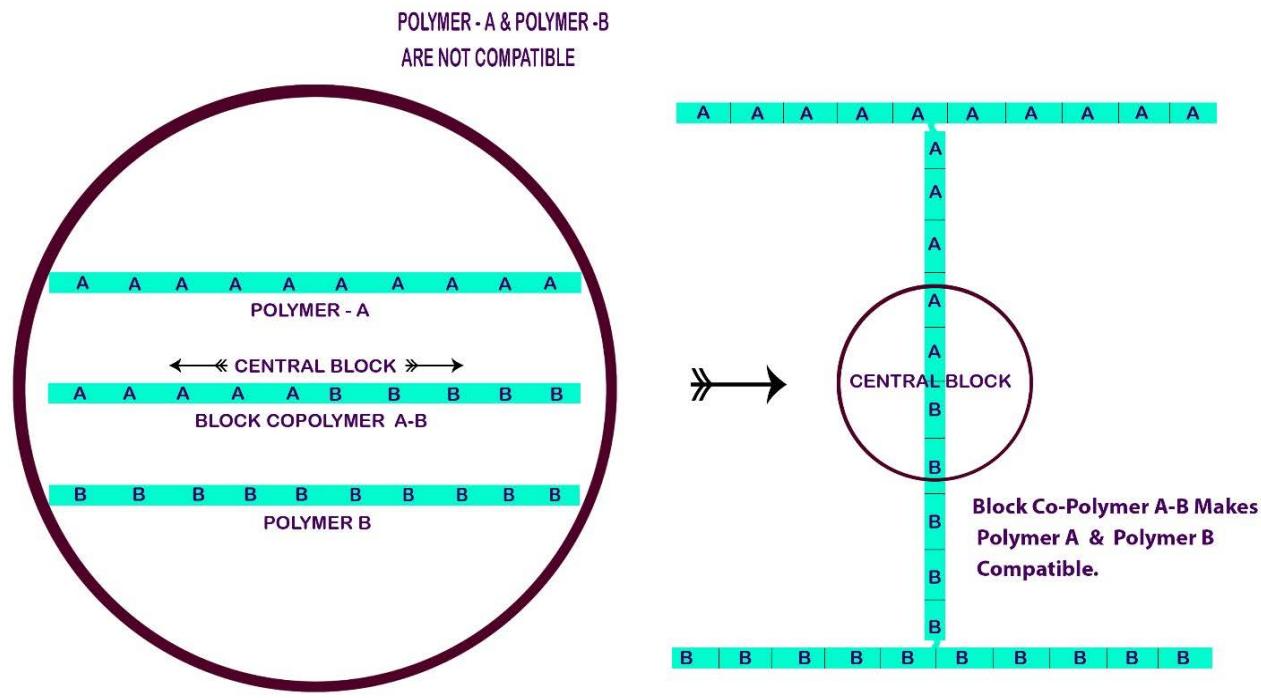 Figure 1: Compatibilizing Action of a block Co-polymer on an another Polymer Pair
As a matter of fact mixture of different polymers are incompatible from the stand point of thermodynamics owing to their vanishing small entropy of mixing. So this entropic disfavored situation is counter balanced by using block co-polymers.Following the physical chemistry dictum like dissolves like', the block co - polymers are tailor made which contains the basic ingredients of the polymer mixture distributed over the 'different' or the 'multi' blocks. Each block of the co-polymer is compatibilizing one or the other polymer of the polymer mixture on the ground of both of them being chemically identical. This way, as a whole the mixture of the 'block co-polymer' and the 'polymer mixture' become an integrated, homogeneous and a compatible entity.
The none of the existing theories of physics are 'complete' for their major shortfalls, the one or the other, and mostly are incompatible to each other as shown in Table 1 below:
Table 1: Incompleteness of the current theories of physics
<table><tr><td>SI No.</td><td>Theory of Physics</td><td>Theory Based on</td><td>Shortfall</td></tr><tr><td>1.</td><td>Classical Or Newtonian Physics</td><td>Laws of motion and the law of Gravitation, Maxwell equations of electrodynamics, classical thermodynamics</td><td>Time space not considered.
Geometry of mass, time and gravitation not offered.
No topological or geometrical presentation of the laws of thermo-dynamics were given</td></tr><tr><td>2.</td><td>Theory Of Relativity</td><td>Space and time are different for different frames (with different velocities) of observation.
Gravitation is the warp of the massive objects and space-time is distorted</td><td>Quantization of 'space -time' could not be explained.
Geometry of mass, time and gravitation not offered.</td></tr><tr><td></td><td></td><td></td><td>No explanation of the dark matter and dark energy of the universe presented.</td></tr><tr><td>3.</td><td>Quantum Physics</td><td>Energy is quantized in the form of 'photons' of different wavelengths.
Photons are dual in nature and do behave both as a particle and an electromagnetic wave.</td><td>Energy and EM-wave are considered to be the same physical variable of the universe and which is fully illogical and unacceptable
Geometry of mass, time and gravitation not offered.
Topology of a photon not described.
No explanation of dark energy and dark matter of the universe given.</td></tr><tr><td></td><td></td><td></td><td>No Explanation Of Dark Matter And Dark Energy Of The Universe</td></tr><tr><td>4.</td><td>Quantum Mechanics</td><td>Heisenberg's uncertainty principle of position and momentum of microscopic particles.
Dual nature of objects both as particle and wave.
The trajectory of the microscopic particles are represented by wave functions and the existence of objects in the space are probabilistic.
Properties such as position, speed, energies are discrete and are distributed in the form of packets, or quantum</td><td>Fully silent on the phenomenon of gravitation, the rheological and the thermodynamic properties of matter.
The mystery of the dual nature of the objects could not be revealed.
The wave function is a complex and non-observable quantity and its physical significance to a particle not described.
While some observables are shown to be quantized, the 'time observable' is considered continuous and absolute.</td></tr><tr><td>5.</td><td>String Theory</td><td>All the particles (photons and quarks) are represented by one dimensional strings of length of similar degree of order to planck length.
Brains of string theory are sheet like objects are capable of moving through space-time obeying the rules of quantum mechanics.
Talks about extra 6 dimensional 'space-time' although no direct evidence proposed.
A serious attempt had been taken to merge quantum mechanics and general relativity with limited success.</td><td>Cannot explain the quantum nature of the observables
Cannot unify the other theories of physics and cosmology in a large frame.
cannot offer the geometry of gravitation and 'time-space'.
Cannot explain the dark energy and dark matter of the universe.
Cannot explain the physical significance of the constants in physics like universal gas constant, Stefan-Boltzmann constant and others.
Cannot explain the cold nuclear fusion phenomena of the universe.</td></tr></table>
All the said 'shortfalls' of the different theories as presented in Table 1 above have been overcome in TTQG, by the way of explaining the cosmic phenomena of the universe through the exchange, entanglement, interference and superposition of the multi various 'push forward' and 'pull back' quantum gravitons, and is being presented in this article.
In figure 2 below, the topologies of the gravitons of TTQG are shown. [99]
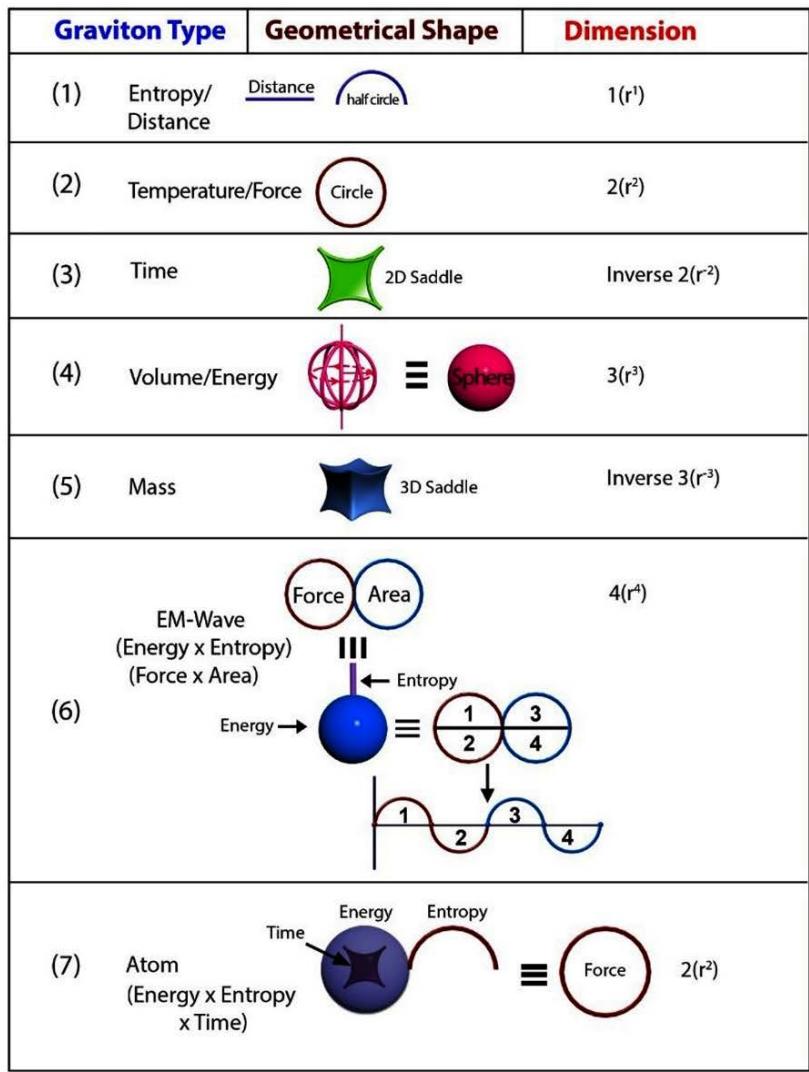 Figure 2: Geometrical shapes of the gravitons of TTQG
'THEORY OF EVERYTHING(TOE)'; in context to the current need of physics and cosmology [1-97], is a topic of much discussions now. As is playing in the minds of most of the first line scientists of physics and cosmology, that to fit in the model of TOE, a theory has to be very robust and versatile and the theory should be in a position to fully explain and connect all the happenings and aspects of the universe. In this regard to add here, that the said TOE has to be a multi block compatibilizing one (as explained above) and as well has to establish the fact that the theories of physics proposed so far, though have been presented in many forms but they are inherently identical by their origins or routes. The multi block compatibilizing characteristic of TTQG is schematically shown in Figure 3 below:
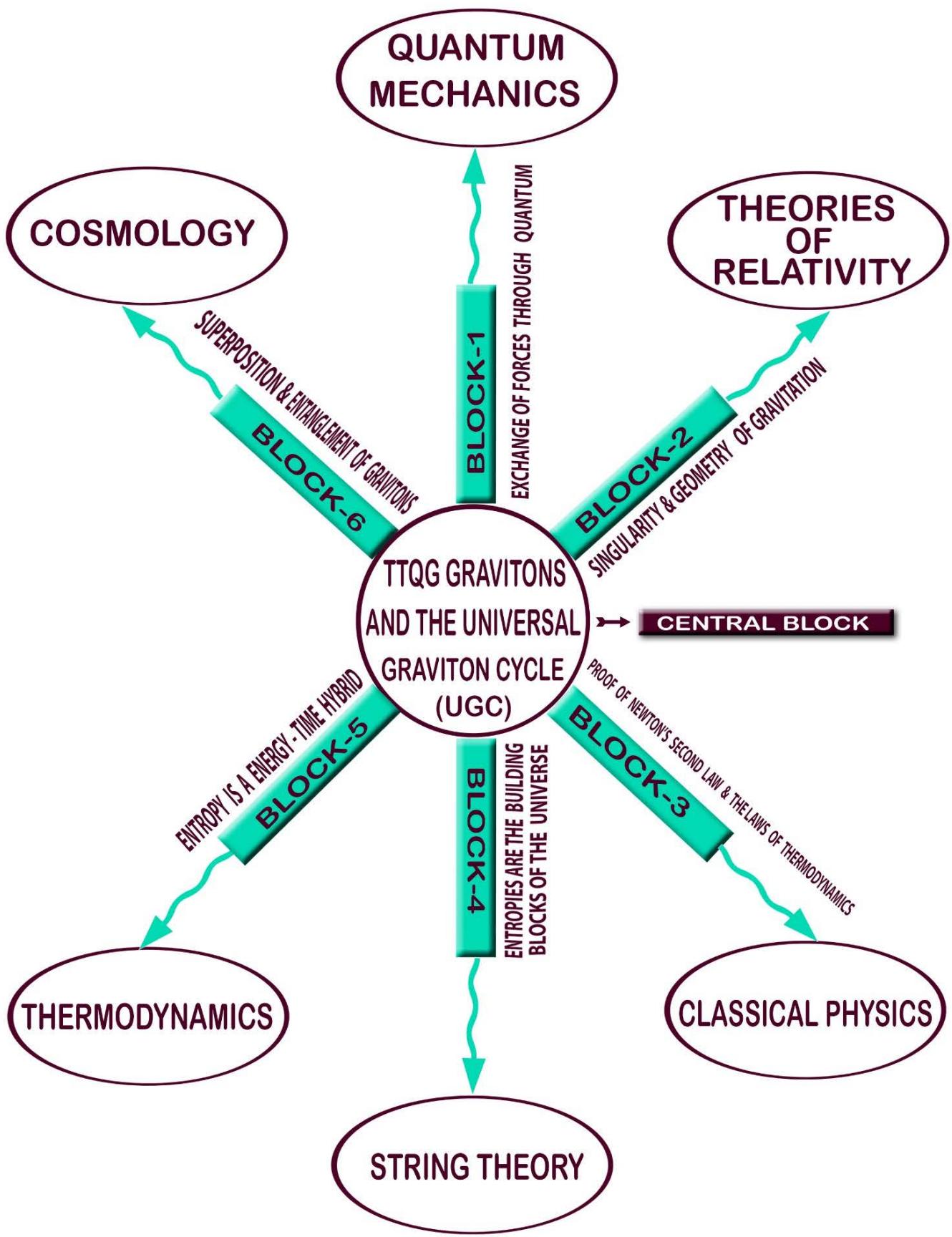 Figure 3: TTQG - Bridging and compatibilizing the existing theories of Physics & Cosmology
## II. PLANCK'S CONSTANT h AND
### HEISENBERG'S UNCERTAINTY PRINCIPLE
Planck constant $h$ is related very much to the Heisenberg's uncertainty principle by the following equation
$$
Et = h \tag{1}
$$
Where $E$ represents energy and $t$ represents time. The above mentioned equation is obtained from the main hypothesis of Heisenberg (i.e $\Delta p \Delta x = h$, $\Delta p$ and $\Delta x$
stand for uncertainty in momentum and position (respectively)) by doing some simple algebraic manipulation. However, since time is an 'abstract' variable so the product of E and t gives rise to an another abstract physical variable, h, being expressed in the unit 'energy. second'. It is the TTQG only, which for the first time in the history of physical science could topologically establish the identity of h being same to same to that of the thermodynamic parameter (or 'degree of randomness' parameter, S), entropy. This is shown diagrammatically in Figure 4 below:
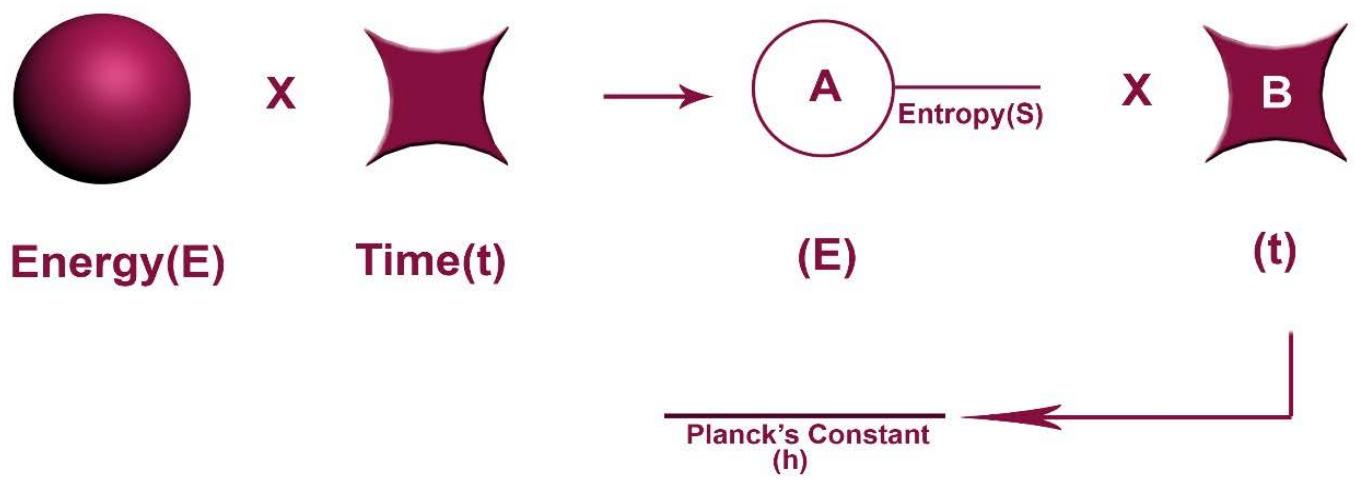 Figure 4: Topological presentation of 'E-t' or 'Energy-time' hybrid
In figure 4, the circle A and the 2D saddle B swallow each other (since their dimensions are inverse to each other) so what is left is a 'distance' S (represented by r in TTQG) and which is the entropy parameter of thermodynamics as established in TTQG. Mathematically this is being shown as below:
$$
\mathrm {h} = \mathrm {E t} = (4 \pi \mathrm {r} ^ {3}) \times (3 / 4 \pi \mathrm {r} ^ {2}) = 3 \mathrm {r}. \tag {2}
$$
## III. ENERGY EXPRESSION OF CLASSICAL
### PHYSICS VIS-A-VIS TTQG EXPRESSION
#### OF ENERGY AND EM-WAVE
The energy expression of classical physics is:
$$
Energy (E) = Force \times Distance \dots \tag{3}
$$
Equation (3) can be rewritten in the form $\{\text{keeping in mind that force} = (\text{pressure x area})$ and $(\text{area}) \times (\text{distance}) = \text{volume}\}$
$$
E = \mathrm{Pressure} \times \mathrm{area} \times \mathrm{distance} \tag{4}
$$
Neither from the equation(3) and nor from the equation(4) of classical physics one can evaluate the dimension of 'Energy'. The said situation is analyzed below:
i) In equation (3), the dimension of 'distance' is known. To determine the dimension of 'Force', one faces the problem of 'circularity of definition'. ii) 'Force' is the product of 'Pressure' and 'Area' and while the dimension of 'Area' is known but in classical physics, 'Pressure' is expressed in regard to 'Energy' as 'Energy per unit volume' and 'Energy' in turn is expressed in regard to 'Pressure' as 'Pressure x volume'. This is what is called the 'problem of circularity' of definition. iii) Obtaining the topology of energy in the 'Discrete' or 'Quantum' form is not possible without utilizing the topology of the physical variables as shown in Figure 3 above of TTQG and the new mathematical relation derived in the same, i.e., $E = 3V$, or the energy density of space is constant ( $E / V = 3$ ).
The well known ideal gas equation is (for 1 mole of ideal gas):
$$
P V = R T \dots \tag {5}
$$
R is the 'Universal gas constant' and T is the temperature. Under the condition of equilibrium with the surroundings, $P = 1$, and replacing V by (E/3) in equation (5), one gets
$$
E = 3 R T \dots \tag {6}
$$
Now utilizing the TTQG mathematical expression of $E$ ( $= 4\pi r^3$ ) and $T$ ( $= 4\pi r^2 / 3$ ), one gets from equation (6) above,
$\mathsf{R} =$ universal gas constant $= (\mathrm{E} / 3\mathrm{T}) = \mathrm{r}$....(7)
So energy, E, in classical physics can be represented in the form of 'quantum' by 3 numbers of
3D spheres of radius $r$ each, such that the summation of three volumes (V), gives the energy, E:
$$
E = (4\pi r^3/3) + (4\pi r^3/3) + (4\pi r^3/3) = (V + V + V) = 3V
$$
As shown in Figure (5) below [101], when each of the above said 3D sphere is squeezed, either through $x$, $y$ or $z$ axis, they turn into a force circle and one of the radius's (r) emerge out of the 3D sphere. In such situation the energy 3D quantum takes the shape of hybrid of 'force' and 'distance'. In Figure 5 below, the form 'A' is 'integrated' form, 'B' is the 'transitory' form and form 'C' is the 'differential' form of the energy quantum.[101]
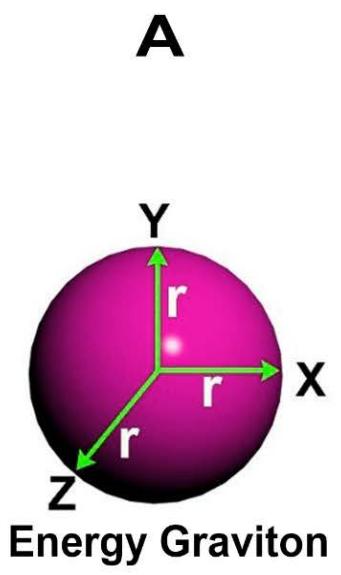
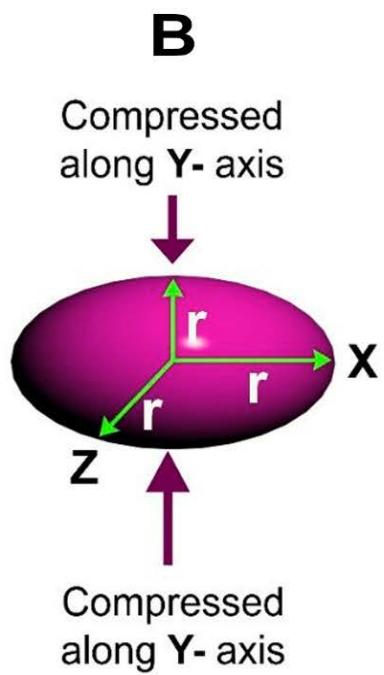
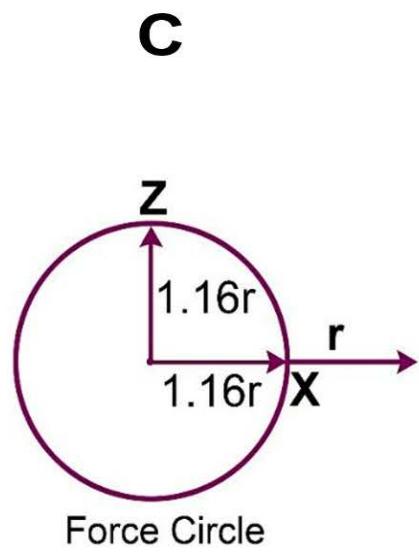 Energy = Work Done = Force x Distance Figure 5: Energy Graviton (3D SPHERE) expressed as the hybrid of 'force' and 'distance'(r)
The mathematics of the transformation of the energy quantum from integrated form (A) to the differential form is shown below:
$$
(4 \pi r ^ {3} / 3) = (4 \pi r ^ {2} / 3) \times r = \left\{\pi (1. 1 6 r) ^ {2} \times r \right\}. \dots \dots \dots \dots \dots \dots \dots \dots \dots \dots \tag {8}
$$
From each 3D sphere one 'r' is emerged out and for 3 numbers of 3D spheres, the total distance becomes $(\mathbf{r} + \mathbf{r} + \mathbf{r}) = 3\mathbf{r}$ and which is the value of the Planck constant 'h' as shown in equation 1. So it is firmly established that 'Planck constant', h, is purely en-tropic. So the energy expression in TTQG takes the following form (from equation 6 above)
$$
Energy (E) = 3RT = (entropy × temperature)
$$
$$
= \{3 r \times (4 \pi r ^ {2} / 3)\}
$$
\[In TTQG, 'temperature'(T) is a 'push forward force Graviton' and time (t) is a 'pull back force graviton' such that $(\mathrm{T}t = 1)$ \] In both classical physics and quantum physics, in one hand, at times, no distinction has been made between 'energy' and 'electromagnetic or EM wave' and very often the said two physical variables have been cited in the literature interchangeably in place of the other but on the other hand their definitions have been put in such a fashion that they appear to be different physical variables of the universe. Electromagnetic radiation, in classical physics, is the flow of energy at the speed of light through space or through a material medium in the form of electric and magnetic fields that make up EM waves such as radio waves, visible light, UV light, gamma rays...etc.
As per as the logic and philosophy of the TTQG is concerned[98], the 'energy' and 'EM-wave' are distinctly different physical variables of the universe having different dimensions and topology. While 'energy' is a quantum in the form of a integrated 3D sphere/ellipsoid, when it flows to the space, it has to acquire another new axis for its motion (in the form of distance or entropy) and it unfolds to the differential form. In other words, 'Energy' is the superposition of 'push forward force' and 'entropy' to form 'packets' or 'quanta' of a certain volume (equation 9 above), the 'EM-wave' is the superposition of 'energy' and 'entropy' and resulting to the further spread of the energy in the form of 'EM-wave packet or quanta' of higher volume than the 'energy quanta'.
$$
\begin{array}{l} E M - w a v e = (E n e r g y \times E n t r o p y) \\= (4 \pi r ^ {3} \times 4 \pi r) \\= (4 \pi r ^ {2} \times 4 \pi r ^ {2}) \\= (1 6 \pi^ {2} r ^ {4}) \dots \tag {10} \\\end{array}
$$
The difference between 'energy' and 'EM-wave' is shown below diagrammatically in Figure 6 below:
 Figure 6a:
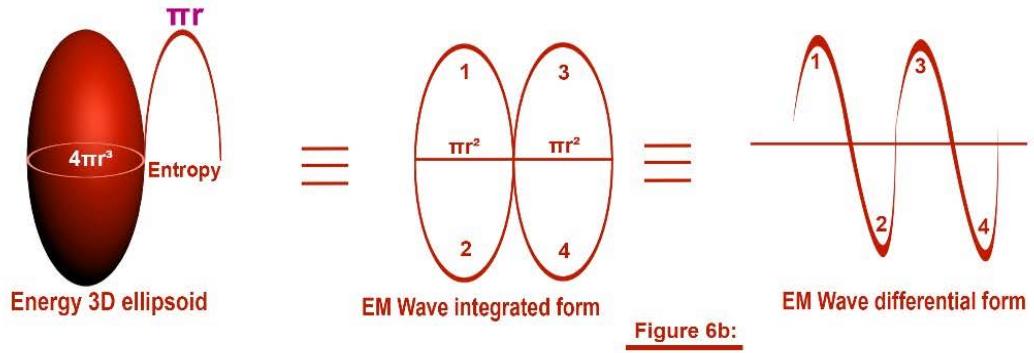 Figure 6a & 6b: Presentation of 'Energy' and 'EM Wave' as distinctly different physical variables of the universe
## IV. TTQG DRIVEN NEW CONCEPT OF QUANTUM PHYSICS
At the beginning, the fact to remind the readers, that all the scientists (working from the very beginning in the field of physical science) had continued doing their valuable research work accepting the state of abstractness of the physical variable 'time'. It is TTQG only, which for the first time in the history of science
gave the said physical variable a perceptible shape from the angles of physics, mathematics and geometry and as a result of that, the world science have encountered altogether a new turn around and the traditional stuff has emerged in a whole new form.
The subject 'quantum physics' start with the concept of 'photon', the expression of 'energy'(E) for the same was put forward by Max Planck as
$$
E = h v \dots \tag {11}
$$
In equation 11, $h$ is the Planck's constant and $v$ is the frequency of the 'EM - wave' being expressed in Hertz or cycles per second. The $v$ is related to the velocity of light (C) and wave length $\lambda$ of the wave by the following equation
$$
\mathbf{v} = (\mathrm{C} / \lambda) \dots \tag{12}
$$
So the ultimate expression of energy becomes
$$
E = (hC/\lambda) \dots \tag{13}
$$
Equation 13 shows an inverse relationship between $E$ and $\lambda$ (which is very much obvious) but the state of the affair is bit more complex than what it does apparently look alike. The said state of affair is revealed from the following dimensional break-up of equation 13: (using SI unit, for $C = 3 \times 10^8$ meter and $\lambda$, (for example) $= 10^{-8}$ meter)
$$
\begin{array}{l} E = [ h \times (3 \times 10^{8}) \text{meter / second} ] / (10^{-8} \text{meter}) \\= [ h x \left\{\left(3 x 10^{16}\right) / (\sec)\right\} ] \dots \tag{14} \end{array}
$$
[N.B. The dimension of wavelength get canceled between the numerator and the denominator of equation (14) and the 'inverse relationship between energy and wavelength' passes on to 'inverse relationship between energy and time'] In the above example, the number $(3x10^{16})$ is the number of wave fronts passing through any point of the propagation path of the EM-wave per unit time. The constant, $h$, had been introduced by Max Planck very arbitrarily (the dimension being energy $x$ sec) such that the 'sec' appearing in the denominator of equation (14) gets canceled and one is left with a 'energy' dimension only.
The energy expression of equation (14) can be written in the following form:
$$
E=h\times\left(\text{number of wave fronts}/\text{time}\right)\quad\quad\quad(15)
$$
The energy expression of photons in the form of equation (15) becomes a decaying function of time and which is not acceptable. To make the energy expression free of time and to overcome the situation one needs to adhere to the definition of time as given in TTQG. In TTQG, 'time' is defined as an inverse 'force' or inverse 'area' (in the form of a pull back graviton, a 2D saddle), which is holding the universe.
$$
Dimensionally,\,(Time)\,=\,(1\/area)
$$
So if this concept is utilized one can write in context to the equation (15):
$$
(T i m e) = (1 / \text{areaofeachwavefront})
$$
Then equation (15) takes the form
$$
E = h \times \text{(number of wave fronts \times area of each wave front)}
$$
If in equation (16), the number of wave fronts (an integer) and the area of a wave front are represented by $n$ and $A$ respectively, the equation becomes:
$$
E = n h A \dots \tag {17}
$$
So area of the wave fronts are very important and on this said aspect, both Max Planck and Einstein were very silent else were not concerned at all. So 'energy', rather than maintaining the inverse relationship with 'wavelength', truly bears a direct proportionality to the area of the wave fronts. Higher the area of the wave fronts, higher would be the energy and the so called 'wavelength' of Planck is no way related to the energy.
Now utilizing equation (2) and equation (8) of the previous section, equation (17) converges to classical expression of energy $\left[\mathrm{h} = 3\mathrm{r}\right.$ and $\mathrm{A} = \left(4\pi r^{2} / 3\right)$ as:
$$
E = n \times (\text{entropy} \times \text{area}) = n \times (\text{distance} \times \text{force}) = n \times (3r) \times (4\pi r^{2}/3) = (n \times 4\pi r^{3})\tag{18}
$$
The geometrical shapes of the wave fronts (symmetric, longitudinal or lateral skewed, peak height to peak width ratio..etc.) and their area/volumes have been fully ignored in the quantum physics. In figure 7 below, two different types of wave fronts have been shown (but their so called Planck 'wavelengths' are the same).
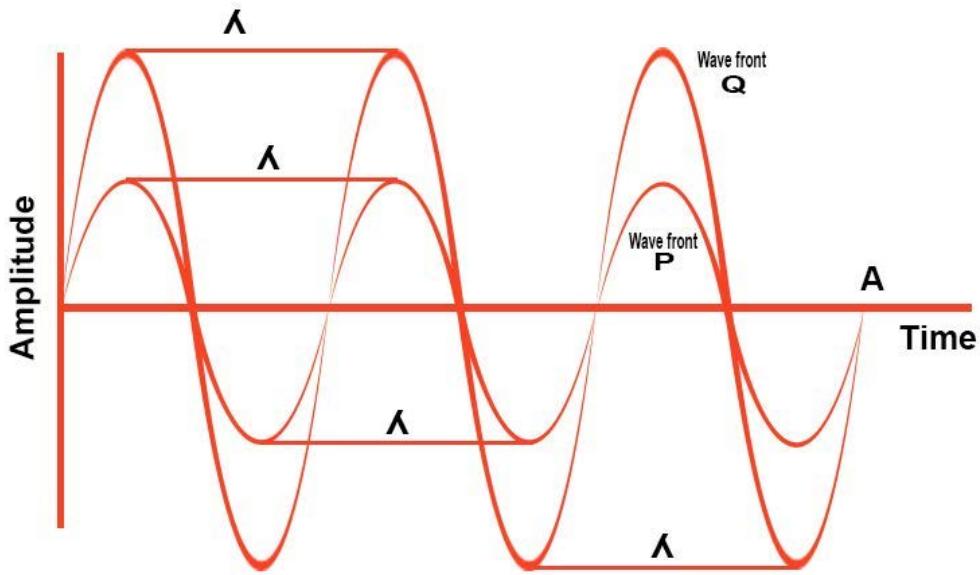 Figure 7: Different type of Wave fronts having the same wave length $(\lambda)$
It is quite easy to follow that between the two different types of wave fronts $P, \& Q$, the former one has higher energy as per equation (16) since the area of the wave fronts of $Q$ are higher than the other.
What the 'EM-waves' are, and how do they differ from 'energy' both dimension ally and topologically have already been presented in detail in the previous section. It is to conclude that the concept of 'photons' needs to be abandoned and it has to be replaced by the concept of 'EM wave gravitons' in the form of equation (10) and they are 4-dimensional wave packets or quantum. As far as the TTQG philosophy is concerned, the 'photon waves' are evolved out of the travelling of the swarm of photons through space and which gives rise to the familiar phenomena of 'space expansion' (the so called 'acceleration' of Newtonian
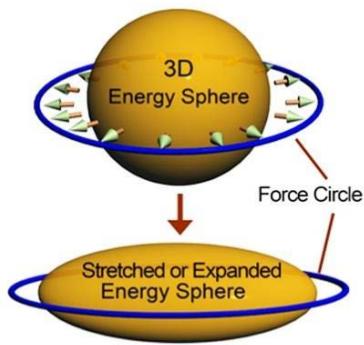 Figure 8a: Presentation of space expansion in the form of a 3D Sphere/Ellipsoid and a Circle
In figure 8a above, the 'space expansion' has been shown in the lateral fashion. The outside circle is stretching the sphere laterally such that the 3D space of the sphere increases and hence it is called the phenomenon of lateral space expansion. Such
Physics'). The 'EM-wave gravitons or quantums' are further expanded to form the said 'space expansion gravitons or quantums'. While the 'EM-wave gravitons' are formed out of the superposition of 'entropy' and 'Energy', it is the superposition of 'entropy' and 'EM-wave' (entropy x EM-wave), from which the 'space expansion gravitons or quantums' $(16\pi^{2}r^{5}/9)$ are emerged and those are 5 dimensional (5D).
The space expansion gravitons can be represented as the superposition of 3D sphere and an encompassing circle $\{\text{dimension-ally}, \pi^2 r^5 = (\pi r^3 \times \pi r^2) = (\pi r^2 \times \pi r^2 \times r)\}$. In figure 8 below the space expansion phenomena in the said 'superposition form of a sphere and a circle' and 'superposition of two circles and an entropy' (distance) are presented in Figure 8.
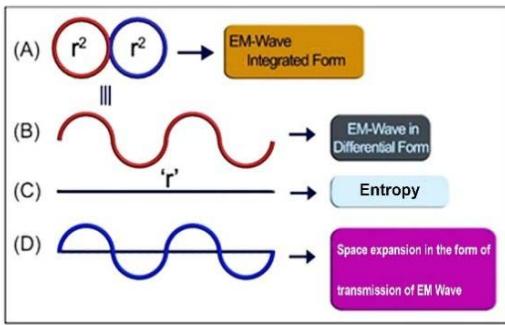 Figure 8a: Presentation of space expansion to the form of superposition of 2 circles and an Entropy Graviton
expansion may occur longitudinally too and in that case it will be 'longitudinal space expansion'.
In figure 8b, it is shown how the two numbers of circles are unfolded and on an entropy or distance axis the wave fronts do propagate leading to space expansion.
The phenomenon of 'space expansion' [98,101,103] being a 5D phenomena resembles the 'energy transmission' or 'power output' too. It is the happening out of the passage of the 'EM-wave gravitons' to the space. Power is 'energy transmission per unit time' and dimension-ally as per TTQG it is,
$$
\text{Power} = (\text{energy / time}) = \left[ \left(r ^ {3}\right) / \left(1 / r ^ {2}\right) \right] = \left(r ^ {5}\right) \dots (1 9)
$$
So the 'space expansion' in the form of $r^5$ is power output too. Most interestingly, the said 'space expansion gravitons' are the so called photon waves of 'quantum physics'. The shapes of the photon waves are shown in Figure 9 below.
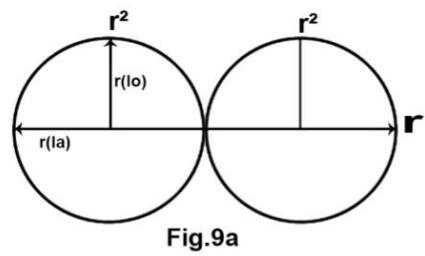
Low energy Photons r(lo): Longitudinal Entropy
r(la): Lateral Entropy
$$
r(lo) = r(la)
$$
三
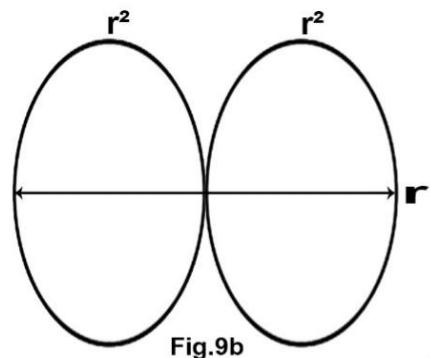
Medium energy Photons r(lo) >r(la)
or,
$r(la) > r(lo)$
三
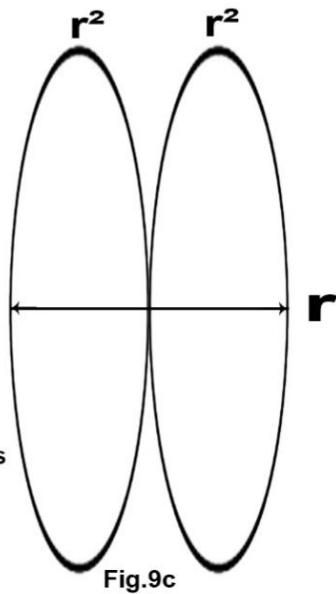 Figure 9: Geometrical shapes of the 'space expansion graviton' or the photons of lower to higher energy
High energy Photons r(lo) >> r(la)
or, r(la) >> r(lo)
As far as the logic and philosophy of the TTQG is concerned, the term 'photon waves' does not fit into its model since the term 'photon' is very abstract for the following obvious reasons there off
i) At times they are described as particles and a particle has to have a mass. ii) On the other hand they are called mass less iii) They are described sometimes as 'energy packets' and sometimes as 'EM waves'. iv) No light had been shed on the size and shape of the photons (how do the photons look alike?).
So in TTQG, from now the term 'photon' will be replaced by a new term 'SEG' or 'space expansion graviton'. From the above Figure 9, it is very clearly understood that the spread of the higher energy 'SEG' are more than the lower energy ones. While the lower energy 'SEG' are more or less isotropic (in regard to their longitude and latitude), the higher energy ones are either longitudinally or laterally skewed and are nonisotropic.
The energy level of the 'SEG' are directly proportional to the ratios of 'longitudinal length/entropy $(L_{\mathrm{lo}})$ to 'lateral length/entropy $(L_{\mathrm{la}})$ ' as shown in figure 9 above. When the said ratio is higher the energies are higher and when it is 1:1, the energies are lower. One should be moving away from the dictum of 'lower wavelength- higher energy' and 'higher wavelength-lower energy'. In figure 10 below the shapes of the SEG's of the red light to violet light has been shown \[in the differential form they are 5-dimensional, $(\pi r^3$ sphere/ellipsoid x $\pi r^2$ -base) and in the integrated form they look like 3 dimensional)\] as has been evaluated through the TTQG driven new theory of color physics.[104]
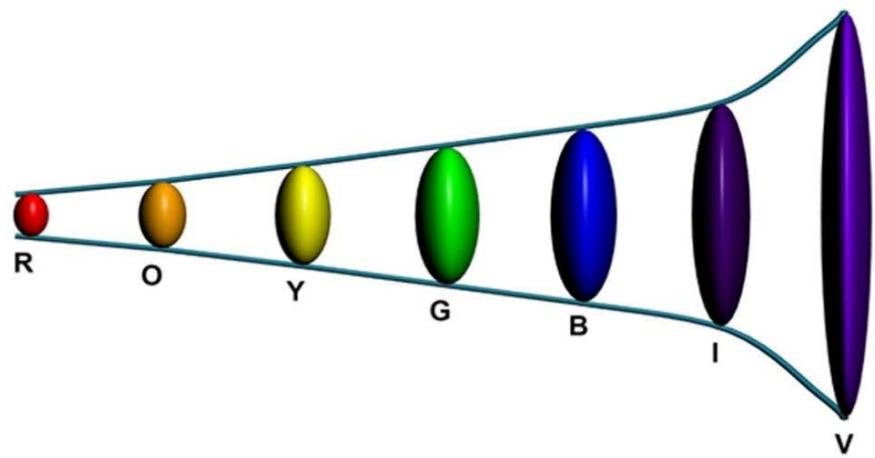 Figure 10: Shapes of all the 'VIBGYOR' EM-WAVE gravitons or the so called Photons of the Newton's Color Wheel from Red to Violet
From figure 10 it is observed that as one passes from the red to orange to yellow to green to blue to indigo to violet SEG, the volume of the gravitons/quantal increase and as well the above said to $L_{\mathrm{lo}}$ to $L_{\mathrm{la}}$ ratio increases. So the following two numbers of criteria are important to assess the level of energy of the SEG's:
i) Higher the volume of the SEG, higher would be its energy. ii) Higher the $L_{\mathrm{lo}}$ to $L_{\mathrm{la}}$ ratio, higher would be the energy of the SEG's
The above said criteria (related to the magnitude of energy of SEG's) are matching to the large scale uniform, homogeneous and isotropic state of the universe but the Planck-Einstein concept of, energy being inversely proportional to the wavelength of the photons, does not match to the same. As per the Planck concept, when the energy level of the photons are higher the wavelengths are smaller and hence the wave fronts are narrower and the peaks are closely spaced one after the other. As a result, the volume swept by the wave fronts are lower. Hence the energy density of space for the swarm of high energy photons would be pretty high (since energy density is equal to the ratio of amount of energy to the amount of volume and energy is high and volume is low). For the lower energy photons, the wave fronts are wider and the peaks are relatively distantly placed one after the other and hence the wavelengths are higher and the volume swept by the wave fronts are higher. So energy density of space would be lower. If this be so, then all through the space of the universe, the gradient of energy density would have been developed and the universe would have lost its large scale homogeneous and isotropic character. But unfortunately this is not so.
If the TTQG depicted SEG's geometries and shapes are examined (Figure 10 above), it is found that starting from lower energy SEG, as one moves to higher energy SEG's (from Red to Orange to Yellow to Green to Blue to Indigo to Violet), the volumes do increase as well. Since energy (E) remains directly proportional to volume (V) so the energy density has to remain constant. The criteria of the uniform spatial energy density of the universe is, when the energy is lower, volume has to be lower and when energy is higher, volume has to be higher (and the said increase and decrease of volume against the increase and decrease of energy has to be very much proportionate) and it has been proved in TTQG that, $(\mathsf{E} / \mathsf{V} = 3)$. [98]
Surprising outcome are obtained upon the comparison of energy definition as given in 'classical physics', 'quantum physics' and 'thermodynamics'. But this surprising outcome or the findings make the foothold of TTQG very firm and affirmative as explained below.
<table><tr><td rowspan="4">CLASSICAL PHYSICS (CP)</td><td>ENERGY = (PRESSURE X VOLUME)</td></tr><tr><td>= (ENERGY/VOLUME) X (VOLUME)</td></tr><tr><td>= [(ENERGY / (AREA X DISTANCE)] X (AREA X DISTANCE)</td></tr><tr><td>= [(ENERGY/AREA)] X (AREA)]</td></tr><tr><td rowspan="4">QUANTUM PHYSICS (QP)</td><td>ENERGY = (PLANCK'S CONSTANT X FREQUENCY OF LIGHT WAVE)</td></tr><tr><td>= [(PLANCK'S CONSTANT X NUMBERS OF CYCLES/TIME)]</td></tr><tr><td>= [(ENERGY XTIME X N)/TIME]</td></tr><tr><td>= [N X (ENERGYXTIME) X (1/TIME)] [N= number of cycles]</td></tr><tr><td rowspan="2">THERMODYNAMICS (THDMS)</td><td>ENERGY = (BOLTZMAN CONSTANT X TEMPERATURE)</td></tr><tr><td>= [(ENERGY/TEMPERATURE) X (TEMPERATURE)]</td></tr></table>
So if the definitions of 'Quantum physics' and 'Thermodynamics' are compared to each other, in the expression of the later, the time(t) variable of the former is being replaced by the reciprocal of temperature (T). So one can conclude that
$$
T = (1 / t) \text {o r} t = (1 / T)
$$
$$
So,\mathrm{Tt}=1.0
$$
If the definition of 'classical physics' is compared separately with the other two definitions as given above, the results one gets are:
$$
CP & QP TIME = (1/AREA)
$$
$$
CP & THDMS TEMPERATURE = (AREA)
$$
So the predictions of TTQG of the i) 'time-temperature' multiplicative inverse relationship, ii) the dimension of time (inverse area) and iii) the dimension of temperature (area) and the above said results are found to be the same and as well the hidden 'time-temperature entanglement' relationship of the conventional physics are unveiled.
De Broglie's wave length $\lambda$, associated with a particle is expressed in regard to its mass (m) and velocity(v) is in the following form (linked to the Planck's constant, h)
$$
\lambda = (h / m v) \dots \tag {20}
$$
So the wave associated with a massive particle would be lower in its wavelength and consequently the energy of the said wave would be pretty high as per the Planck's energy equation, $E = hc / \lambda$. So for a moving train with a mass of the order of $10^{6}$ gms and a velocity of the order of $10^{5}$ cm/sec will have an associated wavelength would be in the order of $10^{-38}$ cm. The energy of such a small wavelength wave would be about $10^{30}$ times higher than $\gamma$ ray having a wavelength of about $10^{-7}$ cm. So at the thrust of a moving train everything would have burned all out. But this is not happening so and one needs to re look the De Broglie's wave length equation in the light of TTQG.
In TTQG, it has been established that velocity $v$, converges to volume, $V$, and the product of mass and volume is constant ( $mV = 3$ ). So the equation (20) takes the form \[considering $h = 3r$, as shown in equation 2\]
$$
\lambda = r \tag{21}
$$
So Planck's energy expression of a photon would take the shape \[the velocity of light would be in the form of a volume and in terms of $r$ it will be, $(4\pi r^3 / 3)$ \] and in TTQG 'force/temperature' and 'entropy' are being expressed as $4\pi r^2$ and $r$ respectively\].
$$
E = (hC/\lambda) = [3r \times (4\pi r^3/3)/r] = 4\pi r^3 = (4\pi r^2 \times r) = (\text{force} \times \text{entropy}) = (\text{temperature} \times \text{entropy}) \dots \dots \dots \dots \dots \dots . (22)
$$
So one should move away from the traditional concept of tracing the 'energy' in inverse relationship to 'wave length' (λ) and should adhere to the following new concepts:
i) The wave length $\lambda$ of Planck's equation in fact represents 'entropy'. ii) In the language of TTQG, 'energy' is the superposition of 'area' and 'entropy' or 'force' and 'entropy' or 'temperature' and 'entropy'. iii) When the 'area/force/temperature' remains constant, the energy is directly proportional to 'entropy'. As the entropy increases, the energy increases and vice versa, iv) When the 'entropy' remains constant, the 'energy' is directly proportional to 'area/force/temperature'. As the 'area/force/temperature' increases, the energy increases and vice versa.
The arguments and the mathematical equations put forward by Albert Einstein to explain the familiar phenomenon of photo electricity suffers from the problems of ambiguity and self contradiction as described below:
i) The phenomenon of photo electricity has been referred to as the event of 'interaction of light wave and matter' but the photons are considered as 'particles' striking the metal surface. The geometry or the shape of the particles, though very important but were not at all thought of. Such mix-up of concepts (between particle and wave) are illogical and are not acceptable.
ii) The proposition that 'the photons are dual in nature and sometimes they behave as waves and sometimes as particles' is fictitious since no attempt was taken to link the said proposition and itself the phenomenon of photo electricity, to any of the very important aspects of 'quantum to quantum interaction' like the phenomena of 'entanglement', 'superposition', 'exchange' and 'interference'. iii) The subject of 'failure of the low energy photons to eject the electrons from the surface of matter even when their intensities are higher' had been linked to the event of inability of the light waves to add up the energies of the photons (due to the discrete or discontinuous nature of the energy packets or the photons). It is a matter of common experience that the pressure of a gas (which is originated from the collision of the molecules with the walls of the container) increases if a certain fixed amount of a gas is transferred to a smaller size container from a higher size container, keeping the temperature the same, the number of collisions of the molecules with the walls increase per unit area per unit time (increase of intensity of collision). As a result the pressure increases although the average kinetic energy of the molecules remain the same since the temperature is the same. If the energies can add up in the case of discrete gas molecules, why it cannot happen for the photons considered as particles? So the argument of Einstein is not an acceptable version.
iv) The phenomenon of photoelectricity is a quantum phenomena as proposed by Einstein. But his very famous mathematical equation of the photoelectric effect is a subtractive model. He proposed that the energy of the photons (while striking the metal), are fully subtracted and the same passes on to the metal. The thrust of the said energy unbound the electrons from their orbits. As discussed above, the interaction of the quantum forces with each other rests on the principles of 'entanglement', 'superposition', 'interference' and 'exchange' of the said quantums. Hence any 'subtractive' model is not compatible with the logic and philosophy of quantized 'space-time' of the universe.
The TTQG model of the photoelectric effect vis-a-vis the Einstein's typical model (as shown in the standard text books of physics) are shown schematically in figure 11a and 11b respectively.
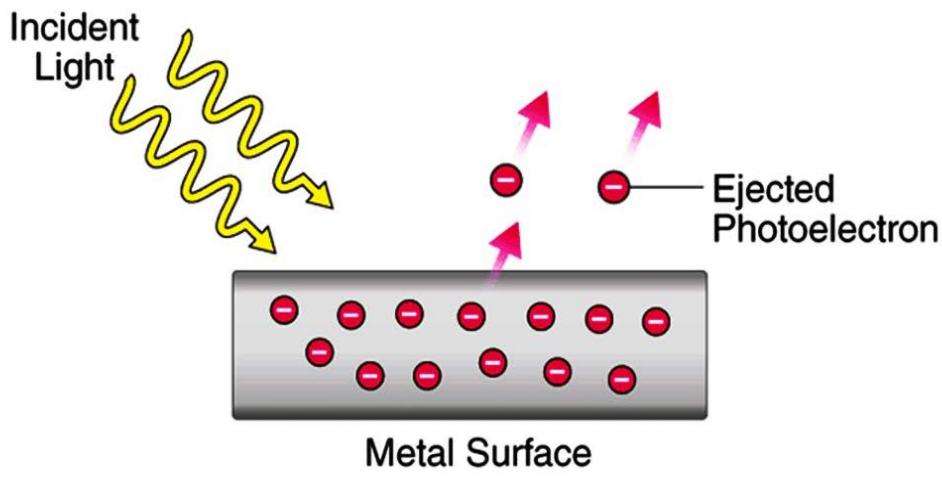 Figure 11a: Schematic presentation of the Photo-electric Phenomena in regard to Einstein's Photo-electric equation
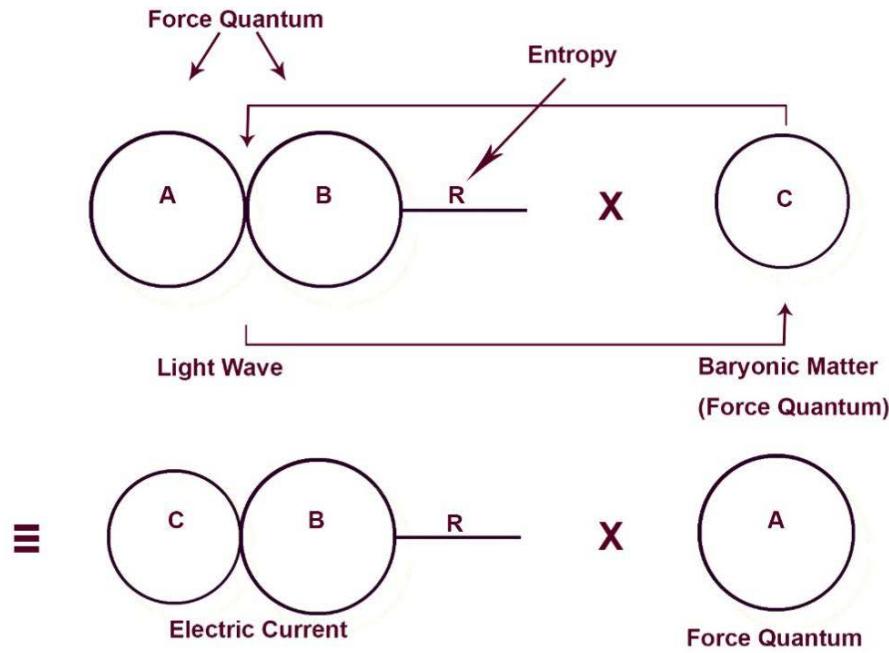 Figure 11b: Presentation of Photo-electric phenomena in regard to the exchange of Quantum forces between the light wave and the Baryonic matter
While the mechanism of quantum interaction of the 'light wave' with the metal could not be shown by Einstein (Figure 11 a), it is TTQG which shows very clearly how through the exchange of quantum forces (between EM-wave and the substrate) the charge quantaums are generated from the metal as is shon in Figure 11b.
The inability of the 'low energy photons (SEG)' to eject the electrons is related to their geometrical shapes. As shown in Figure 10, the low energy SEG's are spherically more symmetrical than the high energy SEG's which are more sharper (either at the their longitudinal or their lateral edges) at one of their two ends. As a result of this sharper geometrical shapes of the later, their penetrating powers are much higher. So Einstein's explanation of the said happening, based on the discrete energy levels of the energy packets (photons), is not appropriate, due to the following main reasons:
i) The photo electric phenomena is not 'subtractive' but is based on the exchange of forces through quanta ii) The temperature remaining constant, for a fixed quantity of a gas, the pressure of the gas is a function of, the number of gas molecules striking the wall of the container per unit area per unit time. Higher the number of impacts on the wall, higher is the pressure. iii) The penetrating power of the quantum is related very much to their geometrical shapes and the said factor was not considered at all.
## V. TRUE SIGNIFICANCE OF THE TERM 'RELATIVITY' IN THE SPECIAL AND GENERAL THEORY OF RELATIVITY AS DERIVED THROUGH TTQG
Einstein's theory of relativity, why it is called relativity, is more or less known to the scientific community. The very common explanation of the word 'relativity' is 'how different observers can have different measurements of space and time, depending on their 'relative motions'. While with an extraordinary power of intuition, Einstein could predict that space and time are interwoven to each other, he in fact could not express his thoughts in the right way. His predictions of special and general theory of relativity were in fact 'quasi-true' on the following grounds:
i) The interrelation between 'space-time' and velocity as was made in the special theory of relativity is very fragile since when one considers the physical reality of the universe (the dimension of 'time' and 'temperature' as revealed through TTQG), the physical variable 'velocity' does merge to the concept of 'volume'. The cup of tea indeed is the 'volume' not the 'velocity'. The 'space-time' is quantized and the universe appearing before us is being originated from the entanglement, superposition and interference of the 'push-forward' and 'pull-back' gravitons. ii) The very famous equation of special theory of relativity relating energy (E) to the mass (m) in the form of $E = mc^2$ (c, the velocity of light) is again non-appropriate since he tried to link energy to velocity. However, in TTQG, it has been very firmly established that this equation in fact converges to the TTQG derived equation, $E = 3V$, (V being a 'volume' graviton') which means that the energy density of space is constant.
iii) The GTR of Einstein talks about 'gravity' and the prediction is, it is the 'gravity' only, which affects the shape of 'space-time'. Einstein put forward his 'field equations', popularly known as Einstein Field.
Equations (EFE's), which are fictitious and difficult to comprehend. Over and above, neither in STR nor in GTR, the 'time', 'mass' and 'gravitational attractive force' was tried to be traced to the 'molecular level interactions' among the astronomical objects or matters of the universe.
As far as the logic and philosophies of the TTQG is concerned, the actual meaning of the term 'relativity' in realm to the cosmological physics of the universe is, how one is fixing up the sizes (distance, area and volume and their inverses) of the single units of a entropy graviton, an area/force /temperature graviton and a volume/energy graviton vis-a-vis the entangled order graviton, time graviton and mass graviton. In Figure 12 below this subject is clearly shown.
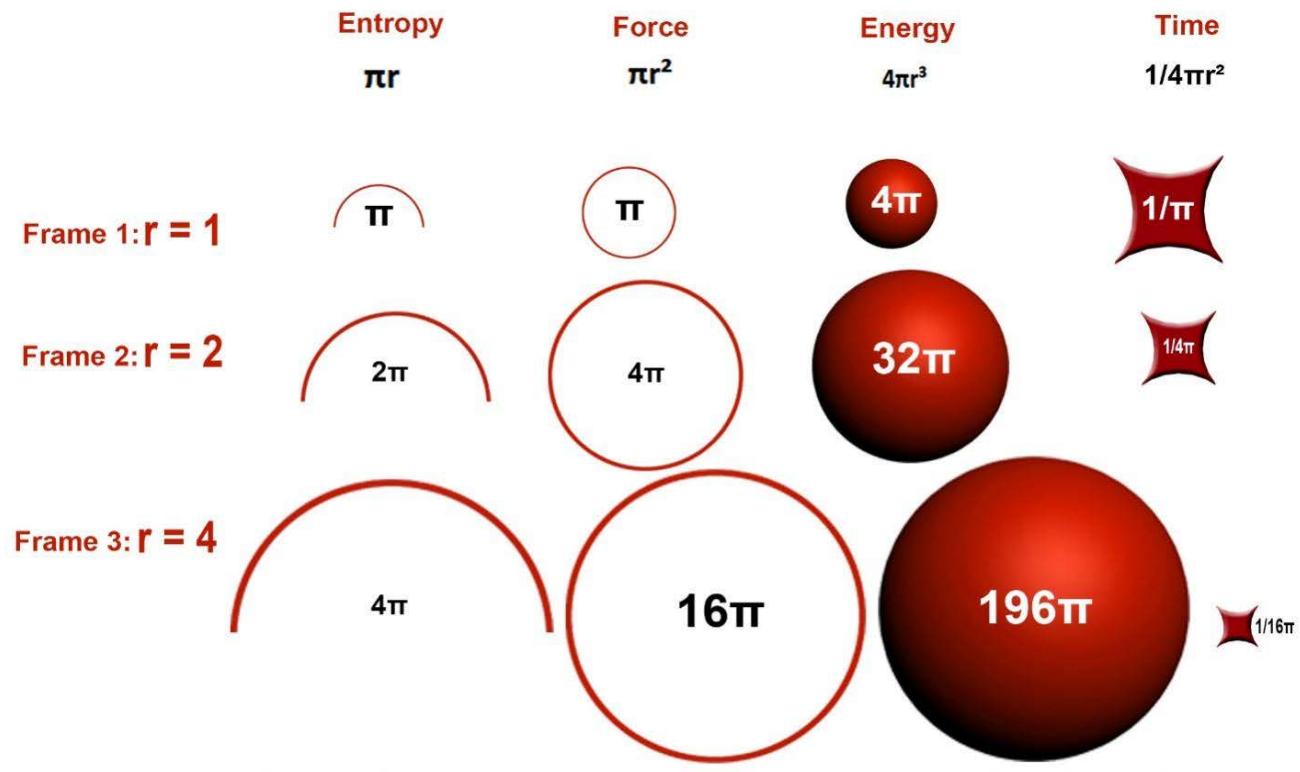 Figure 12: The real significance of the special theory of relativity of Albert Einstein
In Figure 12, if the three different frames (frame -1, frame -2 and frame -3) are compared to each other one would led to conclude that the single units of entropy graviton, force graviton, time graviton and volume graviton in frame -3 corresponds to 4 units, 16 units, 49 units and 4 units of entropy, force, energy and time gravitons respectively of frame-1. Similar type of correlations would be valid for any pair of the said three numbers of frames. This is what is called 'relativity' in the language of Einstein of the different zones/frames of the universe. However, this so called 'relativity' is not creating any gradient of energy distribution in the space since the 'energy -density' of all the frames are constant \[the mathematical expression of the same is, $(\mathsf{E} / \mathsf{V}) = 3$, as explained above\] and the universe remains homogeneous, uniform and isotropic.
## VI. TTQG INTERPRETATION OF THE
QUANTUM MECHANICAL CONCEPTS OF
'SUPERPOSITION', 'ENTANGLEMENT', 'AND'
EXCHANGE OF FORCES
The push forward and pull back gravitons in TTQG are all in the form of 'packets' or 'quanta' in the normal and inverse dimensionality as is shown in Figure 2. The act of superposition, i.e., placing of one thing on the top of another, leads to different types of outcome depending on the geometrical shapes of the involved things [98,101]. In Figure 13 below, three different types of quantum superposition are shown:
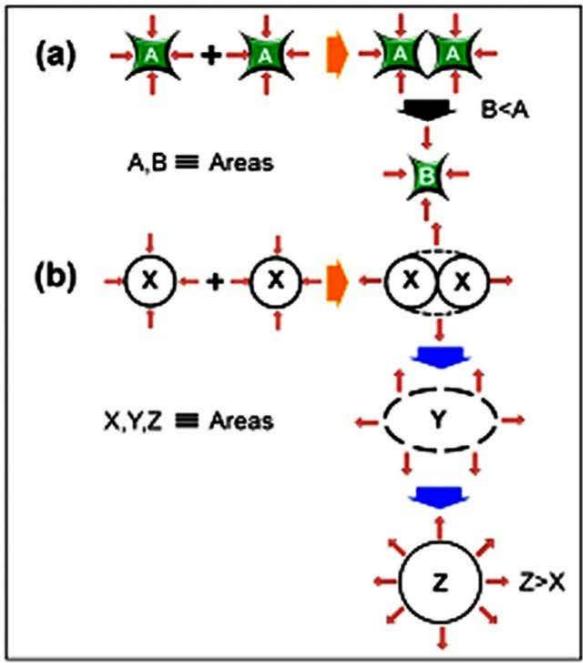 Figure 13a: Superposition of two pull back gravitons to form a new Quantum state. Figure 13b: Superposition of two push forward gravitons to form a new Quantum state.
Figure 13b (interaction of two numbers of push forward gravitons, PFG) and Figure 13a (interaction of two numbers of pull back gravitons, PBG) correspond to the principle of quantum mechanics, i.e., additions of the two quantum states yield another valid quantum state. However, in case of two numbers of PFG, the newly generated quantum state is higher in area than the individual PFG's because of their dispersive characters. However, in case of two numbers of PBG's, since they are squeezing type, the resulting quantum state is smaller in area.
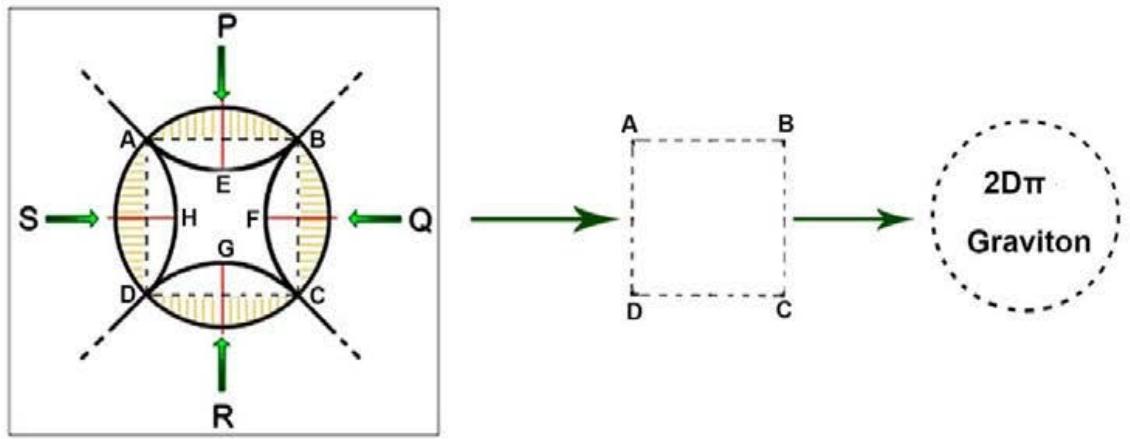 Figure 13 c: Entanglement of push forward and pull back gravitons to form Vaccum space TT -gravitons
The superposition as shown in Figure 13c\[98\](the interaction of a PFG & a PBG) rightly reflects the 'SCHRODINGER'S CAT PARADOX'.As shown in Figure 13c, the inverse curvatures of the segments of the circle and a 2D saddle swallow each other (APB & AEB), (BQC & BFC), (RCD & DGC) and (RCD & DGC) produces the 4 numbers of equal length empty space straight lines AB,BC,CD & AD to form the vacuum square space ABCD. However the said vacuum square space homogenizes to a circle to attain minimum circumference and which is called as a 'vacuum space 2D $\pi$ -graviton' or simply '2D $\pi$ -graviton'. Similarly the interaction of a 3D sphere and a 3D saddle generates '3D $\pi$ -graviton'. In the state of superposition of 'force' (circle) and 'time' (2D saddle), in Figure 13 c, the following statements stand logical:
i) No 'time' and no 'force' does exist at all in the universe. ii) The 'time' and 'force' do co-exist with each other in the universe. iii) From the state of a vacuum space of zero dimensionality, 'time' and 'force' gravitons or quanta are auto generated, which are inverse to each other in their dimensions such that the dimensionality of one cancels the dimensionality of the other such that the net dimensionality is zero. This way new dimensionality are continuously created in space.
The 'SCHRODINGER'S CAT PARADOX' as cited above, as such, is much difficult to comprehend and he could not express his thought in the right way. The paradox is, a cat is put in a box which contains a bowl of poison and the box is closed. When the box is opened after some time, the cat would be found either alive or dead. Schrodinger put the argument that though apparently the cat is found either alive or dead after opening the box but the physical reality of the universe is, the cat is both alive and dead simultaneously or in state of superposition of the two. He could not put forward any quantum description of the superposition phenomena.
However, in continuation with the discussions of the previous paragraph, if the 'force' graviton and the 'time' graviton, for example, represents the 'state of alive' and 'the state of death' respectively, one may conclude that none of the so-called living species in the universe are neither fully alive nor fully death. In a state of superposition with each other, they are both alive and dead simultaneously. The very broad frame essence of the discussion made above (against Figure 13c) is, the universe belongs to a state of superposition of 'existence' and 'non-existence'. Philosophically one might say 'Yes, the universe does exist very much but at the same time it does not exist too'.
The phenomenon of 'entanglement' or 'quantum entanglement' is very much related to the concepts of mathematical 'integration' and 'differentiation'. Mathematically, If the smallest segment of distance/length (which is a physical variable), for example, is being represented by dx, then its integration gives x (considering the dimensional part only not the constant part) and the further integration of x gives $x^2$. The integration of $x^2$ gives $x^3$. In the language of TTQG, integration is a physical process through which a physical variable does spread itself more and more in the space and its entity becomes the 'part and parcel' of the space. In the example cited above, the linear translations of the small distance segment (dx, which can be considered as a point) in space gives rise to straight line, which is x. Then the translation of the said line segment in a 2D space (in either of the 2 mutually perpendicular directions) to a distance of its own length $x$, gives a square of dimension $x^2$. Finally the translation of the said square (in any of the three mutually perpendicular directions) to a length of $x$ gives a homogeneous cube of dimension $x^3$. So integrating a physical variable is to move (both rotation and translation) it in space such that the physical variable gets more and more 'hybridized' with the space. Differentiation is just the reverse of integration. While in case of integration, the build up of dimensions take place one after another, in the case of differentiation what happens is the chronological collapse of the dimensions. For example from $x^3$ it passes on to $x^2$ and from $x^2$ to $x$ and finally from $x$ to $dx$. In other words, the dimensions collapse from 3D to 2D to 1D to zero dimension (a geometrical point is of zero dimension) in case of differentiation.
The said two terms, i.e., 'hybridization and 'integration' are the key words of the two different subjects (the former one is of chemistry and the later one is of mathematics) but they are virtually the same and carries the same significance altogether. The actual meaning of the statement made above, 'physical variable does spread itself.....of the space' needs to be elaborated at this juncture and is described below:
i) If, for example, one talks about 'entropy' (which is being represented by a 1 dimensional line of length 'r' in TTQG), then its passing on to higher dimensions one after another (from 1 dimensional line to 2 dimensional circle to a 3D sphere or from r to $r^2$ to $r^3$ ), are considered to be 'integration' or 'hybridization'. A 2D circle represents force and a 3D sphere represents energy and so the said transition takes place from entropy to force to energy. ii) If, for example, one talks about 'force' (which is being represented by a 2D circle in TTQG), then its increase in size is also considered as 'integration' or 'hybridization.
So for any physical variable, either its 'dimensional step-up' or its 'increase in size without changing the dimension' both belong to the process of 'integration' or 'hybridization'. Similarly for any physical variable, either its 'dimensional step-down' or its 'decrease in size without changing the dimension' both belong to the process of 'differentiation' or 'dehybridization'.
The 'differentiation/dehybridization' and 'integration/hybridization' are simultaneous events. This has got a very good analogy with the processes of 'oxidation' and 'reduction' in chemistry. When a chemical reaction takes place, if there is an oxidation occurring therein, a reduction has to inevitably occur too. The real concept of physics is, whenever there is a differentiation or dehybridization taking place, somewhere in the space, a simultaneous integration or hybridization has to take place to maintain the dimensions of the universe constant. The concept of 'entanglement' of physical variables is resting on the following three physical aspects,
i) An equilibrium has to exist between the concerned 'entangled' physical variables. ii) When one of the variables get integrated (hybridized), the other one will differentiate itself (at whatever distance it lies from the other) such that the net dimensions remain constant. iii) The 'simultaneous integration - differentiation' does take place through the mechanism of exchange of quantum between the concerned physical variables.
Suppose there are two entangled physical variables $r^2$ and $r^3$ existing in equilibrium with each other \[The net dimensionality is $(2 + 3) = 5$, the constant of proportionality which does exist in such types of equilibrium is not shown\]
$$
r^{2} \rightleftharpoons r^{3}
$$
Now if the LHS physical variable is being integrated and the RHS is differentiated (only considering the dimensional part), the above equilibrium takes the following form and the net dimensionality '5' is being retained.
$$
r ^ {3} \leftrightarrows r ^ {2}
$$
Suppose there are 6 numbers of entangled physical variables (serial number 1,2,3,4,5 & 6) are existing in chronological equilibrium with each other in the following manner:
$$
r ^ {1} (1) \leftrightarrows r ^ {2} (2) \leftrightarrows r ^ {3} (3) \leftrightarrows r ^ {4} (4) \leftrightarrows r ^ {5} (5) \leftrightarrows r ^ {6} (6) [ N e t d i m e n s i o n a l i t y i s (1 + 2 + 3 + 4 + 5 + 6) = 2 1 ]
$$
Now if one starts from the right most side of the above shown equilibrium and $6^{\text{th}}$ one is integrated, $5^{\text{th}}$ one has to be differentiated, $4^{\text{th}}$ to be integrated, $3^{\text{rd}}$ to be differentiated, $2^{\text{nd}}$ to be integrated and finally the $1^{\text{st}}$ one to be differentiated. If all these are done, the above equilibrium takes the following shape,
$$
r^{0}(1)\leftrightarrows r^{3}(2)\leftrightarrows r^{2}(3)\leftrightarrows r^{5}(4)\leftrightarrows r^{4}(5)\leftrightarrows r^{7}(6)\[\text{Net dimensionality is}(0+3+2+5+4+7)=21]
$$
The 'hybridization' and the 'dehybridization' of the entangled physical variables of the universe take place in the above shown manner such that the net dimensionality of the universe remains constant. The distance of one physical variable from the other is not at all a factor of concern for the validity of the occurrence of the said 'hybridization' and the 'dehybridization'. From one angle of view, this said constancy of the dimensions of the physical variables is a consequence of the following four numbers of (TTQG derived equations) entanglement equilibrium of the different gravitons or quanta and from an another angle of view, the said following entanglements are the consequence of the above said simultaneous 'hybridisation' and 'dehybridisation' concept.
$$
\mathrm{m V} = 3 \mathrm{m} = \text{mass}, \mathrm{V} = \text{volume - " conservationofmomentum}
$$
$$
T t = 1 T = \text{temperature / force} t = \text{time - ' Time and temperaturearemultiplicativeinversetoeachother}
$$
$$
m E = 9 m = \text{mass}, E = \text{energy -} ^ {\prime} \text{massenergyequivalenceoftheuniverse}
$$
$$
E = 3 V E = \text{energy}, V = \text{volume -} ^ {\prime} \text{Energydensityofspaceisconstant} ^ {\prime}
$$
The said simultaneous 'hybridisation' and 'dehybridisation' concept is also valid for two physical variables in equilibrium with each other and are multiplicative inverse to each other.
The entanglement of 'time' $(1 / r^2)$ and 'force/temperature' in TTQG is represented in the following way:
$$
r^{2} = (1/r^{2})
$$
Now, in such type of entanglement, the net dimensionality is zero. The said simultaneous 'hybridisation' and 'dehybridisation' concept is also valid here. If the LHS of the above equation is integrated and the RHS is differentiated, one gets (only the dimensional part, not constant part)
$$
r^{3} = (1/r^{3})
$$
So the net dimensionality remains zero out of this simultaneous 'hybridisation' and 'dehybridisation'.
The above said simultaneous 'hybridisation' and 'dehybridisation' can also be represented in the form of exchange of quantum between the RHS and LHS of an entangled equilibrium. An equilibrium is shown below between two numbers of physical variables
$$
\pi^ {2} \mathsf {r} ^ {4} \leftrightarrows \pi^ {2} \mathsf {r} ^ {5}
$$
The LHS of the above said equilibrium can be represented by two numbers of circles of radius $r$ each. The RHS of the above equilibrium can be represented as the product of two numbers of circles of radius $r$ each and a distance $r$. The break up form of the said equilibrium can be represented as,
$$
(\pi r^{2}) \times (\pi r^{2}) \Leftrightarrow (\pi r) \times (r^{2}) \times (\pi r^{2}) - BREAKUP FORM
$$
If the LHS and the RHS of the above equilibrium are differentiated and integrated respectively, it takes the following form,
$$
\pi (\pi r ^ {2}) \times (r) \leftrightarrows [ (\pi r ^ {3}) \times (\pi r ^ {3}) ] - M U T U A L D if F E R E N T I A T I O N - I N T E G R A T I O N F O R M O F L H S & R H S
$$
Exchanging the entropy graviton $\pi r$ of RHS with one of the force gravitons $\pi r^2$ of the LHS, the same MUTUAL DIFFERENTIATION- INTEGRATION FORM OF LHS & RHS is obtained dimension ally, as shown below
$$
\pi \left(\pi \mathsf {r} ^ {2}\right) \times \left(\mathsf {r}\right) \leftrightarrows \left[ \left(\pi \mathsf {r} ^ {3}\right) \times \left(\pi \mathsf {r} ^ {3}\right) \right]
$$
In the space innumerable 'mutual interactions' of the physical variables take place and those can be viewed and understood in the light of the quantum mechanical phenomenon of 'exchange of forces through quantum'. To illustrate this, for example, if the event of interaction of 'force' and 'space expansion' gravitons or quanta (mathematically expressed as $\pi r^2$ and $\pi^2 R^5$ respectively, where $r$ and $R$ are the radiuses of the force circle and space expansion graviton circle) are considered, how the magnitudes of the 'force' and 'space expansion graviton' would remain correlated to each other before and after the interaction taking place is shown below:
INTERACTION (EXPRESSED AS A PRODUCT OF TWO VARIABLES) = (Force graviton) x (space expansion graviton)
$$
= (\pi \mathsf {r} ^ {2}) \times (\pi^ {2} \mathsf {R} ^ {5}) = (\pi \mathsf {r} ^ {2}) \times [ (\pi \mathsf {R} ^ {2}) \times (\pi \mathsf {R} ^ {3}) ]
$$
Case I: when $r = R$ and an exchange of quantum takes place $[( \pi r^2)$ and $(\pi R^2)$ in the $3^{rd}$ bracket of the above equation interchanges their position) between the variables and after the interaction, the above equation can be written as,
$$
(\pi\mathrm{R}^{2}) \times [ (\pi\mathrm{r}^{2}) \times (\pi\mathrm{R}^{3}) ] = (\text{New force graviton}) \times [ \text{New space expansion graviton} ]
$$
This is based on the equilibrium of the following type,
$$
\left\{\text{(original force graviton)}\times\text{(original space expansion graviton)} = \left\{\text{(new force graviton formed)}\times\text{(new space expansion graviton formed)}\right\}\right\}
$$
Now since $r = R$, inspite of the exchange of quantums between the two, the magnitudes of the force gravitation and the space expansion graviton remain the same before and after the interaction.
Case II: When $r > R$, then due to the above type of exchange, the following correlation will hold true
Magnitude of 'force' graviton before interaction $>$ Magnitude of the new 'force' graviton formed after interaction
Magnitude of 'space expansion graviton' before interaction $<$ Magnitude of the new 'space expansion graviton'
Case III: When $r < R$, then due to the above type of exchange, the following correlation will hold true
Magnitude of 'force' graviton before interaction $<$ Magnitude of the new 'force' graviton formed after interaction
Magnitude of 'space expansion graviton' before interaction $>$ Magnitude of the new 'space expansion graviton'
All the above discussions made are being shown diagrammatically in Figure 14a, 14b and 14c respectively.
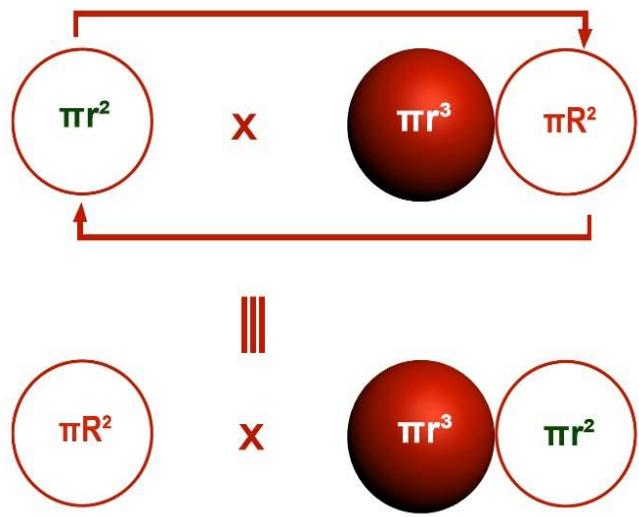 Case 1: $r = R$ Figure 14 a: Exchange of quantum forces between a force graviton and a space expansion graviton
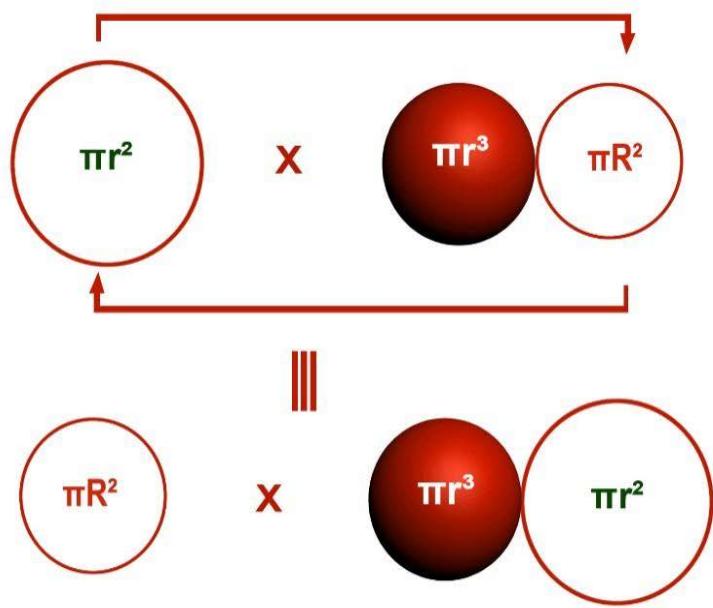 Case 2: $r > R$ Figure 14 b: Exchange of quantum forces between a force graviton and a space expansion graviton
Case 3: $r < R$
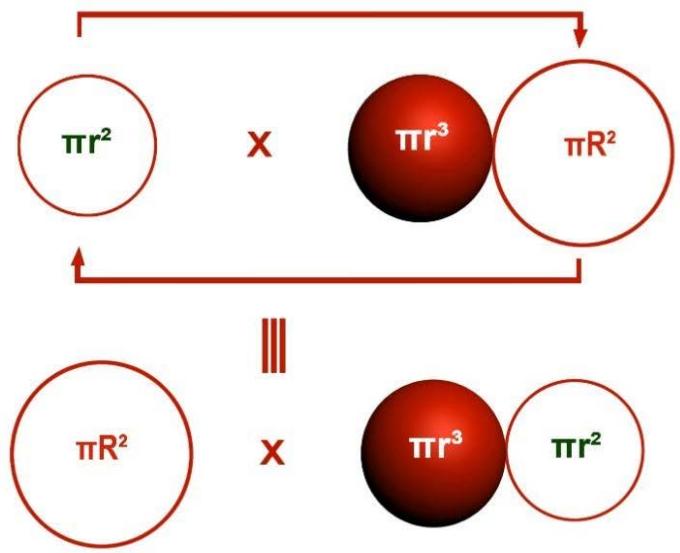 Figure 14 c: Exchange of quantum forces between a force graviton and a space expansion graviton
The TTQG depicted 'universal graviton cycle' [98,104] is shown in Figure 15 below. A 'singularity graviton' decays and as a result of that twelve numbers of different entanglement equilibrium are originated and which is shown in Table 2 below:
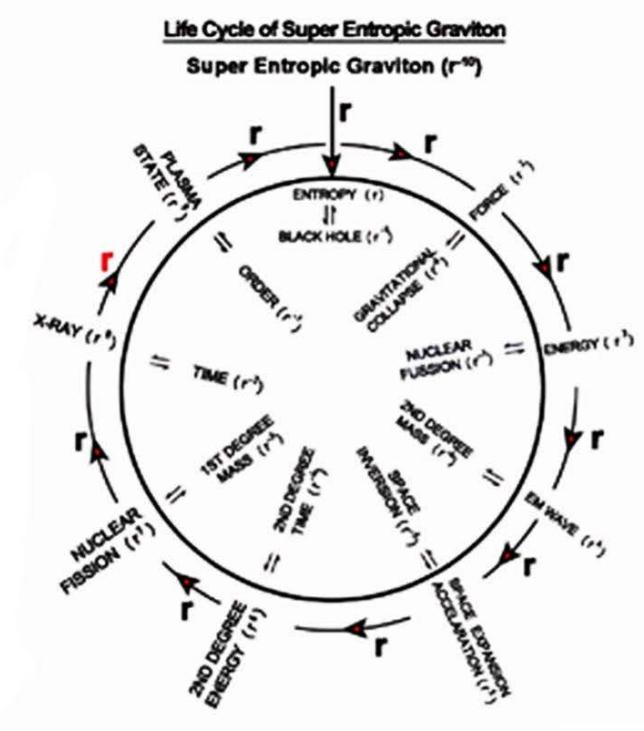 Figure 15: UNIVERSAL GRAVITON CYCLE
Table 2: Stepwise decay of the singularity graviton and emerging of the twelve numbers of entanglement
<table><tr><td>STEP NO.</td><td>STATE OF GRAVITON</td><td>EMISSION FROM THE GRAVITON</td><td>EQUILIBRIUM BETWEEN PUSH FORWARD AND PULL BACK GRAVITONS</td><td>OBSERVABLE PHYSICAL VARIABLES IN EQUILIBRIUM WITH EACH OTHER</td></tr><tr><td>1.</td><td>1/f2=81/256π4r10</td><td>π</td><td>81/256π3r10 ⇌ π</td><td>Empty space π-graviton or space hole graviton and super entropic graviton</td></tr><tr><td>2.</td><td>81/256π3r10</td><td>r</td><td>81/256π3r9 ⇌ π r</td><td>Entropy graviton and Black-hole graviton</td></tr><tr><td>3.</td><td>81/256π3r9</td><td>r</td><td>27/64π3r8 ⇌ 4/3 π r2</td><td>Fourth degree time graviton and push forward /temperature/force graviton</td></tr><tr><td>4.</td><td>27/64π3r8</td><td>r</td><td>81/64π3r7 ⇌ 4 π r3</td><td>Nuclear fusion graviton and first degree energy graviton</td></tr><tr><td>5.</td><td>81/64π3r7</td><td>π r</td><td>81/16π2r6 ⇌ 16π2r4</td><td>EM-wave graviton and 2nddegree mass graviton</td></tr><tr><td>6.</td><td>81/16π2r6</td><td>r</td><td>9/16π2r5 ⇌ 16π2r5/9</td><td>Space inversion-space expansion, color graviton of object,and color graviton of EM wave</td></tr><tr><td>7.</td><td>9/16π2r5</td><td>r</td><td>9/16π2r4 ⇌ 16π2r6/9</td><td>2ndorder time graviton or 2ndorder force or temperature graviton</td></tr><tr><td>8.</td><td>9/16π2r4</td><td>π r</td><td>9/4π2r3 ⇌ 64π3r7/9</td><td>1storder mass and nuclear fission graviton</td></tr><tr><td>9.</td><td>1/4πr3</td><td>r</td><td>3/4πr2 ⇌ 64π3r8/27</td><td>Time graviton and X-ray, gamma ray graviton</td></tr><tr><td>10.</td><td>3/4πr2</td><td>r</td><td>1/πr ⇌ 256π3r9/81</td><td>Plasma state graviton and order graviton</td></tr><tr><td>11.</td><td>1/πr</td><td>π</td><td>1/r ⇌ π</td><td>Order graviton and π graviton</td></tr><tr><td>12.</td><td>1</td><td>r</td><td>1≠πr</td><td>Enlarged singularity and entropy graviton</td></tr></table>
It is to note from Table 2 (from the mechanism of stepwise decay of the singularity gravitons in the different steps) that the all the twelve numbers of different entanglement equilibrium are very much connected to each other. So any change in the magnitude of any of the graviton of any of the steps, will affect the magnitude of the all other gravitons (irrespective of how far they are positioned in the space from each other) since all the twelve steps exist in chronological equilibrium or entanglement with each other. Table 3 below shows the entanglements of the 'conjugate graviton-antigraviton' pairs of the universe.
Table 3: Graviton - Anti-Graviton Conjugate Pairs
<table><tr><td>Sl. No.</td><td>Type of Anti-Graviton</td><td></td><td>Type of Graviton</td></tr><tr><td>1.</td><td>DISTANCE COLLAPSESING GRAVITON OR ORDER GRAVITON (r-1)</td><td>⇔</td><td>ENTROPY GRAVITON, INDEX OF RANDOMNESS, VOLTAGE/POTENTIAL DIFFERENCE (r1)</td></tr><tr><td>2.</td><td>TIME GRAVITON, VISCOSITY, MAGNETIC POTENTIAL (r-2)</td><td>⇔</td><td>FORCE, TEMPERATURE, CHARGE (r2)</td></tr><tr><td>3.</td><td>MASS GRAVITON (r-3)</td><td>⇔</td><td>ENERGY GRAVITON, INTENSITY, VOLUME (r3)</td></tr><tr><td>4.</td><td>INVERSE MAGNETIC FIELD (r-4)</td><td>⇔</td><td>EM WAVE GRAVITON/SO CALLED PHOTONS (r4)</td></tr><tr><td>5.</td><td>SPACE INVERSION, INDUCTANCE, MASS LOCALISATION, COLOR GRAVITON OF OBJECT IN MASS FORM (r-5)*</td><td>⇔</td><td>SPACE EXPANSIOIN, DELOCALISATION OF MASS, COLOR GRAVITON IN EM WAVE FORM (r5)*</td></tr><tr><td>6.</td><td>CONDENSED STATE MASS GRAVITON OR SECOND DEGREE MASS GRAVITON (r-6)</td><td>⇔</td><td>2ND DEGREE ENERGY GRAVITON, PHOTO-ELECTRICITY (r6)</td></tr><tr><td>7.</td><td>NUCLEAR FUSION GRAVITON (r-7)</td><td>⇔</td><td>NUCLEAR FISSION GRAVITON (r7)</td></tr><tr><td>8.</td><td>GRAVITATIONAL COLLAPSE GRAVITON (r-8)</td><td>⇔</td><td>X-RAY, GAMMA RAY GRAVITON (r8)</td></tr><tr><td>9.</td><td>BLACK HOLE GRAVITON (r-9)</td><td>⇔</td><td>3RD ORDER ENERGY, PLASMA STATE GRAVITON (r-9)</td></tr><tr><td>10.</td><td>SUPERENTROPIC/SINGULARITY GRAVITON (r-10)</td><td>⇔</td><td>ANTI-GRAVITY OR SUPERNOVA (r-10)</td></tr></table>
Sir Isaac Newton had expressed his $3^{\text{rd}}$ law of motion as 'To every action, there is an equal but opposite reaction'. However, he could not explain why there is an opposite reaction always. After the discovery of TTQG, one finds the logic behind it. The entanglement of push forward and pull back gravitons is responsible for the evolution of the opposite force since the pull back gravitons of the universe are always trying to swallow or neutralize the effect of the push forward gravitons and vice versa.
## VII. THE PHYSICAL SIGNIFICANCE OF THE
### QUANTUM MECHANICAL, 'WAVE
#### FUNCTION' AND 'OPERATORS' REVEALED
#### THROUGH TTQG
The subject of quantum mechanics started with the hypothesis of 'wave - particle duality'. Till date no full proof definition of particle has been given in physics or chemistry. It is the TTQG which for the first time in the history of science put forward the tripartite definition (based on physics, mathematics and geometry) of particles or masses. Through the 'universal graviton cycle', the several entanglement equilibrium and the 'graviton-antigraviton' conjugate pairs, TTQG, has firmly demonstrated that in fact the 'wave particle duality' is in fact the equilibrium of push forward gravitons (those are in the form of EM-wave) and the pull back gravitons (those are in the form of the masses of $1^{\text{st}}$ degree, $2^{\text{nd}}$ degree, $3^{\text{rd}}$ degree...etc...) as shown in Table 3 above. So one should move away from the notion of 'wave -particle duality' and the word 'duality' should be deleted from it and the same to be renamed as 'entanglement of wave and particle' or 'wave- particle entanglement'.
TTQG, however, has developed, '3 in 1 type' pictorial presentation, of the 3 different types of 'quantum entanglements' as shown below in Figure 16 and Figure 17. As shown in the said figures the three numbers of physical variables, i.e., i) 'π gravitons', ii) 'force gravitons' and iii) 'EM-wave constituent gravitons' are all represented by circles (so the term '3 in 1 type' has been used) and another three numbers of physical variables, i.e., i) 'anti-π gravitons' ii) 'time gravitons' and iii) 'particle constituent gravitons are all represented by 2D saddles.
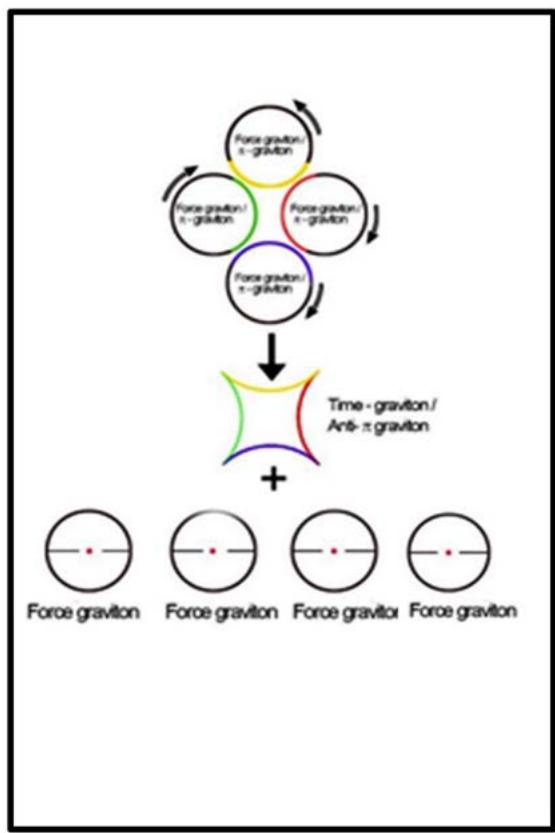 Figure 16: Formation of 'Time' Graviton from the closely interacting of 4 nos. of 'Force Gravitons'. The direction of rotation of the force gravitons are shown by arrow. On the figure, the similar fashion an anti- $\pi$ graviton is formed from 4 nos. of rotating $\pi$ gravitons and a particle constituent is formed from 4 nos. of wave constituent
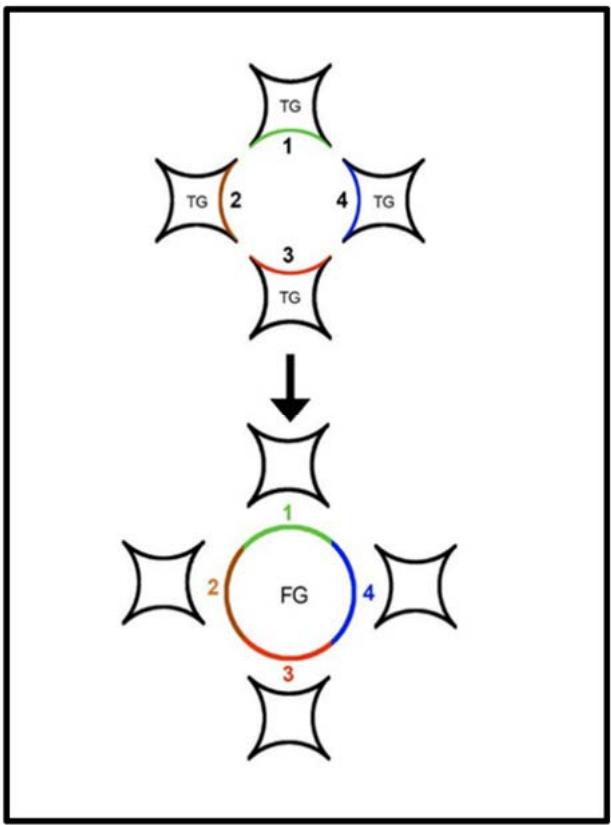 Figure 17 represents the following entanglements:
Figure 17: Formation of a Force Graviton (FG) from 4 nos. of Time Gravitons (TG) or formation of a $\pi$ Gravitons from 4 nos. of anti- $\pi$ Gravitons. a wave constituent is formed from 4 nos. of particle constituent
Figure 16 represents the following entanglements:
i) Wave to particle ii) 'π gravitons' to 'anti π gravitons' iii) 'Force graviton to time graviton'
i) Particle to wave ii) 'anti $\pi$ gravitons' to $\pi$ gravitons iii) 'time graviton' to 'force graviton'
The physical significance of 'wave function' of quantum mechanics could not be put forward as yet. It is often told that the wave function is a complex and non-observable quantity. This means that the wave function is something abstract but TTQG has offered a very distinctly visible shape of the wave function, explained the physics of its formation, and provided a mathematical expression of the same.
A bicycle or a motor cycle contains two wheels (of circular geometry) and operations like balancing, steering, braking, accelerating,...etc...are acted upon the wheels. Similarly, the brains of the human being and the living animals send signals to the muscles of the different organs (like for examples fingers, hands, legs, limbs...etc...., having some or the other geometrical shapes) to perform the following day to day life activities as and when required:
i) Walking ii) Running iii) Balancing and standing on one leg iv) Dancing v) Skating vi) Changing direction while walking or running vii) Scrolling viii) Vibrating or shaking hands In the examples as cited above for the wheels of the bicycles or the organs of human being, all are conserved, i.e, the wheels or the organs go back to their resting positions, once the said activities are completed. This is to note that in the above examples of several activities, the pattern of the movements of the organs or the pattern of the forces playing part vary widely from each other and the outputs are different too. When the activity is 'running', the output is the creation of kinetic energy, walking downhill is creation of space expansion (the so called acceleration), walking uphill is gaining potential energy, walking along a straight line is linear momentum generation, running or walking through a circular orbit is generation of angular momentum,...etc....
The wave function $\Psi$ in quantum mechanics, is same to the EM-gravitons' of TTQG and which is bearing a typical geometrical shape. The different quantum mechanics 'operator'(like the different signals of the brains as discussed above), are acting on the same wave function differently to yield different physical variables, as for example, the 'potential energy', the 'kinetic energy', the 'linear momentum', the 'angular momentum', the 'force', the 'space expansion'...etc.... The physics, mathematics and the topology of the convergence of the quantum mechanics $\Psi$ to that of the 'EM-wave gravitons' of TTQG is explained below.
From the quantum physics concept of Niel's Bohr, the electrons are rotating around a nucleus in different electronic orbits. The waves are generated from the movement of the electrons (the so called concept of 'wave-particle' duality and De Broglie's hypothesis of, a moving particle is always carrying a wave associated with it). An orbit has the following characteristics:
i) It has a specific energy level ii) It has its angular momentum called 'orbital angular momentum', L
The energy expression of TTQG is $(4\pi r^3)$ and the angular momentum, $L$ is expressed through the following mathematical expression,
$$
\mathsf {L} = (2 \pi \times \mathsf {M} \times \mathsf {f} \times \mathsf {r} ^ {2}) \dots \tag {23}
$$
\[\\text{[M = mass, f = frequencyofrotation = (numberofcycles/time), r = radiusoftheorbit]}\]
The above equation (23) takes the form:
$\mathsf{L} = (2\pi \times \mathsf{M}\times \mathsf{n}\times \mathsf{r}^2) / \mathsf{t}$ [n = integer = numbers of cycles and t= time].(24)
Now putting the TTQG expressions of mass and time \[ $(9 / (4\pi r^3)$ and $(3 / (4\pi r^2)$ respectively for mass and time\], one gets
$$
\mathsf {L} = [ 2 \pi \times (9 / (4 \pi \mathsf {r} ^ {3}) \times \mathsf {n} \times ((4 \pi \mathsf {r} ^ {2}) / 3 ]
$$
$$
\mathsf{L} = 6\pi\mathsf{r}.\tag{25}
$$
(the integral multiple $n$ is not considered)
Since L is a vector quantity in physics and so 'angular momentum' is a 'directional entropy' of TTQG. In a 3D sphere by applying the right hand thumb rule (the movement of the particle and the positioning of angular momentum vector), one can find the six numbers of angular momentum. (2 numbers in each of the mutually perpendicular x,y and z directions)
Now, it is very logical to conclude that the creation of wave or the wave function $\Psi$, is a superposition of 'energy' and 'angular momentum' or 'the directional entropy',
So the wave function
$$
\begin{array}{l} \Psi = (\text{energy} \times \text{angularmomentum}) \\= (4 \pi \mathrm{r} ^ {3} \times 6 \pi \mathrm{r}) \\\end{array}
$$
$$
\Psi = (24 \pi^{2} r^{4}) \dots \dots \dots \dots \dots (26)
$$
From equation (26) one can conclude that the wave function $\Psi$ can be represented geometrically as, i) the hybrid of 2 numbers of circles or ii) hybrid of a 3D sphere and a half circle or iii) four numbers of half circles.
The Schrodinger 'time independent' wave equation is functionally equivalent to the Newton's second law derived expression of force, i.e.,
$$
\text{Force} = (\text{mass}) \times (\text{acceleration})
$$
$$
\text{Force} = (\text{mass}) \times (\text{spaceexpansion})
$$
The 'time independent' Schrodinger wave equation is,
$$
V ^ {2} + \frac {8 \pi^ {2} m}{h ^ {2}} (E - V) \Psi = 0 \quad \dots \tag {27}
$$
In the above equation, $\nabla^2$, m, h, E, and V stand for the Laplacian operator (second derivative of the wave function $\Psi$ (that is $d^2\Psi /dx^2$ ), mass, Planck's constant, energy and potential energy respectively. The definition of the Laplacian operator is
$$
-\nabla^{2}=\left(\frac{\mathrm{d}^{2}}{\mathrm{d}x^{2}}+\frac{\mathrm{d}^{2}}{\mathrm{d}y^{2}}+\frac{\mathrm{d}^{2}}{\mathrm{d}z^{2}}\right)\Psi\tag{28}
$$
So the dimension of equation (28) has to be the same as that of $[8\pi^2\mathsf{m} / \mathsf{h}^2 (\mathsf{E - V})\Psi ]$
The dimensional break-up of $[8\pi^2\mathsf{m} / \mathsf{h}^2$ (E-V) $\Psi ]$ turns out to be in regard to TTQG, \[considering the expression of $\mathsf{m} = (9 / 4\pi \mathsf{r}^3)$, $\mathsf{h} = \pi \mathsf{r}$, E and V = $\pi \mathsf{r}^3$ and $\Psi = \pi^2\mathsf{r}^4]$, is,
$$
\begin{array}{l} [ 8 \pi^ {2} \mathrm {m} / \mathrm {h} ^ {2} (\mathrm {E} - \mathrm {V}) \Psi ] = [ \pi^ {2} \times \text {m a s s (m)} \times \text {e n e r g y (E - V)} \times \pi \mathrm {r} ^ {4} (\Psi) ] / \mathrm {r} ^ {2} ] (\mathrm {r} ^ {2} = \mathrm {h} ^ {2}) \\= [ \text {m a s s} \times \pi^ {2} \mathrm {r} ^ {5} ] [ \ln \text {T T Q G}, \pi^ {2} \mathrm {r} ^ {5} \text {s t a n d s f o r s p a c e e x p a n s i o n} \\\end{array}
$$
(acceleration of Newtonian physics\]
$$
= (\text{mass} \times \text{spaceexpansion}). \tag{29}
$$
The $(\mathrm{d}^2\Psi /\mathrm{dx}^2)$ is in the form $(\pi r^2)$ and which stands for 'force' in TTQG. So the equation (27), the famous Schrodinger's equation converges to the very primitive equation of classical/Newtonian physics, i.e.,
$$
\text{Force} = (\text{mass}) \times (\text{acceleration})
$$
Or in the language of TTQG,
$$
\text{Force} = (\text{mass}) \times (\text{spaceexpansion})
$$
The origin of force as the 'superposition' of mass and space expansion is shown below diagrammatically in Figure 18 below.
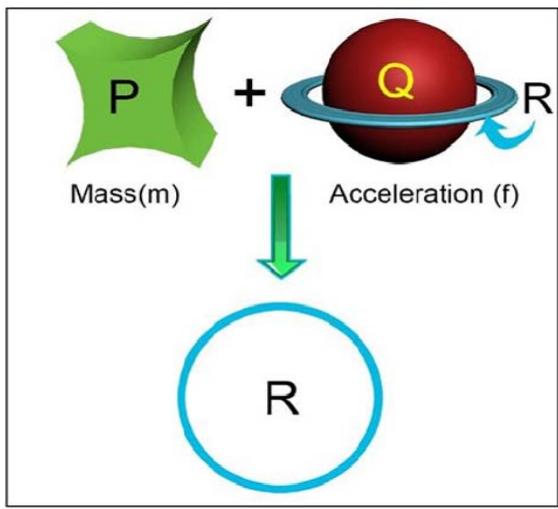 Figure 18a: Mass and Space expansion (Acceleration) interaction to produce force
Schrodinger's time dependent equation, however, has no validity as explained below. The time dependent equation is,
$$
\Psi = A.e^{-i\omega t}
$$
$\Psi$ is the wave function, $\hbar$ is the reduced Planck constant, $A$ is the proportionately constant, $t$ is time and $\omega$ is the angular frequency
Now angular frequency is (number of cycles)/(sec) and as per unified theory it has a dimension of $1/(1/r^2)=r^2$. So, when the value of is put into equation (30), it takes the form
$$
\Psi = A. e ^ {- 1} \omega t = A. e ^ {- l}. r ^ {2} \frac {1}{r ^ {2}} = A. e ^ {- l}. \dots \tag {31}
$$
So, the time part is totally eliminated from the time-dependent form of wave function $\Psi$.
So, the time-dependent wave equation proposed by Schrodinger has no real significance.
The action of the quantum mechanical operators on the wave function is a dual phenomena of 'exchange of quantum' and a 'simultaneous hybridization-dehybridization' process and this takes place in four numbers of different steps, which are explained below:
i) In step I, the system (the wave function $\Psi$ ) is dehybrized to lower dimensions (from 4 to 3 to 2...etc.) by operating the differential operators ( $1^{\text{st}}$ derivative $d/dx$ or second derivative, $d^2/dx^2$,...etc.) on the wave function. ii) In step II, the obtained dehybrized dimensions (those are lost by the wave function) in step 1 are transferred to the surroundings. iii) Step III, is a step of 'integration' or 'hybridization' where the lost dimensions of the wave function are being returned back to the system (the left out differential form of the wave function) such that the wave function is rebuilt and retained. However, the return of the dimensions does not take place directly. The support is taken of an another physical variable (like entropy, force, energy, space expansion..etc..), which in fact transfers the lost dimensions of the wave function back to it.
iv) In step 4, the lost dimensions of the above said physical variable of step III, is compensated by the surroundings (which the surroundings had received in step I from the system).
[To simplify the understanding of the functioning of the quantum mechanical operators on the wave function, the term 'system' and 'surroundings' have been used. In the following sections to come it has been shown that in this universe such sharp demarcation between 'system' and 'surroundings' is not possible and it does not carry any significance too]
The above said four numbers of steps is shown diagrammatically in Figure 18b below:
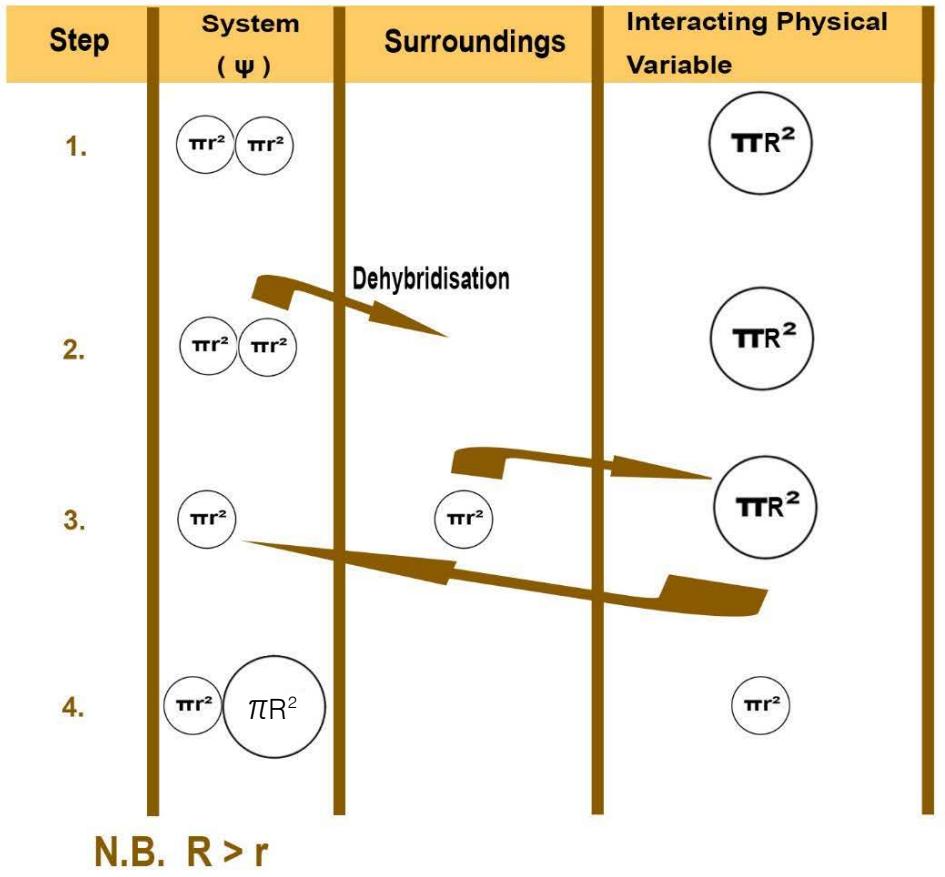 Figure 18b: Topological Presentation of the operability of the Quantum mechanical operators
The above said steps are now being explained with an example, e.g., by considering the event of operability of kinetic energy operator, $(\mathrm{h}^2 / 2\mathrm{m}) \mathrm{d}^2/\mathrm{dx}^2$, on the wave function $\Psi$. The parameter, $(\mathrm{h}^2 / 2\mathrm{m})$, is dimensionally a space expansion graviton \[since $h = r$ and $m = (1 / \pi r^3)$ such that, $(h^2 / 2m) = (\pi r^5)$ \] and the interaction between the wave function and the said operator can be represented as:
$$
(h^2 / 2m) d^2 / d x^2 (\Psi) = (\pi^5) x d^2 / d r^2 (\pi^2 r^4) = (\pi^5) x (\pi^2 r^2) = (\pi r^3 x r^2) x (\pi^2 r^2) = (\pi r^3) x (\pi^2 r^4) = (energy) x (wave function) = (\mathsf{E} \Psi) \tag{32}
$$
When the different operators do act on the wave function $\Psi$, the one or the other output are obtained but the wave function is retained. The diagrammatic presentations of the operability of three different operators, i.e., momentum, kinetic energy and angular momentum on the wave function $\Psi$ are given in figure 19a, 19b and 19c respectively. It is to note that any quantum mechanical operator represents one or the other a physical variable and the actions of such operators on $\Psi$ can be described as:
$$
i \hbar \nabla = i x r / \pi x d / d r [ \psi ]
$$
Dehybridization
$$
= i x r / \pi x d / d r [ \pi^ {2} r ^ {4} ]
$$
$$
= i x r / \pi x \pi^ {2} r ^ {3}
$$
$$
= i / \pi \times \pi r \times \pi r ^ {2} \times r
$$
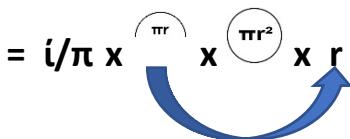 Figure 19b: Topological Presentation of Angular momentum Operator in Quantum mechanics Panel label: hybridization.
$$
\begin{array}{l} = i / \pi x ^ {\left(\pi r ^ {2}\right)} x ^ {\left(\pi r ^ {2}\right)} \\= i / \pi x \psi \\\end{array}
$$
Figure 19a: Topological Presentation of momentum operator in Quantum mechanics
$$
r x i \hbar \nabla = r x i / \pi x r x d / d r [ \psi ] \text {D e h y b r i d i z a t i o n}
$$
Angular momentum operator $= r \times i / \pi \times r \times d / dr$ [π2r4]
$$
\begin{array}{l} = r \times i / \pi \times r \times \pi^ {2} r ^ {3} \quad \text {h y b r i d i z a t i o n} \\= r \times i / \pi \times [ \pi^ {2} r ^ {3} \times r ] \\= r \times i / \pi [ \pi^ {2} r ^ {4} ] \\= r x i / \pi x \left(\pi r ^ {2}\right) \left(\pi r ^ {2}\right) \\= i / \pi . r. \psi \\\end{array}
$$
$$
\left(\hbar^ {2} / 2 m\right) / \nabla^ {2} = 1 / \pi^ {2}. r ^ {2}. \pi r ^ {3} d ^ {2} / d r ^ {2} [ \psi ] \quad \text {D e h y b r i d i z a t i o n}
$$
Kinetic energy operator
$$
\begin{array}{l} = 1 / \pi^ {2}. r ^ {2}. \pi r ^ {3}. d ^ {2} / d r ^ {2} [ \pi^ {2} r ^ {4} ] \\= 1 / \pi^ {2}. r ^ {2}. \pi r ^ {3} [ \pi^ {2} r ^ {2} ] \\\end{array}
$$
$$
= \pi / \pi^ {2}. \pi r ^ {3}. \pi r ^ {2} [ \pi r ^ {2} ]
$$
 Panel label: Hybridization.
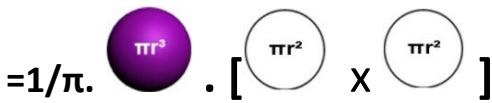 Panel label: Energy.
 Figure 19c: Topological Presentation of Kinetic Energy Operator in Quantum Mechanics
$$
\equiv E \psi
$$
The wave function $\Psi$ takes different shapes as and when required for balancing the forces between the two force circles. The said balancing of forces are illustrated in Figure 20 below.
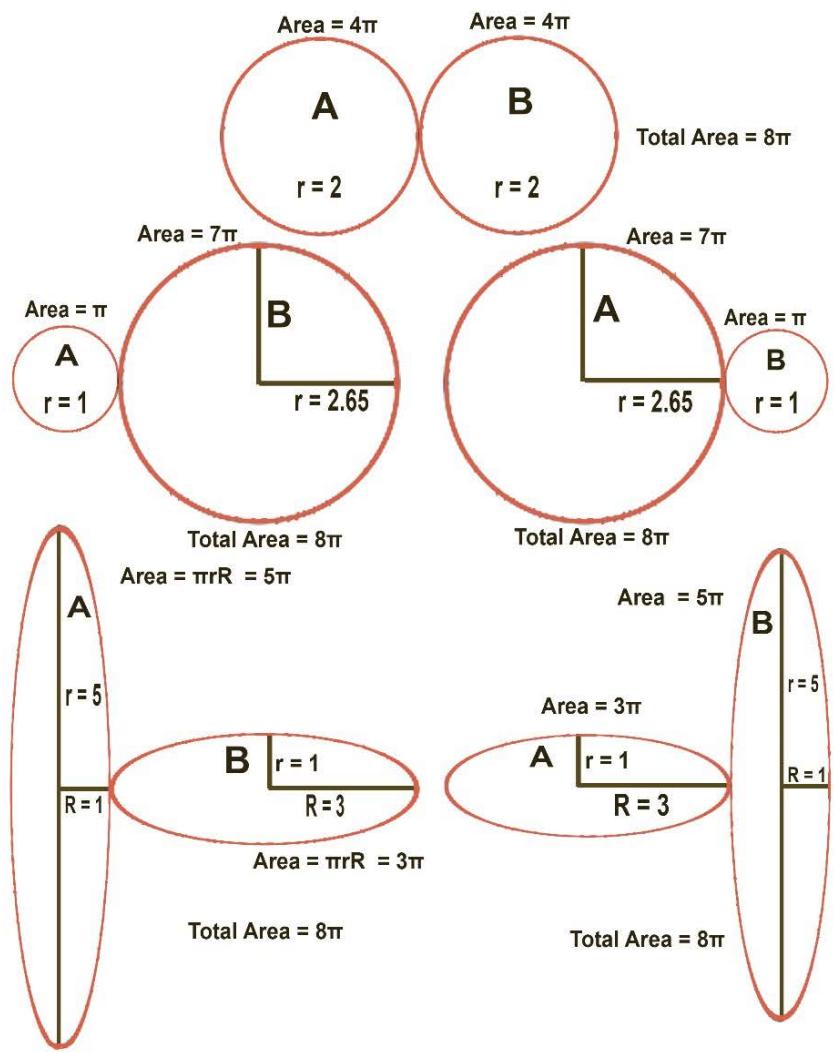 Figure 20: Different isomeric or topological forms of wave function(Ψ)
As is found from the above figure 20 that due to the balancing of forces, the different isomeric or topological forms do evolve of the wave function. When one of the force circles increase in size, the size of the other force circle decreases. When one of the force circles is longitudinally more expanded (than its lateral
spread width), the other force circle is expanded laterally more to balance it and the vice versa. However, one thing to note here that the sum of the areas of the two circles remain to be constant always as has been clearly shown in Figure 20. [98]
The 'exchange of force circles' between two energy gravitons is shown diagrammatically in Figure 21 below.
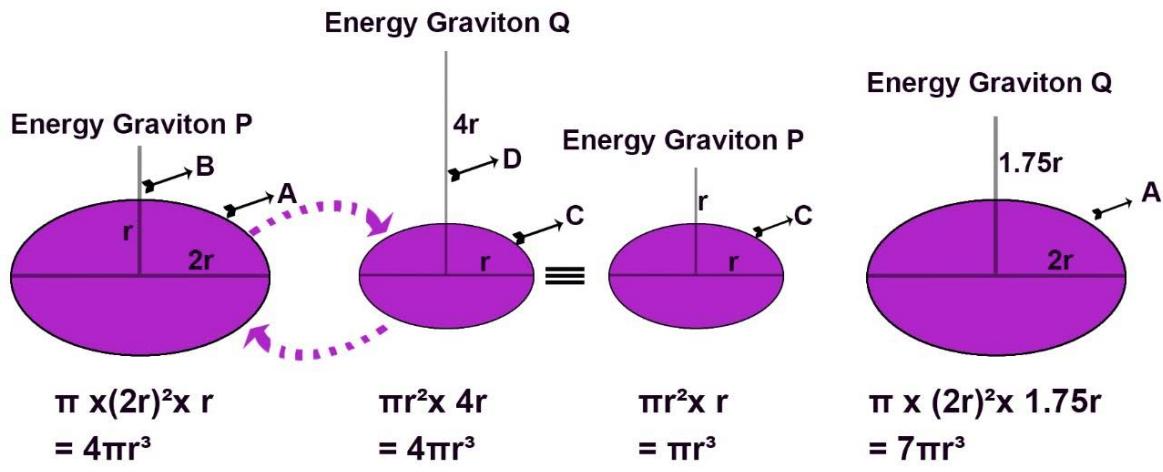 Figure 21: Topological presentation of exchange of forces through quantum (Base circle A & Base circle C have radius $2r$ & r respectively)
The figure 21 clearly demonstrates how the 'force quantum' are exchanged between two energy gravitons keeping the sum total of the energies of the two gravitons constant.
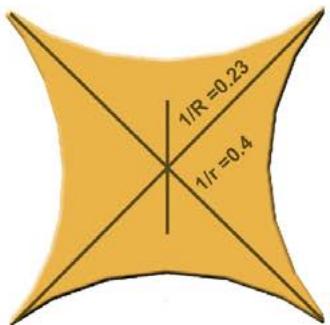
The 'law of conservation of energy' and the 'law of conservation of mass' are the two principal laws of science but the none of the said laws have been described topologically in the history of science. The said two law are geometrically presented in figure 22a and 22b below and those are self explanatory. \[in calculation of the volume of the sphere/ellipsoid in the said figures, the factor, (4/3) has not been considered since it a common factor for all and what is done, is the comparisons of the volumes. The volume of a sphere or a ellipsoid is obtained through a formula, $(4\pi x a x b x c)/3$, where $a$, $b$ & $c$ represents the length, breadth and height respectively\].
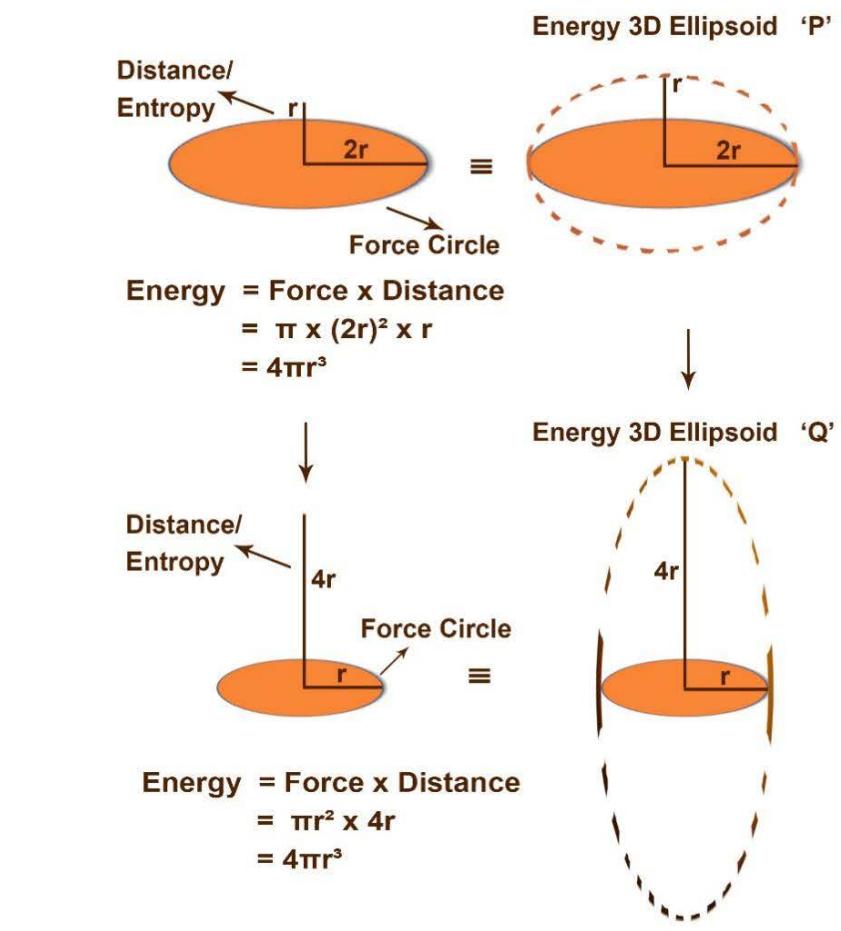
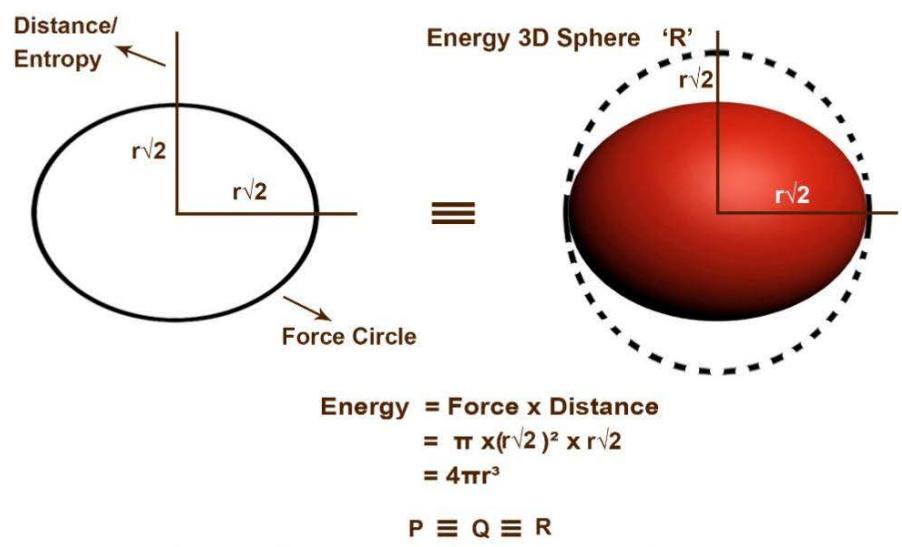 Figure 22a: Topological presentation of laws of conservation of energy
$$
\begin{array}{l} \mathrm {M a s s} = 1 / \pi r ^ {2} \times 1 / R \\= 1 / \pi (2. 5) ^ {2} \times 1 / 4. 3 \\= (1 / 2 7 \pi) \\\end{array}
$$
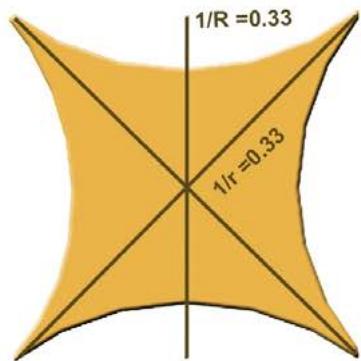
$$
\begin{array}{l} \mathrm {M a s s} = 1 / \pi r ^ {2} R \\= 1 / \pi (3) ^ {2} \times 1 / 3 \\= (1 / 2 7 \pi) \\\end{array}
$$
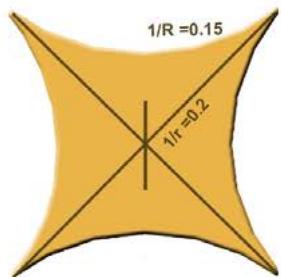 Figure 22b: Topological presentation of Conservation of Mass
$$
\begin{array}{l} \mathrm {M a s s} = 1 / \pi r ^ {2} R \\= 1 / \pi (2) ^ {2} \times 1 / 6. 7 5 \\= (1 / 2 7 \pi) \\\end{array}
$$
The salient features of the principle of conservation of energy are: (in context to figure 22a)
i) The 'energy graviton' is the superposition of a 'force graviton' (represented by a circle) and an 'entropy graviton' (a distance, represented by a straight line). ii) When the area of the force circle increases, the length of the adjoined straight line decreases and when the area of the force circle decreases, the said length increases such that the product of the two remain constant. This inverse relationship between force and entropy has a much bigger implication on the large scale structure of the universe. Since the total energy of the universe is constant, as the universe expands, the more and more entropy are generated but the universe from a spherically symmetrical shape does pass on to more and more flatter geometry.
iii) The universe does expand longitudinally, reaches out to a maximum point, and the universe essentially becomes flat or linear (as if the only longitudinal entropy line is existing with a vanishing small force circle). However, after reaching to the state of highest longitudinal expanded state, the longitudinal entropy does start decreasing. Then the lateral entropy starts increasing and the universe does go on expanding laterally and reaches out to a state of highest possible lateral expanded state. Then again the longitudinal expansion does begin. The said cycles are repeated time and again. The total space occupied by the universe remains constant even though the universe does always remain in the state of expansion either longitudinal
or the lateral. In figure 23, the said periodic 'longitudinal and lateral expansion' of the universe is shown:
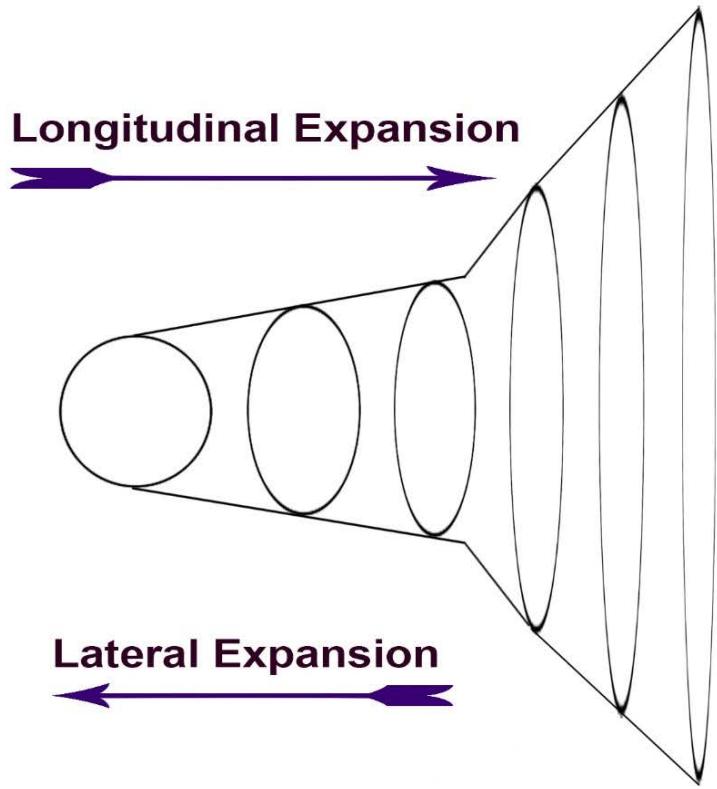 Figure 23: Periodic longitudinal & lateral expansion of the universe and the conservation of the total space (The area of the ellipsoid/circle are the same)
Between the two entropy parameters (the longitudinal entropy and the lateral entropy), the either of the two always remain in the increasing mode and the following conditions do always hold:
## VIII. LONGITUDINAL OR THE LATERAL EXPANSION OF THE UNIVERSE
(CHANGE IN LONGITUDINAL ENTROPY) + (CHANGE IN LATERAL ENTROPY) >0
$$
: (\Delta \mathrm {S}) _ {\text {l o n g}} + (\Delta \mathrm {S}) _ {\text {i a t}} > 0
$$
When the universe expands longitudinally, $(\Delta S)_{\mathrm{long}} > (\Delta S)_{\mathrm{lat}}$ \[( $\Delta S$ ) is positive, ( $\Delta S$ ) is negative but the modulus of the former is higher than the later\] When the universe expands laterally, $(\Delta S)_{\mathrm{long}} < (\Delta S)_{\mathrm{lat}}$ \[( $\Delta S$ ) $_{\mathrm{long}}$ is negative, ( $\Delta S$ ) $_{\mathrm{lat}}$ is positive but the modulus of the former is lesser than the later\] In the literature there does exist numerous definitions of the second law of thermodynamics and one of them is, (which is much important and much discussed topic of physics/physical chemistry):
For a spontaneous process the sum total of the 'change in entropy of system' $(\Delta S_{\mathrm{sys}})$ and the 'change in entropy of surroundings' $(\Delta S_{\mathrm{sur}})$ is always greater than equal to zero and which is mathematically expressed as:
$$
\left(\Delta \mathrm {S} _ {\text {s y s}}\right) + \left(\Delta \mathrm {S} _ {\text {s u r}}\right) > = 0
$$
However, the proof of the above theorem or postulate of thermodynamics (as is being found in the standard books of physics/physical chemistry) is obscure and abstract and which is much difficult to understand. When one considers the occurrence of the expansion of the universe (which is a spontaneous one), the question arises which is the 'system' and which is the 'surroundings'? The universe itself is the 'system' and the 'surroundings' too. Actually there does not exist anything like system and surroundings separately. In the universe the innumerable physical variables do exist in the form of quantum (having a particular geometrical shape or the other) and there are superposition, entanglement and exchange of forces taking place among themselves. Rather than 'system' or surroundings' what is more important is the change in geometries of the physical variables and attainment of new quantum state during a change. In the incidence of the longitudinal expansion of the universe, the lateral entropy quantum are passed on to the longitudinal entropy and as a result of that the later is surpassing the other and sum of the change in longitudinal entropy and the lateral entropy is always positive. The reverse will be true in case of the lateral expansion of the universe. The following exercise will help one to understand the above said topic in a more distinct fashion and some other notions of modern cosmology.
In this exercise for simplification, a circle is considered having a radius of 5 (in any arbitrary scale of measurement) and which starts expanding longitudinally (contracting laterally) first in the different stages and attains almost a flat geometry. Then the process is reversed and the lateral expansion takes place and the geometry is back to the circle again. The Table 4 shows the expansion in difference stages. At the start both r and R (longitudinal radius/entropy and lateral radius/entropy respectively) are the same but they start differing from each other but, $\pi \mathrm{Rr}$, the area of the 2D ellipsoid remain to be constant.
Table 4: The periodic longitudinal and the lateral expansion of the universe
<table><tr><td>STAGES</td><td>r (longitudinal entropy)</td><td>R (lateral entropy)</td><td>Δr (change in longitudinal entropy) (Final - initial)</td><td>ΔR (change in lateral entropy) (Final - initial)</td><td>(r/R) (ratio of longitudinal to lateral entropy)</td><td>(πRr) (Area of the circle/2D ellipsoid)</td><td>(Δr + ΔR) (sum total of the change in longitudinal entropy and the lateral entropy)</td></tr><tr><td>START</td><td>5</td><td>5</td><td>-</td><td>-</td><td>1.00</td><td>25π</td><td></td></tr><tr><td>STAGE 1</td><td>6.7</td><td>3.7</td><td>1.7</td><td>-1.3</td><td>1.8: 1</td><td>25π</td><td>0.4</td></tr><tr><td>STAGE 2</td><td>8.9</td><td>2.9</td><td>2.2</td><td>-0.8</td><td>3.2: 1</td><td>25π</td><td>1.4</td></tr><tr><td>STAGE 3</td><td>11.9</td><td>2.1</td><td>3.0</td><td>-0.8</td><td>5.6: 1</td><td>25π</td><td>2.2</td></tr><tr><td>STAGE 4</td><td>15.6</td><td>1.6</td><td>3.7</td><td>-0.5</td><td>9.75: 1</td><td>25π</td><td>3.2</td></tr><tr><td>STAGE 5</td><td>20.8</td><td>1.2</td><td>5.2</td><td>-0.4</td><td>17.3: 1</td><td>25π</td><td>4.8</td></tr><tr><td>STAGE 6</td><td>27.7</td><td>0.9</td><td>6.9</td><td>-0.3</td><td>30: 1</td><td>25π</td><td>6.6</td></tr><tr><td>STAGE 7</td><td>37</td><td>0.67</td><td>9.3</td><td>-0.23</td><td>55: 1</td><td>25π</td><td>9.07</td></tr><tr><td>STAGE 8</td><td>50</td><td>0.5</td><td>13</td><td>-0.17</td><td>100: 1</td><td>25π</td><td>12.5</td></tr></table>
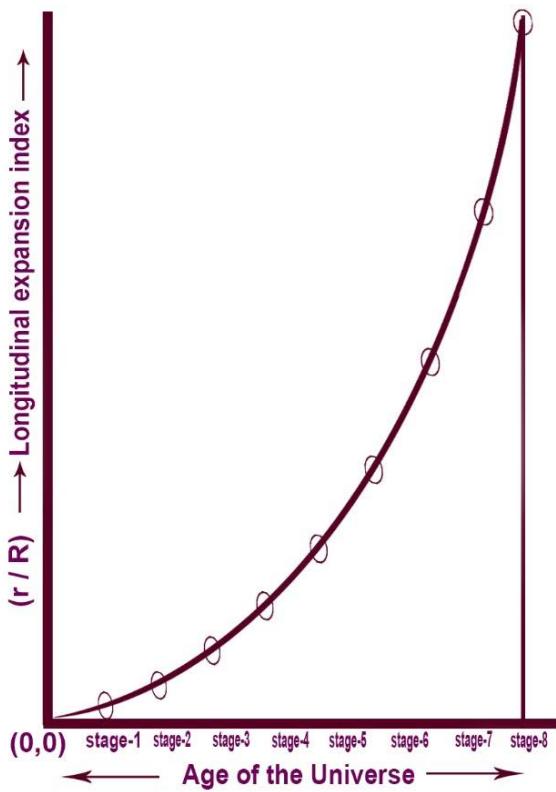 Figure 24: Space expansion of the Universe as a Function of age of the Universe
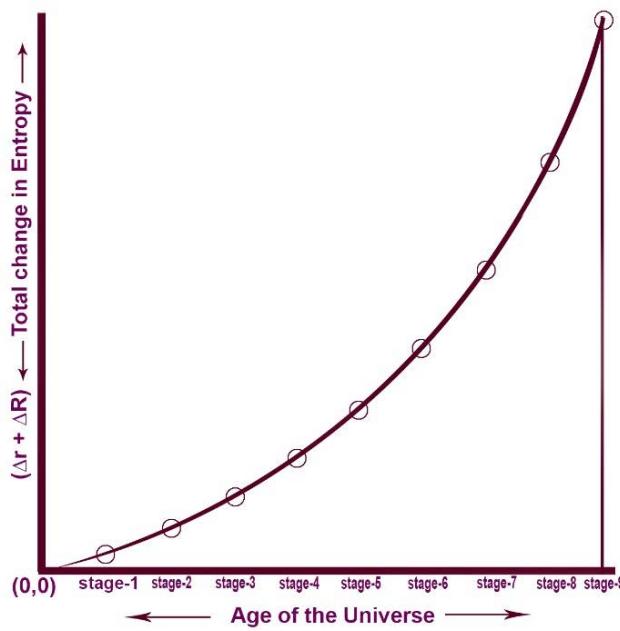 Figure 25: Presentation of net increase of entropy of the Universe as a function of the age of the Universe
From the above said figures one would conclude that:
i) From figure 24 it is seen that the space expansion (or acceleration) is taking place in the universe at a very high rate and the said expansion is in a ever rising path. This matches fully with the modern cosmological concept of accelerating universe, which says that our universe is not only accelerating but it is accelerating more and more with time. ii) From figure 24, it is also found that the universe with the progress of its expansion is attaining more and more flat geometry and which is the concept of the current day cosmology too. iii) From figure 25 it is clearly revealed that the 'change in entropy of the universe' is always a rising function of the expansion of the universe. Though the one of the principal postulates of the subject of thermodynamics is, the entropy of the universe is increasing and going towards maximum, but this postulate could not be presented in the right way in the history of the development of thermodynamics. For the first time through the concepts of TTQG, the topology of the said concept is revealed. There does not exist any such thing as entropy of the system and the entropy of the surroundings. What is true is the distribution of randomness over the longitudinal and the lateral directions and in spontaneous physical and chemical processes, the said two entropy parameters is changing in opposite directions and the modulus of either of the two surpasses the other such that the net change in entropy is positive or there is always a net gain in entropy of the universe. From the data presented in Table 4 and the graph of the Figure 24, one would be very much tempted to conclude that our universe itself is an entropy generating machine.
## IX. TTQG DRIVED NEW THEORY OF COLOR
### PHYSICS - A NEW HORIZON IN PHYSICS
TTQG driven new theory of color physics have been recently offered[89, 90, 98, 104]. The said new theory, in one hand has revealed many mysteries of the cosmological physics and on the other hand could rightly explain the black body radiation and their associated phenomena. The topology of the baryonic matters of the universe (as discovered in the new theory of color physics) is shown in Figure 26a and 26b below:
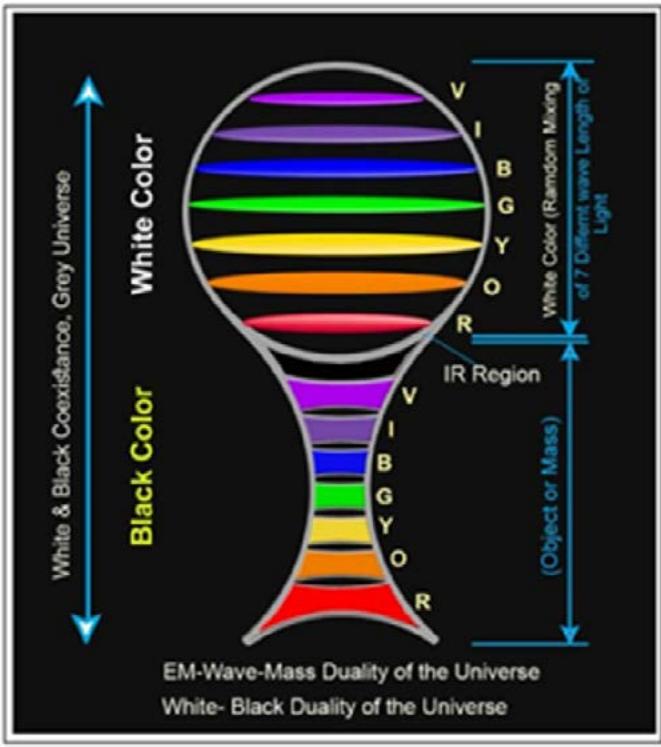 Figure 26a: The Topology of the Baryonic matters of the Universe.
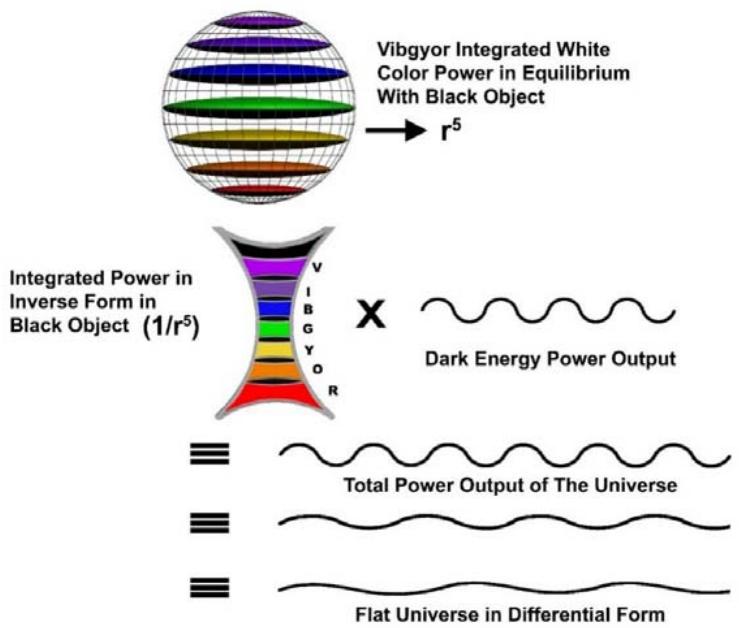 Figure 26b: Presentation of the dark energy and dark matter of the universe
The new theory of color physics considers the baryonic matter as the outcome of the incidence of superposition of 'COLOR HYBRID FUNCTION OF LIGHT, CHFL' and 'COLOR HYBRID FUNCTION OF OBJECT, CHFO'. Figure 26a as shown above is the geometry of the superposition of the said, 'CHFL' AND 'CHFO' THE figure makes us understand the following phenomena of the universe:
i) The upper spherical part of the said figure is multi faceted and it represents the following a. This represents a 'qubit' or a 'quantum bit' of the wave transmission/teleportation of modern quantum computing system. b. This also represents the 5D color space of the light wave of the universe. c. This represents the origin of the 7 different colors of 'VIBGYOR', which no other theory of physics could establish. d. d. This represents the 'wave' part of the 'wave- particle entanglement' of the universe. e. e. This represents the white color of the universe f. f. This represents the ' dark energy' of the universe g. g. This also describes the 'spectral power distribution' of the 'Black Body Radiation' or the sun's energy spectrum.
ii) The lower 3D -saddle part of the said figure is also multi -faceted and it represents the following a. This represents a particle or mass 'qubit' or a 'mass quantum bit' and could become the potential tools for the mass transfer from one place to the other. b. This also represents the inverse 5D color space of the objects or particles of the universe. c. This represents the origin of the 7 different object colors of 'VIBGYOR', which no other theory of physics could establish. d. This represents the 'particle or mass' part of the 'wave- particle/mass entanglement' of the universe e. This represents the Black color of the universe f. This represents the ' dark matter' of the universe g. This also describes the 'inverse spectral distribution' of the 'Black Body mass' or the Black Hole.
So the upper spherical part and the lower saddle part together represents an entangled quantum pair of the baryonic matters of our universe. The upper white color part and the lower black color part makes the universe grey since the combination of white color and black color make a grey color.
The entanglement of 'quantum bits' are shown in the literature as shown in the following Figure 27. However, how such apparent 3D looking quantum (with the inscribed circles) are originated has never been discussed in the literature. The TTQG driven new theory of color physics, however, reveals this mystery too.
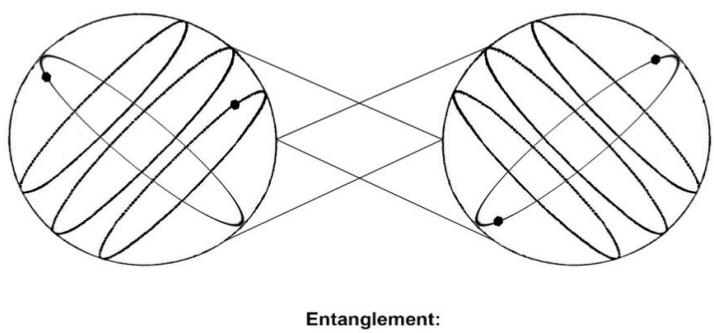 Figure 27: Typical presentation of quantum entanglement
As explained in the previous section of quantum mechanics, how the entropy is continuously being generated in the universe. Now this generated entropy in sequence by the way of the phenomena of superposition, generates the following
Entropy to force to energy to EM-wave to 5D power propagation, and could be represented as,
5D power generation = (entropy) x (EM-wave) = (entropy) x (entropy) x (energy) = (entropy) x (entropy) x (entropy) x (force) = (entropy) x (entropy) x (entropy) x (entropy) x (entropy) = (entropy)5.
The 5D power generation as shown above in fact has been diagnosed as the 'dark energy' of the universe. So the universe continuously does go on producing dark energy and this way the dark energy stock of the universe is rising. Some people have opined that the it is the parameter 'dark energy' which is responsible for the expansion of the universe. The present article firmly establishes that the 'entropy' is the cause and the 'dark energy' is the manifestation of it. So the actual candidate is the 'entropy', which is responsible for the expansion of the universe.
The point to highlight here (in context to the Figure 26) that the upper wave part and the lower mass part are 5D and inverse 5D respectively and they are the idols of the 'dark energy' and the so called 'dark matter' or the 'dark mass' of the universe. When they are separated from each other (breaking their entanglement to each other) by some means or the other and they reside separately, they represent the 'dark energy' and 'dark matter' respectively.
## X. THE TTQG DRIVEN TOPOLOGICAL PRESENTATION OF THE THREE LAWS OF THERMODYNAMICS
The said presentation are given below in Figure 28, Figure 29 and Figure 30 respectively and those are self explanatory.[101].
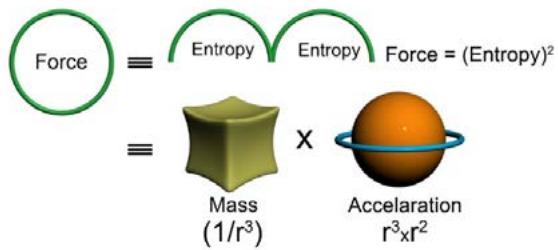
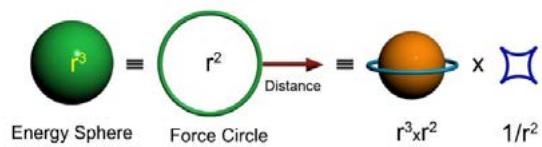
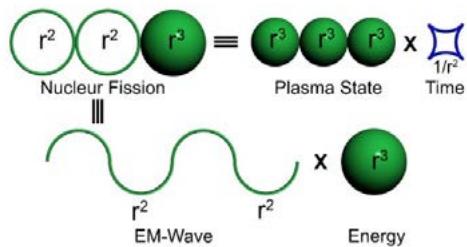 Figure 28: Quantum gravity theory driven geometrical presentation of $1^{\mathrm{st}}$ law of thermodynamics From the above geometrical presentation in Figure 28, it is being very clearly understood that energy can be represented by numerous other permutations and combinations in the hybrid form of 'push forward' and 'pull back gravitons'.
Coming out of the very specific physical variable 'energy', of the first law of thermodynamics, one can put the first law of thermodynamics in a very broad frame in altogether a different fashion as
"Any physical variable of the universe could be observable either in the form of a push-forward or pull back graviton or in numerous permutation-combination hybrid forms of the different gravitons, retaining the magnitude of the physical variable being unchanged."
The above statement of first law of thermodynamics stands to be the most updated statement as far as the newly discovered TQG is being concerned or taken into account.
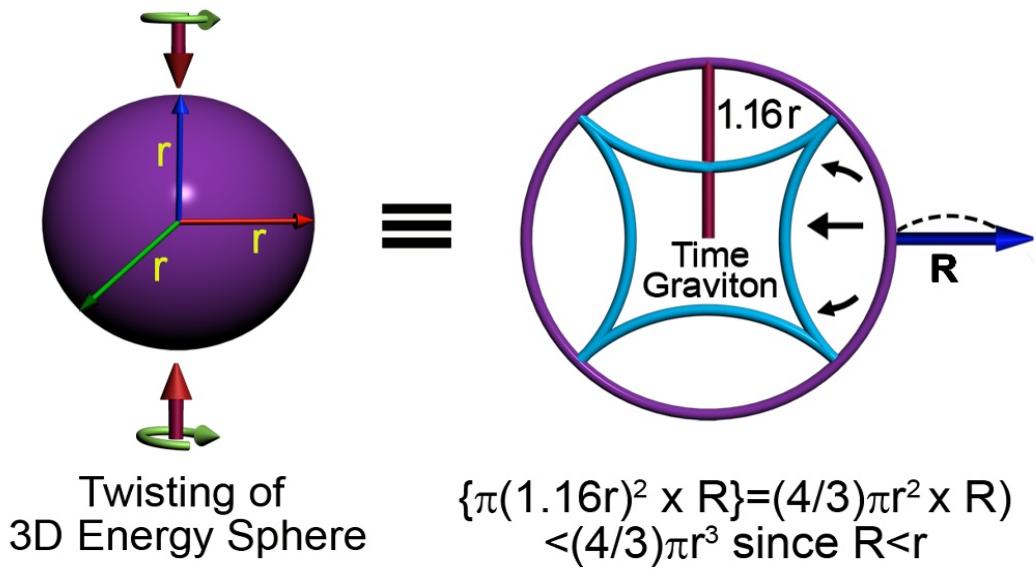 Twisting of 3D Energy Sphere
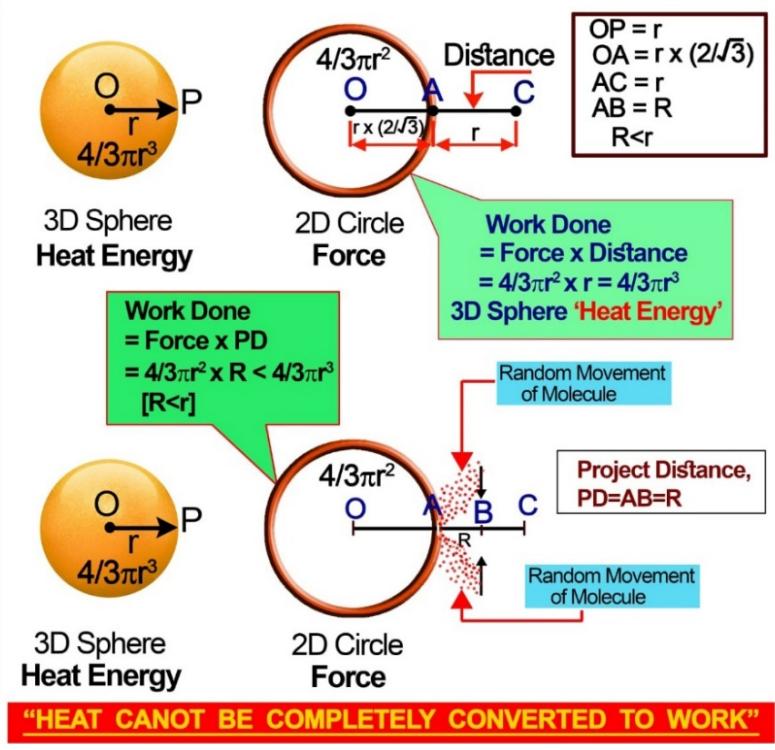 Figure 29: Quantum gravity theory driven geometrical presentation of second law of Thermodynamics.
The time graviton being intrinsically a sort of 'attractive cage' enforces the development of a curvature (randomness) to the emerged 'directional entropy', which is being shown in figure 29 too. The randomness part is being ultimately merged with the 2D force circle and become an integral part of it as combinatorial entropy. The net result is the length of the directional entropy diminishes and it attains a value of 'R' (as shown in figure 5) and this makes 'R\<r'. So the work done (W)(in the form of force x distance) is less than the magnitude of energy (E) 3D sphere. So both the 'combinatorial' and 'non-combinatorial' parts of entropy be responsible for not allowing the energy to be fully converted to work. However, apparently the entropy is the responsible for W\<E but the real responsible physical variable is the 'time graviton'. The 'time graviton' is the cause and the 'entropy graviton' is the effect as the TTQG very clearly is revealing above.
There does exist so many statements of the second law of thermodynamics but the main essence is "Energy cannot be completely converted to wok due to the existence of randomness or entropy". The second law of thermodynamics as has been proved above geometrically driven by TQG, leaves a scope to modify the second law of thermodynamics as "Energy cannot be completely converted to work due to the presence of time graviton or time attractive cage in an atom of a baryonic matter".
The TQG being in the hand of the global scientific community, a more explicit and much broader version of the second law of thermodynamics is the need of the day as is being felt and which should not only talk about heat and work only. It has to be very broad one such that the 'directional to multidirectional' or 'multidirectional to directional' phenomena of the entire universe would come under its periphery. Such a version could be stated as
"To pass on to a state of directionality from a multidirectional state, one has to adopt the route of generating as much energy (E), as possible, and then operate the same on time graviton (t) to dilute the unfavorable time attractive force (acting in opposition to generate directionality) such that the hybrid of the two, Et, results into directional entropy".
As per TQG, the hybrid of E and t is,
$$
E \times t = (4 \pi r ^ {3}) \times (3 / 4 \pi r ^ {2}) = 3 r = E n t r o p y \tag {2.1}
$$
One of the derived phenomena of the universe from Heisenberg's uncertainty principle is, (energy x time) $=$ Planck's constant, h. In TQG, it has been proved that 'h' is in fact a physical variable same to same as 'entropy'.
All the above discussion as made above regarding the second law of thermodynamics leads one to very justifiably conclude that the second law of thermodynamics and Heisenberg's uncertainty principle are virtually the same though the said two laws/principle, apparently look to be dissimilar or have no link to each other.
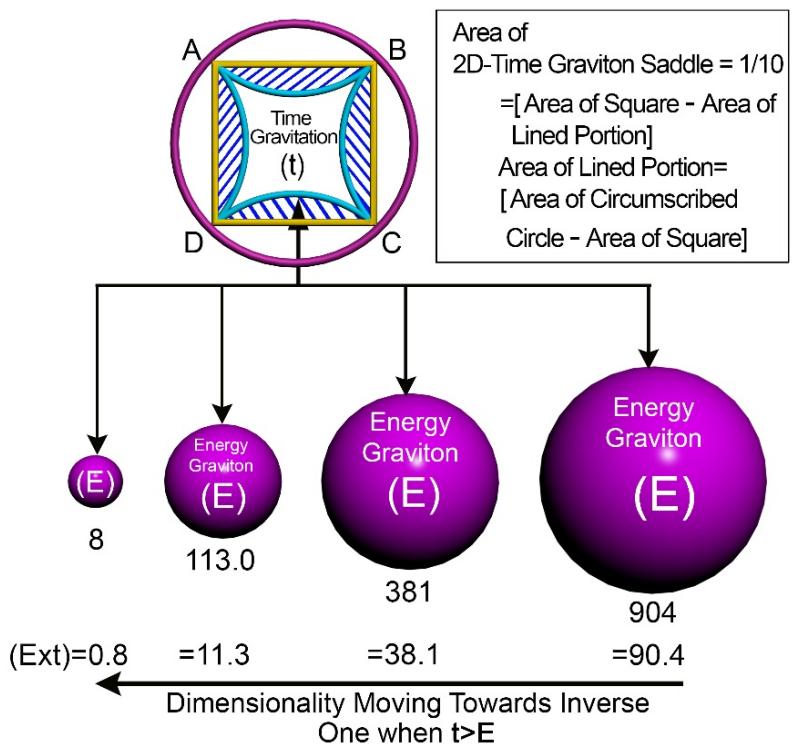 Figure 30: Quantum Gravity theory driven geometrical presentation of 3rd law of thermodynamics
## XI. THIRD LAW OF THERMODYNAMICS
The third law of thermodynamics and the concept of entropy are very much related to each other. Continuing with the concept of $\text{Et} = r =$ entropy and $tT = 1$ of TQG as is being shown in the following figure 30, as soon as the temperature (T) is lowered, time (t) becomes more and more stronger being the multiplicative inverse of T. This inverse dimensional stronger force insists the Et hybrid or the entropy 'r' to pass on to inverse dimensionality in the form of 'order graviton' of TQG. The said order graviton or inverse entropy graviton does asymptotically approaches zero although it cannot become exactly be zero.
The TQG showered definition or statement of third law of thermodynamics needs to be put as
"There does exist an inverse dimensionality (which remains in the form of order graviton or inverse entropy graviton) of the universe arising out of the hybridization of energy and time graviton when the time graviton is much stronger than the magnitude of the energy graviton and the said inverse dimensionality approaches asymptotically the state of perfect order or zero.
## XII. SUMMING UP OF TOG DEFINITION OF THE LAWS OF THERMODYNAMICS
In a very nutshell, all the three laws of thermodynamics are the consequences of energy (E) and time (t) interacting with each other. The sum-up of the above said definitions are as under:
i) The first law of thermodynamics is suited to any range of domain of $E$ and $t$ or any phenomena of the universe. ii) The second law of thermodynamics is suited in the domain of the universe when $E > t$ (in the multiplicative inverse sense) from energy/work to EM-wave/dark energy flow to space expansion to photo-electric phenomena to nuclear fission to X-ray, gamma ray to plasma state to dark energy. iii) The third law of thermodynamics is suited in the domain of the universe when $t > E$ (in the multiplicative inverse sense) from order to mass to gravitational lensing to space inversion to nuclear fusion to black hole to dark matter or dark mass.
## XIII. CONCLUSIONS
In this article the following theories of physics have been presented altogether in new modified forms:
### 1. Cosmology
All the cosmic phenomena of the universe have been tied up to the same source by the discovery of 'universal graviton cycle'(UGC). The UGC is originated from the superposition and entanglements of the different push forward and pull back gravitons. All the gravitons are in the form of quantum.
#### 2. Theories of relativity
While presenting the theories of relativity (the special and general ones) Einstein talked about distorted 'time-space', 'singularity', 'geometry of gravitation', 'cosmological constant'...etc...and so on but he could shape none of them properly and the said theories were incomprehensible to many people. In TTQG, by constructing the geometry of gravitation and shaping up the concept of singularity, the relativity theories have come up in a newer simplified way in front of people. The very famous equation of Einstein, $E = mC^2$, has been shown to converge to one of the major findings of TTQG and which is the constancy of the energy density of the space of the universe.
#### 3. Quantum Mechanics
The roots of the subject of Quantum mechanics are 'Heisenberg's uncertainty principle' and the 'wave-particle duality'. However, both the said phenomena carry different significance than the way they were presented to the scientific community. In TTQG, It has been shown for the first time in the history of science that Hiesenberg's uncertainty principle is basically the generation of entropy of the universe and the wave particle duality is a phenomenon of entanglement of mass and EM-wave.
The famous Schrodinger's equations were developed from the classical equation of mechanical wave of particles and from the TTQG point of view no new value addition was made to physics by proposing the said equation. It has been shown in this article that the 'time-independent' equation of Schrodinger had just converged to the Newton's second law of motion which is omnipresent in physics in the form of, (Force = mass x acceleration). Though the Newton's said equation is correct dimension-ally but the physical variable 'acceleration' is ambiguous and TTQG rightly labeled 'acceleration' in regard to 'space-time' concept as (Force = mass x space expansion).
Quantum mechanics did never offer the topology and the physical significance of the wave function, $\Psi$. The topology of the wave function, $\Psi$, was first provided by TTQG and its physical significance was explained in the form of 'balancing of forces of the universe' by its bi circular hybrid geometrical shape. Through the concept of 'mutual hybridization - dehybridization' of TTQG, the actual physical process occurring during the operability of quantum mechanical operators on the wave function have been diagnosed and presented topologically.
#### 4. Quantum Physics
The subject of quantum physics is resting on the hypothesis put forward by Max Planck of 'discrete photons' and the 'energy equation' (with inverse dependency on the wavelength of light). However, it has been shown that that photons are 'EM-wave gravitons' and the energy is a 3D quantum of dimension 4 and 3 respectively. The Planck's constant in the energy equation of Planck represents 'entropy'. The inverse relationship of energy with wavelength, as shown by Planck, is apparent and energy is inversely proportional to 'time', which is of inverse area dimension and hence energy is being directly proportional to the area or volume of the wave fronts. The idea of energy of Quantum physics (inverse function of the wavelength of light) has been fully reversed in TTQG and the photo-electric phenomena has been shown to be a phenomena of 'exchange of force quantum' between the light wave and the baryonic matter rather than the subtractive model of the same as offered by Albert Einstein.
The 'black body radiation' phenomena, the Stefan-Boltzman law' and the 'spectral power distribution of Black body radiation or sun's energy spectrum could not be explained by the subject of Quantum Physics. Planck had to do some tedious mathematics to explain the typical black body radiation curves but which is again an incomprehensible one. However, in TTQG through the 'new theory of color physics' and the concept of 'constancy of the energy density of space', the black body radiation, Stefan-Boltzman law' and 'spectral power distribution' have been clearly interpreted without doing any tedious mathematical exercise.
#### 5. Classical Physics and Thermodynamics
The major shortfall of classical physics was the ignoring of the 'time-space' of the universe and the most of the physical variables were presented shapeless. TTQG has filled the said incompleteness of the semiclassical physics and thermodynamics as well. TTQG has shown that the so called 'acceleration' of Newtonian physics is in fact a 'time-space' phenomena in the form of 'space expansion'. When there is a longitudinal space expansion, the increase in longitudinal entropy surpasses the decrease in lateral entropy and in case of lateral space expansion, the reverse is true. The net change in entropy (the longitudinal and the lateral) is always positive during the spontaneous expansion of the universe and the so called acceleration and the said entropy always remain in the rising path and tending towards maximum.
The world scientific community needs to realize the fact that the representation of force in the form of (Force = mass x acceleration), is one of the representations of force out of the possible innumerable superposition equations which could be fabricated through TTQG as shown below:
Force = (entropy)2, Force = (mass x entropy x EM-wave), Force = (Nuclear fission x mass)1/2, Force = (Nuclear fusion x EM-wave x space expansion), Force = (EM-wave)1/2..... so many. In the language of chemistry one may say that all these forms of force are the isomeric forms of force and based on this concept, the first law of thermodynamics has been reshaped by TTQG and presented in this article.
For the first time in the history of science, the TTQG came up with the geometrical proof of the second law of Newton and all the three laws of thermodynamics. The most updated versions of the three laws of thermodynamics have been given.
#### 6. String theory
String theory is based on the idea of microscopic strings (of lengths of the order of Planck length) spread all around the universe and are considered to be the 'building blocks' of the universe. As a matter of fact the string theory could not shape up itself properly mainly on ground of ignoring the topology of 'time-space'. As a result of that it failed to explain the geometry of the gravitation and though talked about the multidimensional universe but could not prove it. The line of thinking or the postulates of the string theory needs to be diverted towards the TTQG postulates and is required to be restructured.
The topology of the dark matter and dark energy had been kept at total dark in the string theory. TTQG has shown in a very straight forward fashion the physics of the formation of dark matter and dark energy, their geometrical shapes and the mathematical expression through the presentation of TTQG driven new theory of color physics.
To end, this is to say that based on the altogether many new findings, discoveries and the successful interpretation of the physics and cosmology of the universe by TTQG, the basic and the advanced text books of physics and physical chemistry (especially the chapters of thermodynamics, chemical kinetics and chemical equilibrium.) needs to be re-written immediately to update our knowledge and recognize the cosmos in a new way altogether.
Dedication: Dedicated to my beloved late parents (Mr K P bhattacharya and Mrs Aruna Bhattacharya) and my dearest friend and colleague late Mr Sajal Kumar Roy (of Austin Paints & Chemicals Private Limited, Kolkata).
#### ACKNOWLEDGEMENT
I acknowledge my daughter Ms Sulagna Bhattacharya, my wife Mrs Chandana Bhattacharya, the senior technician Mr Debabrata Chatterjee and CEO, Mr Bijoy Sarkar of Austin Paints & Chemicals Private Limited for their constant inspiration and encouragement. Special thanks are due to Mr Debabrata Chatterjee for drawing the critical figures of this manuscript.
Generating HTML Viewer...
References
99 Cites in Article
J Jones (1924). On the determination of molecular fields. —II. From the equation of state of a gas.
Teik-Cheng Lim (2003). The Relationship between Lennard-Jones (12-6) and Morse Potential Functions.
(null). Van der waals force.
An alternative model of particle physics in a 10dimension (pseudo) Euclidian space time.
K Keelhy,Talish Menon,Quarashi (2018). Wave particle Duality in asymmetric Beam interference.
O Zslavski (2006). Ultimate gravitational mass defect.
Jose Gama (2014). NISTunits: Fundamental Physical Constants and Unit Conversions from NIST.
David Halliday,Robert Resnick,E Little (1963). Physics for Students of Science and Engineering.
Rodney Loudon (1973). The Quantum Theory of Light.
W Duffin (1990). Electricity and Magnetism.
A Ser Way,John Raymond; Jewelt,Jani Wilson,Anna Wilson,Rowlands Unknown Title.
Jose Gama (2011). NISTunits: Fundamental Physical Constants and Unit Conversions from NIST.
G Rybicki,A P B; Lightman (1979). Radiative Processes in Astrophysics.
Donald A; Mcquarrie,John Simon (1979). Physical Chemistry: a molecular approach.
Michael Browne (2013). Unknown Title.
George Rybicki,Alan Lightman (1985). Radiative Processes in Astrophysics.
Edward Purcell,J David (2013). Electricity and Magnetism.
James Maxwell (1998). A Treatise On Electricity And Magnetism.
(1921). Nobel Foundation reduces prize amount.
M Arore,M Singh (1994). Unknown Title.
Robert Goldston,Paul Rutherford (1995). Introduction to Plasma Physics.
Sharma (2017). Detecting Cosmic rays from a galaxy far, far away.
(2012). Fermi finds gamma-rays from Tycho's star.
G Verdenne,J-L Attetia (2009). Gamma-ray Bursts. The brightest explosions in the Universe.
E Schrodinger (1926). An Undulatory Theory of the Mechanics of Atoms and Molecules.
David Griffiths (2004). Introduction to Quantum Mechanics.
Unknown Title.
P Atkins (1977). Unknown Title.
Wolfram Sander (1974). Quanta. A Handbook of Concepts. 2. Auflage. Von P. W. Atkins. Oxford University Press, Oxford, 1991. 434 S., geb. £50.00. ‐ ISBN 0‐19‐855572‐5; Broschur, £ 25.00. ‐ ISBN 0‐19‐855573‐3.
Einstein Albert (1916). The foundation of the General Theory of Relativity.
Oybind Gron,Sigbojorn Hernik (2007). Einstein Tensor for a General Spherical Metric.
Dennis Lemkhl The Genesis of Einstein's work on the problem of motion.
A Chirmas,A Levan,E Stanway Kwierseme The Black Hole merger event GW150914 within a modified Theory of General Relativity 35. Chandra and Hubble Space Telescope Observation of dark Gamma-ray bursts and their host galaxies.
S Van Der Bergh (2011). The curious case of Lemaitre's equation no.24.
H; Nussbaumer,L Bieri (2011). Who discovered the expanding universe?.
M Way (2013). Dimantling Hubble's Legacy?.
Robert World,M (1984). General Relativity University of Chicago.
R World (1997). Gravitational Collapse and Cosmic Censorship.
Dennis Overbye (2015). Black Hole Hunters" NASA Archived from the original on 9.
Colin Montgomery,Wayne Orchiston,Ian Whittingham (2009). MICHELL, LAPLACE AND THE ORIGIN OF THE BLACK HOLE CONCEPT.
B Abbot (2016). Observation of Gravitational waves from a binary Black Hole merger.
The Event Horizon Telescope (2019). First M87 Event Horizon Telescope Results. I. The Shadow of the supermassive Black-Holl.
Stuart Shapiro,Saul Teukolsky (1983). Black Holes, White Dwarfs, and Neutron Stars.
Waltz -Jagjit Space,Singh Unknown Title.
R Penrose (2002). “Golden Oldie”: Gravitational Collapse: The Role of General Relativity.
Charlie Rose (2013). A conversation with Dr. Stephen Hazking and Lucy Hawking.
Patnaik Srikanta (2017). Recent Development in intelligent Nature -inspired Computing IGI Global ISBN.
S; Giddings,S Thomas (2002). High energy colliders as black hole factories.
Lisa Grossman (2010). Fire a black-hole laser to put Hawking to the test.
K Kumar,B Kiranagi,C Bagewadi (2012). How a black hole emits Hawking radiation.
E Schmutzer (1980). Hawking, S. W./Israel, W. (Eds.), General Relativity. An Einstein Centenary Survey. Cambridge, Cambridge University Press 1980. XVIII. 919 S., £ 12.50 A H/C. ISBN 0‐521‐29928‐4.
Jacob D Bekenstein (2008). Bekenstein Bound.
S Hawking,G Ellis (1975). The Large Scale Structure of Space-Time.
Misner Charles,; Jhorne,Kip,S; Wheeler John (1973). Unknown Title.
J Peacock (1999). Cosmological Physics.
Dieter Brill (2012). Black Hole Horizons and How They Begin.
Y Chen,J Shu,X Xue,Y Yuan,Zhao Proting Axions with event Horizon Telescope Polarimetric measurements.
Steven Giddings (2019). Searching for Quantum Black Hole Structure with the Event Horizon Telescope.
Marc Kunter (2003). Astronomy; A Physical perspective.
K Schwarzschild (1916). Kräfte und Spannungen.
Wald Robert (1984). General Relativity.
Scheffer Simon (1979). John Mitchell and Black Holes.
Dimitar Valev (2008). Consequences from conservation of the total density of the universe during the expansion.
Nicholas Mcconnell,Chung-Pei Ma,Karl Gebhardt,Shelley Wright,Jeremy Murphy,Tod Lauer,James Graham,Douglas Richstone (2011). Two ten-billion-solar-mass black holes at the centres of giant elliptical galaxies.
H Robert,Sandesses (2013). The Discovery of the Milky Way Galaxy.
Carol,M Seam (2004). Space-time and Geometry Addison Wesley.
(1965). Gravitational collapse and space-time singularities.
Roy Kerr,P (1963). Gravitational Field of a Spinning Mass as an Example of Algebraically Special Metrics.
Ezra Newman,Allen Janis (1965). Note on the Kerr Spinning-Particle Metric.
Debra Elmegreen (2018). Bar Properties as a Function of Hubble Type.
Joann (2014). 's Haranas and Joannis Gkigkitzis.
Unknown Title.
Explanation of the Special Theory of Relativity by Analytical Geometry and Reformulation of the inverse square law G-Modestino.
J Diag-Polo,E Borza (2007). Loop quantum gravity and Planck-size Black Hole entropy.
Martin Bojowald (2007). Singularities and Quantum Gravity.
Abhay Ashtekar (2007). Introduction to Loop Quantum Gravity and Cosmology.
(2007). Gamma-ray Burst UV/optical afterglow polarimetry as a probe of quantum gravity" 83.
Johan Hansson (2010). Newtonian quantum gravity..
B Ward (2008). RESUMMED QUANTUM GRAVITY.
Null- Wang (2006). New ‘phase’ of quantum gravity.
Durmuş Demir,Şükrü Tanyıldızı (2006). Higher curvature quantum gravity and large extra dimensions.
C Kiefer (2005). Quantum gravity: general introduction and recent developments.
John Gregory (1974). Pigment handbook, Temple C. Patton (ed.), lnterscience, New York, Ondon, Sidney, Toronto (1973). Three‐vol. set— $150.00.
Wayne Reitz (2007). A Review of: “<i>Organic Coatings—Science and Technology</i>, 3rd edition, Z.W. Wicks, Jr., F.N. Jones, S.P. Pappas, and D.A. Wicks”.
T Young (1802). Bakerian lecture on the Theory of Light and Coluns.
William Wright,David (1928). A re-determination of trichromic coefficients of the spectral colors.
(2011). Freephoo | free calls from your iPad | Download for free.
Thomas Smith,John Guild (1931). The CIE Colormetric standards and their use.
Jas. Johnstone (1931). Chemical Embryology. By Joseph Needham. (London: Cambridge University Press. 1931. 3 vols.).
H Dimmelmeier,C Ott,H-T Janka,A Marek,E Müller (2007). Generic Gravitational-Wave Signals from the Collapse of Rotating Stellar Cores.
David Sloan,Pedro Ferreira (2017). Cosmology of an infinite dimensional universe.
(2020). Cosmology and Unified Quantum Gravity Theory of the Universe.
(2020). Novel Quantum Gravity Interpretation of Chemical Equilibrium, Free Energy, Dark Energy and Dark Matter of the Universe.
C Bhattacharya (2023). Reformulating the Basics of Conventional Newtonian Physics, Quantum Physics and the Einstein Theories of Relativities Based on the newly discovered Topological Theory of Quantum Gravity (TTQG).
C Bhattacharya (2023). TTQG (Topological Theory of Quantum Gravity) Driven New Theory of Color Physics.
No ethics committee approval was required for this article type.
Data Availability
Not applicable for this article.
How to Cite This Article
C. Bhattacharya. 2026. \u201cThe Newly Discovered Topological Theory of Quantum Gravity(TTQG) ‐ A Multiblock Compatibilizer Cum Modifier of the Existing Theories of Physics, Cosmology, Quantum Mechanics and Quantum Computing\u201d. Global Journal of Science Frontier Research - A: Physics & Space Science GJSFR-A Volume 23 (GJSFR Volume 23 Issue A4): .
Explore published articles in an immersive Augmented Reality environment. Our platform converts research papers into interactive 3D books, allowing readers to view and interact with content using AR and VR compatible devices.
Your published article is automatically converted into a realistic 3D book. Flip through pages and read research papers in a more engaging and interactive format.
Our website is actively being updated, and changes may occur frequently. Please clear your browser cache if needed. For feedback or error reporting, please email [email protected]
Thank you for connecting with us. We will respond to you shortly.
Lorem ipsum dolor sit amet, consectetur adipiscing elit. Ut elit tellus, luctus nec ullamcorper mattis, pulvinar dapibus leo.
The Newly Discovered Topological Theory of Quantum Gravity(TTQG) ‐ A Multiblock Compatibilizer Cum Modifier of the Existing Theories of Physics, Cosmology, Quantum Mechanics and Quantum Computing