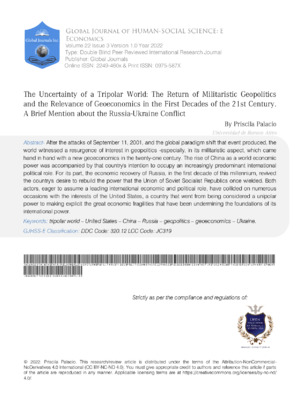
The Uncertainty of a Tripolar World: The Return of Militaristic Geopolitics and the Relevance of Geoeconomics in the First Decades of the 21st Century. A Brief Mention about the Russia-Ukraine Conflict

α
Priscila Palacio
Priscila Palacio

Send Message

To: Author

The Uncertainty of a Tripolar World: The Return of Militaristic Geopolitics and the Relevance of Geoeconomics in the First Decades of the 21st Century. A Brief Mention about the Russia-Ukraine Conflict

Article Fingerprint

ReserarchID

7KR5S

The Uncertainty of a Tripolar World: The Return of Militaristic Geopolitics and the Relevance of Geoeconomics in the First Decades of the 21st Century. A Brief Mention about the Russia-Ukraine Conflict Banner

AI TAKEAWAY

Connecting with the Eternal Ground
  • English
  • Afrikaans
  • Albanian
  • Amharic
  • Arabic
  • Armenian
  • Azerbaijani
  • Basque
  • Belarusian
  • Bengali
  • Bosnian
  • Bulgarian
  • Catalan
  • Cebuano
  • Chichewa
  • Chinese (Simplified)
  • Chinese (Traditional)
  • Corsican
  • Croatian
  • Czech
  • Danish
  • Dutch
  • Esperanto
  • Estonian
  • Filipino
  • Finnish
  • French
  • Frisian
  • Galician
  • Georgian
  • German
  • Greek
  • Gujarati
  • Haitian Creole
  • Hausa
  • Hawaiian
  • Hebrew
  • Hindi
  • Hmong
  • Hungarian
  • Icelandic
  • Igbo
  • Indonesian
  • Irish
  • Italian
  • Japanese
  • Javanese
  • Kannada
  • Kazakh
  • Khmer
  • Korean
  • Kurdish (Kurmanji)
  • Kyrgyz
  • Lao
  • Latin
  • Latvian
  • Lithuanian
  • Luxembourgish
  • Macedonian
  • Malagasy
  • Malay
  • Malayalam
  • Maltese
  • Maori
  • Marathi
  • Mongolian
  • Myanmar (Burmese)
  • Nepali
  • Norwegian
  • Pashto
  • Persian
  • Polish
  • Portuguese
  • Punjabi
  • Romanian
  • Russian
  • Samoan
  • Scots Gaelic
  • Serbian
  • Sesotho
  • Shona
  • Sindhi
  • Sinhala
  • Slovak
  • Slovenian
  • Somali
  • Spanish
  • Sundanese
  • Swahili
  • Swedish
  • Tajik
  • Tamil
  • Telugu
  • Thai
  • Turkish
  • Ukrainian
  • Urdu
  • Uzbek
  • Vietnamese
  • Welsh
  • Xhosa
  • Yiddish
  • Yoruba
  • Zulu

Abstract

After the attacks of September 11, 2001, and the global paradigm shift that event produced, the world witnessed a resurgence of interest in geopolitics -especially, in its militaristic aspect, which came hand in hand with a new geoeconomics in the twenty-one century. The rise of China as a world economic power was accompanied by that country’s intention to occupy an increasingly predominant international political role. For its part, the economic recovery of Russia, in the first decade of this millennium, revived the country’s desire to rebuild the power that the Union of Soviet Socialist Republics once wielded. Both actors, eager to assume a leading international economic and political role, have collided on numerous occasions with the interests of the United States, a country that went from being considered a unipolar power to making explicit the great economic fragilities that have been undermining the foundations of its international power.

References

39 Cites in Article
  1. Fuente (2022). Gráfico 2.4. Crecimiento del PIB en las economías latinoamericanas bajo escenarios alternativos: estímulo fiscal en EE. UU., aumento del proteccionismo y desaceleración más fuerte de lo previsto en China.
  2. A Alonso Marcos,R Nurimbetov (2021). La Organización de Cooperación de Shanghái se enfrenta a una elección estratégica.
  3. G Arrighi (2010). Reading Hobbes in Beijing: great power politics and the challenge of the peaceful ascent.
  4. A Bergesen,C Suter (2018). The Return of Geopolitics.
  5. J Borrell (2017). Análisis de la evolución de la naturaleza y carácter de la guerra.
  6. William Callahan (2008). Chinese Visions of World Order: Post-hegemonic or a New Hegemony?.
  7. Arturo Contreras Polgati (2007). LA IDENTIDAD NACIONAL Y EL EJÉRCITO DE CHILE Desde la Colonia al Bicentenario.
  8. De Mateo Y Sousa,E (1993). De la geopolítica a la geoeconomía: una lectura del siglo XX.
  9. Según Wezeman (2020). Rusia es el segundo exportador más grande de armas en el mundo, después de los EE. UU., mientras que China representa el segundo cliente más importante de armas de Rusia.
  10. G Evans,J Newnham (1998). Dictionary of International Relations.
  11. N Ferguson (2012). Civilización. Occidente y el resto. Trad. por Francisco J. Ramos Mena. Debate.
  12. A Greenspan (2008). La era de las turbulencias. Aventuras en un nuevo mundo.
  13. M Hardt,A Negri (2000). Empire.
  14. G Ikenberry (2008). The Rise of China and the Future of the West. Can the Liberal System Survive?.
  15. R Kagan (2012). Introduction: Made in New York.
  16. Robert Keohane (2009). The old IPE and the new.
  17. Kissinger (1994). La diplomacia. Trad. por Mónica Utrilla. Quinta reimpresión.
  18. H Kissinger (2011). China. Trad. por Carme Geronés y Charles Urritz.
  19. G Larpin (2011). Apéndices.
  20. Jeffrey Legro (2007). What China Will Want: The Future Intentions of a Rising Power.
  21. J Mearsheimer (2014). Can China Rise Peacefully?.
  22. K Ohmae (1997). El Fin del Estado-Nación.
  23. Dana Benadof,Alejandra Rojas,Claudia Muñoz,Natalia Gaspar,Carolina Vidal (1995). Self-medication among individuals attending a university dental clinic in santiago, chile, 2022.
  24. G Tuathail,S Dalby (1998). Rethinking Geopolitics.
  25. P Palacio (2019). Realismo y Cambio Internacional. Estudio sobre la obra de Robert Gilpin "War and Change" y su contemporaneidad en el siglo XXI. Una mirada a Estados Unidos.
  26. P Palacio (2019). Del auge de la globalización a la crisis financiera internacional de 2008.
  27. P Palacio (2018). La geopolítica argentina relegada por condicionantes domésticos (2001-2017). Una mención al caso de la triple frontera.
  28. Marcela Vazquez,Rey Gutiérrez,J Pérez,Arturo Escobar,Juan Rivera,Salvador Vega (2017). Presencia de ftalatos en agua embotellada comercializada en la Ciudad de México y su migración durante el almacenamiento a diferentes temperaturas.
  29. H Rodham Clinton (2014). Decisiones difíciles.
  30. Jan Scholte (1944). Global capitalism and the state.
  31. Susan Strange (1996). El poder en la economía mundial.
  32. W Thompson (2018). The Problem with Unipolarity.
  33. R Triffin (1962). El oro y la crisis del dólar. El futuro de la convertibilidad.
  34. K Waltz (1979). Theory of International Politics.
  35. E Warner (1974). Genios de la Estrategia Militar Volumen XI.
  36. P Wezeman (2019). Stockholm International Peace Research Institute (SIPRI).
  37. Tingyang Zhao (2006). Rethinking Empire from a Chinese Concept ‘All-under-Heaven’ (Tian-xia, ).
  38. Pablo Torres Castillo,Jorge Romero Clavijo (2025). Papel de la comunidad internacional en el conflicto Rusia-Ucrania.
  39. (2014). The Study of Henry Kissinger:.

Funding

No external funding was declared for this work.

Conflict of Interest

The authors declare no conflict of interest.

Ethical Approval

No ethics committee approval was required for this article type.

Data Availability

Not applicable for this article.

How to Cite This Article

Priscila Palacio. 2026. \u201cThe Uncertainty of a Tripolar World: The Return of Militaristic Geopolitics and the Relevance of Geoeconomics in the First Decades of the 21st Century. A Brief Mention about the Russia-Ukraine Conflict\u201d. Global Journal of Human-Social Science - E: Economics GJHSS-E Volume 22 (GJHSS Volume 22 Issue E3): .

Download Citation

Analyzing the return of multi-ethnic geolocations in the 21st century.
Issue Cover
GJHSS Volume 22 Issue E3
Pg. 19- 35
Journal Specifications

Crossref Journal DOI 10.17406/GJHSS

Print ISSN 0975-587X

e-ISSN 2249-460X

Keywords
Classification
GJHSS-E Classification: DDC Code: 320.12 LCC Code: JC319
Version of record

v1.2

Issue date

April 28, 2022

Language
es
Experiance in AR

Explore published articles in an immersive Augmented Reality environment. Our platform converts research papers into interactive 3D books, allowing readers to view and interact with content using AR and VR compatible devices.

Read in 3D

Your published article is automatically converted into a realistic 3D book. Flip through pages and read research papers in a more engaging and interactive format.

Article Matrices
Total Views: 1854
Total Downloads: 44
2026 Trends
Related Research

Published Article

After the attacks of September 11, 2001, and the global paradigm shift that event produced, the world witnessed a resurgence of interest in geopolitics -especially, in its militaristic aspect, which came hand in hand with a new geoeconomics in the twenty-one century. The rise of China as a world economic power was accompanied by that country’s intention to occupy an increasingly predominant international political role. For its part, the economic recovery of Russia, in the first decade of this millennium, revived the country’s desire to rebuild the power that the Union of Soviet Socialist Republics once wielded. Both actors, eager to assume a leading international economic and political role, have collided on numerous occasions with the interests of the United States, a country that went from being considered a unipolar power to making explicit the great economic fragilities that have been undermining the foundations of its international power.

Our website is actively being updated, and changes may occur frequently. Please clear your browser cache if needed. For feedback or error reporting, please email [email protected]

Request Access

Please fill out the form below to request access to this research paper. Your request will be reviewed by the editorial or author team.
X

Quote and Order Details

Contact Person

Invoice Address

Notes or Comments

This is the heading

Lorem ipsum dolor sit amet, consectetur adipiscing elit. Ut elit tellus, luctus nec ullamcorper mattis, pulvinar dapibus leo.

High-quality academic research articles on global topics and journals.

The Uncertainty of a Tripolar World: The Return of Militaristic Geopolitics and the Relevance of Geoeconomics in the First Decades of the 21st Century. A Brief Mention about the Russia-Ukraine Conflict

Priscila Palacio
Priscila Palacio

Research Journals