The newly discovered Theory of Space Quantization (TSQ) is a unifying theory that brings together conventional Newtonian physics, thermodynamics, quantum physics, quantum mechanics, theories of gravitation, and the theories of relativity under a single framework, while also reshaping them. All these theories were proposed without considering ‘thermodynamics’ and the quantized nature of ‘space-time’ or ‘time-space’ in the universe.
The special theory of relativity equation of Einstein relating mass and energy in the form of, $\mathsf{E} = \mathsf{m}\mathsf{C}^2$ converges to equation (c) above, which is $(\mathsf{E} / \mathsf{V}) = 3$, or the energy density of space is constant. Einstein developed the said equation considering the 'space-time' as a continuum but when the concept of space quantization as in the form of as that of TSQ is being considered, the equation loses its significance and does converge to the constancy of the energy density of the 'space-time' of the universe.
- 'Time' is an attractive inverse pull back force which is holding the universe and 'temperature' is the push forward force which is responsible for converting 'time' vis-à-vis energy or heat to work. While 'time' being a pullback force is holding the integrated form of 'energy' (in the shape of a 3D sphere) from being converted to work, the 'temperature' being the push forward force, takes the said integrated form of energy to the differential form of it and that is what 'work' is.
- For the first time in the history of science, time and mass have been defined concerning the inverse curvature of space in the forms of a '2D saddle' and a '3D saddle,' respectively. The mathematical formulas for 'time' and 'mass' are $[t = (3/4\pi r^2)$ and $m = (9/4\pi r^3)]$, where $r$ represents the radius of the 3D energy space quantum.
- The three principal dimensions length, mass and time (usually denoted by L, M and T respectively) have been placed in classical physics such that they appear to be independent among each other. If this be so, the universe could have taken up any dimensions or shapes of desire in the form of $L^x M^y T^z$ (where x, y and z stand for integers) but it is not so. In TSQ it has been proved through the interrelations of the topologies or the geometries of the said space quantum of L, M & T:
As a result, neither of the three physical variables of the universe are independent among each other. None of the said physical variables can be 'boundless' and the universe cannot attain any shape of its desire.
- Gravitation in TSQ is shown to be a property of space and not the property of any baryonic or celestial object of the universe. While an equilibrium does exist between the space expansion $(= 16\pi^2 r^5 / 9)$ and the space inversion $(= 9 / 16\pi^2 r^5)$, the gravitation is arising out of the overlapping of the two such 'inverse space expansion' fields of two different 'inverse space expansion' quantum in the space itself.
$$
\text{Phenomenon of gravitation} = \frac{(9 / 16\pi^2 r^5) \times (9 / 16\pi r^5)}{16\pi^2 r^{10}} = \frac{81}{16\pi^2 r^{10}}
$$
The dimensionality of the phenomenon of gravitation reaches to inverse 10 dimensions and from this said space quantum all the physical variables or the dimensions of the universe has evolved out and this has been shown by an 'universal cosmological cycle' in TSQ. The universe has been shown to be of dimensionality of 10.
## I. INTRODUCTION
The sacrosanct equation in physics is,
$$
\text{Energy} (E) = \text{Force} \times \text{Distance} \tag{1}
$$
The origin of the said mathematical relation is purely thermodynamic as shown below:
In thermodynamics, Energy is being expressed as the product of Pressure (P) and Volume (V). P is considered to be energy per unit volume and hence once it is multiplied by volume, the volume in the numerator and the denominator cancels out each other and what is left is Energy, E. Now when it is taken in the form of equation 1, it is broken up as
$$
E n e r g y = P V = P \times \text{Area} \times \text{Distance} [ \text{Dimensionally}, \text{Volume} = L ^ {3} = L ^ {2} \times L = \text{Area} \times \text{Distance} ] \tag{2}
$$
$$
Energy = E = Force \times Distance [Pressure \times Area = Force]
$$
Now when the energy is constant then equation 1 takes the form:
$$
\text{Force} = \left(\text{Energy / Distance}\right) \tag{3}
$$
Or Force(1/Distance); when energy is constant. (4)
The concept of the 'constancy of energy' of a moving object is being elaborated upon now. For example, if the movement of a vehicle is considered at any instant, the fuel must burn and supply the minimum energy required. This energy enables the vehicle to move, and as it moves, it converts heat or energy into work. The 'work done' by the vehicle is transferred to the surrounding space. Therefore, whatever energy the vehicle receives from the burning fuel is ultimately passed on to the surroundings. Hence, it is accurate to state that the vehicle moves under constant energy conditions since the change in the 'net energy' of the 'system' (the vehicle) and its surroundings (the space) remains the same before and after the vehicle's movement.
However, in classical physics or Newtonian theories of motion, the concept states that as the force applied to an object increases beyond a critical magnitude, the distance traveled by the object also increases. So, how can the constancy of energy be retained under the condition where the distance increases with increasing force?
The solution to this problem can be obtained only through the recently discovered 'Theory of Space Quantization' (TSQ), and the solution itself (as will be shown later in this article) indirectly establishes the fact that space is quantized, or that the 'time-space' of the universe must be quantized.
Another problem in classical and modern physics is that these streams focus mainly on distance, energy, and force to handle the mechanics of the motion of an object. Very little attention, however, was paid to understanding the physics of the evolution of 'time' and 'mass'. They existed for millions of years with the 'abstract' states of these two very principal physical variables of the universe: i) time and ii) mass. In dimensional analysis in physics, mass is represented as 'M' and time as 'T', since they are abstract concepts. The cosmological mystery of the universe could never be resolved until and unless mass and time are embodied. It is the TSQ that can embody these variables in a tripartite fashion (in regard to the physics of formation, topology, and mathematics). As a result, the traditional concepts of physics are undergoing a critical transformation toward a newer platform.
The positioning of 'time' in conjunction with 'motion' or 'movement' of the objects in physics is a bit ridiculous as is being explained now. At the starting point of the motion of an object velocity is considered to be zero, time (t) is considered to be zero and the distance travelled (S) is zero too. So how come the velocity (v = Distance /time) is zero. It becomes a mathematically undefined variable since zero divided by zero is undefined in mathematics. On the other hand, when an object travels a quite longer distance and t is also increasing and both t and S are tending to infinity, again the velocity mathematically becomes undefined (since infinity divided by infinity is undefined). So there must be a problem lying with the conception or positioning of 'time' and this will be discussed in more detail later in this article.
The positioning or the concept of time in TSQ has come out to be different on its own course during the shaping of TSQ. When a football match starts, the conventional practice is, it is being considered that the match is starting from $t = 0$ minutes and it gets over when $t = 90$ minutes. In TSQ the concept of time is just the opposite one. At the start of a football match it is considered $t = 90$ and as the match progresses time decays (as for example 90, 89, 88, 87 minutes.) to zero at the end point. The problem of defining the 'velocity' parameter in conventional physics as described in the previous paragraph is being eliminated this way in TSQ and this will be shown in the subsequent sections of this article.
The following two contrasting concepts of TSQ to that of the 'conventional physics' are of prime importance and needs to be conceptualized well to understand the content of this article:
- In conventional physics 'time' is monitored by the distance of a moving object. Higher the distance travelled, the time is considered to be higher. In contrast to that, in TSQ, 'distance' is monitored by 'time'. At the beginning of the travel of an object, 'time' (an inverse force) remains in the state of its high cohesive form and does hold the 'energy' and does not allow the same to pass on to the differential state in the form of 'force x distance'. Once the external force is being applied on the object, it does overcome the 'inverse force' or the 'time' and the object does move. As the object does continue its motion, the time decays and energy or heat is more and more being converted to work. Time becomes inversely proportional to distance
under such circumstance and as shown in equation (3), as the distance increases the force does decay too
The readers of this article are required to understand the fact that the TSQ philosophies of the 'quantization' phenomena vary to a large extent to that of the other theories like 'quantum physics', 'quantum mechanics' or the 'space-time' theories of Einstein (special and general theory of relativity, STR >R respectively). Table 1 below illustrates how the TSQ is being an unique one among all the said theories.
Table 1: Principle Concepts of TSQ vis-a-vis the other 'quantum/space-time' theories.
<table><tr><td>Quantum Physics/Quantum Mechanics</td><td>'Space-Time' Theories of STR/GTR</td><td>Theory of Space Quantization(TSQ)</td></tr><tr><td>Time has not been defined but considered to be a continuous function.</td><td>Time has not been defined, considered to be continuous but relativistic in regard to the velocity of the moving object or the inertial frame.</td><td>Time is an inverse squeezing force (discrete/quantized) holding the 'heat' or the 'energy' 3D quantum to pass out to the differential state in the form of 'force' quantum and 'distance/entropy' quantum as 'work'. The geometry of time has been proved to be a 2D-saddle.</td></tr><tr><td>Mass has not been defined and the mass of the microscopic particles only have been dealt with, in regard to their position of momentum in the form of 'Heisenberg's uncertainty principle', 'mass-wave duality' and 'conservation of momentum'.</td><td>Mass has not been defined and has been described in a very qualitative manner as 'warp of the space-time of the universe' and considered to be relativistic too.</td><td>Mass is quantized or discrete too and has been shown to exist in the form quantum of inverse 3D spherical (3D saddle) geometry. The conservation of momentum had been expressed as a product of the 'volume quantum' and 'mass quantum' and not in regard to 'mass' and 'velocity' as of conventional physics.</td></tr><tr><td>Electromagnetic waves and energy have been considered to be the same physical variable of the universe and are represented by 'photons' or 'packets of energy'. Only the mathematical identity has been expressed as, Energy (E) = h√= (hC/λ), [h is Planck's constant, C is the velocity of light and √ is the frequency of the EM-wave.] but remained silent about the topology and the physics of generation of the so called 'photons'.</td><td>Energy (E) has been expressed as, E = mC2in STR [m stands for mass]. This is a continuous form of energy and when the mass is considered to be zero, the energy also becomes zero and when the mass increases, both the mass and energy boundlessly tend towards infinity violating both the 'principle of conservation of mass' and the 'principle of conservation of energy'.</td><td>'Energy' and 'EM-wave' are shown to be different physical variables of the universe (while the energy is 3-dimensional, EM-wave is 4-dimensional). The physical variables of the universe like entropy, force, energy, EM-wave, space expansion. do exist in the form of the integral multiple of 'π-space quantum' (2D circle or 3D circle) and the physical variables like order, time, mass, anti-EM wave, space inversion do exist in the form of the 'anti-π-space quantum' (2D or 3D saddles)The three physical variables energy, mass and volume (V) do exist in the form of space quantum, maintaining the following equivalences among themselves and none are boundless by their magnitudemV =3mE =9The physical significance of the above mentioned two mathematical equations are, i) when a quantum of mass interacts with a quantum of volume, 3 numbers of empty π-space quantum are being evolved in space. (as represented by mV =3), ii) when a quantum of mass does interact with a quantum of energy, 9 numbers of empty π-space quantum</td></tr><tr><td></td><td></td><td>are being evolved in the space, (as mE =9).</td></tr><tr><td>A universal wave function ψ has been presented (whose physical significance could not however be described) and by applying the different quantum mechanical operators on the said wave function, the physical variables like energy, angular momentum, linear momentum...etc... are being evaluated.The subject of 'time-space' and 'gravitational physics' have been fully excluded in quantum mechanics and this branch of physics turned into a 'mathematically dominating physics of the microscopic particles of the universe'.</td><td>The presentation of 'time-space' has been done in GTR through EFE's (Einstein Field Equations) and the concept of the 'curvature of space' in the form of Ricci curvature has been introduced.The space of the universe has been claimed to be 4 -dimensional (3 dimensions of space plus the one dimension of time). This was a very qualitative proposition since the topology of the distorted time space could not be described in the tripartite manner.The phenomenon of gravitation has been linked to the parameter 'acceleration' and has been claimed to be a phenomenon of space only. However, this was a very intuitive assumption made by Einstein but he could not furnish the right scientific logic behind this.The GTR had first put forward the concept of 'singularity'. However, why and how the singularity is arrived at the space -time could not be depicted and the concept remained in the state of being fragile till the discovery of the theory of space quantization</td><td>In the tripartite manner in TSQ it has been shown that there does exist an equilibrium between the 'direct space quantum' and the 'reciprocal space quantum' principally in the form of 'space-expansion' and 'space inversion' and the phenomenon of gravitation is a property of the space only and is arising out of the overlapping of the two 'inverse space expansion' fields.The dimensionality of the 'gravitation' is mathematically being proved to be inverse 10 dimensions. This is the point of 'singularity' and all the dimensions of the universe are being merged at this point in their reciprocal or inverse form.The 10 inverse dimensions at this point of singularity, however, decays or disintegrates in different steps (by emitting entropy or π space quantum) one after another and all the dimensions of the 'direct space' are being evolved one after the other too. This is represented in TSQ by a universal quantum cycle. All the cosmological phenomena of the universe do evolve from this said 'singularity'.</td></tr></table>
Acceleration Parameter of Newton's laws of motion
The acceleration (f) had been defined as:
$$
f = (v / t) = (\mathbb{S} / t) \times (1 / t) = (\mathbb{ S} / t^{2}) \tag{5}
$$
Table 1 below shows a case of examination that if for example, an object travelling (from an initial velocity, $v = 0$ at $t = 0$ ) with the uniform incremental velocity per unit of time of $10 \, \text{cm}$ (for example), whether the parameter $(\mathbb{S} / t^2)$ remain constant or not?
Table 2: S versus t data of a travelling object with uniform incremental velocity of 10 cm/per unit of time from the position of rest
<table><tr><td>t</td><td>v = (S/t)</td><td>S</td><td>(S/t2)</td></tr><tr><td>0</td><td>0</td><td>-</td><td>-</td></tr><tr><td>1</td><td>10</td><td>10</td><td>10</td></tr><tr><td>2</td><td>20</td><td>30</td><td>7.5</td></tr><tr><td>3</td><td>30</td><td>60</td><td>6.7</td></tr><tr><td>4</td><td>40</td><td>100</td><td>6.25</td></tr><tr><td>5</td><td>50</td><td>150</td><td>6.0</td></tr><tr><td>6</td><td>60</td><td>210</td><td>5.8</td></tr><tr><td>7</td><td>70</td><td>280</td><td>5.7</td></tr><tr><td>8</td><td>80</td><td>360</td><td>5.6</td></tr><tr><td>9</td><td>90</td><td>450</td><td>5.55</td></tr><tr><td>10</td><td>100</td><td>550</td><td>5.50</td></tr></table>
The plot of $(S / t^2)$ versus $t$ of the data presented in Table 2 above is shown in Figure 1 below:
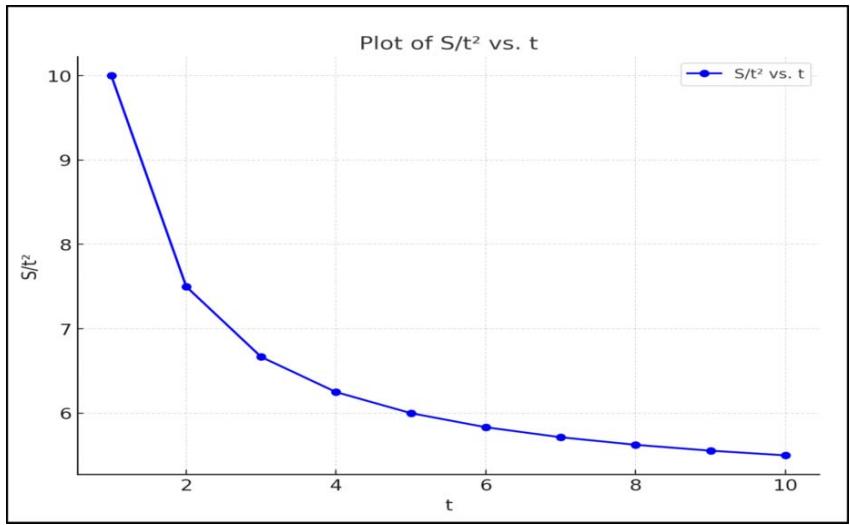
Figure 1: Typical plot of
$(\mathrm{S} / \mathrm{t}^{2})$ versus t as per the data of Table 2 From the above Figure 1 and Table 2 it is clearly found that the manner the parameter acceleration $f$ has been set in the Newton's laws of motions it cannot be a uniform or constant one. It does go on varying with time. Moreover, the value of $f$ decreases continually and after a certain time it would be tending to zero. There is no way by which $f$ can be a uniform acceleration parameter.
While it is very hard to draw up a physical significance of the $f$ parameter of Newtonian physics as has been discussed at the beginning of this article, the way TSQ has looked at it, is very easy to comprehend. If for example a person has been asked to walk on a horizontal road path in the following manner: (assume that marks have been put on the road at equal to equal distances for each of the footsteps)
In the $1^{\text{st}}$ unit of time the person has to walk X footsteps and in second unit the footsteps would be $(X + \Delta Y)$, in $3^{\text{rd}}$ unit of time it would be $(X + 2\Delta Y)$, $4^{\text{th}}$ would be $(X + 3\Delta Y)$ ...like this where $\Delta Y$ is the incremental footsteps per unit of time. So each unit of time the incremental distance the person will cover over the previous unit of time would be equal to the distance of each footstep multiplied by. Now if the distance of each footstep be s on an average, the total distance (S) the person will cover in t unit of time would be:
$$
S = [ (s X) ] + [ (s X + s \Delta Y) ] + [ (s X) + (2 s \Delta Y) ] + [ (s X) + (3 s \Delta Y) ] + [ (s X) + (4 s \Delta Y) ] + \dots \dots \text{upto}
$$
$$
\mathrm {S o} \quad \mathrm {S} = \mathrm {t s X} + \mathrm {s} \Delta \mathrm {Y} (1 + 2 + 3 + 4 + \dots \dots \dots \dots \dots \dots \dots \dots) \tag {7}
$$
$$
\mathrm{S o} \mathrm{S} = \operatorname{tsX} + \operatorname{s} \Delta \mathrm{Y} [ (\mathrm{t} / 2) \{2 + (\mathrm{t} - 1) \} ] \tag{8}
$$
$$
\mathrm {S o} \quad \mathrm {S} = \mathrm {S} _ {1} \mathrm {t} + (1 / 2) \Delta \mathrm {S} _ {\text {i n}} \mathrm {t} ^ {2} \tag {9}
$$
$(sX = S_{1},$ the distance travelled in the first unit of time and for large t, 1 neglected in equation 8 and $\Delta S_{\mathrm{in}} = s\Delta Y / \Delta t) = \Delta L / \Delta t =$ Rate of incremental distance with time.
The equation (9) apparently looks to be dimensionally incorrect since the dimension of the LHS and the RHS of the said equation are not matching. However, it is to be noted that S in fact contains time t. The total distance S can be divided by total time to obtain an average distance $S_{avg}$ such that $S = (S_{avg} \times t)$ and hence equation 9 can be written as:
$$
S = S _ {\text{avg}} t = S _ {1} t + (1 / 2) \Delta S _ {\text{i n}} t ^ {2} \tag{10}
$$
Since $\Delta S_{\mathrm{in}} = (\mathrm{s}\Delta Y / \Delta t)$ the dimension of the LHS and RHS remains to be the same. As a matter of fact, Newton being fallen in the circle of dimensional matching of the RHS and LHS of his proposed three numbers of equations of motions had to introduce a fictitious physical variable in the form of $(S / t^2)$. He did not think in the most rational way as is being done here and he had no option left than to do so.
So the following Newtonian equation of motions do lose their significances on the ground of the nonconstancy of the parameter $f$ (which is acceleration or retardation)
$$
S = ut + \frac{1}{2} f t^{2}
$$
$$
v = u + f t \tag {11}
$$
$$
v ^ {2} = u ^ {2} + 2 f S \tag {12}
$$
[where S is the distance travelled, t is time, u is the initial velocity, v is the velocity at time t and f stands for the uniform acceleration or retardation]
The identical equations equivalent to equation (11) and equation (12) would be derived now as per the new concept of TSQ. TSQ concept driven Equation (9) should replace the equation (10) above proposed by Newton.
The velocity changes in the following fashion
$$
t = 1 \quad v _ {1} = (s X) \tag {12a}
$$
$$
t = 2 \quad v _ {2} = (s X + s \Delta Y) = (s X) + (s \Delta Y) \tag{12b}
$$
$$
t = 3 \quad v _ {3} = (s X + 2 s \Delta Y) = (s X) + (2 s \Delta Y) \tag{12c}
$$
$$
t = 4 \quad v _ {4} = (s X + 3 s \Delta Y) = (s X) + (3 s \Delta Y) \tag {12d}
$$
So the general expression could be written as in case of large value of t:
$$
v_{t} = (S_{1} + (t\Delta S_{\mathrm{in}})) [S_{1} = sX]
$$
or $\mathrm{v_t = S_1 + t\Delta S_{in}}$ (13)
Equation (13) also does apparently look dimensionally incorrect. While developing a general expression of velocity [if the equations (12a) to (12d) are looked into] it is being revealed that $v_{t}$ stands for the distance travelled for a single unit of time. So $v_{t}$ in fact is a distance only. So one can write
$v_{t} = S(t) =$ Distance travelled in one unit of time after (t-1) unit of time is over $= S_{1} + t\Delta S_{in}$
So the dimensionality is retained in equation (13) for the LHS and RHS and it can be re-written as:
$$
\text{or} \quad v_{t} = S(t) = S_{1} + t \Delta S_{\text{in}}
$$
Newton's $3^{\mathrm{rd}}$ equation of motion in the form $\mathsf{v}^2 = \mathsf{u}^2 + 2\mathsf{f}\mathsf{S}$, [equation (12)] is a mathematical elimination exercise only and is not required at all. From equation (10) and (11) it can be written
$$
v ^ {2} = u ^ {2} + 2 f S = u ^ {2} + 2 f [ u t + (1 / 2) f t ^ {2} ] = u ^ {2} + 2 f u t + f ^ {2} t ^ {2} = (u + f t) ^ {2}
$$
$$
so v = u + f t
$$
So from equation (10) and (11), the time variable $t$ had been eliminated by Newton and another equation in the newer form free of $t$ was presented. So this form of equation is not required at all since equation (11) and equation (12) are converging to each other.
Now squaring both sides of equation (13), one gets
$$
\begin{array}{l} \mathrm {v} _ {\mathrm {t}} ^ {2} = \mathrm {S} _ {0} ^ {2} + 2 \mathrm {S} _ {0} \Delta \mathrm {S} _ {\mathrm {i n}} \mathrm {t} + \mathrm {t} ^ {2} \Delta \mathrm {S} _ {\mathrm {i n}} ^ {2} \\= \mathrm {S} _ {0} ^ {2} + t \Delta \mathrm {S} _ {\text {i n}} \left(2 \mathrm {S} _ {0} + t \Delta \mathrm {S} _ {\text {i n}}\right) \tag {14} \\\end{array}
$$
Now when $t\Delta S_{in}$ is very small compared to $2S_0$ equation (14) reduces to:
$$
v_{t}^{2} = S_{0}^{2} + 2 S_{0} \Delta S_{\text{in}} t
$$
When $2S_{0}$ is very small compared to t $\Delta S_{\mathrm{in}}$ equation (14) reduces to:
$$
v _ {t} ^ {2} = S _ {0} ^ {2} + t ^ {2} \Delta S _ {\text {i n}} \tag {16}
$$
The typical plots of equation (10) and, equation (13), are shown below in Figure 2, Figure 3 respectively.
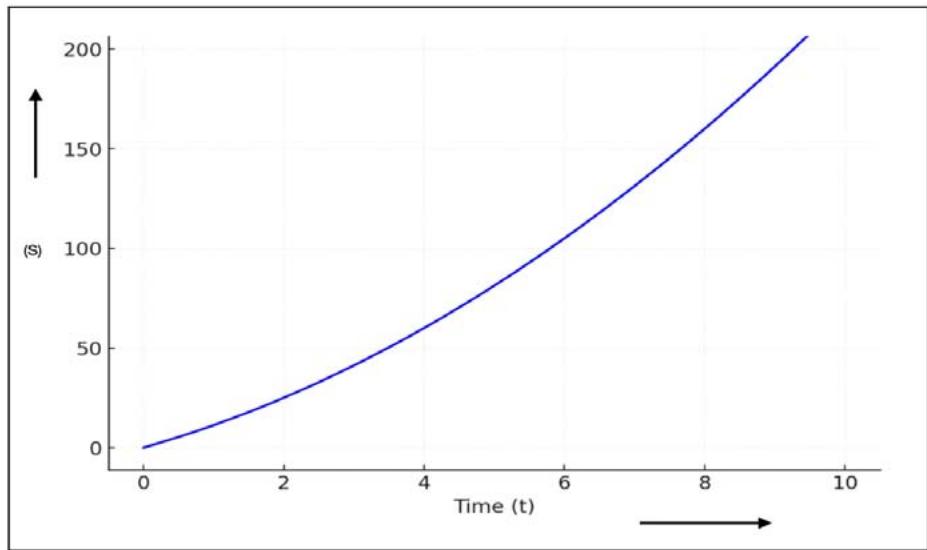
Figure 2: Typical plot of S versus t as per TSQ developed equation 10
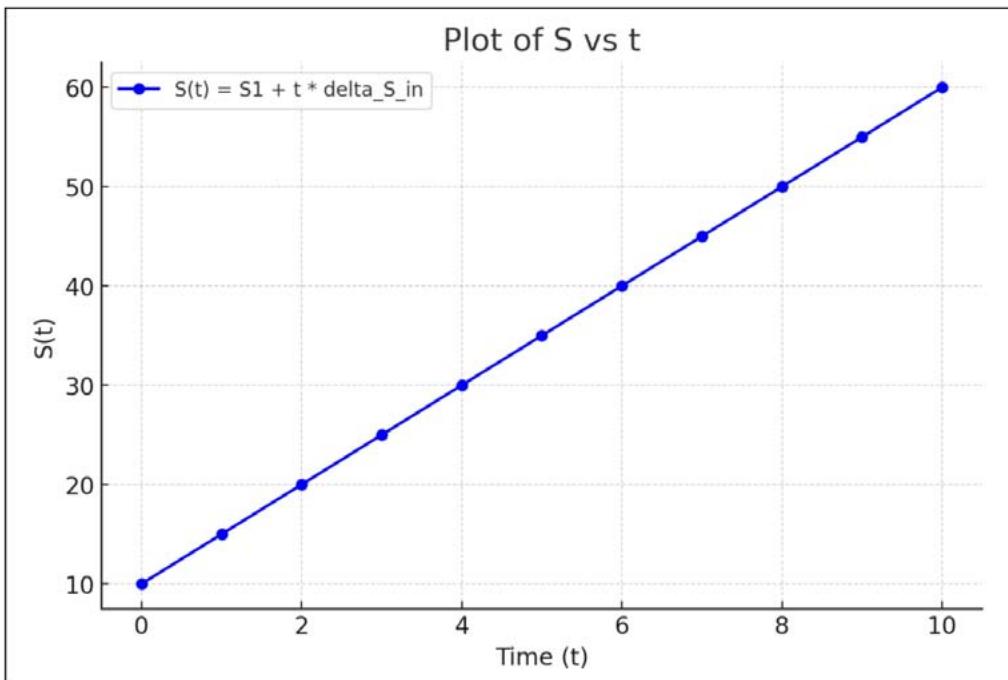
Figure 3: Typical plot of S(t)
$[= v(t)]$ versus t as per TSQ developed equation 13
Newton's second law of motion claimed that force is directly proportional to the rate of change of momentum. However, this appears to be a hypothesis of Newton since no scientific logic was being put against the evolution of such proportionality between the momentum and force. Also it is Sir Newton only who had proposed the 'law of conservation of momentum' and if it be so, how can the momentum be a variable too? Hence Newton's principle of conservation of momentum, while foundational, requires re-evaluation in the light of TSQ.
In TSQ [88, 89, 90, 91] the conservation of momentum had been established through the quantum concepts. A remarkable shift in the concept of the 'measurement tool of translation of a moving object' took place after the discovery of TSQ where the 'time' had been embodied. While conventionally, the 'time' is abstract and the 'measurement tool of translation' is the 'velocity parameter', in TSQ the said tool turned out to be the 'volume', which is being evolved from the impact of a moving object on the 'time-space' of the universe. So, the concept of 'velocity' shifted to the concept of 'volume'. The same is being discussed later in this article in more detail. The physical variable 'mass' does exist in the form of quantum of the reciprocal space of the universe and the physical variable 'volume' also does exist in the form of quantum of the direct space and hence the physical variable 'momentum' instead of
calculating by the product of 'mass' and 'velocity' needs to obtained multiplying mass by volume. In TSQ, it has been proved in tripartite manner that when a quantum of mass interacts with a quantum of 'volume', 3 numbers of $\pi$ space quantum are formed. The mathematical statement of TSQ is:
$$
\mathrm{mV} = 3
$$
In equation $m$ stands for mass and $V$ stands for 'volume' and not being the velocity.
The diagrammatic presentation of equation (17) is being shown in Figure 6 below.

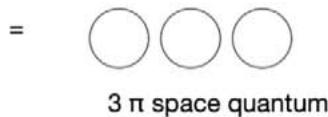
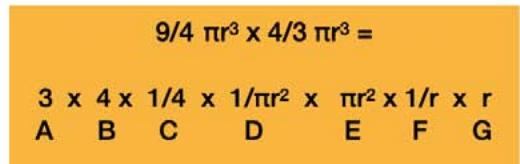
Figure 6: TSQ driven presentation of 'conservation of momentum'
Now in conventional physics the dimensionalities and the geometries or the topologies of the physical variables like time, mass, force, energy, entropy, Planck's constant, the universal gas constant, EM-wave, temperature etc are not known. However, TSQ has filled up this gap and has embodied all the said physical variables in the tripartite fashion (from the angle of physics, mathematics and topology).
Quantum Nature of Space and quantum entanglement In the TSQ, the space ahead of us has been shown to exist in the following equilibrium
Direct Space $\Leftrightarrow$ Inverse Space or Reciprocal Space
The space is composed of 'space points' and any event taking place in the direct space is reciprocated as an inverse event in the reciprocal space. In Figure 7, it is shown that if a circle is formed in the direct space from the adjoining of the space points then a 2D saddle would be formed in the reciprocal space as a reciprocation. The product of the areas of the circle and the 2D saddle would be unity as shown below:
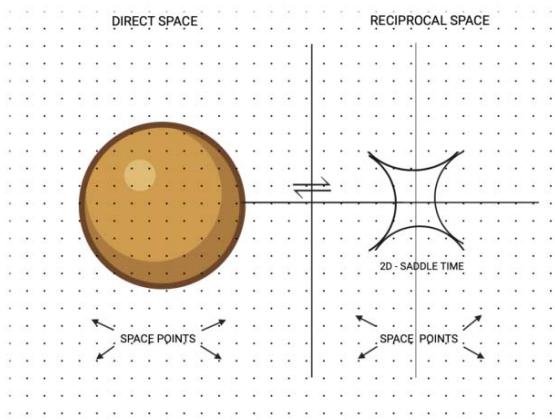
Figure 7: Direct space and reciprocal space equilibrium of universe
$$
[ \text{Areaofthecircle} (\pi r ^ {2}) ] \times [ \text{Areaofthe 2 Dsaddle} (1 / \pi r ^ {2}) ] = 1.0 0 \tag{1}
$$
The circle and the 2D-saddle are multiplicative inverse to each other since the product of the two is unity.
The physical variables like entropy, force, energy, EM-wave, space expansion etc in the forms of quantum (of different topology or geometry) belong to the direct space of the universe and the physical variables like order, time, mass, squeezing EM-waves, space inversion in the similar fashion belong to the reciprocal space of the universe.
The geometries of all the space quantum as revealed through TSQ [88-100] are shown in Figure 8 below:
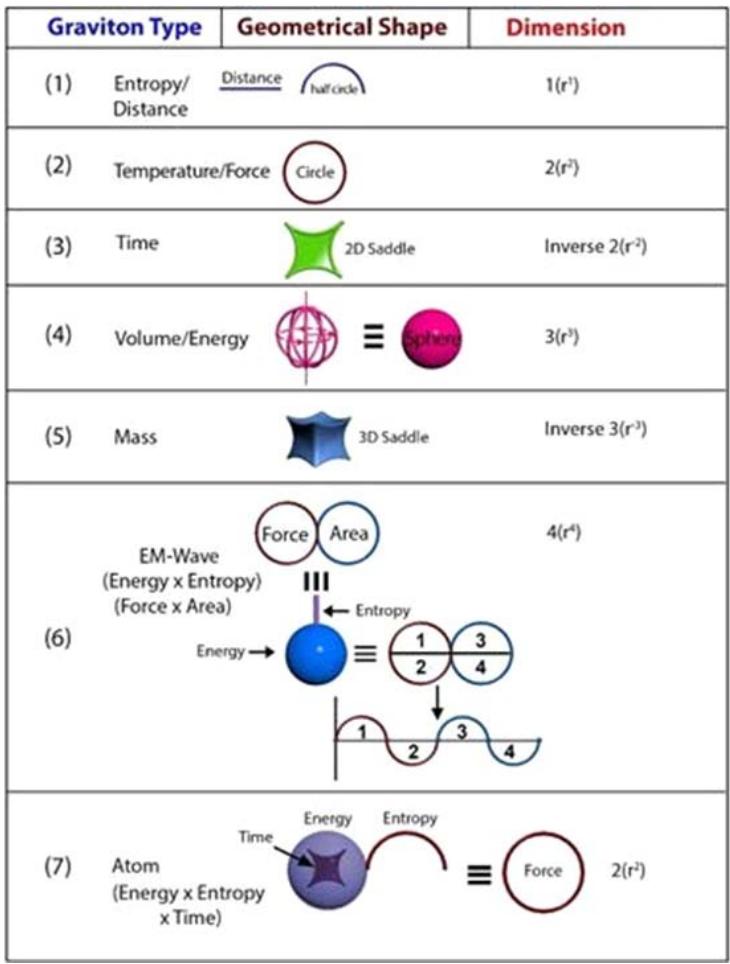
Figure 8: Geometries of all the space quantum
- Evolution of the Dimension and Topology of 'Time' Variable of the Universe
In TSQ any physical variable of the universe has to be defined in a tripartite fashion [88] in regard to its physics of formation, mathematical expression and the geometrical shape [98] as shown below in Figure 9:
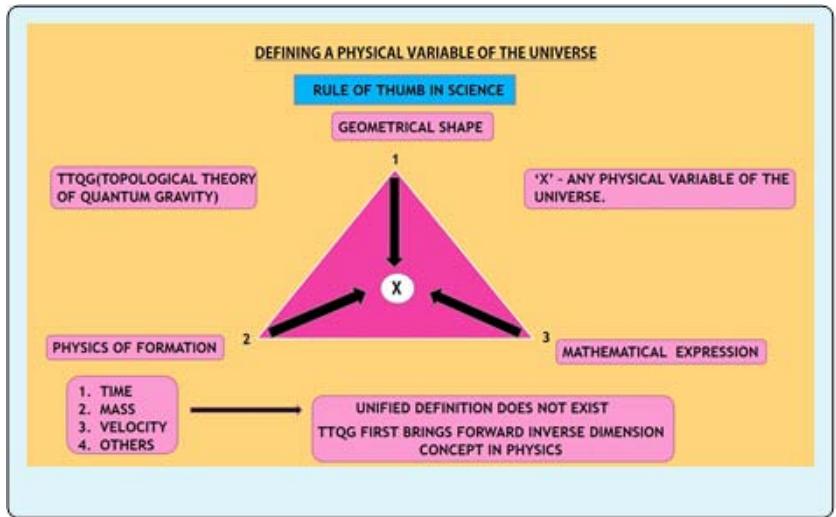
Figure 9: Physics of formation, mathematical expression and the geometrical shape
The theories of conventional physics though dealt with numerous physical variables but did never present any physical variable in the fashion as shown in Figure 9 above.
Regarding the 'time' variable it is to be noted that Energy, entropy and time are very much related to each other and the mathematical statement of the famous Heisenberg's uncertainty principle is $\text{Et} = h$ (E stands for energy, t stands for time and h stands for Planck's constant) [88, 95]. It has been proved in TSQ [99] that the well-known Planck's constant is an entropy parameter only. So, (Energy x Time = Entropy). However, none of the research theories in physics has been able to define time in regard to energy and entropy. The underlying reason behind the same was the lack of the thinking in the line of quantized 'time-space' and the failure to link the subject thermodynamics with it.
The following are the salient principles of TSQ and which are to be noted as the starting point to learn what 'time' is? [88-101]
- Time is an attractive force quantum which is trying to hold the universe.
- Time is a pullback force (PBF) belonging to the reciprocal space of the universe.
- Temperature on the other hand is a push forward force (PFF) which is trying to elongate the universe and is a variable of the direct space.
- The geometry or topology of time is a 2D saddle
- The geometry or topology of temperature is a circle
- 'Time' and 'temperature' are arising out of 'quantum entanglement'.
- Time (t) and temperature (T) are multiplicative inverse to each other such that
$$
Tt = 1.00
$$
- Pressure is a dimensionless parameter and which is a hybrid of PBF and PFF, such that
$$
P = (PPF \times PBF) = Tt = 1.00
$$
- The index of equilibrium and non-equilibrium of any physical or chemical phenomena of the universe is related to the product of T and t: [88-101]
$$
T t > 1. 0 0 - n o n - e q u i l i b r i u m
$$
$$
T t < 1. 0 0 - n o n - e q u i l i b r i u m
$$
$$
T t = 1. 0 0 - e q u i l i b r i u m
$$
The equilibrium relationship between time and temperature in the form of $T_t = 1.00$ is being represented by Figure 10 below [88, 98]:
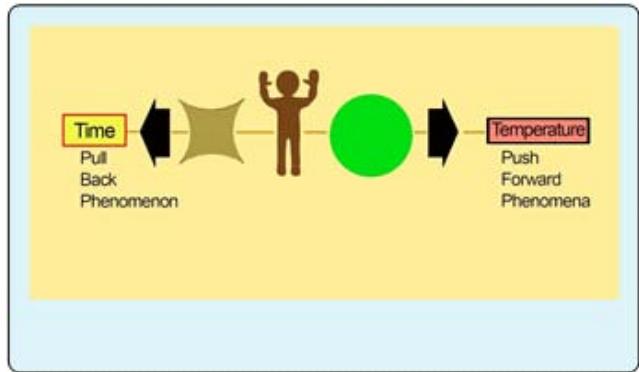
Figure 10: The equilibrium relationship between time and temperature In TSQ energy is represented by a 3D sphere, time is a 2D saddle and entropy is a line segment and an atom being a 'quantum entanglement' and is being represented as (energy x entropy x time) as shown in Figure 11 below:
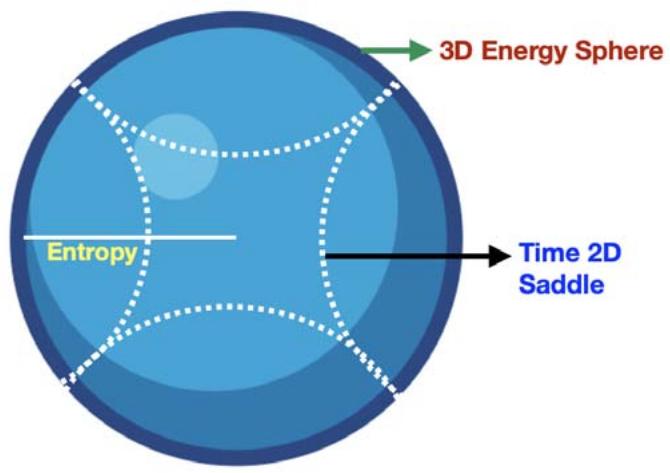
Figure 11: Typical representation of the quantum entanglement of an atom of TSQ as (Energy x Entropy x Time) and state of equilibrium
$T_t = 1.0$
Now when the magnitude of energy is small, the sphere would be lower in size and the attractive pull of the 'time' 2D saddle will pull back the entropy line strongly and as a result the entropy would be under tension and would not be able to elongate. So the time saddle through the energy sphere will be pulling back entropy. So, time equated to 'how energy is pulling pack the entropy'. The mathematical representation of 'time' would be, (Figure 12)
$$
\text{Time} = \left(\text{entropy} / \text{energy}\right) = (3 \mathrm{r} / 4 \pi \mathrm{r} ^ {3}) = (3 / 4 \pi \mathrm{r} ^ {2}) = 2 \mathrm{D} \text{saddle} \tag{18}
$$
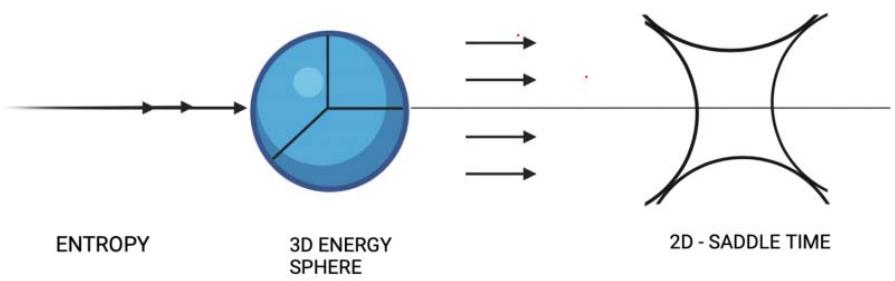
Figure 12: Manifestation of time quantum entanglement variable of the universe Tt <1 On the other hand when the energy sphere is larger in magnitude than in spite of the presence of the time attractive force, the energy sphere pushes forward
the entropy line being the dominant force as shown in Figure 13 below:
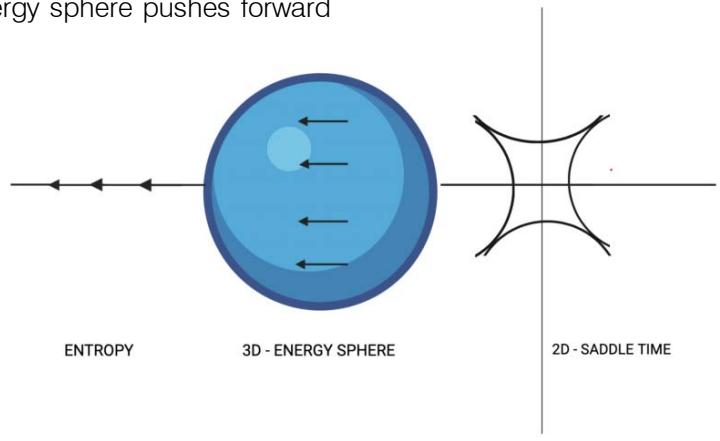
Figure 13: Manifestation of Temperature quantum entanglement variable of the universe,
$T_t > 1$
So 'temperature' is being defined as 'how much or the extent to which the energy sphere pushes forward the 'entropy' and which is being mathematically represented by
$$
T e m p e r a t u r e = \text{(energy / entropy)} = \left(4 \pi r ^ {3} / 3 r\right) = \left(4 \pi r ^ {2} / 3\right) = \text{Circle} \tag{19}
$$
Both temperature and time are the quantum forces of the universe but these were unexplored earlier.
Changing Concepts of Physics
The defining of time in TSQ has led to the following changes in the concept of conventional physics [88-101]:
(The main points are highlighted only):
- 'Velocity' merges with the concept of volume.
- 'Acceleration' is effectively a concept of 'space expansion' rather than a concept of incremental velocity. Its dimension reaches from 3D to 5D.
- EM-wave turns out to be a hybrid of two force circles in its integrated form and in the differential form it resembles a typical EM-wave profile.
- The phenomenon of gravitation emerges as the result of the overlapping of two 'inverse space expansion' fields and the dimension is inverse 10 dimension.
- Cold Nuclear fusion is not an experimental artifact but a real phenomenon of the universe and the dimension reaches to inverse 7 dimensions.
- All the cosmological and astronomical phenomena of the universe is being explained by a universal space quantum cycle [88] as is shown in Figure 14 below:
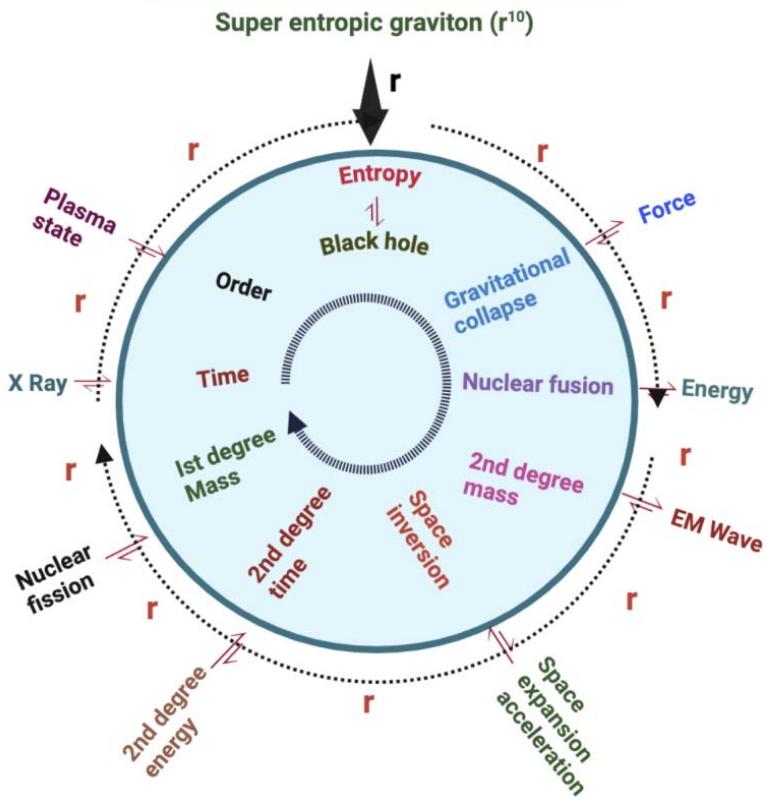
Life cycle of super entropic graviton Figure 14: Presentation of universal space quantum cycle of the universe
- Changing Concept of 'Force' and 'Acceleration' of Newtonian Physics in regard to TSQ
From the discussions made in the previous three sections, it is to be understood that velocity (v) is in reality a concept of volume. Since v= (S/t) and in TSQ any distance in the universe is an entropy space quantum represented by r and a time quantum is being represented by a 2D saddle $(3 / 4\pi r^2)$, hence
$$
v = \left[ r / \left(3 / 4\pi r^2\right) \right] = \left(4\pi r^3 / 3\right) = \text{volume} = V
$$
The concept of TSQ is, when anything does move from the position of rest, it has to overcome the time attractive force first and then it travels a distance and the combined effect of the two generate an impact on the space and a 'volume' is being evolved as shown mathematically through equation (20) above and is being shown topologically in Figure 15 below:
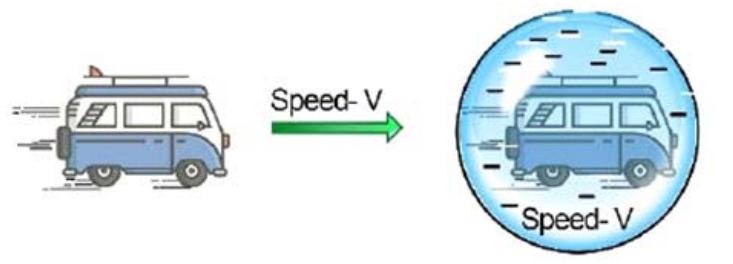
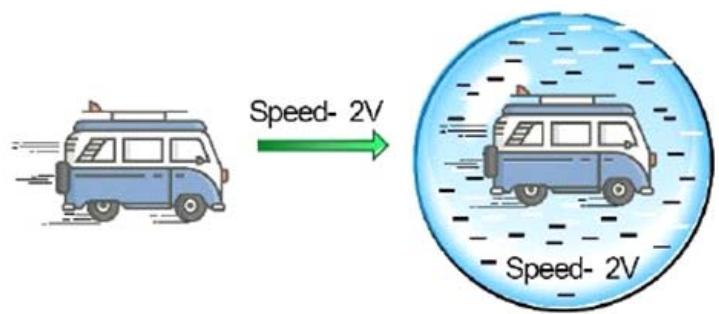
Figure 15: Pictorial Presentation of Creation of Volume as a function of the Speed of a Motor Vehicle
The above Figure (15) does also reveal the fact that as the distance covered as a function of time are being higher, more and more volumes are being evolved. In TSQ, the magnitudes of all the physical variables of the universe are expressed either in regard to length, area and volume (of the direct space) or in regard to the inverse length, inverse area or inverse volume (of the reciprocal space).
In TSQ it has been proved that the energy density of the universe is constant [88, 91] and the energy (E) is related to the volume (V) in the following manner as shown in equation (21) below:
$$
E = 3V
$$
So Energy density $= (E / V) = 3.0$ and is a constant. The physical significance of equation (21) is, an energy Quantum (3D sphere) is composed of three volume quantum [volume of each $= (4\pi r^3 / 3)$ ] over the three principal axis's $x, y$ and $z$ such that,
$$
E = \left[ \left(4 \pi r ^ {3} / 3\right) + \left(4 \pi r ^ {3} / 3\right) + \left(4 \pi r ^ {3} / 3\right) \right] = 4 \pi r ^ {3} \tag{22}
$$
So by dimension Energy and Volume are the same. In Newtonian physics, the energy and volume have been allotted different dimension (dimensions of volume $= L^3$, dimension of energy $= M L^2 T^2$ ) and those incorrect conclusions had been arrived due to the nonconsideration of 'time-space' and 'thermodynamics' of the universe and the absence of a 'Theory of Space Quantization'. Classical physics had considered the three principal dimensions of the universe L, M and T are independent among each other. In TSQ, through the dimensional equivalency proof of energy and volume it has been firmly established that the said 3 physical variables of the universe are interlinked to each other in the following manner:
Dimension of Energy = Dimension of volume
$$
Or,\quad \mathrm{M}\,\mathrm{L}^{2}\,\mathrm{T}^{-2} = \mathrm{L}^{3}
$$
$$
\mathrm{Or},\quad \mathrm{M}\,\mathrm{T}^{-2} = \mathrm{L} \tag{23}
$$
It has been learnt in classical physics that Energy is sum of potential energy (PE) and kinetic energy (KE) such that,
$$
\text{Energy} (\mathrm{E}) = (\mathrm{P E}) + (\mathrm{K E}) \tag{24}
$$
The above type of demarcation of energy had been made without justifying the same in the tripartite fashion as done in TSQ (see figure 9 above) and hence this is not acceptable. In TSQ, in a very much of tripartite manner it has been established that [95,100],
$$
Energy(E) = (Internal Energy, U) + (Volume Energy, PV)
$$
$$
E = (2PV) + (PV)\tag{25}
$$
P is the pressure parameter and unlike the concept of classical physics (where pressure is equated to the energy per unit of volume) where its dimension had been put as, M L $^{-1}$ T $^{-2}$, in TSQ, pressure is a dimensionless parameter being represented as,
$$
\begin{array}{l} \text {P r e s s u r e ,} \mathrm {P} = (\text {p u s h f o r w a r d f o r c e x p u l l b a c k f o r c e}) = (4 \pi \mathrm {r} ^ {2} / 3) \times (3 / 4 \pi \mathrm {r} ^ {2}) \\= [ \text {T e m p e r a t u r e} (T) \times \text {T i m e} (t) = 1, \\\end{array}
$$
So
$$
P = \mathrm{T}t = 1
$$
If the classical physics dimension of pressure $(\mathsf{ML}^{-1}\mathsf{T}^{-2})$ is being looked upon in relation to the TSQ derived equation (23), one gets [94],
$$
P = M L ^ {- 1} T ^ {- 2} = L \times L ^ {- 1} = L ^ {0} \tag {27}
$$
So pressure turns out to be of zero dimension or dimensionless only. Under the condition of equilibrium when $P = 1$, (as shown in equation 26), the equation (25) takes the form:
$$
E = (\text{InternalEnergy} + \text{VolumeEnergy}) = (2 V + V) (2 7 a)
$$
The ratio of internal energy to volume energy remains to be constant [100] for the movement of an object under constant pressure and equilibrium condition:
$$
(Internal Energy: Volume Energy) = 2:1
$$
When the total energy decreases or increases, that is being equally distributed between 'internal energy' and 'volume energy' in the ratio of 2:1 as shown in equation (27b). The topology of Energy, E is shown below in Figure 16 in connection with the said two energies.
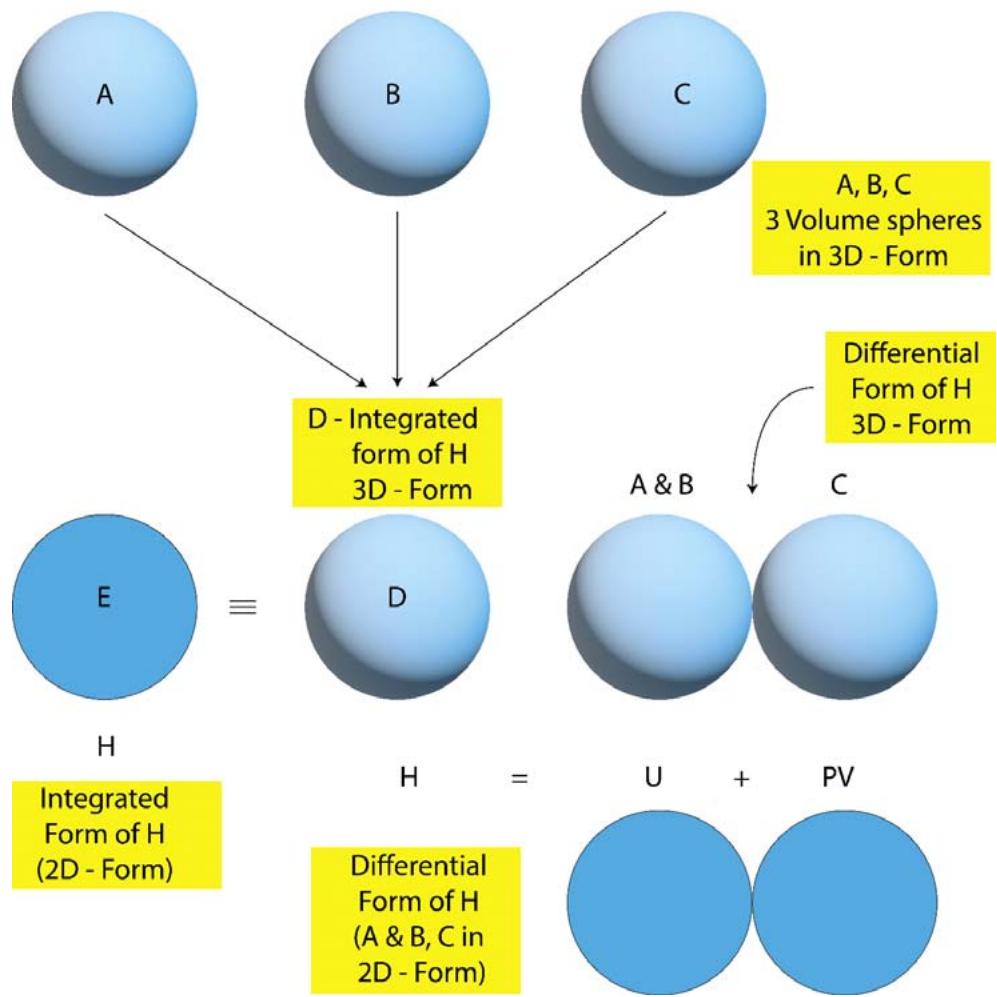
2D and 3D Topological Presentation of Heat Content, H Figure 16: 2D and 3D presentation of 'Energy', E or H (in thermodynamic sense), 'Internal Energy', U and 'Volume energy', PV' In TSQ, energy is a 3D sphere (integrated form) and 'work' is the differential form of energy [91, 100] in
the form of 'Force' and 'distance' as shown in Figure 17 below:
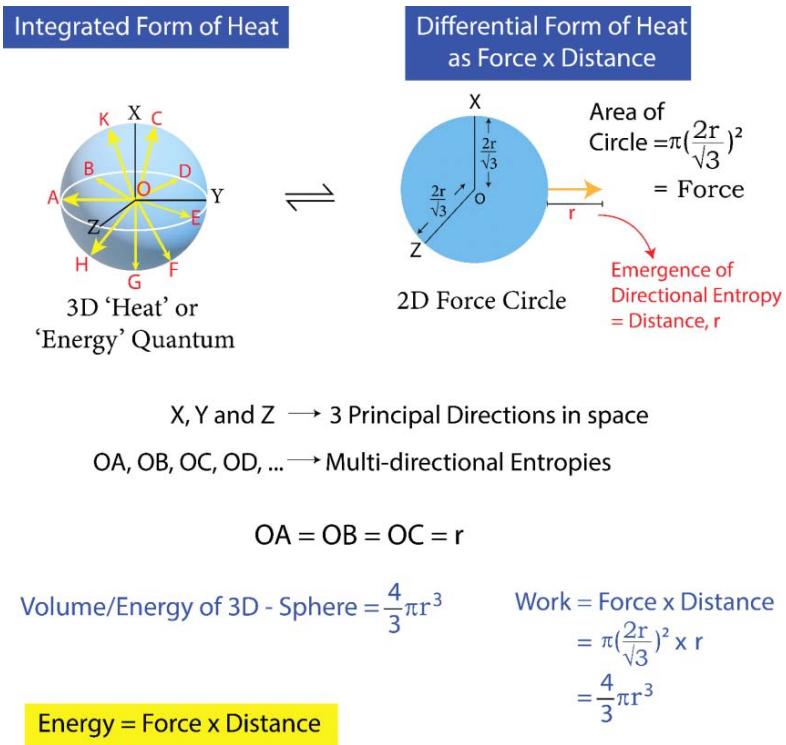
Figure 17: TSQ presentation of 'Integrated' and 'Differential' forms of heat
It is to be noted from Figure 17 that when a 3D energy sphere is compressed isothermally, the sphere transforms to a 2D circle (which is being the force) and out of the three dimensions of a 3D sphere, one of the dimensions comes out from the sphere as a distance with a particular direction in the space. So the RHS of the figure 17 represents the differential form of energy (in the form of force and distance) and that is work. This type of representation of energy in regard to force and distance has been presented for the first time in the history of science. Only the TSQ could reveal it. Based on this diagram only the geometrical or topological proof of the three thermodynamic laws have also been presented.
- Modified approach of the Second law of Newton to define 'Force'
In the earlier sections, it has been commented that the approach of Newton to define force in regard to rate of change of momentum is a bit hypothetical and contradictory for the very valid reason of the standing of the 'principle of conservation of momentum' proposed by Newton. In TSQ, the phenomenon of conservation of momentum has been shown to be true in regard to the quantum nature of 'mass' and 'volume' and not by 'mass' and 'velocity' as Newton proposed.
Now here by two different approaches, the expression of 'force' will be derived, i) modified Newtonian approach ii) TSQ approach.
## II. MODIFIED NEWTONIAN APPROACH
Unlike, Force being proportional to rate of change of momentum, as in Newtonian approach, in the modified Newtonian approach it is in fact proportional to the $(\Delta S_{in} / \Delta t)$, (incremental distance per unit of time) and one has to go on increasing force to get consecutively higher multiple of $\Delta S_{in}$ in regard to time (as the example of walk of a person in $1^{\text{st}}$, $2^{\text{nd}}$, $3^{\text{rd}}$, $4^{\text{th}}$...unit of time the $\Delta S_{in}$ has to change to $\Delta S_{in}$ to $2\Delta S_{in}$ to $3\Delta S_{in}$ to $4\Delta S_{in}$...like this)
Now $\Delta S_{\mathrm{in}} =$ (incremental distance/time) $=$ (ΔL/ΔT) (dimensionally, T stands for time and L for distance) and hence
$$
\text{Force} (\mathrm{F}) \quad (\Delta \mathrm{L} / \Delta \mathrm{T}) \tag{28}
$$
Force can also be viewed as a physical variable which decays as the time increases (as per as the time concept of classical or Newtonian physics) since once a force is applied on an object to let it move and then if the force is being left, the object slows down and stops after travelling a certain distance.
$$
F\left(\frac{1}{T}\right)\tag{29}
$$
So force is a sort of compound physical variable of the universe and applying the theorem of joint variation for the relation of proportionalities as shown in (28) and (29) it can be written,
$$
F(\Delta L / \Delta T) / T
$$
Now the constant of proportionality is the mass of the moving object, $M$, and hence it can be written,
$$
F = \left[ M \left( L _ { 2 } - L _ { 1 } \right) / T \right] \left( 1 / / \Delta T \right) \tag{ 3 1 }
$$
$\left[\left\{\left(L_{2} / T - L_{1} / T\right)\right\} = \left(v_{2} - v_{1}\right), L_{2}\right.$ and $L_{1}$ and $v_{2}$ and $v_{1}$ stands for the final and initial distance and velocities respectively of the object].
As per TSQ, velocity stands for volume when the proper dimension of time is being considered and hence $(\mathsf{v}_2 - \mathsf{v}_1)$ should be equated to the change in volume $(\Delta V)$ and not the change in velocity, $\Delta v$
$$
\mathrm {S o}, \quad F = M [ (\Delta V) / \Delta T) ] \tag {32}
$$
$\left[\left(\Delta \mathrm{V}\right) / \Delta \mathrm{T}\right]$ stands for rate of change of volume with time or rate of change of space expansion with time] So, the final form of force,
$$
F = (\text{mass} \times \text{rate} \text{ofspace} \text{expansionwithtime}) \tag{33}
$$
## III. TSQAPPROACH TO DEFINE FORCE
For an object in motion, energy or heat is being converted to work more and more with a steady value of the $(\Delta S_{\mathrm{in}} / \Delta t)$ parameter. While the accelerating motion of an object is considered, there occurs an expansion of space and the 'time frame' has to become less to less squeezing since as per the philosophy of TSQ, it is the time frame (space quantum, 2D saddle) only, which is holding the '3D energy sphere' to pass on to the differential form as 'force x distance' or 'work'. As the 'time' frame changes, the frame of 'mass' does also change [topologically mass is an inverse 3D saddle $= (1 / \text{time}) \times (1 / \text{entropy}) = (1 / \pi r^2) \times (1 / r) = (1 / \pi r^3)]$. So the 'time' and 'mass' both have to go on decreasing to generate more and more work and do not remain in the form of constant. Both the 'time frame' and 'mass frame' become broader or wider (but less squeezing) and that is what is the so-called 'relativistic effect' of Albert Einstein. In Figure 17a below, it is being shown how the 'time frame' becomes more broader and less squeezing (the squeezing strength of the 2D saddle/3D saddle is inversely proportional to its area, higher the area, less squeezing it is and lower the area, more squeezing it is) as the energy/heat is being converted to more and more to work.
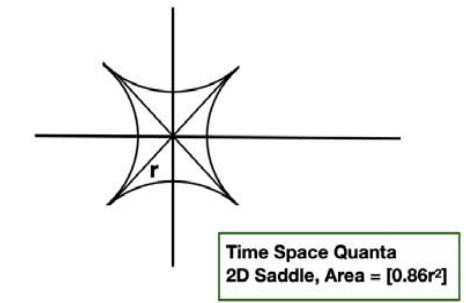
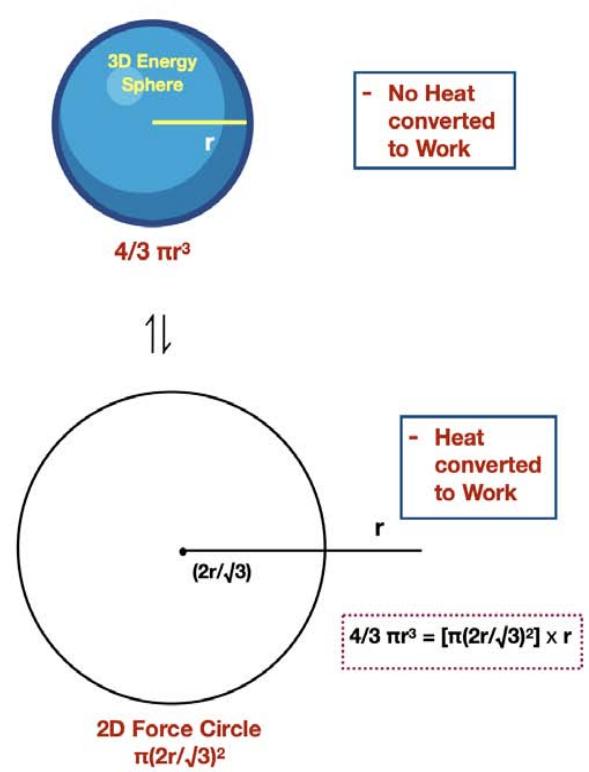
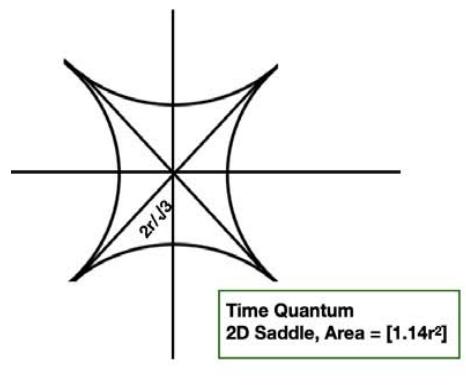
Figure 17a: Relativistic effect on 'time' when heat is being converted to work
So the 'force' under this 'relativistic' condition (non-constancy of the frame of mass and time) cannot not be expressed in regard to the 'absolute mass' or 'absolute time' as Newton did in his equation, expressing force as a product of mass and acceleration $(S / t^{2})$.
The most relevant reason why the Newton's expression of Force in regard to mass is not being suited for the moving objects is being explained below:
This can be understood by taking the example of heating a gas in a cylinder fitted with a piston. As the gas is being heated, the piston will try moving upwards but to keep the volume constant, more and more pressure has to be applied on the piston. As the pressure increases on the piston, the force would also go on increasing since force = (pressure on the piston) x (surface area of the piston). Now upon the application of heat on the gas, the molecules are being accelerated and exert more pressure/force on the piston. The heavier the molecules of the gas (higher be the mass of the molecules) it will exert more pressure/force on the piston. So under this condition,
- Force on the piston become directly proportional to the mass of the molecules
- Force on the piston become directly proportional to the acceleration of the molecules
So force on the piston $= K \times$ mass x acceleration
[K = constant = path length of the molecules= length of the cylinder from its base to the fixed positional point of the piston].
The form of equation above (as that of Newton) stands justified for any non-moving object whether it be a gas, liquid or solid. Newton had presented his equation, (force = mass x acceleration), but did not establish it through any example of a physical occurrence. However, the explanation/example given above is the best possible way to learn the physical significance of Force = mass x acceleration, and this way it is not being taught to the students of physics.
For a moving object in space upon the earth (for example an iron ball), in fact generates a mechanical wave, as is being explained now. The iron ball (or any object) has a certain volume when it rests ( $V_0$ says and is equal to the volume of the space it does occupy or displace) and has a certain mass too. One has to apply a critical force to make the object moving and the magnitude of the force would be higher if the mass of the object is higher. The very instant of time when the object gets an inertia of motion, then its mass no longer remains to be the deciding factor for its further accelerating motion or movement. Under this circumstance, how much the space could be expanded with time in comparison to the above said $V_0$ becomes the true index of force of an accelerating object generating mechanical waves in the space. Higher the value of the ratio of (Rate of space expansion with time/V 0), higher would be the force and more and more it will go on accelerating.
In the game of football, one must be observing that the goal keeper is often taking the football in his own hand and making the ball rolling on the ground and another player kicks the ball in the state of its rolling. This way, kicking the football, makes a good rising of the ball above the ground level and it moves at a higher speed than a football being kicked at its position of rest. The football under the state of rolling (which has overcome its mass already) should be considered as a point in the space or a 'space -point', and the propagation of the said 'space point' in the manner as shown in Figure 17b below gives rise to the progression of 'mechanical wave' in the space.
Newton did not consider all the above said factors and his equation of force would be aligning to the random motion of the molecules of the non-moving objects within a closed system (as the case of heating a gas as cited above). For the directional motion of any object where energy is continually being converted to work, the Newtonian equation loses its significance and becomes a 'misfit' one.
In fact the movement of an object is arising out of the hybrid effect of 'force quantum' and 'energy quantum'. The hybrid effect of 'energy' and 'force' gives rise to the generation of 'mechanical waves' and it is the mechanical wave which spreads in space and there occurs an expansion of space. Its features resemble the propagation of EM-waves. As the force is being increased the space expands more and more with time as shown in Figure 17b below. While the magnitude of energy quantum remains to be constant, the magnitude of the force quantum increases consecutively with time. The geometry/characteristics of the progression of a mechanical wave should be mapped in regard to its, i) direction, ii) velocity and iii) velocity distribution as a function of time. So the 'mass' of the object is not a parameter of concern at all. Since velocity relates to volume in TSQ and the said 'velocity distribution as a function of time' would be related to the very logical reason there off to 'volume/space expansion as a function of time'.
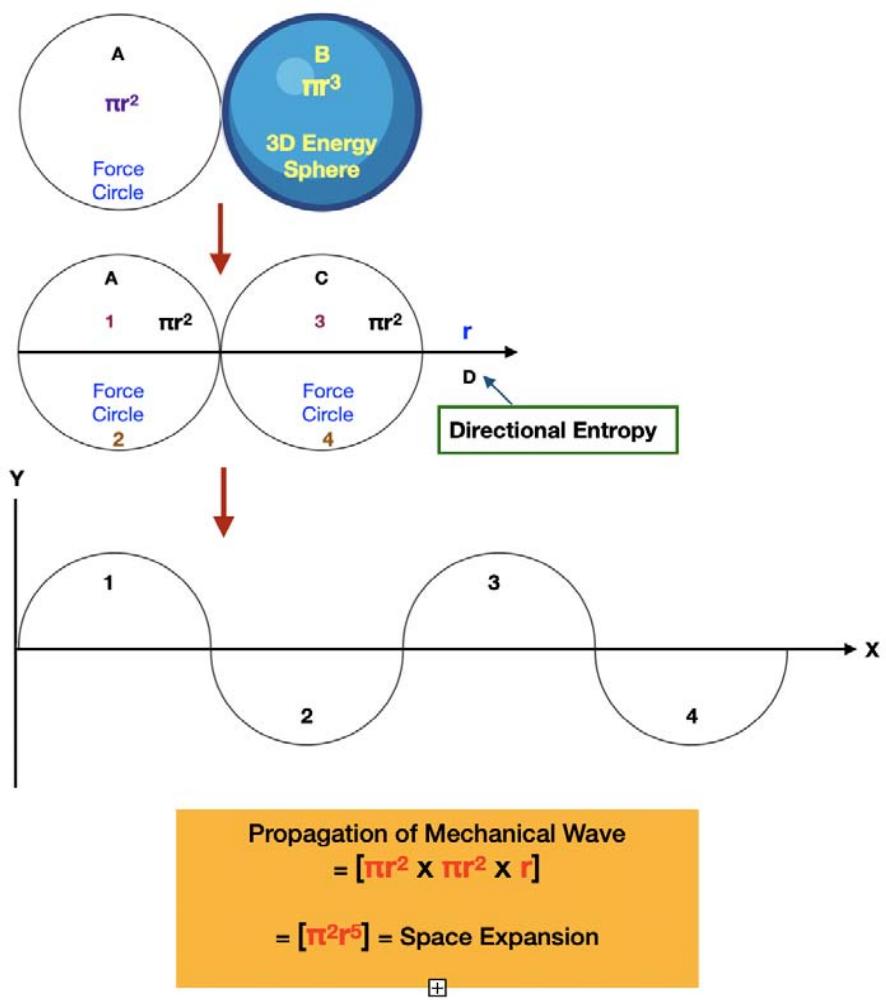
Figure 17b: Schematic presentation of Mechanical Wave in space as 'energy-entropy' hybrid
The force needs to be redefined in relation to 'rate of space expansion with time'. When an object is at rest, it displaces a volume equal to its own volume $(V_0)$. As per the concept of TSQ, energy, $E = 3V_0$, and during the motion of the object, the proportion by which the space expands in relation to the original displaced volume (or energy) is the measure of force. So the force being redefined in TSQ as follows: In the event of the moving of an object,
Rate of Space expansion (dV/dt) is directly proportional to the force when the initial energy/volume is a constant quantity.
So, Rate of Space expansion (dV/dt) = (force) x (original volume, $V_0$ ) (33a)
$$
Force = [1/V0(dV/dt)] = Mechanical space expansion coefficient
$$
= (Rate of Space expansion as a function of time/ volume or energy of the object at rest) (33b) While the 'thermal expansion coefficient' (TEC) is,
$$
\mathrm{TEC} = \left[ 1 / V_{0} \, (\mathrm{d}V / \mathrm{d}T) \right]
$$
It turns out from equation (33a) and equation (33b) that while the 'force' is being related to 'rate of change of volume with time', the TEC, is being related to 'rate of change of volume with temperature'. The TSQ approach derives an expression of 'force' (which unlike Newtonian approach is free of 'mass') in the form of 'mechanical space expansion coefficient' and which indeed is the 'force' of a moving object. This is altogether a new concept in physics.
Now let us examine the difference of the prediction of Newton vis-à-vis TSQ:
$$
\text{Newton} = \mathrm{F} = (\text{massxacceleration}) \tag{34}
$$
The differences between the two approaches [comparing the two equations (33) and (34)] are:
- In Newtonian expression both mass and acceleration are variables but in TSQ mass is being a constant for a particular object and space expansion is a variable.
- If both the mass and acceleration are increasing to a very large extent then force will be tending to very to very large or infinity and energy will be infinite and which is being a forbidden event on the ground of the law of conservation of energy. In TSQ, mass is a constant and even if the space expansion is increasing, the Force or energy will never be tending to infinity since the conjugate 'space inversion' quantum would not allow the same since there is an equilibrium existing between the two (see the universal space quantum
cycle in Figure 14) which shows an equilibrium relationship between the two as [88]:
(space expansion) $x$ (space inversion) $=$ constant (35) As a result none of them can attain a value of infinity. So space expansion might increase but after attaining a limiting value it has to decrease to maintain the constancy of the equation (35).
- In regard to dimension both the Newton's prediction and TSQ are the same and is equal to $\text{Force} = \text{MLT}^2$ but Newton's prediction is forbidden from the point of view of thermodynamics.
Since dimensionally both the predictions (Newton vis - a- vis TSQ) are the same, the topological presentation of 'Force' is shown in Figure 18 below [88]:
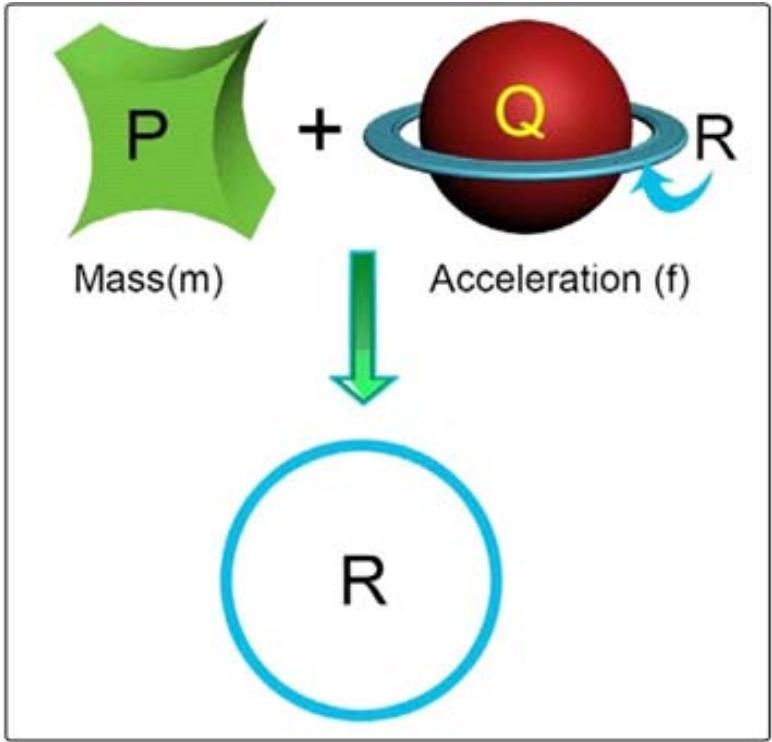
Figure 18: The topological presentation of Force = (mass x Space expansion) of TSQ or of Force = (mass x Acceleration) of Newton In figure 18, the outer force circle R (of the acceleration/space expansion) will be pushing forward the inner 3D energy/volume sphere such that the space expansion occurs. So the dimensionality of space expansion or acceleration reaches to 5D ( $L^3$ of the sphere $\times L^2$ of the circle $= L^5$ ). The inverse 3D dimensionality of the mass quantum being multiplied by a 5D space expansion field creates a force circle $R$ of 2D.
$$
[ \{\text{mass}, (1 / L ^ {3}) \times \text{space} \text{expansion}, L ^ {5} \} ] = L ^ {2} = \text{ForceCircle} \tag{36}
$$
Newton's formula for 'force' in the form of mass and acceleration is suited for 'non-quantized' or 'continuous' sort of 'time-space' constitution of the universe but it does not stand suitably against the quantized 'time-space'. In TSQ depicted 'space-time' there occurs continually i) superposition, ii) exchange and iii) entanglement of the multi various space quantum among each other. The multi various space quantum do have distinct but differing geometrical shapes. So the 'force' does appear in the universe in the different forms of permutation-combination of the several space quantum and 'force' becomes the
resonance hybrid of the different forms of 'time- space'. The presentation of Force can be made in an altogether newer manner than that of Newton's formula of force. In
TSQ, 'force' is a circle $(\pi r^2)$ and a circle can be topologically represented in multiple ways as shown below:
Area of a circle of radius $\mathrm{r} = \left\lbrack {\left( {\mathrm{A}\text{ sphere of radius }\mathrm{r}}\right) /\left( {4\mathrm{r}/3}\right) }\right\rbrack = \left\lbrack {\left( {4\pi }{\mathrm{r}}^{3}\right) /\left( {4\mathrm{r}/3}\right) }\right\rbrack = \left( {\pi }{\mathrm{r}}^{2}\right)$
$$
= (\text{A quantum of volume} / \text{A quantum of Entropy})
$$
Area of a circle of radius $r = \left[\left(\text{A circle of radius } r\right)^2\right] / \left[\left(\text{A circle of radius } r\right)\right] = \left[\left(\pi r^2\right)^2\right] / \left(\pi r^2\right) = \left(\pi r^2\right)^2$.
$$
= [ (\mathrm{A} \text{quantumofEM - wave}) \times (\mathrm{A} \text{quantumofTime}) ] \tag{36b}
$$
[(A circle of radius r)] = [(A 2D saddle of area $1 / \pi r^2$ ) x (A sphere of radius r) x(3/4) x ([A circle of radius r])
$$
= \left[ (1 / \pi r ^ {2}) \times (3 / 4) \times (4 \pi r ^ {3} / 3) \times (\pi r ^ {2}) \right] \tag{36c}
$$
[to note here that the mathematical expressions of the different physical space quantum of TSQ of equation (36a) to (36c) are as following:
$$
\text{Volumequantum} = \left(\pi r ^ {3}\right)
$$
$$
EM - wave quantum = (\pi^{2} r^{4})
$$
$$
\text {T i m e Q u a n t u m} = (1 / \pi r ^ {2})
$$
$$
\text {S p a c e} = (\pi^ {2} r ^ {5})
$$
$$
\text {E n t r o p y} = (\mathbf {r}) \text {o r} (\pi \mathbf {r})
$$
The quantum expression of equation (36a) to (36c) have been made on the above relations]
So, the three expressions of force (out of the innumerable possible expressions of Force in TSQ) are:
$$
\text {F o r c e} = (\text {v o l u m e / e n t r o p y})
$$
$$
F o r c e = (E M - w a v e \times t i m e)
$$
$$
\text {F o r c e} = (\text {S p a c e e x p a n s i o n} \times \text {t i m e})
$$
In TSQ, many to many expressions of force can be fabricated in the manner as shown above and in the language of organic chemistry it might be called the numerous 'isomeric topological forms of force'. The concept of the dynamics of motion in physics does flow altogether to a new horizon in TSQ than from the Newtonian concept where the 'time-space' is considered to be a continuous entity.
If the example of walking of a person as discussed at the beginning of the article is being relooked, it is to be noted that in each unit of time the person will be displacing more and more volume of the space and so side by side developing the kinetic equations of motion in regard to distance, the kinetic equations of motions are being required to be developed with respect to volume or Space expansion quantum. Proceeding in the same fashion as that for distance kinetics of motion, the following equations can be derived very straight forward in regard to space expansion as shown below:
$$
V = V _ {a v} t = V _ {1} t + (1 / 2) \Delta V _ {i n} t ^ {2} \tag {37}
$$
or $\mathrm{V_t = V_1 + t\Delta V_{in}}$ (38) In equations (37) and (38), the following points are to be noted
$V_{t} =$ Total volume/space expansion generated in the journey of the object in time t.
$V_{1} =$ Volume/space expansion generated in the first unit of time.
$\Delta V_{\mathrm{in}} =$ Rate of incremental volume with respect to time, $(\Delta \mathrm{V} / \Delta \mathrm{t})$
$V_{av} =$ Average volume generated for each step of the travel of the object.
Regarding the 'Kinetic Energy' parameter, the formula presented in Newtonian physics, $\text{KE} = (1/2)[\text{mv}^2]$, m, standing for mass and v stands for the velocity of the object, is not acceptable on the ground of the fact that the parameters like constant 'acceleration' or constant 'retardation' (based on which the KE expression as mentioned above had been derived) do not stand at all. In TSQ, the energy $\text{E} = 3\text{V}$ and V represents the 'volume energy' and 2V represents the 'internal energy'. As a matter of fact it is very much required to come out from the concepts of 'potential energy' and 'kinetic energy' of classical or Newtonian Physics. These terms should be replaced with 'internal energy' and 'volume energy' respectively indeed.
The total volume generated by a moving body at any instant of time can be treated as the volume energy (or the so-called kinetic energy) to be obtained from equation (37) knowing the value of $\Delta V_{\mathrm{in}}$. So from a plot of $V$ versus $t$, as per equation (37) the 'volume energy' at any point can be calculated. If an object is moving with a constant velocity for a time $t$, then its volume energy will be $V_t$, here $t$ should be considered as a multiple only. The change in internal energy will occur when an object is being distorted by mechanical process or by other processes and also it will depend on whether the process is being carried out 'isothermally' or 'adiabatically' or under the 'constant pressure' condition.
## IV. CONCEPT OF DISCONTINUOUS TIME SPACE OF THE UNIVERSE
As far as the literature of physics is considered, we often find quotes like 'the physical variables of the universe are not continuous but discrete or discontinuous' or 'the time-space of the universe is not continuous but discrete'. However, the traditional explanations given against the above quotes are:
- The physical variables are quantized.
- While in a continuous space the distance between two points are measured by distance in regard to arbitrary set units (like millimeter, centimeter or kilometer), in a discontinuous space the said distance would have to be counted in regard to numbers.
- A physical variable does grow with some gaps in between.
However, many people do not get clarity and fail to visualize the concept of discontinuous or discrete time-space. TSQ explanation of the discontinuous 'time-space' is given below (which will undoubtedly help the readers to visualize the concept of a discontinuous 'time-space' of the universe):
- When on a plain and straight road either a person walks down or a car does go on moving, it is being assumed that the movement is taking place linearly through a straight line. However, in reality the path of the movement is an up-down wavy one, which is being generated out of the phenomenon of the hybrid of 'force' and 'energy' space quantum associated with the person or the car. This is a mechanical wave and the geometry/topology of the said wave is being shown in Figure, and the person or the car should be treated as a 'point' of the space as if the 'space point' is moving along with the wave.
- The changes or the processes taking place in nature as a regular occurrence belong to either the transformation of heat to work or the transformation of work to heat. While an apple falling from a tree on the ground on the earth is an example of 'work being converted to heat', the event of a swimmer running and diving in a river, is an example of 'heat being converted to work' and for all such occurrences, the 'mechanical waves' do propagate in the space/nature and those are non-linear in nature and not being in the form of a linear straight line. So they are discontinuous in regard to their geometry in comparison to that of the geometry of a straight line.
- The above said mechanical waves do originate from the 'space quantum of the universe' and all the said space quantum are quantized in the sense as shown below in the following Table.
Table 4: Quantized vis -a- vis non-quantized physical variables of the universe
<table><tr><td>Physical Variable of the Universe</td><td>The general mathematical expression of classical physics</td><td>The general mathematical expression of TSQ</td></tr><tr><td>Distance</td><td>nr
r is any arbitrary unit distance and n is a number of any real value.</td><td>ππr is the smallest possible length/entropy quantum of the universe and n is integer only
The physical variables attain values like: πr, 2πr, 3πr, 4πr... respectively</td></tr><tr><td>Area</td><td>nr2
r is any arbitrary unit distance and n is a number of any real value</td><td>π (nr)2r is the smallest possible length/entropy quantum of the universe and n is integer only
The physical variables attain values like: πr2, 4πr2, 9πr2, 16πr2 respectively.</td></tr><tr><td>Volume</td><td>nr3
r is any arbitrary unit distance and n is a number of any real value.</td><td>π (nr)3r is the smallest possible length/entropy quantum of the universe and n is integer only
The physical variables attain values like: πr3, πr 83, πr 273, 64πr3....respectively.</td></tr></table>
The above description of the 'discrete or discontinuous time-space' of the universe being based on the logic and philosophy of TSQ embodies the concept of 'time-space' of the universe in the best possible manner than being presented previously in the literature in many other abstract manner.
Proof of the Quantized nature of the 'time-space' of TSQ In TSQ, the physical variables of the universe have been claimed to exist in the form 'space quantum' of different topologies or geometries. Though all the said physical variables in TSQ have been defined and explained in the tripartite manner in regard to the physics of their formation, their dimensionality or topologies and their mathematical derivations, a penultimate proof of any theory always makes its foothold stronger.
In a recently accepted article [101] to be published, (written by the authors of this current article), it has been proved that $\pi$ is a universal spatial parameter (is evolved from space only) in the form of the smallest possible circle or smallest possible 3D sphere of the universe. The mechanism of formation of $\pi$ space quantum has been described in the said article in regard to physics of formation, the underlying mathematics and the topology of $\pi$. However, it cannot be reproduced here, but here it is being shown how the different direct space quantum and reciprocal space quantum are evolved in space. In fact in the first publication of TSQ [88], it had been shown that there does exist a point of 'singularity' in the universe of inverse 10 dimensionality (which is arising out of the overlapping of the two numbers inverse acceleration fields) and from the disintegration of the said 'singularity' all the other space quantum/cosmological phenomenon has arisen out. (Figure 14 above).
The mathematical presentations of 'space expansion' (SE) and 'inverse space expansion' (ISE) of TSQ are:
$$
\mathrm {S E} = (1 6 \pi^ {2} r ^ {5} / 9) \tag {38a}
$$
$$
I S E = (1 / S E) = [ 1 / (1 6 \pi^ {2} r ^ {5} / 9) ] = (9 / 1 6 \pi^ {2} r ^ {5}) \tag {38b}
$$
$$
\text {S i n g u l a r i t y s p a c e q u a n t u m} = \left[ \mathrm {I S E} \right] ^ {2} = \left(8 1 / 2 5 6 \pi^ {4} \mathrm {r} ^ {9}\right) \tag {38c}
$$
The formation of 'singularity' is being shown diagrammatically in Figure 18a below.
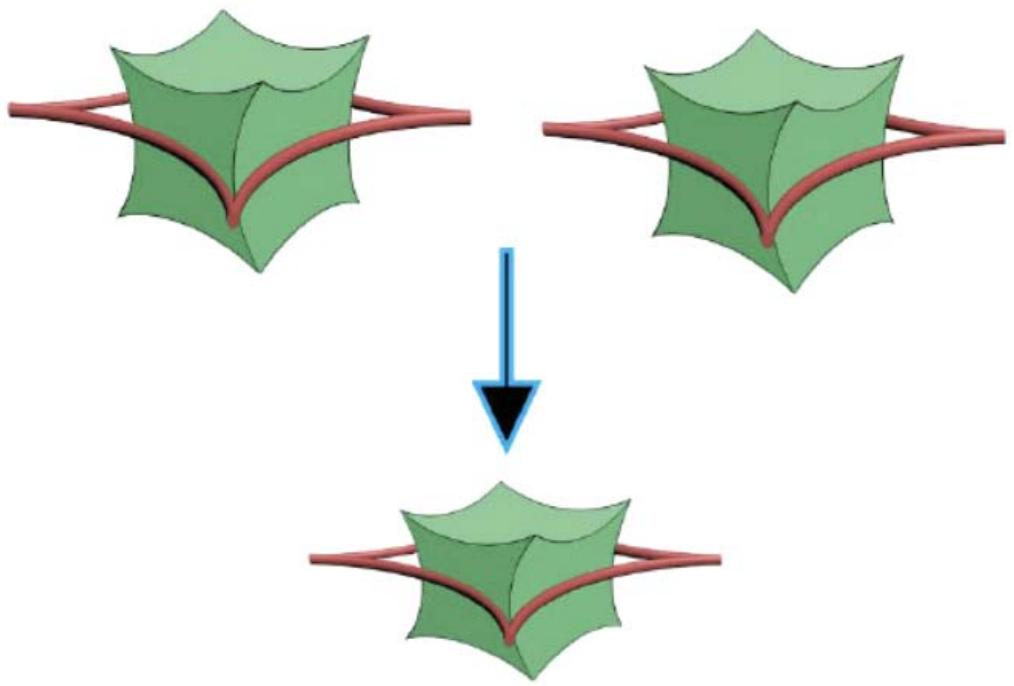
Figure 18a: Overlapping or Hybrid of 2 no. of Inverse acceleration fields to form the Singularity In the Table 4 below, the consecutive disintegrations of the 'singularity' quantum are being shown. In each of the occasions of its disintegration, either one entropy quantum or a $\pi$ space quantum each comes in the direct space upon inversion, and newer space quantum are being generated.
Table 4 Presentation of the Evolution of the Different Space Quantum from the 'Singularity'.
Table 4: Presentation of equilibrium between push forward space quantum and the pullback space quantum
Table 5: List of different conjugate 'push forward space quantum' and 'pull back space quantum' of the universe.
Table 5: 'Push forward Graviton-Pull back the Space Quantum conjugate pairs
The quantized nature of the inverse (in the forms of space quantum) can be seen through the naked eyes in the 'capillary rise' and 'capillary fall' experiments/phenomenon in simple laboratory experiments. On the macroscopic level, the quantum cannot be seen. One cannot expect to see, for example, the 'time' quantum or the '3D energy/volume sphere quantum' within a glass beaker holding a certain quantity of water as for example. The moment a capillary glass tube is being held on the surface of the water, a capillary rise is being observed. The upper meniscus of the water in the capillary is clearly being seen to be concave upwards by its geometry.
In case of doing this experiment replacing water with mercury, instead of capillary rise, a capillary fall is being noticed. Such 'capillary rise' and 'capillary fall' phenomenon are being explained in classical physics/physical chemistry through surface tension, contact angles between glass-air, glass- water/mercury and air-water/glass respectively and are a bit complicated. However, the TSQ interpretation is very simple and straightforward as being elaborated below:
- An atom in TSQ is a hybrid or entanglement of 'entropy' quantum, '2D saddle' 'time' quantum and '3D energy/volume' quantum as shown in Figure 11 to Figure 13.
- In case of water (which is much less cohesive than mercury), once the capillary tube is hold on the surface of water, an '3D energy quantum' pass on to its differential form in the form of 'force' and 'distance' (as shown in Figure 18b, LHS to RHS) and heat is being converted to work. So the '3D energy quantum' disintegrates and no longer exists in the water in the capillary. Under this circumstance, what is left is the '2D saddle time quantum'. A 2D saddle is concave upwards as shown in Figure 11 to Figure 13 and that is being observed at the upper meniscus of water level in the capillary.
- In case of mercury (which is much highly cohesive than water), once the capillary tube is being hold on the surface of mercury, the work in the form of 'force' and 'distance' integrates back to a '3D energy quantum' pass on to (as shown in Figure 18b, RHS to LHS) and work is being converted to heat. So the '3D energy quantum' in its integrated form does exist as a predominant one in the mercury in the capillary. Under this
circumstance, it is the '3D energy sphere which makes the upper meniscus be convex upwards. However, this is very much observable through the naked eyes.
This phenomena are being shown schematically in Figure 18b below:
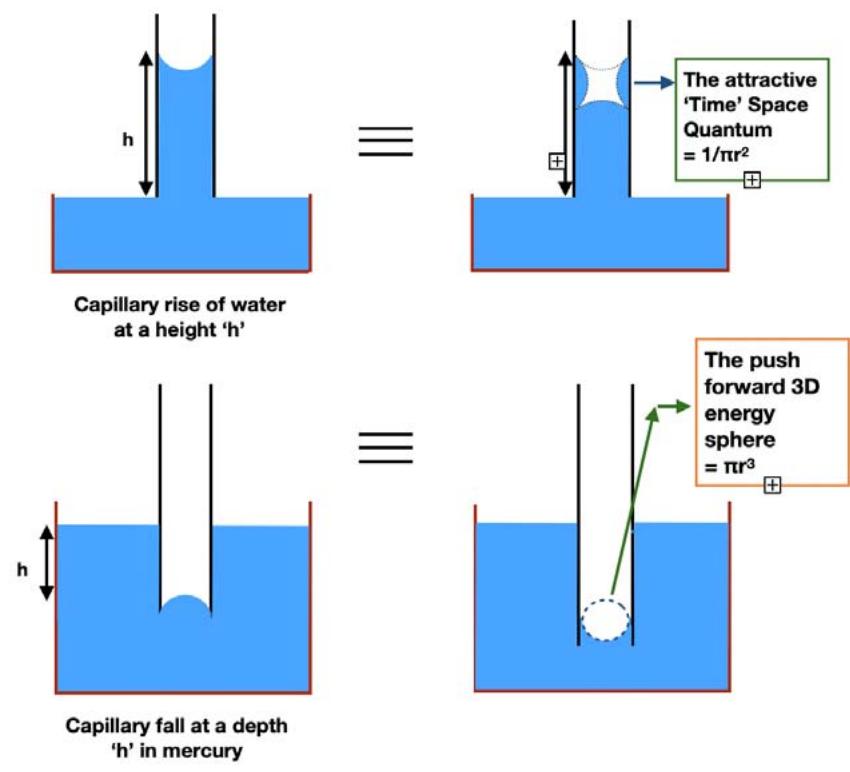
Figure 18b: 'Capillary-rise', 'Capillary-fall' and 'Quantum nature of Space'
The above described phenomenon of 'capillary rise' and 'capillary fall' and the TSQ showered explanation of the said phenomenon very firmly establishes the quantum nature of the 'time-space' of the universe. The explanation being given in conventional physics in the form of, 'in case of water, the adhesive force of water-glass interface is higher than cohesive force of water and that is reason the water meniscus is concave upwards' and 'in case of mercury, the adhesive force of mercury-glass interface is lower than cohesive force of mercury and that is reason the mercury meniscus is convex upwards'. are very fragile concepts indeed are not very convincing too though they are being taught from the higher school levels to the students? However, the text books should start re-explaining things in regard to the TSQ.
As shown in equation (4), force is inversely proportional to distance, when energy is constant. Since the expression of energy in the form of (force x distance) evolved from classical thermodynamics and classical physics, it is very much required to check whether the said inverse dependency of Force and distance could be derived from Classical physics or not.
The energetics of a moving object is required to be understood first. When a car moves, it is driven by energy which comes from the surroundings or space only (from the burning of fuel or the electricity from the transformer or battery), however, exactly the same amount of energy is being transferred back to the surroundings or space. The space thermodynamics is:
'Any energy taken from it has to be returned back to it or any energy given to it, the space will return it back'.
While a car moves, it generates volumes or energy and as a result the space gets back the energy that it had supplied for driving the car. The said deliveries and returns may not always be instantaneous. An apple tree has to impart some energy to the space to let an apple grow, attains its proper shape and ultimately be hanging from one of the branches of the tree. The moment the apple falls from the tree and hits the ground, the energy which was given to the space is being returned back.
The quantum representation of an apple falling from a tree is being illustrated below When a tree grows: in each of the units of its infinitesimally small quantum growth, the heat or energy quantum does break -up into force and distance and the equilibrium as shown in Figure 17 shifts from the left to right (energy converted to the work).
When an apple falls from the tree: The equilibrium as shown in Figure 17 does shift from the right to the left or the differential form of work (work done for the tree/apple to grow and hang) being integrated back to heat energy. In other words, the work is being converted back to heat or energy.
If for example n numbers of 'energy/heat quantum' are being used up (broken up into the differential form of force and distance), when the tree does grow, exactly the $n$ numbers of 'force' quantum will be integrated back to heat or energy. This is the TSQ interpretation of the 'apple falling from a tree'. This being is totally different from Newton's interpretation in the form of gravity/acceleration due to gravity.
When a football is kicked, the person kicking it puts some energy on the football and the person is gaining the energy from the space itself (by up -taking of foodstuff or energy drink) and the football while moving in the space, generates volume or energy and that's the way the space is getting back the energy. When the football falls on the ground the work done is returned back as heat resembling the event of an apple falling from a tree.
Throughout the entire universe every instance many to many movements are continually taking place (the movements of the stars and planets, in our earth there is happening the running around of the cars, the movements of the animal kingdom and human beings, the ships, the aero planes, the trains...etc.. in each and every corner round the clock). For all these happenings, the physical variables 'force' and 'distances' remain in a state of 'increasing - decreasing' but the energy (E) remains to be constant and it has to remain constant only otherwise there would be a situation of violation of the law of conservation of energy.
A thought of experiment to prove the existence of the quantized 'time-space' of the universe:
A thought off experiment of the compression and expansion of rubber ball is shown in Figure 18c and 18d below:
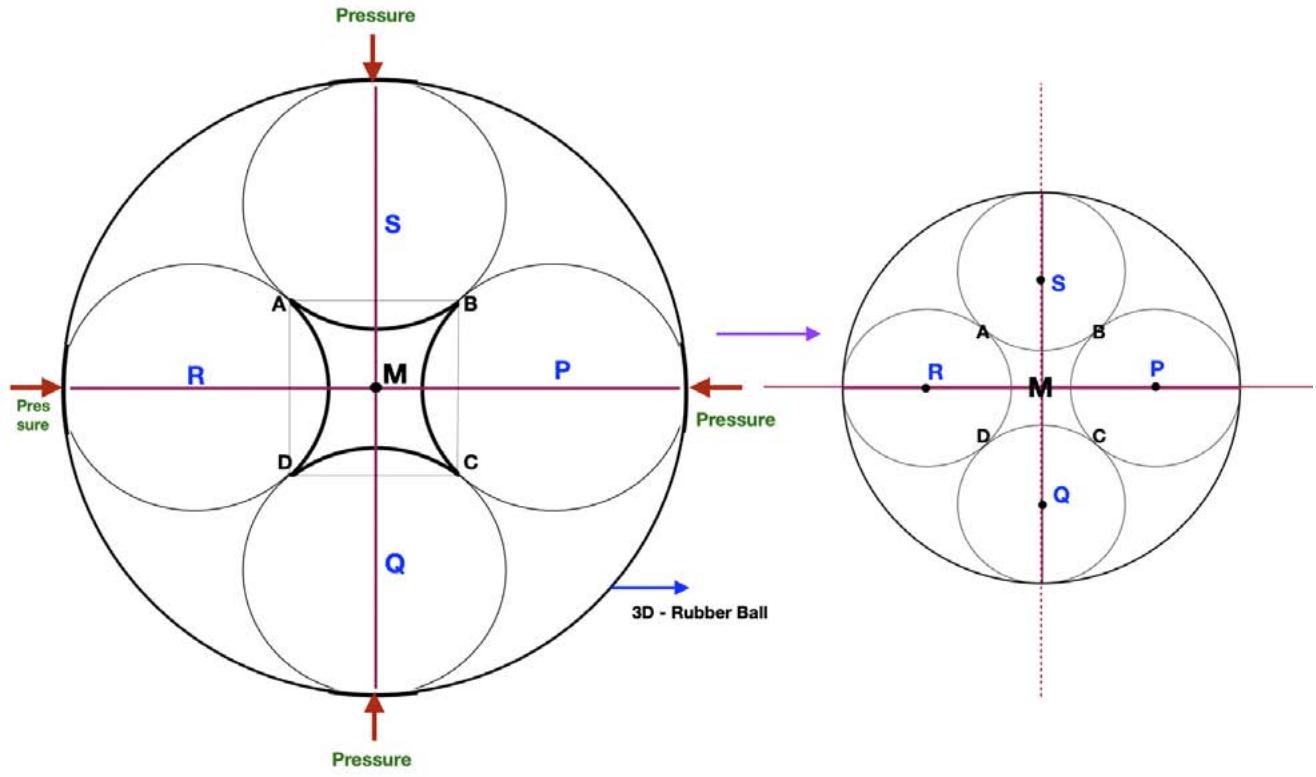
Figure 18c: Compression of an object to reduce its Volume (a presentation of quantum nature of the universe)
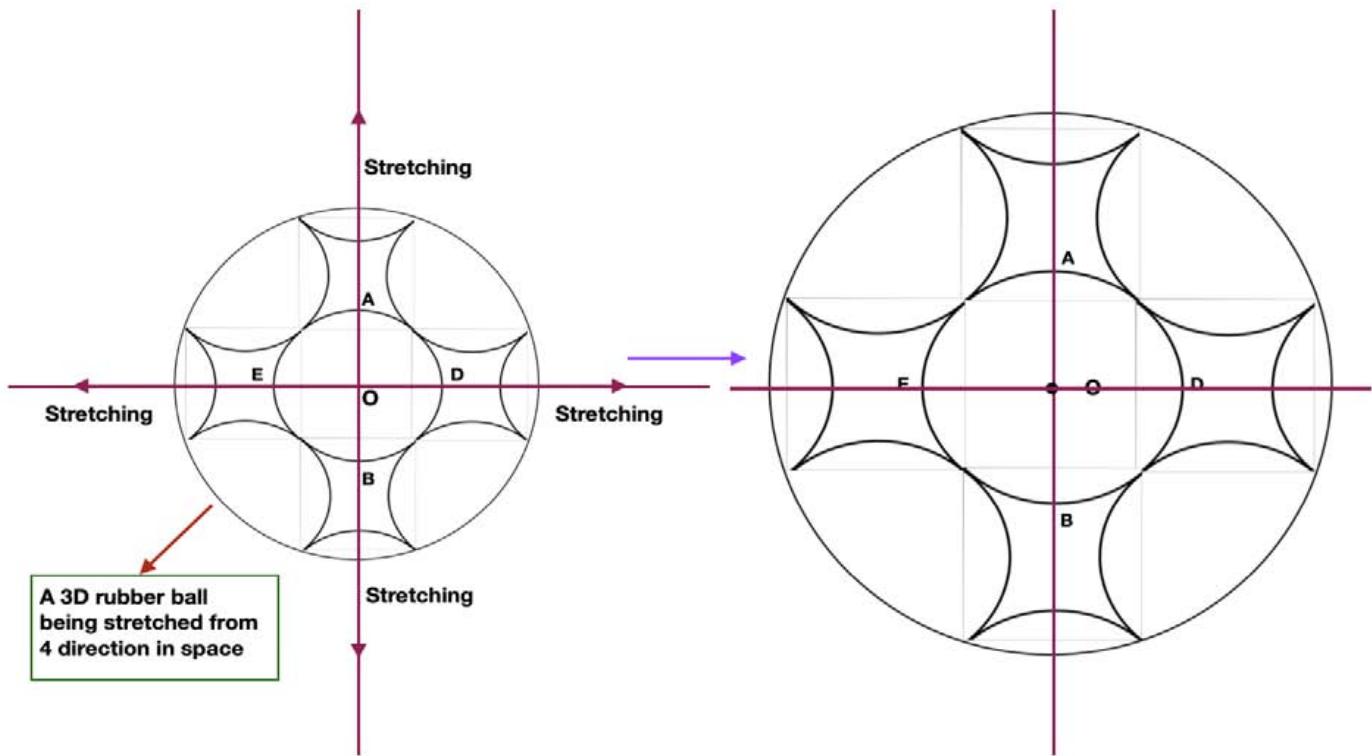
Figure 18d: Stretching of a 3D - object and enlarging the volume (a presentation of quantum nature of a space) As shown in Figure 18c, when the rubber ball is being compressed from the 4 sides uniformly (through the x axes and y axes respectively as shown), as per Newton's $3^{\text{rd}}$ law of motion it should not compress at all since 'action-reaction' forces through the axes's x and y should be cancelling each other. In reality, pressure compression is being done in the practical day-to -day life for sizing the thick metal sheet to a thinner by cold rolling process. Through Newtonian mechanics, however, explaining the physics of cold rolling process or pressure deformation (in the form of shrinkage) turns out to be difficult. TSQ demonstrates this phenomenon in regard to the quantum nature of the 'time-space' of the universe.
As shown in Figure 18c, while compressing the rubber ball, 4 numbers of quantum force circles are getting involved (2 each in x and y axis respectively as shown) and when the alignment/orientation of the said 4 numbers of quantum (P, Q, R & S) attain the shown conformation (in space) as being shown in Figure 18c, a reciprocal squeezing 2D saddle quantum (M) is being formed. This squeezing/attractive 2D saddle quantum becomes responsible for the contraction of the rubber ball. If this reciprocal space quantum would not have been existing in nature/space, compression volume reduction or cold rolling of metal sheet were not at all possible.
In figure 18d, the reverse event of compression, which is the expansion of the rubber ball, is being shown by applying 'pull back force' from the 4 different directions. In this case, at a certain specific orientation/alignment of the 4 numbers of squeezing pull back forces, (2D saddles) a push forward space quantum is being evolved and this only makes the expansion of the rubber ball a possible event.
From the above experiments, it is being revealed that the space has to be a quantized one and otherwise the physical/mechanical 'expansion-compression', cold rolling, wire-drawing, size reduction by grinding would not have been made possible. From the above experiments the following conclusions can be drawn regarding the 'time-space' of the universe.
- The baryonic matter of the universe belongs to the 'hybridized space' which is the hybrid of 'push forward space quantum' (of direct space) and 'pull back space quantum' (of the indirect or reciprocal space). The so-called 'matter' is the co-existence of the 'direct space' and the 'reciprocal space'. An atom is represented in TSQ as a hybrid of energy, entropy and time. Energy and entropy belong to the 'direct space' and the 'time' belongs to the reciprocal space.
- Often, we use the two words 'mass' and 'matter' interchangeably. However, this is a wrong notion. Mass belongs to the 'reciprocal space' and the typical example of mass is a 'black hole'. In fact, any mass which is being considered alone
separated from matter belongs to the category of 'black hole'.
- 'Energy' or 'volume' belongs to the direct space. When energy alone is being considered which is being separated from matter is the 'dark energy'. When a fuel is burnt, energy is converted to work. The said work (differential form of heat) passes on to the space and which is what 'dark-energy' is. It is 'dark' in the sense that it no longer belongs to a matter.
- The 'push forward' and the 'pull back' space quantum are interconvertible among each other (Figure 18a and 18b). Only due to the said 'interconvertibility' phenomenon existing in the 'time-space', the sun is rising, waves are crashing in the sea, the clouds roar, the rain is falling, the days in the universe are being counted with its chest full of hope.
In classical physics, energy expression in regard to the Newton's second law of motion is:
$$
\begin{array}{l} \text {f o r c e} = \text {m a s s x a c c e l e r a t i o n} \\= M L T ^ {2} \tag {39} \\\end{array}
$$
$$
\text {O r}, \quad \text {f o r c e} = (\mathrm {E} / \mathrm {C} ^ {2}) \mathrm {L T} ^ {- 2} \tag {40}
$$
[Since as Einstein mass - energy equivalence mathematical expression $\mathsf{E} = \mathsf{MC}^2$, M is the mass and C is the velocity of light and is a constant]
So from equation (40), one can write, when $E$ is constant too,
$$
\text {F o r c e L T} ^ {2} \tag {41}
$$
So from equation (41), Force being inversely proportional to Distance (L or S) is not being proved.
While it remains to be true that force is inversely proportional to distance when energy is constant but by Newtonian physics it can never be explained.
## V. TSQ ONLY CAN EXPLAIN IT THROUGH PHYSICS, MATHEMATICS AND GEOMETRY AS DISCUSSED BELOW
- Physics - 'Energy' is the integrated form and the 'work done' is the differential form of energy as already discussed.
- Mathematics - Energy(E) is $(4\pi r^{3})$ and it can be broken into force part and distance part as
$$
E = \pi (2 r / \sqrt {3}) ^ {2} \times 3 r
$$
$$
\mathrm {O r} \quad \mathrm {E} = \pi \mathrm {R} _ {1} ^ {2} \times \mathrm {R} _ {2} \quad [ \mathrm {R} _ {1} = (2 \mathrm {r} / \sqrt {3}), \mathrm {R} _ {2} = 3 \mathrm {r} ] \tag {42}
$$
In equation (42), $\pi R_1^2$ stands for 'force' and $R_2$ stands for distance. When the energy is decreasing both
$R_{1}$ and $R_{2}$ decreases maintaining the ratio of the two as shown in equation (42) and the reverse is being true when $E$ is increasing. But when $E$ becomes constant, the dimensions $R_{1}$ and $R_{2}$ adjusts each other in a manner such that $E$ remains to be constant though force and distance both would be varying. For converting force more and more to distances $R_{1}$ decreases but $R_{2}$ increases disproportionately but the product of 'force' and 'distance' remains to be constant. For converting distance more and more to force $R_{2}$ decreases and $R_{1}$ increases disproportionately but the product of 'force' and distance remain constant. The first example of distance increasing is the event of heat or energy being differentiated to 'work' and the second example of distance decreasing is the integrating of 'work' to heat or energy.
Table 6 below shows the changing profile of 'force and distance' when energy remains constant and is transformed to 'work. Table 7 below shows the changing profile of 'force and distance' when work remains constant and is transformed to 'energy'. Newtonian physics paid more attention to dimensional matching of the RHS and LHS of the proposed equations of motion and put a very little focus on thermodynamics and embodying the principal physical variables 'time' and 'mass'.
Table 6: Variation of 'force' and 'distance' when energy is constant – 'energy to work'
<table><tr><td>Energy = (4πR12) x R2</td><td>Distance = R2</td><td>R1</td><td>Force = (4πR12)</td></tr><tr><td>1000</td><td>1</td><td>9</td><td>1000</td></tr><tr><td>1000</td><td>2</td><td>6.3</td><td>500</td></tr><tr><td>1000</td><td>3</td><td>5.1</td><td>333</td></tr><tr><td>1000</td><td>4</td><td>4.5</td><td>222</td></tr><tr><td>1000</td><td>5</td><td>4</td><td>200</td></tr><tr><td>1000</td><td>6</td><td>3.6</td><td>167</td></tr><tr><td>1000</td><td>7</td><td>3.4</td><td>143</td></tr><tr><td>1000</td><td>8</td><td>3.15</td><td>125</td></tr><tr><td>1000</td><td>9</td><td>3</td><td>111</td></tr><tr><td>1000</td><td>10</td><td>2.9</td><td>100</td></tr></table>
Table 7: Variation of 'force' and 'distance' when energy is constant – 'work to energy'
<table><tr><td>Energy = (4πR12) x R2</td><td>Distance = R2</td><td>R1</td><td>Force = (4πR12)</td></tr><tr><td>1000</td><td>10</td><td>2.9</td><td>1000</td></tr><tr><td>1000</td><td>9</td><td>3</td><td>500</td></tr><tr><td>1000</td><td>8</td><td>3.15</td><td>333</td></tr><tr><td>1000</td><td>7</td><td>3.4</td><td>222</td></tr><tr><td>1000</td><td>6</td><td>3.6</td><td>200</td></tr><tr><td>1000</td><td>5</td><td>4</td><td>167</td></tr><tr><td>1000</td><td>4</td><td>4.5</td><td>143</td></tr><tr><td>1000</td><td>3</td><td>5.1</td><td>125</td></tr><tr><td>1000</td><td>2</td><td>6.3</td><td>111</td></tr><tr><td>1000</td><td>1</td><td>9</td><td>100</td></tr></table>
- Topology In figure 19 below, it is being shown why and how the force is inversely proportional to distance when energy is constant.
Figure 20 shows the graphical representation of force $(4\pi R_1^2)$ against distance $(R_2)$ for 'energy' to work and 'work' to energy respectively.
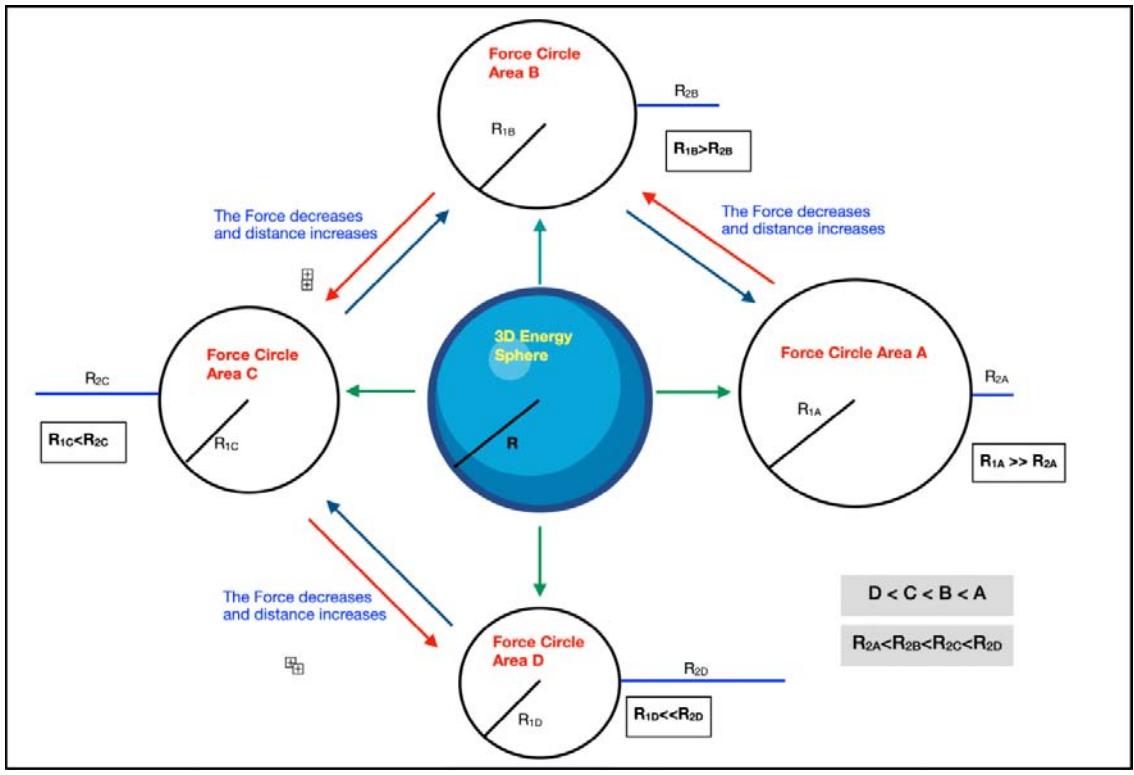
Figure 19: Schematic presentation of data of Table 2 and Table 3, to show the inverse relationship of 'Force' and 'Distance' when 'Energy' is constant
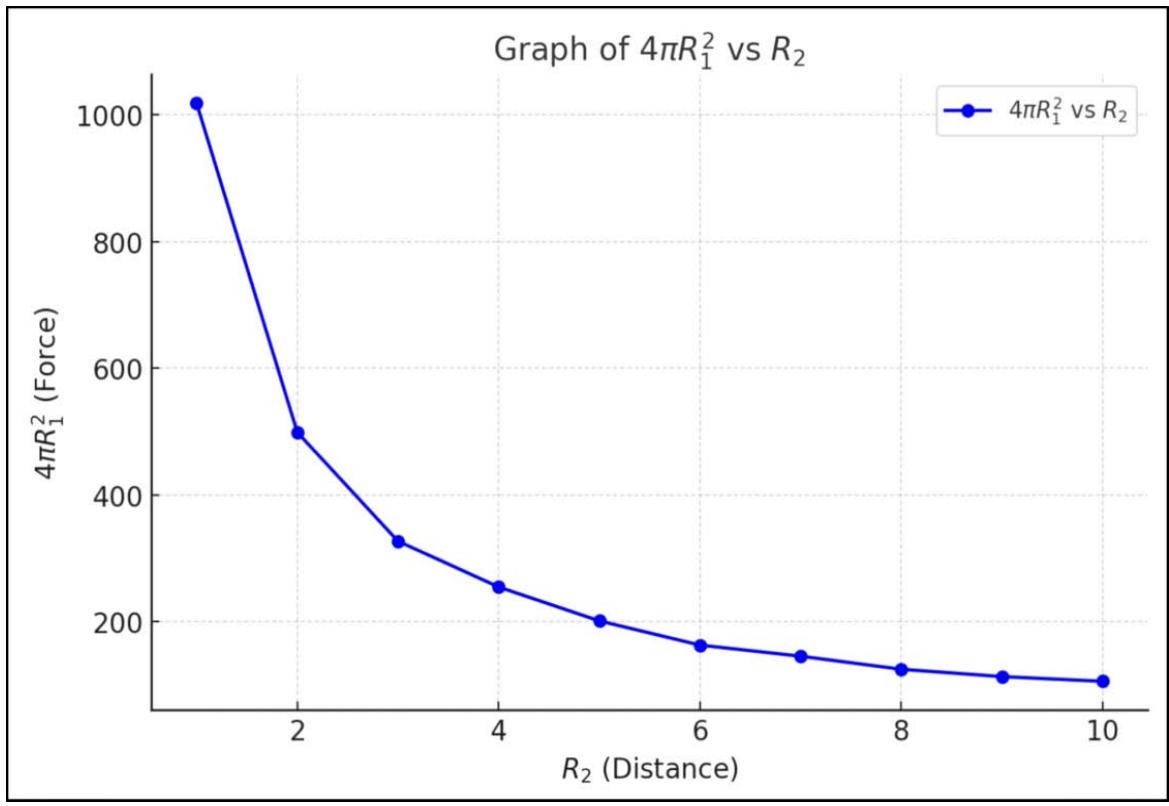
Figure 20: Graphical representation of the variation of Force and Distance as per the data of Table 3
So it is shown that only quantized nature of the space (in the forms of various spaces of the direct space and the reciprocal space) can only explain the 'Force', 'distance' and 'energy' relationship. This as well stamps TSQ as a very realistic theory of the universe.
TSQ shows how 'force' is being converted to distance. While it is said that 'energy' is the integrated form and work is its 'differential form', continuing with this concept, it can be stated that 'force' is the integrated form and 'distance' is the differential form of force.
What is happening in case of incremental motion of an object that at the beginning first unit of time, a certain force is put on the object and when the said force is to a large extent converted to distance (since complete conversion of force into distance is not possible like the one 'heat cannot be completely converted to work, what the second law of thermodynamics is, and a certain part of force has to retained), the higher magnitude of force has to be applied at the second unit of time for the increment of the distance of travel to happen. When this force is converted to distance, yet another higher amount of force than the second unit of time has to be exerted on the moving body for the $3^{\text{rd}}$ unit of time and this would continue so. This kinetics and thermodynamics of motion of TSQ is a superseding theory over the Newtonian mechanics of motion.
The equations of motions as derived in this article equation (14), equation (37) and equation (38) if is recapitulated, they are:
$$
V _ {t} = S (t) = S (1) + t \Delta S _ {\text {i n}} \tag {14}
$$
$$
V = V _ {\text {a v}} t = V _ {1} t + (1 / 2) \Delta V _ {\text {i n}} t ^ {2} \tag {37}
$$
$$
V _ {t} = V _ {1} + t \Delta V _ {\text {i n}} \tag {38}
$$
The expansion in volume (or space expansion) takes place in the direction of motion of the moving object as shown in Figure 20a below.
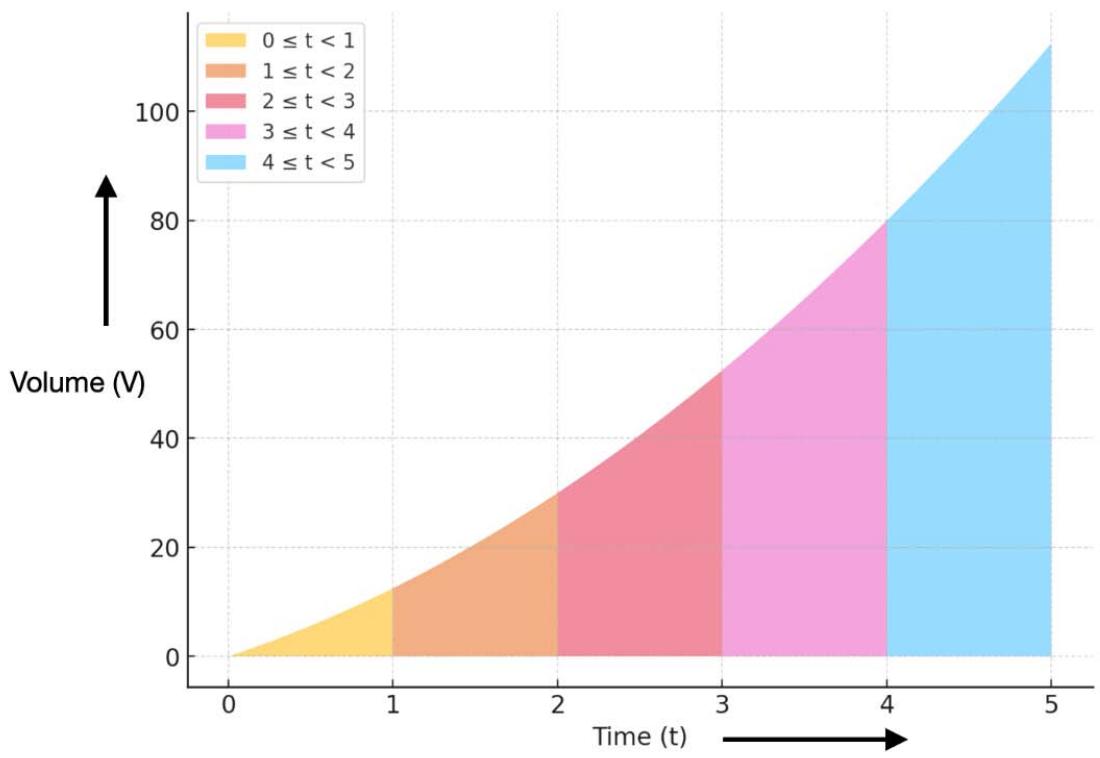
Volume Vs Time with segmented Colours Figure 20a: Presentation of incremental volume generation with time of a moving object (Equation 37)
Now if for example, $V_{1} = 100$, $\Delta V_{\mathrm{in}} = 10$, S (1) = Force (F) and instantaneous energies E for four different u = 20, $\Delta S_{\mathrm{in}} = 5$ are considered, the values $V_{t}$, S (t), values of t (1,2,3 and 4) are shown in Table 8 below:
Table 8: Kinetic and energetics data of a moving object as per equation (13a), equation (37) and equation (38) $\left[V_{1}=100, \Delta V_{\mathrm{in}}=10, S(1)=u=20, \Delta S_{\mathrm{in}}=5\right]$
<table><tr><td>t</td><td>S(t)</td><td>V (t)</td><td>Force (F)</td><td>Energy = 3Vt
= [F × S(t)]</td></tr><tr><td>1</td><td>20</td><td>100</td><td>15</td><td>300</td></tr><tr><td>2</td><td>25</td><td>110</td><td>13.2</td><td>330</td></tr><tr><td>3</td><td>30</td><td>120</td><td>12.0</td><td>360</td></tr><tr><td>4</td><td>35</td><td>130</td><td>11.1</td><td>390</td></tr></table>
The $t$, $S(t)$, $V(t)$, $F$ are being considered in an arbitrary scale of choice.
### The following points to note:
- At Every unit of time, energy given to the moving object = energy returned back to the space by the moving object.
- The energy of the 'moving object + the surroundings or space' at each unit of time remains constant.
- At the completion of one unit of time, a relatively higher energy (and vis-à-vis force) is applied on
the moving object at the beginning of the next unit of time, such that it can cover more distance.
From the data shown in Table 8, it is found that the value of force $F$ is decreasing with time. In fact at the beginning of an unit of time over the previous unit of time, the energy remains in the form of (E x1) [where E stands for force, F and 1 stands for a single unit of distance but upon completion of the said unit of time E falls (or F falls) but the distance is being increased. This is shown in Table 9 below:
Table 9: The pattern of 'fall off' of the hybrid of 'Force and distance' in a single unit of time as per data of Table 8
<table><tr><td>t</td><td>Energy (E)</td><td colspan="2">Hybrid of Force and Distance (beginning of \(t_{th} \) unit) (Force x Distance)</td><td colspan="2">Hybrid of Force and Distance (end of \(t_{th} \) unit) (Force x Distance)</td></tr><tr><td>1</td><td>300</td><td>300</td><td>1</td><td>15</td><td>20</td></tr><tr><td>2</td><td>330</td><td>330</td><td>1</td><td>13.2</td><td>25</td></tr><tr><td>3</td><td>360</td><td>360</td><td>1</td><td>12</td><td>30</td></tr><tr><td>4</td><td>390</td><td>390</td><td>1</td><td>11.1</td><td>35</td></tr></table>
From the data given in Table 8, it is clearly understood as the time progresses, the force starting initially with higher and higher values and ending up with more and more lower values but dissipating to more and more higher distances.
The topological presentation of data of Table 8, Table 9 is shown in Figure 21 below.
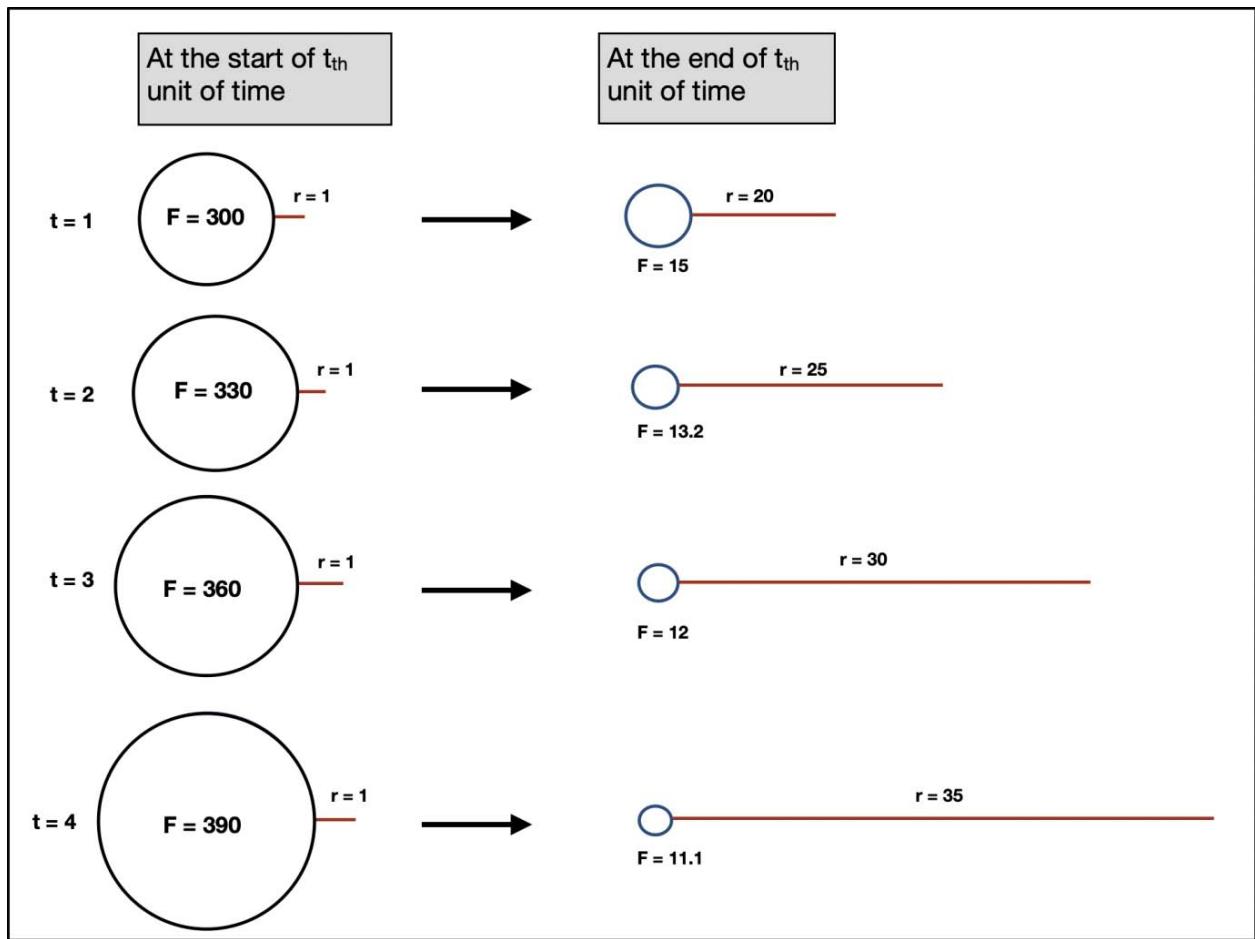
Figure 21: Schematic presentation of how the force is dissipated more and more to distance. (Table 5)
This kinetics and thermodynamics of motion of TSQ is a superseding theory over the Newtonian mechanics of motion.
#### Superseding Laws in Physics
The three laws of motion of Newton are required to be given together newer shapes in regard to the quantum entanglement character of time, mass, volume, energy, work...etc... and the demerits of the three laws of Newton are being discussed below with a brief introduction of what the quantum entanglement [88-100] is:
The schematic representation of quantum entanglement phenomena has been shown in this article in Figures 11 to Figure 13 (the interactions among the space quantum of 'energy', 'entropy' and 'time'. From the said figures, it is clearly understood that neither of the three said variables 'energy', 'entropy' and 'time' cannot change alone. If the entropy changes, it makes the energy to change and energy in turn makes the 'time frame' to change (since they are topologically and mathematically connected). If the length of the 'entropy' quantum be $r$, then energy would be $(4\pi r^3)$ and time would be $(3/4\pi r^2)$ and so any change in magnitude of either of the said three space quantum will automatically impose the changes on the other two. So Figure 11 to Figure 13 are the representations of typical 'quantum entanglement'.
In this connection of the demerits of Newton's laws of motion and 'quantum entanglement' the concepts of 'space expansion', the 'integrated form of energy', the 'differential form of energy' and 'force - decaying with time' (which already been discussed in the earlier sections) need to be recapitulated with some further addition of the concepts.
The 'space expansion' (acceleration of Newton's law) phenomenon had been schematically shown in Figure 15 and Figure 18. In Figure 18, it is being shown, a red color 3D volume/energy sphere is surrounded by a blue color force circle. In fact this is what space expansion is and the physical significance of the same is, the force circle is pushing forward the 3D sphere and as a result the volume of the sphere increases and that is what the 'space expansion' is. While a moving object is speeding up, it is exerting more and more force on the space and the space for the time being (instantaneously) become more dense (towards the direction of the motion) but percolates the force to more and more distances in the space and as a result the space expands towards the direction of the motion (Figure 15). Concrete evidence to support this phenomenon is, the vibration of earth associated with a very highly speeding train can be felt from a long distance from the path of travel of the train. While a plane is taking off from a place, the said vibration reaches very far from the point of takeoff.
While an object moves, energy is being converted to work. Energy is the 'integrated 3D sphere form' and work is the differential form of energy (as being shown in Figure 17, the mathematics of energy and work being shown too) and when the energy is being converted to work, the volume of the space increases as shown in the newly developed equation (38), or $V_{t} = V_{1} + t\Delta V_{in}$.
Another example of very much practically realizable 'space expansion' and 'space -inversion' phenomenon is the swinging of a vertical spring pendulum up and down. When the pendulum bob moves downwards towards the surface of the earth, it is a 'push forward force' and the gaping of the sections of the spring increases. This leads to space expansion. On the contrary, when the pendulum bob does move upwards, it does squeeze the space (the sections of springs get quenched) and this leads to 'space-inversion'.
The phenomenon of 'force decaying with time' could be understood from the data presented in Table 2 in this article. From the data presented in Table 2, it could be followed, as the time increases, the distance of travel increases and as the distance increases, the force decreases. So with increase in time, the force does decay.
## VI. THE DEMERITS OF THE THREE LAWS OF MOTION OF NEWTON ARE THE FOLLOWING
- $1^{st}$ law: $1^{st}$ law of Newton stated 'an object at rest will remain at rest forever until and unless some external force applied on it and a moving body will continue moving forever along a straight line with constant velocity'. It has not been made clear by him whether he is talking about space or a planet like our earth. As a matter of fact, the space quantum is in continual movements and hence none of the baryonic matter of the universe belong to a state of 'rest.' Regarding a moving object, if it is in space (where the atmosphere does not exist) it will simply float around. On a planet like earth, forever moving of the object is thermodynamically forbidden since it would require a continuous energy supply of infinite amount. While proposing the first law, Newton might have considered the space to be a vacuum one. However, this would not be a situation of the reality of the universe.
- $2^{nd}$ law: The $2^{nd}$ law of Newton states force is directly proportional to the rate of change of momentum. In this article this law has been discussed in detail and the demerits have been highlighted.
- $3^{rd}$ law: The version of the $3^{rd}$ law of Newton is an incomplete one in the sense that the law is talking about an effect without explaining the cause behind the same. The law in the form 'to every action there is an equal and opposite reaction' is a breakthrough verdict in science but the reasons behind the said 'action - reaction' occurrences had not been established through thermodynamic logic since the said 'action-reaction' is related to force, distance, energy, work-done etc. and all the said variables are thermodynamic one. Another very important parameter apart from the above said physical variables is 'time'. The occurrence of 'action-reaction' is related very much to 'time'. When 'time' gets involved with a subject, the 'space' would obviously be involved and which makes us remember the popular proverb 'when one pulls the ear the head will come too'. Over and above,
Newton did not think or remained silent about 'time-space 'in connection with his $3^{rd}$ law of motion.
The most updated and superseding version of the $1^{st}$ law of Newton would be as below:
'The 'time-space' of the universe is an equilibrium entity of the direct quantized space and the reciprocal quantized space and the quantum space are entangled among each other'.
The most updated and superseding version of the $2^{nd}$ law of Newton would be as below:
'A mechanical wave remains associated with the movement of an accelerating object which is a hybrid of 'force' and 'energy/volume' and the mechanical wave spreads to the space resembling the progression of the electromagnetic waves. There occurs a 'space expansion' while an object moves arising out of the impact of the mechanical wave associated with the object on the space. The 'force' is being defined as 'the mechanical space expansion coefficient, being expressed as, Force = [1/V0 (dV/dt)], V0 is volume of the object at rest and (dV/dt) stands for the 'rate of space expansion with time'.
Regarding the $3^{\text{rd}}$ law of Newton it is to be understood very much that the simultaneous 'action-reaction' is an occurrence which people do feel in everyday life. If a bullet is shot from a gun, the gun moves backwards, if a ball is dropped on a floor it rebounces, if a person slaps another person, that person feels pain and in return the person slapping feels a pain too. The existence of the reverse pain or force is a hard reality of the universe and no one can deny it. However, Newton's verdict of equality of action and reaction force is an ideal one. The force of action does not remain confined to the point of hit of the substrate. It gets absorbed in the sense it gets spread all over the directions in the substrate and the average width or the depth of the spread varies from substrate to substrate. If two identical rubber balls are dropped from the same height on two floors of different hardness, the ball hitting the harder floor will bounce to a higher height than the other ball hitting a comparatively softer floor. If a person rolls on a bed which is hard, the reaction force in fact would be assisting the person to roll easily. On the other hand if a person tries to roll on sand at the shore of a sea, rolling would not be steady since the force of action is percolated very fast over all the directions and the reaction force will be reduced to a large extent throughout the area of the contact between the body of the person and the sand. If two identical solid iron balls (as for example) are dropped from the same height on water and a high viscous jelly like substance being kept in two identical vessels respectively, (the densities of both the water and jelly are more or less equal and which is much lower than iron) the iron ball falling on water will instantaneously sink to the bottom but the iron ball falling on the jelly will slowly move to the bottom.
The action force to a very fast rate dissipates over all the directions in water but in case of jelly the action force is confined to a lesser width or depth and the reaction force develops faster and becomes higher in magnitude than in water. The 'action-reaction' force also depends on and varies a lot on the material of construction. If a hammer made of iron is being hit on another substrate made of iron too, the 'action- reaction' force will develop proportionally but with the same level of force the same iron hammer is being hit on a substrate made of rubber the 'action -reaction' force will act disproportionately. To get the best 'action-reaction' one has to choose the two substrates having the same material of construction. The following factors regarding 'action-reaction' occurrence are very important:
- Material of construction
- Difference between the compressive strength and the toughness of the two substrates
- The surface area of contact between the two substrates
- The duration of the force of action
- The mass of the two substrates
- The temperature of the substrates
While all the above factors are very important, the readers of this article have to pay attention to the point no. (iv) since from this only the conception of a 'reversible process' and an 'irreversible process' could be well built-up. For example, let the case of compression of a real gas be studied. When a real gas (in a cylinder with a piston on it) is compressed suddenly, the duration of the action force is very little and as a result of that the molecules of the gas do not get the sufficient time for the reaction force to develop to the maximum possible level (though to a certain extent the reaction force is developed) and as a result of that, with the lesser work done on the system, the gas can be compressed. This is an example of an irreversible process. It is called 'irreversible' in the sense the reversible or the opposing forces are not being allowed to develop in the right way. On the contrary, when the same gas would be compressed slowly, the molecules would to a large extent would get the opportunity to develop the opposing or the reverse force. This is the reason the slow compression or slow expansion processes are being called reversible processes. So when a gas is reversibly compressed, much more work has to be done than the irreversible process. In thermodynamics it is taught that for a reversible expansion of a gas the work done is maximum. This statement in fact confuses many students why one will spend more energy upon conducting a reversible process. However, the inner meaning of this needs to be understood. This statement tries to establish the fact that to extract maximum work output from a system as much as possible, reversible expansion is the only route.
Summing up all the above discussions, it can be concluded that 'action -reaction' might be equal in some cases but the process has to be conducted infinite time and which is practically not possible. However, the opposing nature of 'action -reaction' is true but the equality of the two is an 'idealism' or a myth and is not a real occurrence in the practical life of the universe.
## VII. THE SUPERSEDING NEWTON'S THIRD LAW IS BEING STATED BELOW
'The 'quantum-entangled' 'time-space' of the universe is composed of different types of space quantum in the forms of 'push forward' and 'pull-back' space quantum. To every 'push forward' quantum, there exists a 'pull back' quantum in equilibrium with it, called its conjugate space quantum. The said push forward space quantum and the pullback conjugate space quantum belong to the direct space and the reciprocal space of the universe respectively. The 'time'(t), 'température'(T) and the 'pressure'(P) are related among each other as:
$$
\text {P u s h F o r w a r d f o r c e (T) x P u l l B a c k F o r c e (t) = P} \tag {42}
$$
The above equation (42) is the mathematical representation of 'quantum entanglement' of the 'time-space' and the occurrence of any equilibrium or the non-equilibrium of any physical process in the universe are controlled by the following condition between t and T:
$$
T t = P = 1 - \text {e q u i l i b r i u m s i t u a t i o n ,} t \text {a n d} T \text {a r e m u p p l i c a t i v e i n v e r s e t o e a c h o t h e r} \tag {43}
$$
$$
T t = P > 1 - \text {n o n - e q u i l i b r i u m s i t u a t i o n}, T \text {i s d o m i n a t i n g o v e r} t \tag {44}
$$
$$
T t = P < 1 - \text {n o n - e q u i l i b r i u m s i t u a t i o n ,} t \text {i s d o m i n a t i n g o v e r T} \tag {45}
$$
Any 'spontaneous process' of the universe begins with a non-equilibrium state, with either $(Tt > 1)$ or $(Tt < 1)$ and it ends up with the onset of an equilibrium state with $(Tt) = 1$. If a person holding in his hand a rubber ball at a certain height above the ground loosens his fingers, the ball starts falling spontaneously and instantaneously a non-equilibrium situation is evolved out with either $(Tt > 1$ or $Tt < 1)$. When the ball drops on the ground it bounces and ultimately comes to a position of rest or equilibrium with $Tt = 1$. This remains to be true for any spontaneous process of the universe.
TSQ Driven Geometric Mean Concept of 'Temperature' and 'Time'
Regarding the 'temperature' (force) and 'time' (inverse force) TSQ have very clearly established the fact that in our universe, neither the 'temperature' nor the 'time' can be boundless. The quantum entanglement of 'time' and 'temperature' are in turn arising out of the following two quantum entanglement: [88, 99]
$$
\begin{array}{l} T e m p e r a t u r e = [ (s p a c e e x p a n s i o n) \times (o r d e r) ] ^ {1 / 2} \\= [ (\text {3 D s p h e r e} \times \text {c i r c l e}) \times (\text {i n v e r s e d i s t a n c e}) ] \\= \left[ (4 \pi r ^ {3} / 3) \times (4 \pi r ^ {2} / 3) \right] \times (3 / 4 \pi r) ] \\= \left[ \left(4 \pi r ^ {2} / 3\right) (\text {F i g u r e} 2 2) \right. \tag {46} \\\end{array}
$$
$$
\begin{array}{l} \text {T i m e} = [ (\text {s p a c e i n v e r s i o n}) \times (\text {e n t r o p y}) ] ^ {\nu_ {2}} \\= \left[ \left(3 D \text {s a d d l e} \times 2 D \text {s a d d l e}\right) \times (\text {d i s t a n c e}) \right] \\= [ (3 / 4 \pi r ^ {3}) \times (3 / 4 \pi r ^ {2}) ] \times (3 / 4 \pi r) ] \\= \left[ \left(3 / 4 \pi r ^ {2}\right) (\text {F i g u r e} 2 3) \right. \tag {47} \\\end{array}
$$
It is known to us that the geometric mean (GM) of two variables, as for example, $x$ and $y$, is $GM = (xy)^{1/2}$ and hence the temperature remains to be a 'geometric mean' of 'space expansion' and 'order' (inverse curvature distance of the reciprocal space). While the space expansion would be trying to be very large, the order will pull it back and as a result, the space cannot expand boundlessly. So mathematically it sounds very logical to state 'Temperature is the geometric mean (as shown in Figure 22) of 'Space expansion' and 'order'.
The time remains to a geometric mean of 'space inversion' and 'entropy' (the curvature distance of the direct space). While the space inversion will try to reach a very large magnitude, the entropy will push it forward and the space cannot squeeze boundlessly. (as
shown in Figure 23). So mathematically it sounds very logical too, to state 'Time is the geometric mean (as shown in Figure 23) of 'Space inversion 'and 'entropy'.
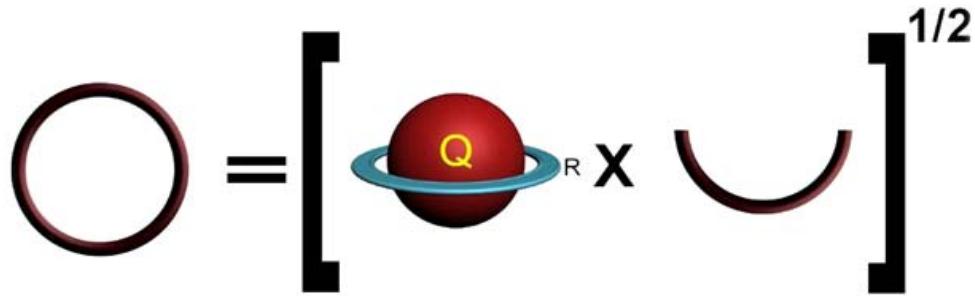
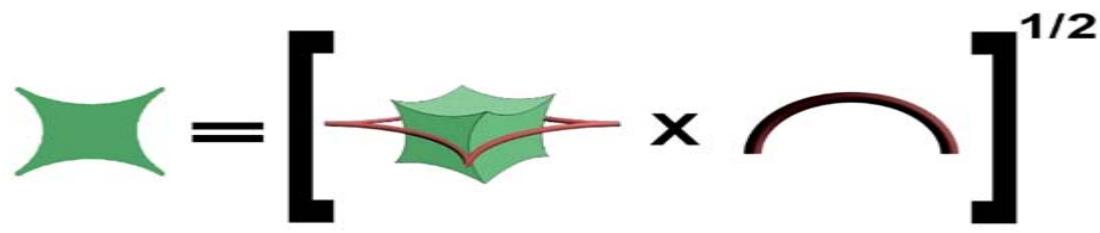
Figure 22: TSQ Driven Geometric mean concept of 'Temperature' (circle of the LHS of the figure) Figure 23: TSQ Driven Geometric mean concept of 'Time' (2D saddle of the LHS of the figure)
## VIII. CONCLUSION
The subject of modern physics of the world will be enriched and further updated with this superseding TSQ propositions in science. This is a 'ground-breaking' theory and the entire subject of physics over time will get altogether new shape. In fact the TSQ is a new discovery in Science and the new findings of TSQ and the inherent new concepts offered by TSQ are innumerable and describing all those in a single article, however, is not possible. The readers of this article have to go through the reference cited in this article exclusively of the TSQ (reference no. 88-99) to develop an overall idea about the logic and philosophy of TSQ and its vast implications in Physics, Chemistry and Mathematics. The said three streams of science will reappear in altogether newer shape sooner or later depending on the level of active interests and attention being paid by the global scientific community realizing the profound underlying significance of the theory, test it and refine the same wherever felt so.
Table 9 below lists the following:
- The major shortcomings/inconsistencies of the theories of conventional physics
- The key contribution of TSQ in physics
- The contribution of this review cum research article.
Table 10: Conventional Physics vis-à-vis Theory of Space Quantization
<table><tr><td>Physical variable/phenomenon of concern</td><td>Shortcomings of the theories of conventional physics</td><td>The contribution of TSQ in physics</td><td>The contribution of this article in physics</td></tr><tr><td>'Entropy'</td><td>Entropy has been described as the 'degree of randomness' and mathematically being defined as energy per unit of temperature. People fail to correlate the said degree of randomness with the mathematical expression. People find entropy to some extent abstract.</td><td>Entropy has been defined in the tripartite manner in TSQ and it has been shown to exist as a space quantum.
Entropy has been shown to exist in the two forms:
a. Directional entropy
b. Multidirectional entropy.</td><td>The energetics of motion of a moving object is related to the (force x distance) or (force x directional entropy). A Moving object continuously goes on generating directional entropies.</td></tr><tr><td>'Time'/'Temperature'</td><td>Neither the 'time' nor the 'temperature' had been embodied in regard to 'time-space' of the universe.</td><td>Both 'time'(t) and 'temperature'(T) have been embodied in regard to the 'time-space' of the universe. They have been shown to be multiplicative inverse to each other in the form: Tt = 1</td><td>Through a unique concept in physics 'time' and 'temperature' has been shown to be related to each other in the form of 'thermal expansion coefficient' (TEC) and 'Mechanical Space expansion coefficient(MEC): TEC = [1/V0(dV/dT)] MEC = 1/V0(dV/dt)] Where V0 and V stand for the volume.</td></tr><tr><td>'Mass'</td><td>Mass has been projected as a continuous entity of the universe but its topology, dimension and physics of formation could not be explained.</td><td>Mass has been embodied as a hybrid of 'time' and 'inverse of entropy'. It is shown to be the inverse of volume. Topologically mass is shown to be an 'inverse 3D saddle' of inverse 3-dimensional geometry.</td><td>The mass of an object is an important parameter when the object is at rest position. Once a critical force is applied to overcome the mass and the object is being taken in the form of 'motion', the mass no longer remains to be a factor for the 'acceleration' of the object.</td></tr><tr><td>'Velocity'</td><td>Velocity in conventional physics has been put as a vector quantity and being defined as, (distance/time). Since 'time' is abstract in conventional physics, the topology of velocity could not be revealed.</td><td>Time being embodied, the concept of 'velocity' in conventional physics does merge to the concept of 'volume'.</td><td>A 'space expansion' does take place in the direction of the moving object.</td></tr><tr><td>'Acceleration'</td><td>Acceleration being defined as, [(distance/(time)2] or (velocity/time), is an ambiguous physical variable of the universe since velocity itself is dependent on time.</td><td>Acceleration has been shown to be a 'space expansion' phenomena and the conventional expression of Newton's acceleration does take the form of: 'incremental distance' per unit of time'.</td><td>Acceleration for a moving object generates a mechanical wave in space and its propagation resembles the propagation of 'electro-magnetic' waves. The dimensionality reaches to 5.</td></tr><tr><td>'Space Expansion'</td><td>Time-space was not at all considered in Newtonian physics.</td><td>'acceleration' is 'space expansion' and 'space expansion' is acceleration.</td><td>Newton's expression of acceleration in the form of (force/mass) is valid for a non-moving object where under constant volume, the molecules of the object are accelerated (as for example by heat). For an accelerated object the above equation is not the right equation.</td></tr><tr><td>'Force'</td><td>Force being defined as the product of mass and acceleration. Neither the mass nor the acceleration being defined in the right fashion.</td><td>Force being represented by a 2D circle space quantum.</td><td>The Force of a moving object being defined as 'mechanical space expansion coefficient</td></tr><tr><td>'Conservation of momentum'</td><td>The product of mass and velocity has been considered to be constant without emphasizing the physics, mathematics and the topology of the phenomenon of conservation of</td><td>The mass and volume both being the quantum of the space. When a quantum of mass interacts with a quantum of volume, three numbers of π space quantum are being</td><td>The phenomenon of conservation of momentum has been topologically presented.</td></tr><tr><td></td><td>momentum.</td><td>developed.
The conservation of mass has been shown to be true in regard to mass and volume and not in regard to mass and velocity</td><td></td></tr><tr><td>'Gravitation'</td><td>Gravitation has been expressed by an empirical mathematical formula by Newton in the form of force (F) acting between the two masses m1 and m2 in the following form [F = (Gm1m2/r2)(i) Or, (Fx) = (Gm1m2/r)](ii) r being the distance of separation between the masses and G the gravitational constant.
In the situation of r tending to zero, the RHS of the equation ii) tending to infinity and the LHS become zero and which is not being acceptable.</td><td>Gravitation is a phenomenon of the 'time-space' only (not the property of matter) and is arising out of the overlapping of the two 'inverse space expansion' space quantum and which is the 'singularity' of inverse 10 dimensionality.
It is the 'singularity' which upon its disintegration generates all the space quantum and the all cosmological cycle. This is being shown by an universal graviton cycle in TSQ</td><td>The falling of an apple from a tree is purely thermodynamic in origin.
[Energy taken up from the space while the tree grows an apple = energy given back to the space when the apple falls from the tree]</td></tr><tr><td>'Potential Energy'</td><td>Potential energy of an object has been defined as (m xg xh) m is the mass of the object, g the acceleration due to gravity and h is the height above the earth. While an object is taken upwards, the energy is being converted to work. So the energy of the object cannot increase</td><td>The concept of 'potential energy' has been replaced by 'internal energy' in TSQ.
It has been shown in TSQ, while taking an object from the earth surface to a higher height, the internal energy decreases.</td><td></td></tr><tr><td>Kinetic Energy</td><td>Kinetic energy has been shown to be [(1/2) mv2], v being the velocity of a moving object.</td><td>The concept of kinetic energy has been replaced by the concept of 'volume energy' in TSQ</td><td>The 'volume energy in fact is related to the rate of space expansion with time, (dV/dt) for a moving object</td></tr><tr><td>'Quantum Nature of the Time -space'</td><td>The variables like mass, energy, velocity, Force, time all are being considered continuous.</td><td>The variables like mass, energy, velocity, Force, time are all being considered 'discrete' or 'quantized' in TSQ.</td><td>It is the quantum nature of the space which is responsible for the physical processes like compression, expansion, cold roll milling of metals, the capillary rise and capillary fall phenomenon of the universe.
The space quantum particles are inter convertible among each other.
A so-called atom of physics is a quantum 'entanglement of 'energy', 'entropy' and 'time'.</td></tr><tr><td>'Newton's Laws of Motion'</td><td>The Newton's laws of motion:
1st law thermodynamically unjustified
2nd law: The mathematical formula of 2nd law in the form of [force = mass x acceleration] is not applicable for a moving object since the</td><td>-</td><td>All the three laws of Newton have been re-formulated based on the quantum entanglement of the space quantum and the 'Force' on a moving body has been shown to be a 'mechanical space expansion coefficient'.</td></tr><tr><td></td><td>propagation of an object in space is a progression of 'mechanical wave'. 3rdlaw of Newton: The equality of action -reaction force is an idealism and never being true.</td><td></td><td></td></tr><tr><td>'Newton's equations of motion'</td><td>None of the equations do stand in the right stead due to the following reasons:
a. The parameter 'acceleration' is ambiguous.
b. The 'acceleration parameter', f, can never be an uniform one.</td><td>-</td><td>The parameter 'acceleration' has been redefined in the form of 'incremental distance per unit of time' and all the three equations of motion of Newton has been rederived in newer forms.</td></tr><tr><td>'Dimensionality of the universe</td><td>The universe dimensionality was not at all being discussed.</td><td>The universe's dimensionality has been proved to be 10 dimensional in TSQ.
The said dimensionality has been shown to evolved from the decay or disintegration of a 'singularity'</td><td>-</td></tr><tr><td>Convergence of 2ndlaw of thermodynamics and Heisenberg's uncertainty principle to the same point</td><td>The 2ndlaw of thermodynamics and the Hiesenberg's uncertainty principle has been presented such that it appeared that the two theories have no link to each other.</td><td>2ndlaw of thermodynamics and the 'Heisenberg's uncertainty principle has been shown to be the same to each other and both of them converge to (energy x time) = Planck's constant = entropy.</td><td>-</td></tr><tr><td>'Geometric proof of all the 3 laws of thermo-dynamics'</td><td>The 3 laws have been presented in the form of being sacrosanct.
No attempt was however being taken to prove them topologically.</td><td>The very distinct 'topological' or 'geometrical' proof has been given of the three laws of thermodynamics.</td><td>-</td></tr><tr><td>'physical significance of quantum mechanical wave function ψ and the quantum mechanical operators'</td><td>The physical significance of the wave function could not be furnished in TSQ</td><td>The physical significance of the wave function of quantum mechanics has been presented in regard to the 'force quantum' of TSQ.
The physical significance of all the quantum mechanical operators have been provided.</td><td>-</td></tr><tr><td>'Embodying the Planck dimensions of the physical variables of the universe in the form of different space quantum'</td><td>Max Planck had presented the dimensions of the physical variables of the universe in the form of continuous 'time-space'</td><td>TSQ have transformed all the Planck dimensions from continuous to the quantum form</td><td>-</td></tr><tr><td>'TSQ driven new theory of Color Physics'</td><td>The theory of color in the conventional physics is based on the continuous type of 'time-space' and the tristimulus value of color is being defined by an integral expression which is a hybrid of i) relative reflectance ii) Energy of the source of light and the iii) three color matching functions.</td><td>In TSQ, the color phenomenon has been shown to arise out from the hybrid of the space quantum and the color of light and the color of the object has been defined separately as:
Color of object = (mass x time)</td><td>-</td></tr><tr><td></td><td>The dimensionality of color could not be evaluated.</td><td>Color of light wave = (energy x temperature.
The dimensionality of color in the light wave is 5 dimensional and the object color is inverse 5 dimensional.
The Planck black Body radiation curve has been explained in regard to 'spectral power distribution (SPD)' and the 'mass-wave duality' of conventional physics has been described topologically with diagrammatic presentations.</td><td></td></tr><tr><td>'Theory of Space Quantization and Quantum Level understanding of the thermodynamic laws and heat engines'</td><td>The 'Carnot Engine' in conventional physics has been presented without highlighting the geometrical profiles of the 'isothermal' and 'adiabatic' processes.
It is being stated that the carnot engine does go on generating entropy in each of its cycles of operation but it has not been shown quantitatively.
The formula for calculating the efficiency of an engine is not standing at the right stead.</td><td>In TSQ, the geometrical profiles of 'isothermal' and 'adiabatic' processes have been revealed.
How a Carnot Engine is generating work in the form of (Force x directional entropy) has been shown.
The proper formula for calculating the 'efficiency' of the Carnot engine has been given.</td><td>-</td></tr></table>
### Dedication
This review cum research article is being dedicated to the god father of Science, late Sir Isaac Newton.
Generating HTML Viewer...
Funding
No external funding was declared for this work.
Conflict of Interest
The authors declare no conflict of interest.
Ethical Approval
No ethics committee approval was required for this article type.
Data Availability
Not applicable for this article.
C. Bhattacharya. 2026. \u201cTheory of Space Quantization (TSQ) Driven Superseding Theory of Newton’s Laws of Motion\u201d. Global Journal of Science Frontier Research - A: Physics & Space Science GJSFR-A Volume 25 (GJSFR Volume 25 Issue A1): .
The newly discovered Theory of Space Quantization (TSQ) is a unifying theory that brings together conventional Newtonian physics, thermodynamics, quantum physics, quantum mechanics, theories of gravitation, and the theories of relativity under a single framework, while also reshaping them. All these theories were proposed without considering ‘thermodynamics’ and the quantized nature of ‘space-time’ or ‘time-space’ in the universe.
Our website is actively being updated, and changes may occur frequently. Please clear your browser cache if needed. For feedback or error reporting, please email [email protected]
×
This Page is Under Development
We are currently updating this article page for a better experience.
Thank you for connecting with us. We will respond to you shortly.