
I. INTRODUCTION
Fibonacci numbers are defined by the recursive formula
The first few Fibonacci numbers are:
1, 1, 2, 3, 5, 8, 13, 21, 34, 55, 89, 144, 233, 377, 610, 987, 1597, 2584, 4181, 6765, 10946, 17711, 28657, 46368,... (OEIS A005478)
A Fibonacci prime is a Fibonacci number that is prime.
The first few Fibonacci primes are:
2, 3, 5, 13, 89, 233, 1597, 28657, 514229, 433494437, 2971215073,... (OEIS A005478).
The first few indices , which give Fibonacci primes are:
3, 4, 5, 7, 11, 13, 17, 23, 29, 43, 47, 83, 131, 137, 359, 431, 433, 449, 509, 569, 571, 2971, 4723, 5387,... (OEIS A001605).
The study of Fibonacci primes has a long history. At present, Fibonacci primes with thousands of digits have been found. For example, 33-th Fibonacci prime is , with 17103 digits. We do not repeat those stories.
From the aspect of primality, like the Mersenne numbers [7], we have an open problem and a conjecture.
There are infinitely many Fibonacci composites with prime indices.
There are infinitely many Fibonacci primes[12][1].
Ref In another paper, we had discussed the open problem [7].
In this paper, we prove the Fibonacci prime conjecture by a recursive sieve method or algorithm.
In order to be self-contained we repeat some contents in papers [7].
II. A SIFTING PROCESS FOR PRIMES
For expressing a recursive sieve method by well-formed formulas, we extend both operations addition and multiplication +, × into finite sets of natural numbers. We introduce several definitions and notations.
We use small letters to denote natural numbers and capital letters sets of natural numbers except for .
For arbitrary both finite sets of natural numbers we write
We define
For example:
For the empty set we define and .
We write for the set difference of and .
Let
be several residue classes mod .
We define the solution of the system of congruences
to be
where is the solution of the system of congruences
If , the solution is computable and unique by the Chinese remainder theorem.
For example, is the solution of the system of congruences
We known that the residue class is the set of natural numbers , several residue classes A mod a is the union of several sets. Thus we may write the relation and set operation .
Except extending into finite sets of natural numbers, we continue the traditional interpretation of the formal language . The reader who is familiar with model theory may know, we have found a new model or structure of the second order arithmetic by a two-sorted logic
and we have found a formal system
where N is the set of all natural numbers, and is the power set of N; PA is the Peano theory and ZF is the set theory.
We denote this model by .
In the traditional first order arithmetics N, we have computed out 33 Fibonacci primes, but the numerical evidence does not provide theoretically information about infinitude.
In the second order arithmetics , we may construct a recursive function on sets of natural numbers by arithmetical operations +, × and set-theoretical operations , its inputs and outputs are sets of natural numbers, it expresses our intuitable idea: we delete all indices of non-Fibonacci primes and retain all indices of Fibonacci primes. Then we obtain a sequence of sets of natural numbers ( ), which converges to the set of all indices of Fibonacci primes. We reveal an exotic structure of the set in second order arithmetics. The existing theory of those structures, order topology, allows us to prove the conjecture.
First we repeat the recursively sifting process for primes.
Let be the -th prime, . Let
From the entire set of natural numbers we successively delete the residue class 0 mod , i.e., the set of all numbers x such that the least prime factor of x is . We leave the residue class . Then the left residue class is the set of all numbers x such that x does not contain any prime as a factor .
Let be the set of least nonnegative representatives of the residue class , the reduced residue system mod . We design a primitive recursive formula for the set and the prime . This formula expresses a recursive sieve method for primes.
where is the solution of the system of congruences
and is a projective function
The cardinality of the set is
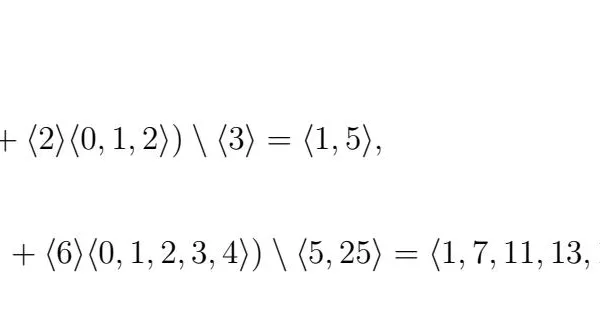
For example:
It is easy to prove this primitive recursive formula by mathematical induction.
Look through a list of primes, the sequence of primes seems chaotic and random. It offers no clues as to how to determine the next number.
Randomness and chaos are anathema to the mathematician [10].
Despite over two thousand years one pursues an order, pattern, structure, and finds a formula that generates all primes exactly and without exception, our endeavour is in vain.
In the second arithmetics the prime formula 2.1 reveals the recursive structure of each primes. Now primes do not appear randomly. They are computed one after the other by . They are governed by a recursive rule. Recursion opens new theoretical windows onto our understanding of the primes. It seems this is a prime conspiracy.
Gauss prime number theorem is an explicitly approximation for the recursive formula . The prime number theorem provides a heuristic model. Due to parity problem, we ought to reflect whether or not the heuristic model describes the sequence of primes enough accurately.
The prime formula is a reformulation of Eratosthenes sieve method.
In contrast with Eratosthenes sieve, which does not automatically yield theoretical information, the recursive sieve method itself mechanically yields a constructive proof that there are infinitely many primes[7].
We can not directly extend this constructive proof to Fibonacci primes.
Below we will refine and modify formula 2.1 to invent a recursive sieve for Fibonacci primes. A recursive formula on the sets of naturel numbers reveals a secret of the patterns of Fibonacci primes.
III. A RECURSIVE SIEVE FOR FIBONACCI PRIMES
Based on the recursive sieve method for primes, formula (2.1), we successively delete all numbers x such that x contains the least prime factor , we delete all composites together with the prime . The sifting condition or 'sieve' is
We refine the sifting condition to be
According to this new sifting condition or 'sieve', we successively delete the set of all numbers x such that x is composite with the least prime factor ,
but save the prime as a survivor.
We delete all sets of composites with from the entire set N of natural numbers and leave the sifted set
The end-sifted set, the set of all primes , is
Let be the set of all survivors less than ,
From the recursive formula (2.1), we deduce that the sifted set is the union of the set of survivors and the residue class ,
We slightly modify the above sifting process for primes to invent a recursive sieve for indices of Fibonacci primes.
We know that the Fibonacci sequence is a divisibility sequence. In fact, the Fibonacci sequence satisfies the stronger divisibility property[13]
In other words, for , divides iff n divides m. It follows that except for the case n = 4, , every Fibonacci prime have a prime index, but not every prime is the index of a Fibonacci prime.
We discuss indices of Fibonacci primes and their infinitude in the set of indices of all Fibonacci numbers.
If we only consider Fibonacci numbers as factors of Fibonacci numbers within the Fibonacci divisibility system, then the set of all primes is the set of indices of all Fibonacci primes except for . But some Fibonacci numbers with prime index contain normal prime factors that are not Fibonacci numbers. For example .
We must remove every prime index q such that is a Fibonacci composite with a normal prime factor.
One uses the rank of a prime p to discuss prime factors of Fibonacci composites with prime index.
Definition: The rank of a prime p, denoted , is the least positive integer k such that .
The first few ranks of primes are:
3, 4, 5, 8, 10, 7, 9, 18, 24, 14, 30, 19, 20, 44, 16, 27, 58, 15, 68, 70, 37, 78, 84, 11, 49, 50, 104, 36, 27, 19, 128, 130, 69, 46, 37, 50, 79, 164, 168, 87, 178, 90, 190, 97, 99, 22, 42, 224, 228, 114, 13, 238, 120, 250, 129, 88, 67, 270, 139, 28, 284, 147, 44, 310,..... (sequence A001602 in the OEIS).
We exhibit some simple facts about normal prime factors of Fibonacci composites with prime index.
(1) A prime number divides at most one Fibonacci number with prime index due to the stronger divisibility property.
(2) If is a prime, then every prime that divides is congruent to [8].
(3) Let be a prime, if , then ; if , then [5]. We have .
(4) if is a prime such that , and is also prime, then [14].
It follows that we only need to modify the set of survivors for each prime to obtain a new set of survivors, such that if then contains neither normal prime nor Fibonacci prime as a factor except itself.
Given any prime , suppose that we have a modified set , then we obtain the next set by the following rules.
If the prime is congruent to 1 mod 4, and if there is an odd prime in the set such that
then is a Fibonacci composite, which contains the least normal prime factor . We add the prime into the set and remove the prime q from the set to obtain the set .
If there is no such a prime q, then for every number x in the sifted set the Fibonacci number does not contain the normal prime as a factor. We add the prime into the set
Now for every number x in the sifted set , the Fibonacci number does not contain Fibonacci number , as a factor, and does not contain the normal prime as a factor except itself.
After modification the first few set are
The sifting condition formula (3.1) is converted into
According to this sifting condition or 'sieve', we successively delete the set of all numbers x, such that is composite with the least factor , or is composite with the least normal prime factor ,
but remain the survivor if or .
We delete all sets with from the set N of all indices of Fibonacci numbers and leave a sifted set
The sifted set is descending
The end-sifted set, the set of all indices of Fibonacci primes, is
We easily verify that the primes 3,4,5,7.11,13,17,23,29,43,47 all are indices of Fibonacci primes by the above algorithm.
The set of survivors is a set of indices of Fibonacci primes or probable primes, the candidates.
Obviously, we have
From the recursive formula (2.1), we deduce that the sifted set is the union of the set of survivors and the residue class .
We intercept the initial segment from the sifted set , which is the union of the set of survivors and the set of least nonnegative representatives, then we obtain a new recursive formula
Except remaining all survivors less than in the initial segment , both sets and are the same.
For example
Let be the number of survivors less than . Then the number of elements of the initial segment is
From formula (2.2) we deduce that the corresponding cardinal sequence is strictly increasing
Based on cardinal arithmetics we have
\lim T_{i}^{\'} = \bigcup T_{i}^{\'} = \aleph_{0}.Based on order topology we have
\lim |T_{i}^{\'}| = \aleph_{0}.Next section we will prove that the set of all indices of Fibonacci primes is an infinite set.
IV. THE INFINITUDE OF FIBONACCI PRIMES
We call an index of Fibonacci prime a F-index.
Let be the subset of F-indices in the initial segment ,
For example:
We consider the properties of both sequences of sets and to prove the conjecture.
Ref
Theorem 4.1. The sequence of the initial segments and the sequence of its subsets of F-indices both converge to the set of all F-indices .
First from set theory [2], next from order topology [6] we prove this theorem.
Proof. For the convenience of the reader, we quote a definition of the set-theoretic limit of a sequence of sets [2].
Let be a sequence of sets, we define and as follows
It is easy to check that is the set of those elements x which belongs to for infinitely many n. Analogously, x belongs to if and only if it belongs to for almost all n, that is it belongs to all but a finite number of the .
If
we say that the sequence of sets converges to the limit
We know that the sequence of sifted sets is descending
According to the definition of the set-theoretic limit of a sequence of sets, we obtain that the sequence of sifted sets converges to the set
The sequence of subsets of F-indices is ascending
we obtain that the sequence of subsets converges to the set ,
The initial segment locates between two sets and
It is easy to prove that the sequence of the initial segments converges to the set
According to set theory, we have proved that both sequences of sets and converge to the set of all F-indices .
In general, for any sequence of finite sets , if locates between two sets and ,
then we have
Thus
Even the limit of set theory is valid too.
We can not use analytic techniques for limits of set theory so that we try to endow them with an order topology, and prove that both sequences of sets and converge to the set of all F-indices .
We quote J.R.Munkres's definition of the order topology [4][6].
Let be a set with a linear order relation; assume has more one element. Let be the collection of all sets of the following types:
The collection B is a base of a topology on X, which is called the order topology.
The empty or singleton is not a linear order set. There is no order topology on the empty set or sets with a single element. For example a constant function has a limit in real analysis, but it has no limit in order topology, as .
The recursively sifting process formula produces both sequences of sets together with the set-theoretic limit point .
We further consider the structures of sets and using the recursively sifting process (3.5) as an order relation
The set has no repeated term. It is a well ordered set with the order type using the recursively sifting process (3.5) as an order relation. Thus the set may be endowed an order topology.
In general, the set may have no repeated term, or may have some repeated terms, or may be a set with a single element .
We have computed out some patterns of the first few F-indices. The set contains more than one element, may be endowed with an order topology. using the recursively sifting process (3.5) as an order relation.
Obviously, for every neighborhood of , there is a natural number , for all , we have and , thus both sequences of sets and converge to the set of all F-indices .
According to the order topology, we have again proved that both sequences of sets and converge to the set of all F-indices . We also have
If , the set only has a single element, which has no order topology. In this case formula (4.2) is not valid and we prove nothing by the order topology.
Theorem (4.1) reveals a particular order topological structure of the set of all F-indices built into the sequences of sets. Now we easily prove that the cardinality of the set of all F-indices is infinite.
We give two proofs.
Proof. A. We consider the cardinalities and of sets on two sides of the equality (4.2), and the order topological limits of cardinal sequences and with the usual order relation , as the sets and both tend to .
From general topology, we know that if the limits of both cardinal sequences and on two sides of the equality (4.2) exist, then both limits are equal; if does not exist, then the condition for the existence of the limit is not sufficient [3].
For F-indices, the set is nonempty , the formula (4.2) is valid, obviously, the order topological limits and on two sides of the equality (4.2) exist, thus both limits are equal
From formula (3.7) we have
Usually, let be the counting function, the number of F-indices less than n. Normal sieve theory is unable to provide non-trivial lower bounds of due to the parity problem. Let n be a natural number. Then the number sequence is a subsequence of the number sequence , we obtain
By formula (4.1), the is the set of all F-indices less than , and the is the number of all F-indices less than , thus . We have
From formula (4.3) we prove
Next, we give another proof by the continuity of the cardinal function.
Proof. Letbe the cardinal function from the order topological spaceto the order topological spacesuch that.
It is easy to check that for every open set in Y the preimage is also an open set in X. So that the cardinal function is continuous at with respect to the above particular order topology.
Both order topological spaces are first countable, hence the cardinal function is sequentially continuous. By a usual topological theorem [6](Theorem 21.3, p130), the cardinal function preserves limits
Order topological spaces are Hausdorff spaces. In Hausdorff spaces the limit point of the sequence of sets and the limit point of cardinal sequence are unique.
We have proved theorem 4.1, , and formulas (3.7), . Substitute, we obtain that the set of all F-indices an infinite set,
Without any estimation or statistical data, without the Riemann hypothesis, with the recursive sieve, we well understand the recursive structure, set theoretic structure and order topological structure of the set of all F-indices on sequences of sets. The theory of those structures allows us obtain an elementary proof of the conjecture.
We prove that the set of indices of all Fibonacci primes is a infinite set. In other words we have proved the theorem
Theorem 4.3. There are infinitely many Fibonacci primes.
V. DISCUSSION
In general, we can not prove that the cardinal function on sequences of sets is continuous. There is a counterexample, the Ross-Littwood paradox [9] [11].
For example: consider the limit of the sequence of sets, which have no pattern
From set theory we know , thus . But we also have from real analysis. If the cardinal function is continuous, then there is a contradiction in real analysis, the empty has an infinite cardinality. In this case, one can only get up the continuity and says that there is no relation between the cardinality of the end sifted set and the limit .
By the recursive sieve method, we have revealed that the set of all F-indices has the structure of a particular order topology
So that we consider the conjecture in the particular order topological space, which is generated naturally by the recursively sifting process (3.5), rather than in real analysis, a metric space.
We consider all sequences of finite sets , such that , and they converge to the end sifted set from set theory
We try to endow all set-theoretical convergence with an order topology using the recursively sifting process (3.5) as an order relation, then construct a particular order topological space G.
Here we must be careful about the existence of order topological limits.
First according to the definition, there exists no order topology on the empty set or sets with a single element[4] [6].
Next, we quote topologist L.D. Kudryavtsev's 'The existence of limits of a function' for .
If the space X satisfies the first axiom of countability at the point and the space Y is Hausdorff, then for the existence of the limit of the cardinal function , it is necessary and sufficient that for any sequence , such that , the limit exists. If this condition holds, the limit does not depend on the choice of the sequence , and the common value of these limits is the limit of at [3].
If the end sifted set is empty . Since the sequence of subsets is ascending, it converges to the set based on the recursively sifting process (3.5), from set theory we know that the set of sets of patterns . only have a single element and the cardinal set . only have a single element 0, both sets have no order topology, both sequences , have no limit of order topology.
Note, we consider the set sequences, the empty is as an element. If we find out at least one prime pattern, then the set sequence has more one element.
Only if the end sifted set is empty , the limits and have no existence. The existence of all other limits is not sufficient from the above general topology. Thus at the point there is no "continuous" or "non-continuous". There is no contradiction. In this case, one needs no order topology.
If the end sifted set is not empty , since the inclusion relation , the sequence has more one element, every sequence has more one element, every limit of set theory may be endowed with an order topology. Every has existence; every has existence. The condition of existence of , and , is sufficient. Thus our proof of theorem 3.1 and 3.2 is correct.
In the formal system we deal with the Ross-Littwood paradox and find out a proof of the Fibonacci prime conjecture in the particular order topological space.
The Ross-Littwood paradox shows that the restricted definition for order topology, assume X has more one element, is necessary.
In fact, we consider the set of various prime patterns , in advance, we have known at least one prime pattern, and in advance, we have known that the end sifted set is not empty .
By the same paradigm, we may prove another prime conjecture, including the twin prime conjecture.
ACKNOWLEDGMENTS
Thank for Qian Liu in Hug Chinese for her support.