To Foundations of General Theory Relativity

1
Dubrovskyi I
Dubrovskyi I
2
Dubrovskyi I.
Dubrovskyi I.

Send Message

To: Author

GJSFR Volume 23 Issue A5

Article Fingerprint

ReserarchID

SFR88LBK

To Foundations of General Theory Relativity Banner
  • English
  • Afrikaans
  • Albanian
  • Amharic
  • Arabic
  • Armenian
  • Azerbaijani
  • Basque
  • Belarusian
  • Bengali
  • Bosnian
  • Bulgarian
  • Catalan
  • Cebuano
  • Chichewa
  • Chinese (Simplified)
  • Chinese (Traditional)
  • Corsican
  • Croatian
  • Czech
  • Danish
  • Dutch
  • Esperanto
  • Estonian
  • Filipino
  • Finnish
  • French
  • Frisian
  • Galician
  • Georgian
  • German
  • Greek
  • Gujarati
  • Haitian Creole
  • Hausa
  • Hawaiian
  • Hebrew
  • Hindi
  • Hmong
  • Hungarian
  • Icelandic
  • Igbo
  • Indonesian
  • Irish
  • Italian
  • Japanese
  • Javanese
  • Kannada
  • Kazakh
  • Khmer
  • Korean
  • Kurdish (Kurmanji)
  • Kyrgyz
  • Lao
  • Latin
  • Latvian
  • Lithuanian
  • Luxembourgish
  • Macedonian
  • Malagasy
  • Malay
  • Malayalam
  • Maltese
  • Maori
  • Marathi
  • Mongolian
  • Myanmar (Burmese)
  • Nepali
  • Norwegian
  • Pashto
  • Persian
  • Polish
  • Portuguese
  • Punjabi
  • Romanian
  • Russian
  • Samoan
  • Scots Gaelic
  • Serbian
  • Sesotho
  • Shona
  • Sindhi
  • Sinhala
  • Slovak
  • Slovenian
  • Somali
  • Spanish
  • Sundanese
  • Swahili
  • Swedish
  • Tajik
  • Tamil
  • Telugu
  • Thai
  • Turkish
  • Ukrainian
  • Urdu
  • Uzbek
  • Vietnamese
  • Welsh
  • Xhosa
  • Yiddish
  • Yoruba
  • Zulu

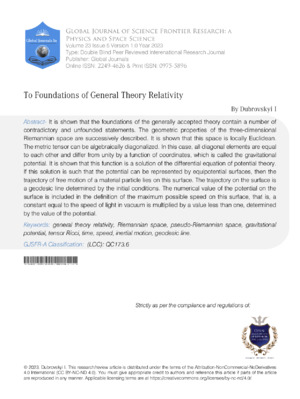
It is shown that the foundations of the generally accepted theory contain a number of contradictory and unfounded statements. The geometric properties of the three-dimensional Riemannian space are successively described. It is shown that this space is locally Euclidean. The metric tensor can be algebraically diagonalized. In this case, all diagonal elements are equal to each other and differ from unity by a function of coordinates, which is called the gravitational potential. It is shown that this function is a solution of the differential equation of potential theory. If this solution is such that the potential can be represented by equipotential surfaces, then the trajectory of free motion of a material particle lies on this surface. The trajectory on the surface is a geodesic line determined by the initial conditions. The numerical value of the potential on the surface is included in the definition of the maximum possible speed on this surface, that is, a constant equal to the speed of light in vacuum is multiplied by a value less than one, determined by the value of the potential.

Funding

No external funding was declared for this work.

Conflict of Interest

The authors declare no conflict of interest.

Ethical Approval

No ethics committee approval was required for this article type.

Data Availability

Not applicable for this article.

Dubrovskyi I. 2026. \u201cTo Foundations of General Theory Relativity\u201d. Global Journal of Science Frontier Research - A: Physics & Space Science GJSFR-A Volume 23 (GJSFR Volume 23 Issue A5): .

Download Citation

Fundamental physics research article on general theory relativity and spacetime.
Issue Cover
GJSFR Volume 23 Issue A5
Pg. 63- 70
Journal Specifications

Crossref Journal DOI 10.17406/GJSFR

Print ISSN 0975-5896

e-ISSN 2249-4626

Keywords
Classification
GJSFR-A Classification: (LCC): QC173.6
Version of record

v1.2

Issue date

July 28, 2023

Language

English

Experiance in AR

The methods for personal identification and authentication are no exception.

Read in 3D

The methods for personal identification and authentication are no exception.

Article Matrices
Total Views: 1095
Total Downloads: 19
2026 Trends
Research Identity (RIN)
Related Research

Published Article

It is shown that the foundations of the generally accepted theory contain a number of contradictory and unfounded statements. The geometric properties of the three-dimensional Riemannian space are successively described. It is shown that this space is locally Euclidean. The metric tensor can be algebraically diagonalized. In this case, all diagonal elements are equal to each other and differ from unity by a function of coordinates, which is called the gravitational potential. It is shown that this function is a solution of the differential equation of potential theory. If this solution is such that the potential can be represented by equipotential surfaces, then the trajectory of free motion of a material particle lies on this surface. The trajectory on the surface is a geodesic line determined by the initial conditions. The numerical value of the potential on the surface is included in the definition of the maximum possible speed on this surface, that is, a constant equal to the speed of light in vacuum is multiplied by a value less than one, determined by the value of the potential.

Our website is actively being updated, and changes may occur frequently. Please clear your browser cache if needed. For feedback or error reporting, please email [email protected]
×

This Page is Under Development

We are currently updating this article page for a better experience.

Request Access

Please fill out the form below to request access to this research paper. Your request will be reviewed by the editorial or author team.
X

Quote and Order Details

Contact Person

Invoice Address

Notes or Comments

This is the heading

Lorem ipsum dolor sit amet, consectetur adipiscing elit. Ut elit tellus, luctus nec ullamcorper mattis, pulvinar dapibus leo.


High-quality academic research articles on global topics and journals.

To Foundations of General Theory Relativity

Dubrovskyi I.
Dubrovskyi I.

Research Journals