
I. INTRODUCTION
Tourism is being seen as a sector which positively contributes to economic growth and development. Its contribution to world economy is significant; being currently the global second largest "industry". It's estimated it contributes with about the of the world's GDP (WTO, 2021). Tourism main economic effects are related to foreign exchange income, job creation and its role as a catalyst of other sectors of local economies. (Brida et al., 2008; Aznar et al., 2016; Hall, 2019; Ozturk & Al-Kuwari, 2021).
Tourism is the third source of non-oil income in Ecuador. Foreign currency annual behavior from tourism in that country has registered a positive fluctuation over the past few years, moving from 781 MMUSD in 2010 to 2.282 MMUSD in 2019. Nonetheless, this sector hasn't have the same share in economy throughout all Ecuadorian regions. Tourism contribution to national economy among all the country's regions: Tourism contribution to domestic economy in all zones was as follows: to the Coast, to Mountain range and only to the Amazonia (INEC, 2020).
For decades the Amazonia's social and economic development has been distinguished by conflicts over land use, internal migration, and unequal opportunities. There's a high rate of poverty in Pastaza, because of unsatisfied basic needs (UBN), with a value of ; out of eight of the 21 parishes show very high levels of poverty, with NBI values between 96.7 and (INEC, 2019). At provincial level, of the population is urban and is rural, a value above national average, which is of for urban population. Pastaza dwells the least populated rural parishes in the country, with less than 1000 inhabitants.
According to the World Tourism Barometer, the growth dynamics of Ecuador's tourism sector paused in 2020 due to Covid 19 pandemic, causing a reduction in international tourist arrivals by and revenues by . (OMT, 2021). The World Tourism Organization's (UNWTO) predictions for July 2021, are no better. At the end of the first semester of 2021, Ecuador registers a contraction in international tourist arrivals of about , compared to 2019 (UNWTO, 2021).
This paper is mainly aimed at determining tourism contribution to Pastaza economy; a province distinguished by its large biodiversity and cultural richness which is displayed throughout all its territory by all native peoples and nationalities living there. (GADPPz, 2019). Pastaza dwells seven native nationalities living through all the zone. Each of them preserving its own language and culture. (Luna and Lastra, 2020). All these particular features become both recreational tourist attractions and of scientific interest. (Izurieta, et al., 2021)
II. PUBLIC POLICY ON TOURISM IN ECUADOR
Public policy on tourism is endorsed in the Constitution of the Republic enacted in 2008. According to what's legislated in the constitution, a legal framework for tourism management has been set up, being focused on sustainable development in the economic, socio-cultural and environmental dimensions. Among the main documents that govern tourism policy in Ecuador there are as follows:
- The Constitution of Ecuador (art. 38, 48 and 383) and (art. 275, 283, 275 and 283).
- The National Tourism Development Plan 2030 (Axes 1, 2, 4 and 5).
- Tourism Law and General Regulations.
According to Piguave and Suárez (2021), in Ecuador's public tourism policy, the following principles can be highlighted: recreational rights, its inclusiveness, sustainable economic development, socio-cultural development and improvement of living conditions.
In 2008, Ecuador's new public policy and its implementation principles came into force for 14 productive sectors, including tourism, in hopeful expectation it would do far in changing the country's economic structure. Although progress was made in the touristic sector's economic revitalization, compared to years prior to 2008; tourism goals concerted on the plans for tourism development were not achieved, despite the institutional priority and the legal framework update, defined for tourism management.
III. THEORETICAL FRAMEWORK
a) Tourism as a Factor of Growth
Tourism sector is perceived as a positive contributor to economic growth and development. Its contribution to world economy is significant, being currently the second largest "industry" in the world (WTTC, 2020). Its contribution to world GDP is estimated at around . Tourism main economic effects are related to foreign currency earnings, job creation and its role as a catalyst for other sectors of local economies. (Brida et al., 2016; Hall, 2019; Sharpley, 2020) The link between tourism and economic growth has been widely analyzed through various theoretical approaches. For better understanding upon which are tourism transferring mechanisms to a region economy, it is vital to previously understand what the determining factors for economic growth can be.
b) The Concept of Development
The Concept Development has been the object of reflections throughout the history of thought. This issue began to be studied more systematically in the discipline of economics. The concern for development is inherent part of economy since its very dawn; this concept first notions can be found in authors from the seventeenth and eighteenth century or in today's authors. (Sen, 2013) As for the concept of sustainable development, its meaning is not yet completely clear since many authors have different approaches. On the one hand, there is a conception that natural resources exploitation and GDP growth are necessary. According to Hickel (2019), followers of this approach to economic growth consider that technology will be able to mitigate the problems of inefficient use of resources; which will make it possible to grow economically at a rate that allows the regeneration of the environment. However, in practical terms, this hypothesis has been developed with unquestionable weaknesses that have not allowed its full application. (Lalangui, et al., 2017; Tugcu, 2020; Menegaki, et al., 2021; Otero & Al-Kuwari, 2021)
The contradiction between development and natural resources was a central theme of the United Nations Conference on the Human Environment, which was held in June 1972 in Stockholm, Sweden. In this context, the report carried out by a group of researchers from the Massachusetts Institute of Technology at the request of the Club of Rome stands out, whose conclusions were:
"If current trends in world population growth, industrialization, environmental pollution, food production and resource depletion continue, this planet will reach the limits of its growth over the next hundred years. The most likely outcome would be a sudden and uncontrollable decline in both population and industrial capacity" (Meadows, 1972)
c) The Concept of Sustainability
In 1987, the United Nations World Commission for Environment and Development released the report known as "Our Common Future" or Brundtland Report, which reflects the best known and most widespread definition of sustainable development (United Nations, 1987):
"One who seeks to satisfy the needs of the present without compromising the ability of future generations to meet their own needs".
The concept of sustainability becomes the necessary model to establish development strategies in all spheres and sectors of production. In tourist activity, numerous actions and definitions for the development of sustainable tourism have been exposed by international organizations.
d) Sustainable Tourism
UNWTO defines sustainable tourism as the one that "... meets the needs of present tourists and host regions, while protecting and enhancing future opportunities. It is focused on managing all resources in such a way that all economic, social and aesthetic needs are met while respecting cultural integrity, essential ecological processes, biological diversity and life support systems" (OMT, 2004).
Three decades after the definition of the concept of sustainable development, institutional advances do not prove to have achieved its practical application. The fact leads to question whether the approaches and the media can change current trends or if on the contrary they favor them. Table 1
| Year | Event/Contributions |
| 1980 | "I World Strategy for the Conservation of Nature and Natural Resources" (United Nations Environment Program). |
| 1987 | "Our Common Future" Report (Brundtland Report of the United Nations World Commission on Environment and Development). |
| 1991 | "The World Strategy for the Conservation of Nature and Natural Resources" (United Nations Environment Program and World Wide Fund for Nature). |
| 2012 | Rio + 20 Conference of Nations. A new sharing is presented whose objectives were focused on renewing the commitment to sustainable development. |
| 2015 | International Network on Regional Economics, Mobility and Tourism Organization. This event is considered as a first step of basic statistical information for the regions and other territorial aggregates. |
| 2018 | 18th Meeting of the Statistics Committee at UNWTO. Progress towards a consistent and coherent statistical approach to measure sustainable tourism. |
| 2019 | UNWTO/UN, 2019. "Reference report on the integration of sustainable consumption and production patterns in tourism policies." PR 1904. |
IV. METHODOLOGY
a) Methods for Measuring Tourism Contribution to Economic Growth
Various methods have been used to measure the economic impact of tourism, such as the significance analysis that analyzes the size and structure of the tourism sector; the impact analysis that analyzes the money spent by tourists and the cost-benefit analysis focused on evaluating the feasibility and efficiency of tourism projects. (Zurub, et al., 2015) Specifically, there are some methodologies to estimate the impact of tourism on GDP, such as the Tourism Satellite Accounts, the Computable General Equilibrium, as well as the growth of tourism GDP as a percentage of GDP growth total (Ivanov & Webster, 2007; Rasool et al., 2021).
Ivanov and Webster (2007) developed a method for assessing tourism contribution to economic growth by means of the real GDP growth rate per capita, because by definition economic growth is equal to the real GDP growth rate per capita. This is taken in a disaggregated way in order to have, separately, growth generated by tourism and the generated by other sectors. The methodology proposed by Ivanov and Webster has been applied in several countries (Brida, et al., 2008; Such, et al., 2009; Fuinhas, et al., 2020).
Information collected from secondary sources, based on papers and researches already issued, was also included. Likewise, data was collected from entities such as the UNWTO, the Ministry of Tourism of Ecuador (MINTUR) and the National Institute of Statistics and Censuses (INEC), accountability reports from autonomous governments, as well as Interviews and surveys carried out to tourism professionals, academics and managers.
The current state of tourism in Pastaza was verified from the Weighed Participatory Strategic Test (WPST), a combination of two traditional test methods, SWOT and Delphi (Miller, 2001; Choi & Sirakaya, 2005).
A workshop was held in order to assess tourism performance in Pastaza, where key players involved in local tourism management attended, furthermore SWOT analysis was applied. After all the criteria had been analyzed and evaluated, the lists were reduced and the prevailing ideas identified by voting were used for the Analysis, together with tourist environment elements (Weaknesses, Threats, Strengths and Opportunities).
The environmental elements identified in the SWOT analysis upon Pastaza tourism development were evaluated by experts with close links between professional, institutional and/or research activity. The analysis was carried out using a Likert-type scale (1-5) (from none to maximum), by means of which it was granted the importance each element in the tourist context of the province has. The elements were validated using Cronbach's alpha reliability coefficients, an internal consistency analysis using corrected total correlation coefficients of elements and questions of the quantitative aspects with different reliability levels to validate those items.
Tourism sector is analyzed in this research based on statistics from hotels and restaurants. A Gross Added Value (GAV) indicator was used for measuring the added value performed by each sector in the final goods and services production process. GAV was studied in each specific activity in the period between 2010 and 2019.
b) Scope of the Study Area: Characteristics and Location
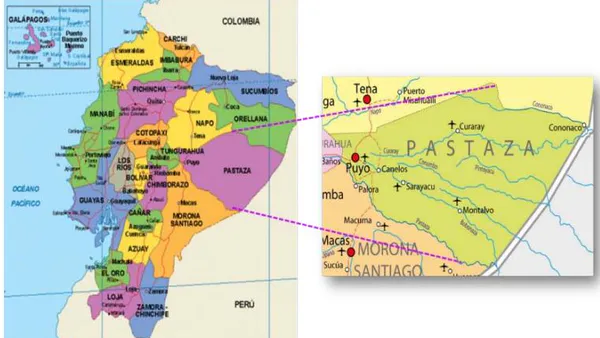
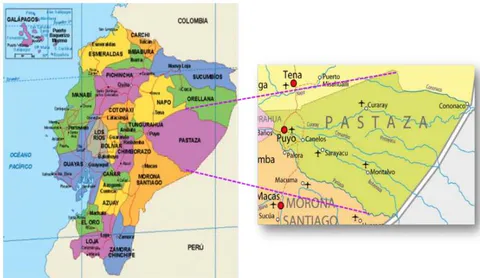
Pastaza province is located in the center of the Ecuadorian Amazon Region, between the geographic coordinates of south latitude and west longitude; and of south latitude and of west longitude. It borders the province of Napo and Orellana to the North, the province of Morona Santiago to the South, the Republic of Peru to the east and the province of Tungurahua to the west. It belongs to the humid tropical zone of the continent with an annual average temperature between 18 and C. Figure 1.
Source: Extracted from https://imagenesnoticias.com/mapa-del-ecuador
c) Players' identification and their tourism perception in Pastaza province
Players' identification and their perception of tourism in Pastaza province was carried out mainly through semi-structured interviews. This type of interview gives freedom not only but also to the interviewee and the interviewer as well, allowing all relevant topics to be included and all the necessary information can be collected. (Chan & Cheung, 2020; Husband, 2020).
In order to guarantee the results to show the internal and external conditions affecting the development of tourism and its contribution to the province's economy. It was settled that the interviewees to be people devoted to different areas of knowledge:
University professors linked to research on tourism planning of natural spaces and environment.
Trained professionals from public, tourist and environmental institutions.
Institutions and/or public and private organizations members related to natural spaces planning and management.
Professionals from private companies with experience in tourism planning and management of natural spaces.
Community representatives in areas used for tourism.
In all cases, the existence of a close link between the professional, institutional and/or research activity of the invited experts to collaborate and the subjects under study was established as a requirement. The surveys and interviews technical sheet include the process core elements. Table 2
| Items | Details |
| Unit | Hotels, hostels, accommodation, guest houses, travel agencies, universities and public and private organizations. |
| Interviewees | Directors, professionals, academics, owners and tourism managers. |
| Extension | Pastaza, Mera, Santa Clara and Arajuno municipalities, the Ministry of Environment, Pastaza Chambers of Commerce and Chamber of Tourism |
| Time | Fieldwork, August 2017 to February 2018 and July to September 2019. |
| Response rate | 100% of the managers from the province four municipalities, managers and appointed professionals from the Ministries of Tourism and Environment. |
| Program | SPSS version 25.0, SWOT analysis on the tourism sector in Pastaza province, Cronbach's Alpha 0.944 based on standardized elements. |
36% of those surveyed are doctors in different branches of knowledge. The presidents of the Chamber of Commerce and the Chamber of Tourism attended. A Seminar-Workshop was held where 57 businessmen and professionals from the sector participated.
V. RESULTS
a) Identification of entrepreneurs and their perception of tourism in Pastaza
Stakeholders participation in planning tourism on surveys and interviews with many tourism stakeholders in Pastaza, allowed the community to be involved and to learn about the key principles helping to create unions and foster cooperation. Furthermore, by means of these actions, criteria were shared on tourism benefits and threats from the point of view of the community, professionals, government managers and public entrepreneurs.
Understanding tourist environment of the sector in Pastaza, based on SWOT analysis, will give the chance to define strategic lines of action that can be organized to ensure the sector stability, but above all this to favor its growth.
Those ones consulted attribute similar importance to internal factors (Weaknesses and Strength) as to external factors (Opportunities and Threats). However, there is consensus among those ones consulted on the need to increase the socioeconomic weight of tourism in the province. In addition, they recognize that there are problems in the province on basic aspects to achieve tourism real development demanding a greater national institutional support. Table 3
| Strengths | Weaknesses | ||
| 1 | Amazonia with great diversity at a global level. | 11 | Lack of promotion and marketing channels. |
| 2 | The existing natural, cultural and historical heritage. | 12 | Limited integration between tourism and the rest of the sectors. |
| 3 | Need to increase the sector weight. | 13 | Lack of strategies for tourism development in the region. |
| 4 | Hospitality and peacefulness | 14 | Lack of information for decision making. |
| 5 | Being close to destinations with a large flow of visitors. | 15 | 15 Seasonality and tourists stay. |
| Opportunities | Threats | ||
| 6 | National policy on conscious tourism. | 16 | Lack of promotion and marketing channels. |
| 7 | Creation of new marketing channels. | 17 | Geographical situation. |
| 8 | Tourism as a catalyst for Amazonia development. | 18 | Meteorological instability affecting tourist offer. |
| 9 | Tourism for poverty reduction. | 19 | Strong competition with tourism markets in the region. |
| 10 | Tourism for environmental protection. | 20 | National and international economic situation. |
Analysis' elements related to tourist environment being ranked based on the ratings given by the experts. Table 4
| Item | Elements* | Rate | Order |
| Strength | 1, 2, 3, 4, 5 | 4,24 | IV |
| Opportunities | 6, 7, 8, 9, 10 | 4,25 | III |
| Weaknesses | 17, 18, 19, 20 | 4,26 | II |
| Threats | 11, 12, 13, 14, 15 | 4,31 | I |
| *Elements identification as per numbers appearing within the list on Table 3 | |||
The interviews and to a lesser extent the surveys carried out in this sector show us that the approach, to face the unfavorable situation that tourism in Pastaza is going through. Firstly it's focused on overcoming its weaknesses, which is justified by the province little development of as a tourist destination suggesting a lack of management and leadership experience within the sector.
b) Pastaza province main economic and productive activities
According to data provided by Banco Central de Ecuador (2019), Pastaza province activity with the highest participation in the economy is oil and natural gas drilling with of the GAV, followed by the public administration with and transport and storage activities with . Tourist activities, accommodation and restaurant services only represent . Table 5
| Economic and Productive Activities | Contribution GAV $(000) | % from total GAV | |
| 1 | Oil drilling, gas and related services | 380,453 | 52.0 |
| 2 | Administración Pública, defensa,seguidad social | 54,306 | 7.4 |
| 3 | Education | 42,256 | 5.7 |
| 4 | Construction | 37,595 | 5.1 |
| 5 | Transport and Warehousing | 33,296 | 4.5 |
| 6 | Social and Health Services | 29,830 | 4.1 |
| 7 | Trade and automotive vehicle repairs | 26,035 | 3.6 |
| 8 | Forestry, timber harvest and related activities | 18,379 | 2.5 |
| 9 | Financial services activities | 17,369 | 2.2 |
| 10 | Accommodation and food services | 16,078 | 2.1 |
| 11 | Real Estate Activities | 14,529 | 1.6 |
| 12 | Other productive and service activities | 60,822 | 8.3 |
| Total general | 730,948 | 100.0 |
c) Behavior of economic sectors in Pastaza province
Oil export and banana, cocoa and roses sales, among other products, have been increased in Ecuador in the last few years. In order to achieve sustainable development but not depending on oil drilling, the country's strategy is to transform the productive matrix aimed at exporting products and services with greater added value. It's been raises to take advantage of human resources, raw materials transforming industries together with agriculture development, which eventually will gradually make possible imports substitution and exports growth. This research was based on figures provided by Banco Central de Ecuador (2020), the following sectors were considered as parts of Pastaza economy:
Primary: Oil and Natural gas drilling and service activities related to agriculture and forestry, timber production and activities related to fishing and fish farming (except shrimp), mining and quarrying. In 2010 this sector contributed with 535 million dollars and 409.2 in 2019, which meant a reduction of .
Secondary: Meat production, wood production and wooden products, textile products manufacturing, clothing; and leather goods, milling products, bakery and pasta, paper manufacturing, furniture and metal products, heavy industry, dairy products, beverages and cigar products, among other foodstuff. The secondary sector contributed with 9.2 million dollars to the province's economy and 16.3 in 2019, representing an increase of in 2010
Tertiary: Administrative, social and health services, commerce, financial services activities, accommodation and food services, real estate activities, courier and communications, professional activities. Electricity and water supply. In 2010, the tertiary sector contributed with 214.1 million dollars to the province's economy and 303.9 million in 2019, which represents a growth of . d) Comparing tourism contribution between Pastaza and four selected provinces
considers exports as a driving force for economic growth. According to Brida et al. (2013), tourism fuels economic growth, which admits a two-way relationship between both variables.
In the period 2010-2019 the differences between Ecuadorian provinces economies were huge. Pichincha and Guayas contributed with of the country's GAV and of the tourism sector's GAV.
Last decade, the Ecuadorian economy grew a in terms of an absolute variation. This growth has contributed to a reduction in poverty rates. The provinces of Pichincha, Guayas, Tungurahua and Azuay rank among the ones with the lowest poverty rate in the country. (INEC, 2019) Meanwhile, Pastaza economy did not grow in the period. Table 6
| Year | Ecuador | Pichincha | Guayas | Tungurahua | Azuay | Pastaza |
| 2010 | 66,499,460 | 16,449,770 | 1,792,863 | 1,792,863 | 3,353,436 | 759,702 |
| 2011 | 76,536,215 | 18,292,542 | 2,029,842 | 2,029,842 | 3,727,619 | 1,134,771 |
| 2012 | 83,856,171 | 20,662,585 | 2,271,712 | 2,271,712 | 3,944,848 | 1,042,881 |
| 2013 | 90,533,862 | 22,956,885 | 2,375,376 | 2,375,376 | 4,222,873 | 1,032,771 |
| 2014 | 96,894,741 | 25,865,822 | 2,524,414 | 2,524,414 | 4,432,976 | 981,797 |
| 2015 | 92,042,505 | 25,312,810 | 2,757,000 | 2,757,000 | 4,765,706 | 613,011 |
| 2016 | 93,038,286 | 25,650,241 | 2,682,274 | 2,682,274 | 4,782,811 | 546,685 |
| 2017 | 97,082,733 | 26,406,871 | 2,857,483 | 2,857,483 | 5,013,920 | 634,614 |
| 2018 | 99,955,953 | 26,571,645 | 2,866,045 | 2,866,045 | 5,343,370 | 713,844 |
| 2019 | 100,871,577 | 27,025,827 | 2,799,401 | 2,799,401 | 5,414,337 | 730,948 |
Annual tourism revenues nationwide as well as in the provinces of Pichincha, Guayas, Tungurahua and Azuay grew. The provinces Tungurahua and Azuay
stand out, reaching annual growth rates of and respectively. Though Pastaza annual rate decreased by , Table 7
| Year | Ecuador | Pichincha | Guayas | Tungurahua | Azuay | Pastaza |
| 2010 | 1,312,445 | 333,026 | 459,820 | 54,161 | 46,839 | 18,829 |
| 2011 | 1,427,889 | 386,472 | 481,965 | 67,984 | 56,613 | 15,110 |
| 2012 | 1,631,804 | 477,044 | 495,421 | 94,979 | 68,384 | 19,608 |
| 2013 | 1,877,562 | 543,926 | 619,778 | 97,121 | 70,544 | 18,504 |
| 2014 | 2,054,398 | 615,151 | 721,742 | 85,708 | 69,222 | 17,108 |
| 2015 | 2,083,056 | 625,220 | 715,490 | 83,077 | 77,855 | 16,152 |
| 2016 | 2,123,199 | 649,042 | 717,626 | 88,993 | 74,648 | 17,894 |
| 2017 | 2,225,384 | 673,288 | 733,036 | 103,968 | 105,874 | 13,757 |
| 2018 | 2,314,342 | 664,007 | 687,524 | 138,458 | 132,688 | 17,285 |
| 2019 | 2,422,591 | 647,137 | 764,704 | 147,592 | 148,203 | 16,078 |
Tourism in Pastaza province registered negative rates, unlike the national and selected provinces performance in the period 2010-2019. Figure 2
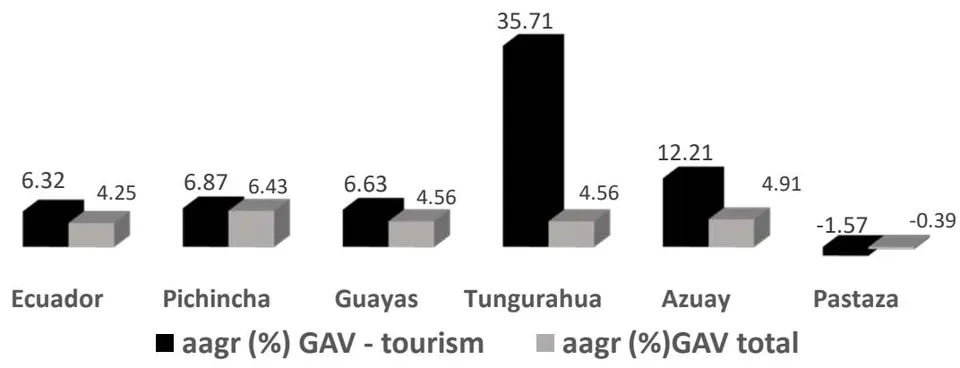
Correlation between tourism contribution and economy growth was determined using data on Tables 6 and 7, combining a temporal dimension with a
transversal one in order to apply Pearson's correlation as well as contrasting work hypothesis.
| GAV | Average | Deviation | Pearson | |
| Ecuador | Tourism | 1.947.267 | 389.444 | ,965** |
| Total | 89.731.150 | 1.096.230 | ,965** | |
| Pichincha | Tourism | 561.431 | 122.572 | ,992** |
| Total | 23.519.499 | 378.577 | ,992** | |
| Guayas | Tourism | 639.711 | 117.200 | ,921** |
| Total | 2.495.641 | 371.160 | ,921** | |
| Azuay | Tourism | 85.087 | 68.82 | ,897** |
| Total | 4.500.189 | 330.97 | ,897** | |
| Tungurahua | Tourism | 96.204 | 28.650 | ,751* |
| Total | 2.495.641 | 371.160 | ,751* | |
| Pastaza | Tourism | 17.032 | 1.793 | ,236 |
| Total | 819.102 | 209.482 | ,236 |
e) Pearson's correlation among (non-oil) economic sectors with the highest contribution to GDP and tourism in Ecuador in the period 2010-2019
Data from the Ministry of Tourism of Ecuador and INEC were used. The information was processed using the SPSS 25 software. The combination of a temporal dimension with another transversal to apply Pearson's correlation contrasted the working hypothesis:
accommodation and food services as economic activity has a significant impact on other sectors economic growth. Table 9
| Activity | Pichincha | Guayas | Tungurahua | Azuay | Pastaza | Ecuador |
| Construction | ,751* | ,835** | ,340 | ,880** | -,406 | ,912** |
| Forestry | ,686 | ,848** | ,490 | ,719* | -,150 | ,597 |
| Trade | ,360 | ,929** | ,614 | ,675 | -,413 | ,851** |
| Real Estate | ,597 | ,740* | -,130 | ,670* | ,216 | ,831** |
VI. DISCUSSION
Previous research on tourism participation in Ecuador's economy has been focused on measuring its nationwide contribution, without estimating its impact on each of the country's provinces; something important in Ecuador as it is a very heterogeneous country where the economic growth generated by tourism is different for each region. Thus, public policies focused on tourism must be different as per the zone in question.
In the 2010-2019 period, the tourism average annual growth rate registered negative figures in Pastaza, despite the fact that in the same period the province tertiary sector grew by . Tourism is considered a relevant activity for the tertiary sector, however, in Pastaza it has not represented an important contribution to this sector growth.
Despite the fact that researches being carried out in other countries demonstrate tourism relationship with trade and real estate services at international level, there is little research on this relationship within provincial level. (Brida et al., 2008; Aznar et al., 2016; Hall, 2019). This article shows there is a direct relationship between tourism and other sectors, regarding Ecuadorian provinces cases where the economy is growing.
Pastaza has a surprising potential for sustainable tourism, because of its natural and cultural heritage. Among its tourist attractions, however, this tourist potential has not yet become a source of income and employment. Based on different methods and sources, it is considered the main problems tourism faced in Pastaza province are:
- Limited integration between tourism and the rest of the sectors.
- Lack of strategies for developing tourism in the region.
- Lack of useful information for decision making.
VII. CONCLUSIONS
The research, without attempting to be exhaustive, provides elaboration statistics where various estimates are highlighted on tourism contribution to Pastaza province economy, as well as expert evaluations on inner and outer elements involved in tourism development. These results are considered a
must to define policies, strategies and concrete actions needed to support tourism sustainable development.
The annual behavior of foreign currency earnings from tourism in Ecuador has registered a positive variation for the last 10 years. However, tourism sector has not had the same participation in the economy in all regions. The Coast contributed of GDP and the Sierra , while the Amazon only contributed . Analyzes by provinces have shown an uneven development level of the tourism sector, which tend to believe accurate public policies for tourism are needed in order to suit their characteristics.
The research showed the main causes affecting tourism performance in Pastaza are influenced by: the current economic scenario, a limited integration between tourism and the rest of the sectors, a lack in renewing strategies for tourism development and a lack of statistical records and strategic information for decision-making.
Tourism as an alternative to reduce poverty in the province of the Amazon regions requires comprehensive solutions involving not only to face other problems related to basic infrastructure construction but also using heritage for tourism purposes as well.
A strengthening of tourism sustainable development in Pastaza requires a work orientation that fosters, starting from tourism, companies' competitiveness, jobs creation and public-private alliances based on mechanisms that allow an integration between tourism and the all other sectors of the economy and society.