Deforestation and forest degradation are related to human-induced activities practiced compared to the conservation of forests and their management in Nigeria. This work evaluated the diversity status of tree species in Shasha Forest Reserve utilizing a simple random sampling method for plot differentiation, with a transect established in the assessment area. Sixteen sample plots of 25 m x 25 m were found within the minimally protected and unprotected plots of the reserve. Descriptive statistics were used to analyze the data generated. The results of the tree appraisal showed that 644 individual trees and 60 different tree species (23 families) were identified. The tree species diversity indices obtained were (3.855 and 0.596) for Shannon-Weiner and species evenness, respectively. Rauvolfiavomitoria of the family Apocynaceae (46) was the most predominant tree species, followed by Celtiszenkeriof, the family Ulmaceae (32), and the families with the highest number of species were Sterculiaceae (8) and Euphorbiaceae (7).
## I. INTRODUCTION
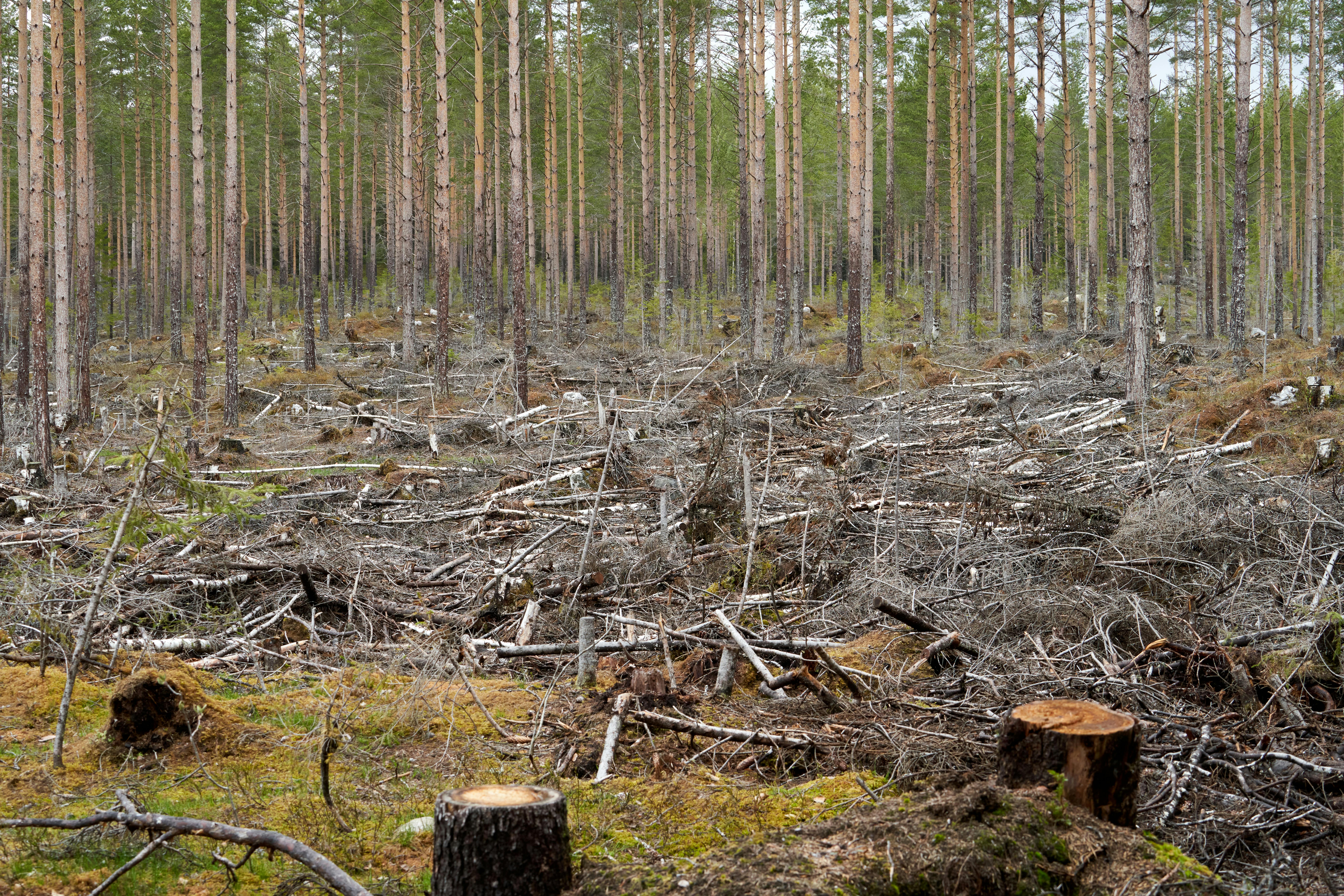
Deforestation and forest degradation are associated with human activities working against the protection of forests and their management in Nigeria. Knowing the factors leading to deforestation and forest degradation, twin problems influencing sustainable forest management, and on-site biological diversity conservation will assist in implementing policies to control them. These twin human activities are closely related to socio-political, economic, and demographic problems. About 10 million hectares of rainforests are destroyed yearly (FAO, 2015), and based on the report by Ogunrinola et al. (2020) the species-rich tropical rainforests in Nigeria have been under severe stress to meet needs for forests and non-forest products, leading to painful destruction concerning bizarre and bulk of the wooded area habitat.
A document by FAO (2015) revealed that Nigeria has one of the universe's most significant amounts of primary forest deforestation. It lost 55.7 percent of its primary forests between 2000 and 2005 (Butler, 2005). A scenario that Wilcox (1995) examined to encourage habitat fragmentation generally results in species extinction, decline in species diversity, and a reduction in primary productivity. Knowing the contributory factors and fundamental impact of deforestation and forest degradation is needed to design trade-off policies for their causes. Forestry Management Evaluation and Coordinating Unit (FORMECU, 1999) noted that about 58 (10.4%) of 560 tree species in Nigeria's forest are endangered. The investigations carried out in Queen's Forest, Oluwa Forest, and Elephant Forest by Onyekwelu et al. (2008) revealed that 16 of 51 species, 15 of 45 species, and 8 of 31 species, respectively were endangered. Onyekwelu and Fuwape (2008) believed that not more than $5\%$ of Nigeria's tropical wood is left without severe degradation.
Alarmingly in Nigeria, the primary contributor to deforestation and habitat fragmentation are crop production, fuel, and building supplies. In the northern part of the nation, excessive grazing, and clearance of trees for fuelwood for cooking are also major issues. In the southwest of the country, logging (commonly in size) continues to cause the growing fragmentation of remnant forestry ecozones. General essential infrastructural development (roads, power lines, mining, built-up areas, and the likes) are primary factors. These factors are aggravated by outdated forest laws and weak law enforcement, a lack of training and capacity in the forestry industry, and a general shortage of resources for forest management at all tiers (federal, state, and local government). It is significant to point out that Nigeria is the Federal Republic with a high level of self-reliance at the state tier. While the Federal Ministry of Environment sets national policies, it has little enforcement power.
Enforcement of forest management relies on each nation's 36 states, each of which has its forestry laws guided by those at the federal level. In several states, the management power of the state forestry departments and indigenous organizations is poor, with low funding, low staff morale, inadequate technical training, illiteracy from citizens and decision-makers, shortage of logical forest policies (lacking in most of the nation's development plans), distortion due to oil economy and usually high rates of government corruption.
In Osun State, agricultural expansion and commercial tree felling remarkably rank on the list of deforestation contributors, while urbanization and domestic energy use come next. As with other states, poor conservation and poor implementation of forest laws, policies, and regulations intensify these deforestation contributors. Previous research done by Ogunrinola et al. (2020) highlighted that the major contributors to deforestation and habitat fragmentation in Nigeria were owing to land clearing for arable land, plantation establishment, unrestrained exploitation, population settlements, excessive grazing, charcoal business, poaching, construction, and poor funding of the forestry subsector. To Morales-Barqueroet al. (2015), the intensity of forest degradation is linked to landowners' decisions managing their shifting farming practices.
There is a growing concern in determining ecosystem qualities like forest structure, floristic composition, and species richness in primary forests (Ogunrinola et al., 2020). This arises from the government's concern in reinstating the nation's severely degraded primary forest ecological community. A situation that has guaranteed the adoption and execution of sustainable forest management practices like REDD+ (Reducing Emissions from Deforestation and Forest Degradation) in some parts of the country. Knowing the multitudes of factors fostering deforestation and forest loss in the forestland reserves will assist in applying REDD+ policies that will control this social milieu and encourage forest ecosystem sustainability (Oladipo et al., 2001).
Increasing food production is the number one major contributor to deforestation emissions universally and especially in Nigeria, where the level of deforestation is put at $3.5\%$ per annum as revealed by the Environmental Management Programme Survey (Federal Ministry of Environment, 1999). The evaluation of vegetation and land management variation between 1978/78 and 1993/95 authorized by the Federal Department of Forestry reported that there was substantial expansion in the expanses of agriculture as all kinds of agriculture recognized developed by a total of 84,073km2 within the 18 years (FORMECU,1999).
Likewise, grazing land seems to be increasing irrepressibly. Its area enlarged from 18.3 percent in 1976/78 to 20.06 percent in 1993/95 (FORMECU,1999). A speedily rising population employing a finite resource lacking changes in land use designs or technological developments increases the pressure on land with related destruction hence this study.
The paramount significance of the paper was to add initial information on the subject of study. Therefore, it was bound that this study would add to the available literature on the subject. Results from this study will be useful in the following aspects: (i) identify and analyze tree species diversity and richness under different physiognomy, (ii) identify and analyze tree biodiversity abundance under different physiognomy, and (iii) study seasonal differences in tree biodiversity abundance under each physiognomy.
Similar literature on the above topic have been studied (Adedeji and Adeofun, 2014; Awotoye et al., 2013). The subsequent gaps (which this current work attempts to fulfill) were discovered. There are documented studies on deforestation and forest depletion, most of which occur in Nigeria, but there are just a couple that emphasize on evaluation of deforestation and forest loss in Shasha Forest Reserve (Adedeji and Adeofun, 2014; Awotoye et al., 2013). This manuscript attempts to highlights the status of tree species diversity degradation in Shasha Forest Reserve with a focus on the state of deforestation and habitat fragmentation. Furthermore, the gaps in the attribute of the site of the study need to be checked. A diversity of the literature studied was conducted in the Southwestern region, and none, focused on the deforestation and forest loss quality condition of Shasha Forest Reserve. This study was a comprehensive study on the tree species diversity and richness under the different physiognomy of the forest reserve ecosystem.
This work aims at expanding insight into the interaction between deforestation and degradation, in a bid to identify the factors responsible for tree species diversity degradation in the study region. The aim of this research is also to apply geospatial techniques together with field evaluation of tree diversity state to identify the factors and status of tree species diversity degradation in Shasha Forest Reserve, Southwestern Nigeria.
## II. MATERIALS AND METHODS
### a) Site Depiction and Experimental Design
This study was conducted in Shasha Forest Reserve in Osun State, Southwestern Nigeria. The study site situates on latitude and longitude (7° 05' and 4° 55' E) at an altitude of 178 m above water level. The forest reserve is located within the rainforest ecozone with a land cover of 337.298 km2 (Field Trip Earth, 2008). It has experienced a quick degradation from poaching and indiscriminate timber harvesting, wildfires, fuelwood gatherers, and transformation to plantations and cropland (Field Trip Earth, 2008). It has a mean annual rainfall of 1421 mm (Adekunle, 2006), most of which falls during the rainy season from April to October. Shasha Forest Reserve was chosen for the studies because its long-term land-use history is known. The extensive forestland is named after the "Shasha River", a large river in the study area. The Shasha River lies within the 337.298 hectares of land, which comprise the forest reserve. It has mixed moist vegetation. This reserve is one of the few forests that comprise some ecologically distinctive flora and fauna in South western, Nigeria and also includes different forest physiognomies of concern such as indigenous natural forest, non native tree plantation, and arable lands, respectively. The sampling was carried out for a period of twenty-four months (January 2020 to December 2021), spanning two wet seasons and two dry seasons. The variation in the explanatory parameters was utilized in evaluating the physiognomies that were most appropriate for species diversity conservation.
### b) Sampling Technique for Tree Species Evaluation
A simple random sampling technique was adopted for the reasonably protected and unprotected plot. A sample plot of $100\mathrm{m}\times 100\mathrm{m}$ area was marked.
The $100\mathrm{m} \times 100\mathrm{m}$ area was demarked within the field. The sampling units $25\mathrm{m} \times 25\mathrm{m}$ were located where the vegetation was relatively protected, and the edge effect satisfactorily surmounts. Sixteen fields were chosen in the tracts for the study, eight each at the two end corners of each lot. Tree species within diameter at breast height (dbh) $>10$ cm were classified, and assigned to families, and relative diversity (the number of species in a family) was determined. Most plants were classified on the field, but plants that could not be classified were tagged "unidentified", and portions of that woody species (leaves, bark, and fruits) were taken to the Forestry Herbarium, Ibadan (FHI) of Forestry Research Institute of Nigeria for classification and identification. Each tree species was recorded separately in the field forms, and a possible attempt was identified not to neglect any qualified stem in a sample plot. After the floristic survey of the sampled sites, the tree will be classified into species and families, species richness and abundance of each species in the biotic community, and will be established applying the Shannon-Weiner index specified by Ogunrinola et al. (2020). The number of trees found in the sampling plots on a species basis was estimated by multiplying it by the number of parcels ha-1 to see the abundance of the species in one hectare.
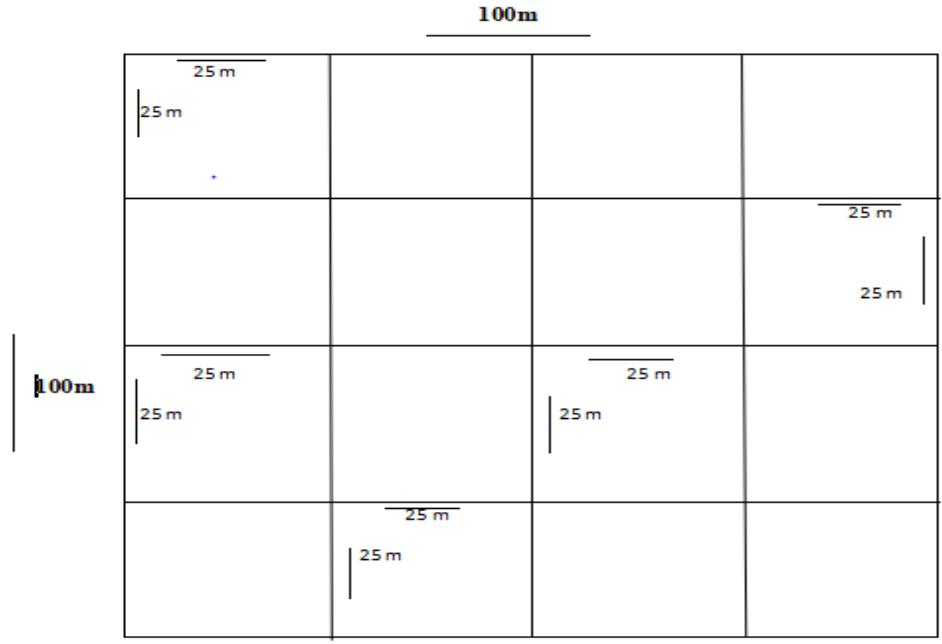 Figure 1: Plot Layout with Simple Random Sampling Technique
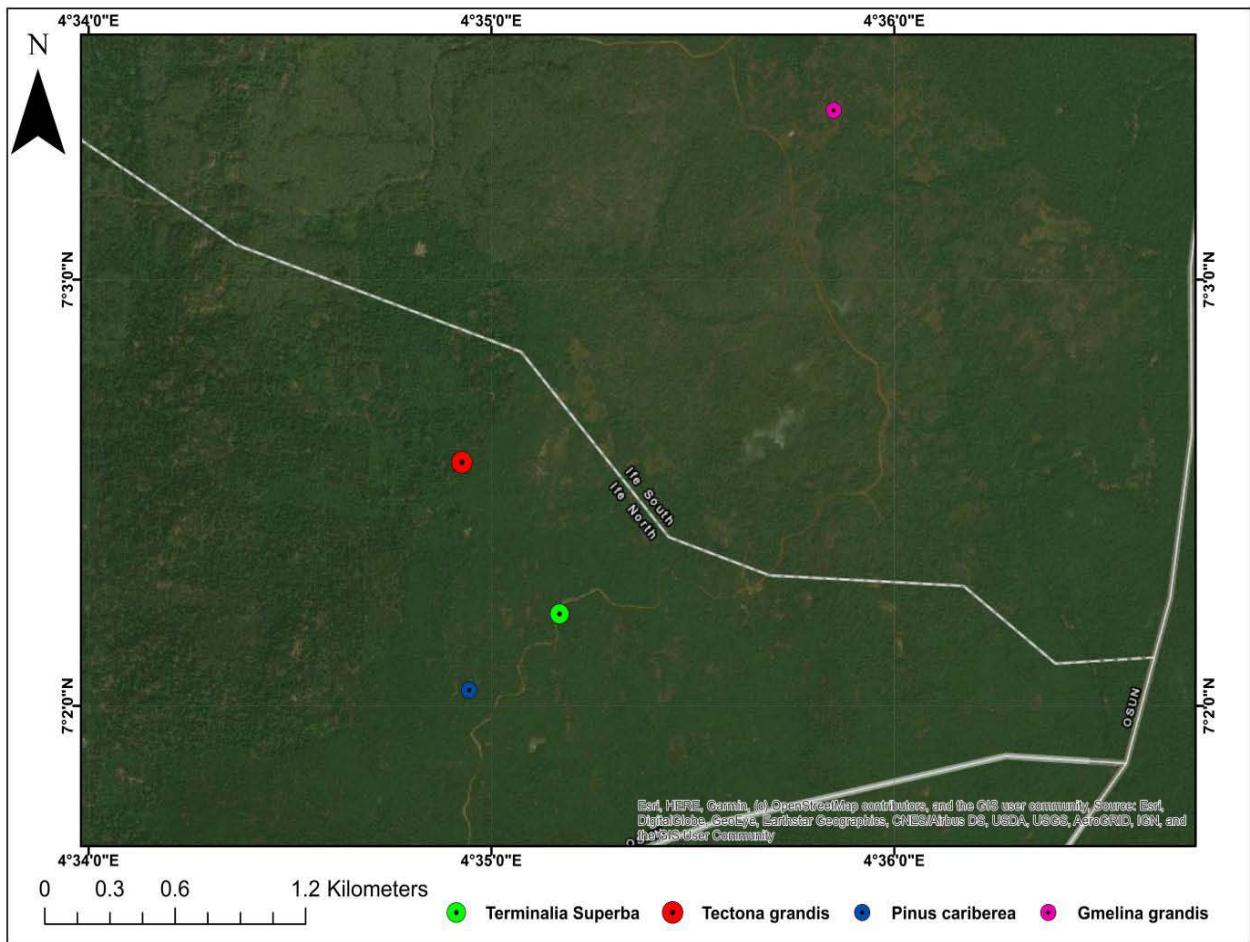 Figure 2: Map of the Study Area
### c) Plant Species Identification, Grouping, and Biodiversity Indices
Plant species composition, abundance, and the number of families were established for each plot in line with their countenance. A marker was employed to label each enumerated woody plant to prevent double enumeration. The biodiversity indices were found for each sampled point and were used for the comparison of species diversity among the physiognomies.
The subsequent biodiversity indices were found for the location
Species Relative Density (RD) number of individuals per hectare was found by applying the formula in line with Ogunrinola et al. (2020):
$$
RD = \left[ \frac{n_1}{N} \right] \times 100 \dots \dots \dots \dots \dots \dots eqn \tag{1}
$$
Where RD = relative density, ni = the number of individuals of species i, and N = the total number of individuals in the whole population.
Species Diversity Index was extrapolated by applying the Shannon-Weiner diversity index (Ogunrinola et al., 2020):
$$
\sum_ {i = 1} ^ {s} p _ {i} \ln \left(p _ {i}\right) \dots e q n \tag {2}
$$
Where:
$\mathsf{H}^{\prime} =$ Shannon-Weiner diversity index
S = Total number of species in the community
Pi = Rate of S constituted of the ith species
$\mathsf{In} =$ Common logarithm
Species Evenness in each community was carried out by applying Shannon's equitability (EH):
$$
E_{H} = \frac{H^{i}}{\ln S^{i}} = \frac{\sum_{i=1}^{s} P_{i} \ln (P_{i})}{\ln \text{区}(S)} \dots \dots \dots \dots \dots eqn \tag{3}
$$
## III. DATA ANALYSES
The data collected were subjected to appropriate descriptive analysis for tree species diversity and richness and the abundance under the different physiognomy, and subjected to analysis of variance (ANOVA).
## IV. RESULTS
The results of the tree relative density showed that 9 (39.91%) of the local tree species observed were the predominant onespresent during the study (Table 1). Six hundred and forty-four (644) individual tree stands, belonging to 60 species and 24 families of the trees were recorded. Rauvolfia vomitoria of the family
Apocynaceae (46) mainly predominated tree species, followed by Celtiszenkeriof the family Ulmaceae (32), and the families with the highest number of species were Sterculiaceae (8), Euphorbiaceae (7), and Ebenaceae (6) (Table 1). The tree species diversity indices obtained showed that Shannon-Weiner diversity and species evenness were (3.855 and 0.596), respectively. Rauvolfia vomitoria of Apocynaceae family had the highest Shannon-Weiner (0.189, 0.029) and Diospyrosmon buttensis, Diospyros canaluculata of Ebenaceae family, Memecylon afzeliiof Melastomataceae family, and Oxyanthus specious of Rubiaceae had the lowest Shannon-Weiner respectively (0.010, 0.002).
Table 1: Family Distribution of Genera, and Species in Shasha Forest Reserve in both Seasons
<table><tr><td>Family Name</td><td>Species Names</td><td>No of Genera</td><td>No of Species</td><td>Total No of Species</td></tr><tr><td rowspan="3">Annonaceae</td><td>Clestopholis patens(Benth.) Engl. and Diels</td><td>1</td><td>1</td><td>6</td></tr><tr><td>Enantiachlorantha Oliv.</td><td>1</td><td>1</td><td>3</td></tr><tr><td>Xylobiae (Dunal) A.Rich</td><td>1</td><td>1</td><td>3</td></tr><tr><td rowspan="5">Apocynaceae</td><td>Alstonia boonei DeWild.</td><td>1</td><td>1</td><td>10</td></tr><tr><td>Funtumiaelastica(Preuss) stapf</td><td>1</td><td>1</td><td>19</td></tr><tr><td>Holarrhena floribunda(G.Don) T. Durang&Schinz</td><td>1</td><td>1</td><td>5</td></tr><tr><td>Pricalima nitida(Stapf) T Durand &H.Durand</td><td>1</td><td>1</td><td>30</td></tr><tr><td>Rauvolfia vomitoria Afzel.</td><td>1</td><td>1</td><td>46</td></tr><tr><td rowspan="2">Bignoniaceae</td><td>Mikhamiasp</td><td>1</td><td>1</td><td>7</td></tr><tr><td>Spathodeacampanulata P. Beauv.</td><td>1</td><td>1</td><td>13</td></tr><tr><td>Caesalpiniodeae</td><td>Danieliogea(Harms) Rolfe ex Holland</td><td>1</td><td>1</td><td>10</td></tr><tr><td>Capparaceae</td><td>Buchholziacoriacea Engl.</td><td>1</td><td>1</td><td>18</td></tr><tr><td rowspan="2">Combretaceae</td><td>Terminalia ivorensis Chev.</td><td></td><td></td><td></td></tr><tr><td>Terminalia superb Engl. & Diels (Limba)</td><td>1</td><td>2</td><td>21</td></tr><tr><td rowspan="6">Ebenaceae</td><td>Diospyrosbarterii Hiern</td><td></td><td></td><td></td></tr><tr><td>Diospyros canaluculata De Wild</td><td></td><td></td><td></td></tr><tr><td>Diospyrosdendo Welw.exHiern</td><td>1</td><td>6</td><td>78</td></tr><tr><td>Diospyrosmonbuttensis Gurke</td><td></td><td></td><td></td></tr><tr><td>DiospyrossuaveolensGurke</td><td></td><td></td><td></td></tr><tr><td>Diospyroscanaliculata De Wild</td><td></td><td></td><td></td></tr><tr><td rowspan="7">Euphorbiaceae</td><td>Drypeteschevellerii Beille</td><td></td><td></td><td></td></tr><tr><td>Drypetes floribunda (Muell.Arg) Hutch.</td><td>1</td><td>4</td><td>40</td></tr><tr><td>DrypetespaxiiHutch.</td><td></td><td></td><td></td></tr><tr><td>Drypetesprincipum (Muell.Arg) Hutch</td><td></td><td></td><td></td></tr><tr><td>Macaranga barteri Müll-Arg</td><td>1</td><td>1</td><td>19</td></tr><tr><td>Ricinodendronafricanum (Ball.) Pierre</td><td>1</td><td>2</td><td>5</td></tr><tr><td>Ricinodendronheudotii (Ball.) Pierre</td><td></td><td></td><td></td></tr><tr><td>Malvaceae</td><td>Nesogordoniapapaverifera(A.Chev.) R.Capuron</td><td>1</td><td>1</td><td>6</td></tr><tr><td>Melastomataceae</td><td>Memecylon afzelii G.Don</td><td>1</td><td>1</td><td>1</td></tr><tr><td rowspan="2">Meliaceae</td><td>Entandrophragmaangolense(welw.) C. DC</td><td>1</td><td>1</td><td>5</td></tr><tr><td>Guareacedrata(A.Chev.) pellegrin</td><td>1</td><td>1</td><td>5</td></tr><tr><td></td><td>Trichlisiamonadelpha A Juss</td><td>1</td><td>1</td><td>19</td></tr><tr><td rowspan="5">Moraceae</td><td>Ficus exasperate Vahl</td><td>1</td><td>1</td><td>12</td></tr><tr><td>Milica excelsa (Welw.) C.Berg</td><td>1</td><td>1</td><td>8</td></tr><tr><td>Morusmosozygia Stapf</td><td>1</td><td>1</td><td>4</td></tr><tr><td>Musangacercropioides R.Br</td><td>1</td><td>1</td><td>26</td></tr><tr><td>Myrianthusarboreus P. Beauv.</td><td>1</td><td>1</td><td>4</td></tr><tr><td>Myristicaceae</td><td>Pycnanthusangolensis (Welw.) Ward</td><td>1</td><td>1</td><td>11</td></tr><tr><td>Olacaceae</td><td>Strombosiapustulata Oliv.</td><td>1</td><td>1</td><td>26</td></tr><tr><td>Pandaceae</td><td>Microdesmispuberula Hook f. ex planch</td><td>1</td><td>1</td><td>13</td></tr><tr><td>Passifloraceae</td><td>Barteriafistulosa Mast</td><td>1</td><td>1</td><td>3</td></tr><tr><td rowspan="2">Rubiaceae</td><td>Canthiumhispidium Benth</td><td>1</td><td>1</td><td>2</td></tr><tr><td>Oxyanthus specious DC</td><td>1</td><td>1</td><td>1</td></tr><tr><td>Sapindaceae</td><td>Chytranthusma crobotry (Benth)</td><td>1</td><td>1</td><td>3</td></tr><tr><td rowspan="2">Sapotaceae</td><td>Aningeriarobusta(A.Chev.) Aubrev. And Pellegr.</td><td>1</td><td>1</td><td>12</td></tr><tr><td>Malacthaalnifolia (Baker) Pierre</td><td>1</td><td>1</td><td>4</td></tr><tr><td rowspan="8">Sterculiaceae</td><td>Cola gigantean A.Chev.</td><td>1</td><td>1</td><td>20</td></tr><tr><td>Hildegardia bareri Schott &Endl</td><td>1</td><td>1</td><td>2</td></tr><tr><td>Mansonia altisima A Chev.</td><td>1</td><td>1</td><td>21</td></tr><tr><td>OctolobuanguustatusHutch.</td><td>1</td><td>1</td><td>8</td></tr><tr><td>Sterculiaoblonga Mast</td><td rowspan="3">1</td><td rowspan="3">3</td><td rowspan="3">36</td></tr><tr><td>SterculiarhinopetalaK. Schum.</td></tr><tr><td>Sterculiatragacantha K. Schum</td></tr><tr><td>Triplichiton scleroxylon K.Schum</td><td>1</td><td>1</td><td>6</td></tr><tr><td rowspan="2">Tiliaceae</td><td>Desplatsiadewevrei (De. Wild. andTh.Dur.) Burret</td><td rowspan="2">1</td><td rowspan="2">2</td><td rowspan="2">11</td></tr><tr><td>Desplatsialutea Bocq</td></tr><tr><td rowspan="3">Ulmaceae</td><td>Celtismildbraedii Engl</td><td rowspan="3">1</td><td rowspan="3">3</td><td rowspan="3">39</td></tr><tr><td>Celtistenufolia Nutt.</td></tr><tr><td>CeltiszenkeriEngl</td></tr><tr><td>Violaceae</td><td>Rinoreadentata(P. Beauv.) Kuntze</td><td>1</td><td>1</td><td>3</td></tr></table>
Table 2: Floristic Composition and Significance of Tree Species Recorded
<table><tr><td>Family Name</td><td>Species Names</td><td>Common Name</td><td>Uses</td></tr><tr><td>Apocynaceae</td><td>Alstonia booneiDe Wild.</td><td>Stool wood, pattern wood</td><td>Timber; Root and bark are used in the treatment of diseases.</td></tr><tr><td>Sapotaceae</td><td>Aningeriarobusta(A.Chev.) Aubrev. And Pellegr.</td><td>Aningeria</td><td>Veneer, carpentry, furniture, and interior joinery.</td></tr><tr><td>Passifloraceae</td><td>BarteriafistulosaMast</td><td>Ant tree</td><td>Stem bark, roots, and leaves are used in disease treatment.</td></tr><tr><td>Capparaceae</td><td>Buchholziacoriacea Engl.</td><td>Wonderful kola</td><td>House construction; Fruits and seedsare consumed most time.</td></tr><tr><td>Rubiaceae</td><td>CanthiumhispidiumBenth</td><td>Buje</td><td></td></tr><tr><td>Ulmaceae</td><td>Celtismildbraedii Engl</td><td>Red-fruited stinkwood</td><td>Light construction, flooring, interior, furniture, and good for fuel.</td></tr><tr><td>Ulmaceae</td><td>Celtistenufolia Nutt.</td><td>Dwarf hackberry</td><td>Timber and fiber-rich bark are utilized for the manufacture of ropes and paper.</td></tr><tr><td>Ulmaceae</td><td>CeltiszenkeriEngl</td><td>Ivory coast</td><td>Light construction, flooring, interior, furniture, particleboard.</td></tr><tr><td>Sapindaceae</td><td>Cyrtanthusmacrobotrys (Benth)</td><td>savannah</td><td></td></tr><tr><td>Annonaceae</td><td>Cleistopholis patens(Benth.) Engl. and Diels</td><td>Salt and oil tree</td><td>Timber and medicinal purpose</td></tr><tr><td>Sterculiaceae</td><td>Cola gigantean A.Chev.</td><td>Giant cola</td><td>Furniture; Nuts used in the manufacture of cola drinks.</td></tr><tr><td>Caesalpinioideae</td><td>Danieliaogea(Harms) Rolfe ex Holland</td><td>West African gum</td><td>Plywood, joinery, general millwork, furniture, boxes, and decorative veneer.</td></tr><tr><td>Tiliaceae</td><td>Desplatsiadewevrei (De. Wild. And Th.Dur.) Burret</td><td></td><td></td></tr><tr><td>Tiliaceae</td><td>DesplatsialuteaBocq</td><td></td><td></td></tr><tr><td>Ebenaceae</td><td>DiospyrosbarteriiHiert</td><td></td><td>The wood is used locally, and stems are used as chew sticks.</td></tr><tr><td>Ebenaceae</td><td>Diospyroscanaluculata De Wild</td><td></td><td></td></tr><tr><td>Ebenaceae</td><td>Diospyrosdendo Welw.exHiern</td><td></td><td></td></tr><tr><td>Ebenaceae</td><td>Diospyrosmon buttensis Gurke</td><td></td><td></td></tr><tr><td>Ebenaceae</td><td>Diospyrossuaveolens Gurke</td><td></td><td></td></tr><tr><td>Ebenaceae</td><td>Diospyroscanaliculata De Wild</td><td></td><td></td></tr><tr><td>Euphorbiaceae</td><td>Drypeteschevelleri Beille</td><td></td><td></td></tr><tr><td>Euphorbiaceae</td><td>Drypetesfloribunda (Muell.Arg) Hutch.</td><td></td><td></td></tr><tr><td>Euphorbiaceae</td><td>Drypetespaxii Hutch.</td><td></td><td></td></tr><tr><td>Euphorbiaceae</td><td>Drypetesprincipum (Muell.Arg) Hutch</td><td></td><td></td></tr><tr><td>Annonaceae</td><td>EnantiachloranthaOliv.</td><td></td><td></td></tr><tr><td>Meliaceae</td><td>Entandrophragmaangolense (welw.) C. DC</td><td>Tiama Mahogany English mountain mahogany</td><td>Timber, cabinetwork, exterior and interior joinery, veneer and plywood, shipbuilding.</td></tr><tr><td>Moraceae</td><td>Ficus exasperate Vahl</td><td>Forest sandpaper</td><td>Used for making canoes, house posts, furniture, stools, utensils, containers, and drums.</td></tr><tr><td>Apocynaceae</td><td>Funtiumia elastica(Preuss) stapf</td><td>West Africa rubber tree</td><td>Used for carving spoons, bowls, and other household utensils; Timber for beams and rafters in buildings[</td></tr><tr><td>Meliaceae</td><td>Guareacedrata(A.Chev.) pellegrin</td><td>Scented guarea</td><td>The wood is used for house building, flooring, joinery, interior trim, paneling, window frames, doors, shipbuilding, vehicle bodies, furniture, cabinetwork, decorative boxes, crates, veneer and plywood. It is suitable for musical instruments.</td></tr><tr><td>Sterculiaceae</td><td>Hildegardia bareri Schott &Endl</td><td></td><td>It is used to make ropes, floats, plates, and dishes.</td></tr><tr><td>Apocynaceae</td><td>Holarrhena floribunda (G.Don) T. Durang & Schinz</td><td>False rubber tree</td><td>It can be used as a glue; used traditionally for carvings, combs, spoons, stirrers for the rice-pot, and handles for axes and small implements.</td></tr><tr><td>Euphorbiaceae</td><td>Macaranga barteri Müll-Arg</td><td></td><td>It is used as vermifuge and febrifuge. (antioxidant) It is also used to relieve cough and bronchitis</td></tr><tr><td>Sapotaceae</td><td>Malacthaalnifolia (Baker) Pierre</td><td>Country mallow</td><td></td></tr><tr><td>Sterculiaceae</td><td>Mansonia altisimaA Chev.</td><td>African black walnut</td><td>Used as high-class joinery, cabinetwork, furniture, turnery, decorative veneer and handicrafts. It is also used in the construction of doors and windows, shop fittings, and boxes and crates</td></tr><tr><td>Melastomataceae</td><td>Memecylon azelii G.Don</td><td>Edwinani</td><td></td></tr><tr><td>Pandanaceae</td><td>Microdesmispuberula Hook f. ex planch</td><td>Diola</td><td>The twigs serve as chew stick; It is used to make chairs, spring traps,</td></tr><tr><td></td><td></td><td></td><td>handles, and implements and made into a type of guitar.</td></tr><tr><td>Bignoniaceae</td><td>Mikhamia spp</td><td></td><td></td></tr><tr><td>Moraceae</td><td>Milicia excelsa (Welw.) C.Berg</td><td>African teak</td><td>It is used for construction work, shipbuilding and marine carpentry, sleepers, framework, trucks, draining boards, outdoor and indoor joinery, stairs, doors, frames, garden furniture, cabinetwork, paneling, flooring and profile boards for decorative and structural uses. It is also used for carving, domestic utensils, musical instruments, and toys.</td></tr><tr><td>Moraceae</td><td>Morusmosozygia Stapf</td><td></td><td>The wood is suitable for sliced veneer, high-class furniture, flooring, staircases, joinery, and turnery, agricultural implements, toys, novelties, carvings, boxes, crates, vats, posts, poles, piles, mine props and shingles.</td></tr><tr><td>Moraceae</td><td>Musangacercropioides R.Br</td><td>Corkwood</td><td>Production of stools, musical instruments, walkingsticks, trays, baskets, toy popguns.</td></tr><tr><td>Moraceae</td><td>Myrianthus boreus P. Beauv.</td><td>Giant yellow mulberry, Monkeyfruit</td><td>It is used to make domestic utensils and also used for fencing.</td></tr><tr><td>Malvaceae</td><td>Nesogordonia papaverifera(A.Chev.) R.Capuron</td><td>Red wood</td><td>It is used for general construction, floors, joinery, turnery, boatbuilding, tool handles, gunstocks, plywood, utility crossarms, and furniture.</td></tr><tr><td>Sterculiaceae</td><td>Octolobusangustatus Hutch.</td><td></td><td>The stems are made into spear shafts</td></tr><tr><td>Rubiaceae</td><td>Oxyanthus speciosus DC</td><td>Whipstick loquat</td><td>The wood is used for building poles, whipsticks, and tool handle. The wood is used for fuel.</td></tr><tr><td>Apocynaceae</td><td>Picralima nitida (Stapf) T Durand &H.Durand</td><td></td><td>Small dippers and spoons are made from the shell of the fruit. It is used traditionally to make items such as combs incense holders, spoons, walkingsticks, arrows, weaver's shuttle.</td></tr><tr><td>Myristicaceae</td><td>Pycnanthusangolensis(Welw.) Ward</td><td>African nutmeg/lomba</td><td>It is used for veneer peeling, panels, furniture frames, box-making, pencils, and minor joinery.</td></tr><tr><td>Apocynaceae</td><td>Rauvolfia vomitoriaAfzel.</td><td>Poison devils pepper</td><td>Hunting poison</td></tr><tr><td>Euphorbiaceae</td><td>Ricinodendronafricanum (Ball.) Pierre</td><td></td><td>It is used in making small kitchen utensils, carved material, dye, and tanning.</td></tr><tr><td>Euphorbiaceae</td><td>Ricinodendronheudelotii (Ball.) Pierre</td><td>African oil-nut tree</td><td>Paper pulp, bowls, used for fishnet floats and rafts for heavy timbers, used for rough planks and coffins.</td></tr><tr><td>Violaceae</td><td>Rinoreadentata(P. Beauv.) Kuntze</td><td>Oloborobo</td><td>Chewing stick</td></tr><tr><td>Bignoniaceae</td><td>Spathodeacampanulata P. Beauv.</td><td>African tulip tree</td><td>It is used for making blacksmiths' bellows. The wood is used for the carving and production of plywood.</td></tr><tr><td>Sterculiaceae</td><td>Sterculiaoblonga Mast</td><td>Yellow sterculia</td><td>It is used for flooring, beams, planks, and furniture.</td></tr><tr><td>Sterculiaceae</td><td>Sterculiarhinopetala K. Schum.</td><td>Aye</td><td>Timber, construction, flooring, joinery, interior trim, paneling, stairs, high-quality furniture, ship and boat building, turnery, tool handles, toys, poles, veneer and plywood.</td></tr><tr><td>Sterculiaceae</td><td>Sterculiatragantha K Schum</td><td>English African Tragacantha</td><td>It is used for posts, boards, and construction work.</td></tr><tr><td>Olacaceae</td><td>Strombosiapustulata Oliv.</td><td>Itako</td><td>Veneer, building poles and transmission poles, and heavy-duty flooring.</td></tr><tr><td>Combretaceae</td><td>Terminalia ivorensis Chev.</td><td>Idigbo/Ivory coast almond</td><td>Light construction, door and window frames, joinery, furniture, cabinetwork, veneer and plywood. It is suitable for flooring, interior trim, vehicle bodies, sporting goods, boxes, crates, matches, turnery, hardboard, particleboard, and pulpwood.It is used locally as planks, roof shingles, fencing posts, dug-out canoes, drums, and mortar.</td></tr><tr><td>Combretaceae</td><td>Terminalia superbaEngl. & Diels (Limba)</td><td>Afara/ black limba</td><td>It is used as interior joinery, doorposts and panels, mouldings, furniture, office fittings, crates, matches, and especially for veneer and plywood.</td></tr><tr><td>Meliaceae</td><td>TrichliliamonadelphaA Juss</td><td></td><td>The wood is used in house building, suitable for light flooring, joinery, interior trim, shipbuilding, vehicle bodies, furniture, cabinetwork, boxes, crates, toys, novelties, veneer, particleboard,plywood, hardboard and as well as pulpwood for paper production.</td></tr><tr><td>Sterculiaceae</td><td>Triplichiton scleroxylon K.Schum</td><td>Obeche</td><td>Timber and woodwork</td></tr><tr><td>Annonaceae</td><td>Xylophiaethipica(Dunal) A.Rich</td><td>Ethiopian Pepper</td><td>It is used for making bows and crossbows for hunters and warriors.It is used also for requiring resilience such as boatconstruction, masts, oars, paddles and spars</td></tr></table>
## V. DISCUSSION
A designed evaluation for an exploratory, checklist of biodiversity species, genus, and their families in biological Shasha Forest Reserve, Osun State, was revealed in Table 1. A total of six hundred and forty-four (644) species distributed into forty-five (45) genera were identified in Shasha Forest Reserve. Rauvolfia vomitoria of the family Apocynaceae (46) mainly predominated tree species, followed by Celtiszenkeriof the family Ulmaceae (32), and the families with the highest number of species were Sterculiaceae (8), Euphorbiaceae (7) and Ebenaceae (6) (Table 1). From the study that was conducted in the sampling site, it was observed that Rauvolfia vomitoria (Apocynaceae) had a more prevalent dominant species in the whole four sampled plots because the species is more suitable for the geographical area in terms of survival rate and reproduced more frequency by natural means (through the dispersal of seedlings by wind, water, birds and rodents, and biological agents) which causes it to be in more abundances than the other tree species.
The results also revealed that a substantial part of Shasha Forest Reserve had been altered between
1986-2021. Most of the forested areas have been encroached on by farmers for crop production and the like purposes. This result corroborates the study of Nathaniel et al. (2012), which revealed a steady decline in forest and land utilization intensification with expansion in croplands/fallow ground and housing areas in south western Nigeria. The notice able fallin forested ranges and rise in the arable land was not without a heavy toll on the tree species.
The number of tree species (60) found in the study area is lesser relative to the number found by Ihenyen et al. (2010) in Ehor Forest Reserve, Nigeria.
The result was equally lower comparative to the report of several scholars in other tropical forests (Gerald et al., 2004). The decline in forested habitats and tree species compared to earlier studies in the tropical wood could be due to increasing human intrusion into the forest reserve in need for agricultural purposes by farmers who currently settled in villages that have now been opened within the forest and fringes and borders.
The expansion in cropland and reduction in the forest range confirms the claim of Adedeji and Adeofun (2014) that forests were cleared to make way for food and tree crops. The number of tree species per hectare
(60) recorded in this study was observed to be higher than the number of species recorded (55) in the same area by Adekunle (2006) and (Onyekwelu et al., 2005).
Part of the explanation for this may be that moderately or slightly unprotected tropical forests are likely to maintain more plant speciesthan a forest that is dense and protected (Mishra et al., 2004). This also shows the degree to which man has encroached on the forest between 2000 and 2021. The more varied a range is, and the, more its unchangeability. The overall Shannon's equitability of 0.596 for this study is smaller than the 0.66 observed by Onyekwelu et al. (2005) for Queen Forest, an unaltered ecological community reserve in Ondo State. This showed lower naturally-occurring of individual tree species within the species reported, indicating that species evenness lesser declined as forest depletion intensified. This agrees with the finding of Nath et al. (2005) for tropical biomes in India that tree species'evenness declined with the rise in intensity of forest stress. The results of the tree relative density showed that 9 (39.91%) of the indigenous tree species observed were the predominant onespresent during the study (Table 1). Shasha Forest Reserve, generally is predominated by tree species in the families Sterculiaceae, Euphorbiaceae, and Ebenaceae.This result is corroborated by Adekunle (2006), who observed Sterculiaceae; Euphorbiaceae, has one of the prevalent families in the primary forest of the research area. Furthermore, Ihenyen et al. (2010) in Ehor Forest Reserve in Edo State also observed that Sterculiaceae, Euphorbiaceae, and Ebenaceae be among the predominant families in those forest reserves.
The types of tree species such as (Picalina nitida, Celtiszenkeri, Diospyrosspp, Strombosiapustulata, and Sterculiarhinopetala.) primarily found in this range are immature for commercial timber uses, because most of them are below the merchantable girth of $(48\mathrm{cm})$ required for harvesting. This signifies that the ecological community has been previously logged, during which matured invaluable economic trees have been selectively exploited. Strombosiapustulata Oliv was one of the predominant tree species found by Adekunle (2006) in the primary forest of the study area 2006.
Nevertheless, some of these tree species Strombosiapustulata Oliv, Diospyros spp, and Funtumia elastica (Preuss) Stafp, were among the tree species obtained by Onyekwelu et al. (2008) to dominate Oluwa Forest Reserve, the adjacent forest reserve to the study area.
Therefore, considerable numbers of the tree species found are fewer in abundance due to exploitation and degradation of the forest area and rate of conversion to cropland.
This study was designed to assess the woody plant diversity to signify the number and variety of diverse species in the ecosystem within the area under investigation. Good insight on how to give proper accountability of a reserve and to preservediversity is crucial for both current and subsequent generations.
The structural composition of tree species conservation within Shasha Forest Reserve is fast declining owing to the encroachment of arable farmlands into the forested area. The increasing of cultivated farmlands and non-forested, abandoned sites, uncontrolled logging, charcoal business, commercial fire collection, human population settlement, and habitat fragmentation are severe degrading factors within the reserve. In reversing this, urgent measures have to be taken to give a trade-off for land needed for subsistence agriculture and impaired land meant for afforestation in place of primary forest in Shasha Forest Reserve. Management interferences like enrichment planting, regulated selective logging, and protection of biological regeneration can further aid in restoring this ecological community. Finally, planned of regenerating the indigenous tree species in the forest reserve is an imperative means to confront the present rate of depletion in the area. Further study on the factors contributing tothe such menace is recommended to monitor the seasonal variations in contents of biodiversity indices and relate to the past treespecies diversity studies. The work has provided information on the extent of forest degradation in the Shasha Forest Reserve as a way of evaluating the ecological health of the study field as a result of deforestation. The work also added to the benchmark information on plant species diversity indicesstudiesin our environment.
## ACKNOWLEDGEMENTS
The authors are grateful to Directors and Workers of Shasha Forest Reserve, Osun State for permitting the useof their reserve as sampling site for this study. The Forestry Herbarium, Ibadan (FHI) of Forestry Research Institute of Nigeria, is to be thanked for their assistance in classification and identification analysis. The Obafemi Awolowo University, Ile-Ife is also acknowledged for providing the enabling environment for the study.
### Statement of Competing Interests
The authors declare that they have no competing interests.
Generating HTML Viewer...
References
21 Cites in Article
Oludare Adedeji,Clement Adeofun (2014). Spatial Pattern of Land Cover Change Using Remotely Sensed Imagery and GIS: A Case Study of Omo-Shasha-Oluwa Forest Reserve, SW Nigeria (1986-2002).
V Adekunle (2006). DIVERSITY AND ABUNDANCE OF LESSER-KNOWN PLANT SPECIES OF FOOD AND ETHNOMEDICINAL POTENTIAL IN TROPICAL RAINFOREST ECOSYSTEM OF SOUTHWEST NIGERIA.
O Awotoye,S Adebola,O Mathew (2013). The Effects of Land-Use Changes on Soil Properties in a humid Tropical Location; Little-Ose Forest Reserve, South-Western Nigeria.
O Awotoye,S Adebola,O Mathew (2013). LAND USE EFFECTS ON SOIL CARBON AND NITROGEN ENZYMES IN A HUMID TROPICAL ECOSYSTEMS OF SOUTH WESTERN NIGERIA.
R Butler (2005). A World Imperiled: Forces behind forest loss Retrieved from.
(2015). Forest and Forest Soils: an Essential Contribution to Agricultural Production and Global Food Security.
(1999). Federal Agency Regulations Implementing NEPA.
(2008). Field Trip.
Formecu (1999). Forest Resources study of Nigeria.
E Gerald,L David,M John (2004). Density and species diversity of trees in four tropical forests of the Albertine rift, western Uganda.
J Ihenyen,J Mensah,E Okoegwale (2010). Tree/Shrubs Species diversity of Ehor Forest reserve in Uhunmwode Local Government Area of Edo State, Nigeria.
B Mishra,O Tripathi,R Tripathi,H Pandey (2004). Effects of anthropogenic disturbance on plant diversity and community structure of a sacred grove in Meghalaya, northeast India.
Lucia Morales-Barquero,Armonia Borrego,Margaret Skutsch,Christoph Kleinn,John Healey (2015). Identification and quantification of drivers of forest degradation in tropical dry forests: A case study in Western Mexico.
P Nath,A Arunachalam,M Khan,K Arunachalam,A Barbhuiya (2005). Vegetation analysis and tree population structure of tropical wet evergreen forests in and around Namdapha National Park, northeast India.
O Nathaniel,A Albert,A Samson (2012). Geospatial Analysis of Deforestation and Land Use Dynamics in a Region of South western Nigeria.
O Ogunrinola,T Ogunwale,S Oke,P Ogar (2020). Effect of Four Different Physiognomies on Selected Macro arthropod Communities in Akure Forest Reserve, Aponmu, Southwestern Nigeria.
Oladipo (2001). First National Biodiversity Report on Nigeria.
J Onyekwelu,J Fuwape (2008). Conservation and Restoration of Degraded Forest Landscapes in Rainforest Zones of Nigeria through Reforestation Projects.
J Onyekwelu,V Adekunle,S Adeduntan (2005). Does the tropical rainforest Ecosystem possess the ability to recover from severe degradation?.
J Onyekwelu,A Agbelade,M Tolorunju,A Lawal,B Stimm,R Mosandl (2008). CONSERVATION POTENTIALS, TREE SPECIES DIVERSITY, DISTRIBUTION AND STRUCTURE OF SACRED GROVES IN SOUTH-WESTERN NIGERIA.
B Wilcox (1995). Tropical forest resources and biodiversity: the risks of forest loss and degradation.
No ethics committee approval was required for this article type.
Data Availability
Not applicable for this article.
How to Cite This Article
Taiwo O. Ogunwale. 2026. \u201cTree Species Diversity Status and Contributors to Forest Degradation in Shasha Forest Reserve, Nigeria\u201d. Global Journal of Science Frontier Research - H: Environment & Environmental geology GJSFR-H Volume 23 (GJSFR Volume 23 Issue H1): .
Explore published articles in an immersive Augmented Reality environment. Our platform converts research papers into interactive 3D books, allowing readers to view and interact with content using AR and VR compatible devices.
Your published article is automatically converted into a realistic 3D book. Flip through pages and read research papers in a more engaging and interactive format.
Deforestation and forest degradation are related to human-induced activities practiced compared to the conservation of forests and their management in Nigeria. This work evaluated the diversity status of tree species in Shasha Forest Reserve utilizing a simple random sampling method for plot differentiation, with a transect established in the assessment area. Sixteen sample plots of 25 m x 25 m were found within the minimally protected and unprotected plots of the reserve. Descriptive statistics were used to analyze the data generated. The results of the tree appraisal showed that 644 individual trees and 60 different tree species (23 families) were identified. The tree species diversity indices obtained were (3.855 and 0.596) for Shannon-Weiner and species evenness, respectively. Rauvolfiavomitoria of the family Apocynaceae (46) was the most predominant tree species, followed by Celtiszenkeriof, the family Ulmaceae (32), and the families with the highest number of species were Sterculiaceae (8) and Euphorbiaceae (7).
Our website is actively being updated, and changes may occur frequently. Please clear your browser cache if needed. For feedback or error reporting, please email [email protected]
Thank you for connecting with us. We will respond to you shortly.