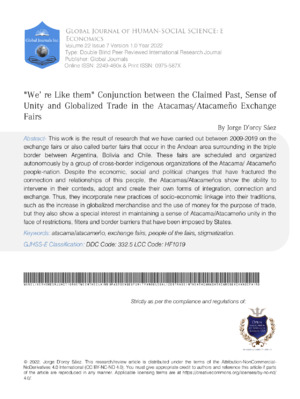
We are like them Conjunction between the Claimed Past, Sense of Unity and Globalized trade in the Atacamas/Atacameno Exchange Fairs

α
Jorge D’Orcy Saez
Jorge D’Orcy Saez

Send Message

To: Author

We are like them  Conjunction between the Claimed Past, Sense of Unity and Globalized trade in  the Atacamas/Atacameno Exchange Fairs

Article Fingerprint

ReserarchID

B258B

We are like them  Conjunction between the Claimed Past, Sense of Unity and Globalized trade in  the Atacamas/Atacameno Exchange Fairs Banner

AI TAKEAWAY

Connecting with the Eternal Ground
  • English
  • Afrikaans
  • Albanian
  • Amharic
  • Arabic
  • Armenian
  • Azerbaijani
  • Basque
  • Belarusian
  • Bengali
  • Bosnian
  • Bulgarian
  • Catalan
  • Cebuano
  • Chichewa
  • Chinese (Simplified)
  • Chinese (Traditional)
  • Corsican
  • Croatian
  • Czech
  • Danish
  • Dutch
  • Esperanto
  • Estonian
  • Filipino
  • Finnish
  • French
  • Frisian
  • Galician
  • Georgian
  • German
  • Greek
  • Gujarati
  • Haitian Creole
  • Hausa
  • Hawaiian
  • Hebrew
  • Hindi
  • Hmong
  • Hungarian
  • Icelandic
  • Igbo
  • Indonesian
  • Irish
  • Italian
  • Japanese
  • Javanese
  • Kannada
  • Kazakh
  • Khmer
  • Korean
  • Kurdish (Kurmanji)
  • Kyrgyz
  • Lao
  • Latin
  • Latvian
  • Lithuanian
  • Luxembourgish
  • Macedonian
  • Malagasy
  • Malay
  • Malayalam
  • Maltese
  • Maori
  • Marathi
  • Mongolian
  • Myanmar (Burmese)
  • Nepali
  • Norwegian
  • Pashto
  • Persian
  • Polish
  • Portuguese
  • Punjabi
  • Romanian
  • Russian
  • Samoan
  • Scots Gaelic
  • Serbian
  • Sesotho
  • Shona
  • Sindhi
  • Sinhala
  • Slovak
  • Slovenian
  • Somali
  • Spanish
  • Sundanese
  • Swahili
  • Swedish
  • Tajik
  • Tamil
  • Telugu
  • Thai
  • Turkish
  • Ukrainian
  • Urdu
  • Uzbek
  • Vietnamese
  • Welsh
  • Xhosa
  • Yiddish
  • Yoruba
  • Zulu

Abstract

This work is the result of research that we have carried out between 2009-2019 on the exchange fairs or also called barter fairs that occur in the Andean area surrounding in the triple border between Argentina, Bolivia and Chile. These fairs are scheduled and organized autonomously by a group of cross-border indigenous organizations of the Atacama/ Atacameño people-nation. Despite the economic, social and political changes that have fractured the connection and relationships of this people, the Atacamas/Atacameños show the ability to intervene in their contexts, adopt and create their own forms of integration, connection and exchange. Thus, they incorporate new practices of socio-economic linkage into their traditions, such as the increase in globalized merchandise and the use of money for the purpose of trade, but they also show a special interest in maintaining a sense of Atacama/Atacameño unity in the face of restrictions, filters and border barriers that have been imposed by States.

References

18 Cites in Article
  1. C Aguilar,V Moreno (2001). Encuentro de los Pueblos Antiguos en las Alturas de Atacama.
  2. A Bello (2012). Alianza estratégica Aymaras sin Fronteras: Una respuesta territorial a los desafíos de la glocalización.
  3. V Conti (2011). La frontera argentino-boliviana durante la temprana república. Complementariedad económica e integración social.
  4. Viviana Conti,Gabriela Sica (2009). Arrieros andinos de la colonia a la independencia.
  5. M Choque,C Mamaní (2001). Reconstitución del ayllu y derechos de los pueblos indígenas: el movimiento indio en los Andes de Bolivia.
  6. J D'orcy (1993). Una breve aproximación a las ferias internacionales de trueque entre las comunidades y organizaciones Atacamas/ Atacameñas de Argentina, Bolivia y Chile.
  7. D México Unknown Title.
  8. H Gündermann (2002). DECLARACIÓN ELABORADA POR EL GRUPO DE TRABAJO CLACSO “AFRODESCENDENCIAS Y PROPUESTAS CONTRAHEGEMÓNICAS”.
  9. Enzo Isola (2010). Economías del desierto: sobre las paradojas-circulantes del patrimonio en el Salar de Atacama.
  10. (2011). Los otros arrieros de los valles, la puna y el desierto de Atacama.
  11. C Sanhueza (1992). Tráfico Caravanero y arriería colonial en el siglo XVI.
  12. Gabriel Taruselli (2010). Las expediciones a salinas: caravanas en la pampa colonial. El abastecimiento de sal a Buenos Aires (Siglos XVII y XVIII).
  13. Laura González Laso (2007). El marco político de la cooperación energética en el seno de la unión por el Mediterráneo: avances hacia la energía marina renovable.
  14. O (2007). ¿Qué establece la Declaración de las Naciones Unidas sobre los derechos de los pueblos indígenas?.
  15. O (1989). Convenio Número 169 de la Organización Internacional del Trabajo sobre pueblos indígenas y tribales.
  16. (2012). ¿Qué establece la Declaración de las Naciones Unidas sobre los derechos de los pueblos indígenas?.
  17. S (1985). Contrabando de carne desde Salta, 11 detenidos.
  18. (2012). Declaración de las Quetenas.

Funding

No external funding was declared for this work.

Conflict of Interest

The authors declare no conflict of interest.

Ethical Approval

No ethics committee approval was required for this article type.

Data Availability

Not applicable for this article.

How to Cite This Article

Jorge D’Orcy Saez. 2026. \u201cWe are like them Conjunction between the Claimed Past, Sense of Unity and Globalized trade in the Atacamas/Atacameno Exchange Fairs\u201d. Global Journal of Human-Social Science - E: Economics GJHSS-E Volume 22 (GJHSS Volume 22 Issue E7): .

Download Citation

An academic journal publishing research on social sciences, international trade, and economic development.
Issue Cover
GJHSS Volume 22 Issue E7
Pg. 45- 58
Journal Specifications

Crossref Journal DOI 10.17406/GJHSS

Print ISSN 0975-587X

e-ISSN 2249-460X

Keywords
Classification
GJHSS-E Classification: DDC Code: 332.5 LCC Code: HF1019
Version of record

v1.2

Issue date

February 9, 2023

Language
es
Experiance in AR

Explore published articles in an immersive Augmented Reality environment. Our platform converts research papers into interactive 3D books, allowing readers to view and interact with content using AR and VR compatible devices.

Read in 3D

Your published article is automatically converted into a realistic 3D book. Flip through pages and read research papers in a more engaging and interactive format.

Article Matrices
Total Views: 1616
Total Downloads: 56
2026 Trends
Related Research

Published Article

This work is the result of research that we have carried out between 2009-2019 on the exchange fairs or also called barter fairs that occur in the Andean area surrounding in the triple border between Argentina, Bolivia and Chile. These fairs are scheduled and organized autonomously by a group of cross-border indigenous organizations of the Atacama/ Atacameño people-nation. Despite the economic, social and political changes that have fractured the connection and relationships of this people, the Atacamas/Atacameños show the ability to intervene in their contexts, adopt and create their own forms of integration, connection and exchange. Thus, they incorporate new practices of socio-economic linkage into their traditions, such as the increase in globalized merchandise and the use of money for the purpose of trade, but they also show a special interest in maintaining a sense of Atacama/Atacameño unity in the face of restrictions, filters and border barriers that have been imposed by States.

Our website is actively being updated, and changes may occur frequently. Please clear your browser cache if needed. For feedback or error reporting, please email [email protected]

Request Access

Please fill out the form below to request access to this research paper. Your request will be reviewed by the editorial or author team.
X

Quote and Order Details

Contact Person

Invoice Address

Notes or Comments

This is the heading

Lorem ipsum dolor sit amet, consectetur adipiscing elit. Ut elit tellus, luctus nec ullamcorper mattis, pulvinar dapibus leo.

High-quality academic research articles on global topics and journals.

We are like them Conjunction between the Claimed Past, Sense of Unity and Globalized trade in the Atacamas/Atacameno Exchange Fairs

Jorge D’Orcy Saez
Jorge D’Orcy Saez

Research Journals