## I. SUMMARY AND INTRODUCTION
Seeing through the fog in front of us
There are times when crises provide more eloquent warnings about unattended problems than all discourses and learned studies. The crisis detonated almost 15 years ago by the gas supply cutoff from Argentina, awakened Chile to its perilous vulnerability resulting from its growing (and excessive) dependence on a single source of energy supply. This situation also triggered the opportunity to start addressing emerging issues, particularly environmental concerns.
To this end, a simple "benchmarking" exercise was undertaken to enable Chilean power sector stakeholders to learn from what other countries have done in their energy programs in terms of their: (i) impact or results; (ii) all-in costs; and (iii) required institutional arrangements for implementation.
The results were eye-opening. Whereas countries like Germany embarked on an ambitious recasting of their energy matrix, others followed a more gradualist and organic approach to increase their share of renewables. The former approach, required a solid top-down and disciplined investment effort, resulting in a significant change in the energy matrix, though at a major cost and increased energy risks, which became evident early on the Ukrainian war, when gas supplies were significantly curtailed, triggering an important energy crisis. There were others that acted more gradually, and hedging through some degree of diversification the risks of misjudging energy demand forecasts.
When discussing these outcomes with Chilean civil society organizations, environmental NGOs, utilities, most stakeholders particularly final consumers centered their concerns on affordability (fancy programs being OK, but "not with my money"), energy security and compatibility with the institutional capabilities in the country. In contrast with the top-down framework implied in international meetings, the approach chosen in Chile centered on "crowding in" the private sector for investments, rather than stretching an already overextended (and consequently slow) public sector for such task.
This approach in effect encouraged the Authorities to center their attention on creating business conditions through pricing, taxation and other conditions that could be instrumental in attracting financial and human resources from the private sector to finance and manage investments that otherwise would be difficult to handle, given the institutional limitations and fiscal constraints.
The progress (as described in section V, below) speaks for itself. It does not, however provide for longer-term assurance of continued enhancement, since the very success "crowds in" new players and solutions. This generates potential new sources of competition and other conditions that require further adjustment in the enabling and regulatory environment, which becomes difficult to accommodate when vested interests and inertia constrain adaptation of governance arrangements defended by incumbents.
In all, though, Chile has been ranked among the five best performing countries in terms of the increases attained of renewables in overall energy supply, leaving however a steep and more complex road ahead.
## II. TAKING STOCK
Seeking Collaboration through Institutional Compulsion - vs. Alignment of Interests
Much of international discourse hinges on the premise that issues stemming from global warming are of such magnitude and complexity that they require collective and collaborative efforts to address them in a meaningful way. $^{1}$
Not surprisingly:
- International debates tend to be steered by government institutions, international and multilateral organizations (UNFP, IEA, and various multilaterals), which for the most part have a public sector focus for problem solving.
- As a result, glaringly absent from the debates is an understanding of how civil society organizations, checks and balances, incentive structures including price and tax arrangements, how to hold accountable public authorities, and in what ways private sector entities work, as an integral part of the proceedings including, ultimately, ultimately in proposals for implementation.
- The focus is thus primarily public sector oriented, with predominantly supply-side concerns, such as goal settings, targets, monitoring, and associated regulatory arrangements to clear and authorize
projects, set standards to be achieved, and resources required to be committed.
In the absence of institutions with genuine implementation experience and responsibilities, it has become almost inevitable that projections endorsed by global institutions tend to rely on aggressive assumptions and "tortured" modelling to meet desirable lower emission goals. Feasibility seems to take secondary importance.
It shouldn't thus be surprising to see significant shortfalls from agreed targets. The tendency to seek stretch goals (with limited attention to implementation requirements or feasibility), tends to focus debates on the need for pushing harder to mobilize more financial resources, that others not present in the meetings are unable (or unwilling) to defray.
However, with considerable resource requirements for meeting identified needs, and competing claims for major pent-up adjustments requirements (like economic reactivation following Covid shut-downs) no county or entity seems to be in a position to effectively respond. Under the circumstances, pledges are easy to make, but difficult to deliver, thereby contributing to a gaping difference between goals and reality.
In all, the scale of global financing required to meet mitigation and adaptation needs is vast, and current financing availabilities fall well below desirable levels. For example, according to a November 2022 report from the Rockefeller Foundation and Boston Consulting Group (BCG), "To achieve net zero, public and private sector entities across the globe will need approximately $3.8 trillion in annual investment flows (equivalent to 3.8 percent of global GDP) through 2025. But only a fraction of this capital is currently being deployed. Even when viewed with a wider lens that considers funding such as transition finance, expected needs still outweigh flows by $66\%$."
Energy transition projects alone will need a substantial amount of climate finance. While estimates for this component vary as well, it has been estimated that up to several trillion dollars annually in new investments is needed for this purpose through 2030.
Given the resulting public debates stemming from implementation shortfalls, and the rather removed role of the private sector in such proceedings, attention should seriously shift towards resource mobilization and mainstreaming the private sector into the proceedings. This requires sharper attention on building the business case to attract such resources, and a consequent recasting of the approach to energy transition.
Similarly, the role of multilateral banks, particularly the World Bank and IFC to enhance their capabilities, risk mitigation arrangements, and support for policy development towards enabling conditions will
be needed to achieve a major uptake of investments for energy transition.
## III. MOVING FROM EXHORTATION TO ACTIONS AND OUTCOMES
Impossible Takes a Bit Longer
Aside from this, here are some broader comments beyond Chile:
- Most UN organizations and multilaterals (including much of the environmentalist community) having limited first-hand experience and responsibility in implementation, tend to focus more on exhortation and global concerns, rather than analysis and attention to issues standing in the way for effective progress. This has resulted in debates centered on processes, overall goal setting, rather than substance and focus on results, thereby rendering the proceedings largely immune to learning from empirical evidence. This enabled leaders to hide behind facile statements on the risks of global warming and exhortations, rather than the hard choices and trade-offs to be made, the experiences and results of different approaches being undertaken, and lessons to be drawn to achieve tangible results.
- As elsewhere, the evidence suggests that in the absence of adequate financial incentives, one cannot expect real action and ensuing results. Where polluters pay for the costs they generate, one can see mitigation arrangements and associated investments. This can be seen glaringly in the progress Chile has made in its energy matrix towards increased renewables though proper energy pricing. Something similar occurred in the virtual elimination of sulfur emissions through a cap-and-trade system to price sulfur emissions, which ultimately led to sharp reductions in acid rain cast by SO2 emission.[3]
- There are, of course, various market approaches to pricing externalities to reflect emissions, but the default model on environmental management in much of the world has tended to rely on regulation and top-down goal setting, which are institutionally-intensive and therefore difficult to manage, particularly in institutionally-weak countries. One shouldn't thus be surprised that the results have been at best mixed, if not downright poor, costly and overly dependent on the discretion of public officials. Almost inevitably, this has exposed investment projects to increasing and costly delays, opportunities for corruption and often changing (and contradictory or idiosyncratic) criteria for investments.
- Similarly, there are ad hoc approaches aimed at supporting specific technologies or special financial
instruments to help finance particular projects. This may be a valid, though limited, approach to circumvent constraints by earmarking resources andring-fencing projects, not much different from what the World Bank did in the early days of industrial and mining financing. Such approaches generated generally solid, but enclave initiatives that didn't sustain themselves more broadly in the absence of such special efforts, or sustained financing for further expansions to meet growing needs. Given the magnitude of resources needed to finance a meaningful program, a significantly upscaled effort will be needed to mobilize resources even in the absence of Multilateral Development Banks intervention. Focusing on enabling conditions, including carbon trading and pricing vehicles[4] should avoid having to be exposed to eternal negotiations, the whims of changing political and/or other idiosyncratic conditions, and corruption associated with excessive discretionary powers of regulatory Authorities.
- Finally, as Global Greenhouse Emissions and the attendant climate change are global factors, the current focus on county- and project-level approach has its limitations. The large increase of PV installations is, for instance, grounded on CO2 emission reductions estimates in IPCC models, rather than primary (and verified) data from actual producers. As a result, China, where according to some studies may actually generate much larger emission footprints in the manufacturing of PV facilities — more comparable to natural gas power generation, given the country's large dependence on coal-based power generation-- may serve as a better estimate for the material of its exported PV installations. Conversely, the country or project focus tends to miss the emerging role of international supply chains in emission reduction of commodities like copper, lithium, graphite and nickel, whose role in emerging technologies to decarbonize productive sectors, needs to be explicitly considered as part of program evaluations of the mining as much as in the downstream power sector investments. The evaluations, and investment or policy actions must address the whole supply chain to achieve the intended goals.
## IV. 'VOICES WITH ENERGY' DEBATE IN CHILE
I'm not looking for those who think like me. I look for those who, like me, think
The Chilean electricity sector was the first in Latin America and one of the first in the world to deregulate (1981) and privatize (1986-88) its generation sector, forcing generators to compete with each other. As such, the sector is efficient, transparent and sophisticated, with tariffs equal to the marginal cost of
production plus a market rate of return, reflecting relative scarcity and all-in costs. Chilean electricity can be sold via regulated tariffs to captive clients, and via freemarket contracts with large industrial clients. In addition, generators with excess capacity can sell the electricity surplus to generators with energy deficits via spot market transactions.
The country was at the forefront of electricity deregulation and has provided a transparent, predictable and rational means of delivering appropriate risk-adjusted returns. Chile has delivered reasonably priced electricity; capital flows have not been impeded into the sector and energy efficiency is good by international standards. The energy efficiency seems particularly good considering that Chile's main export goods are energy intensive (mining) and the topography of the country could have led to high costs. Thus, any further developments should be set within the context of building upon what has been, by and large, a successful strategy for over two decades.
The country's greatest advantage is in effect having succeeded in moving towards a streamlined regulatory system (where duplication, offsetting incentives etc. are avoided) that constitutes a solid asset to build on. The country can thus afford to minimize the rules, use pricing where at all possible, and avoid choosing energy development paths that become costly and complicated, and difficult to change when vested interests become dependent on special institutions or different forms of privileged access to resources.
As a result, Chile is in a strong position to deal with new threats to energy supply in a cost-effective manner. In many regards, Chile pioneered de-regulation in the sector, has achieved reasonable levels of energy efficiency (although more can be done) and has a strong record of bringing private finance into the sector. It has done so through a judicious mixture of solid and adaptable policy and a stable and predictable pricing framework.
With newly emerged challenges of dealing with security concerns and the environment, Chile will need to turn to the same innovation and policy adjustments, as it has done in the past. In doing so, it will be able to continue on its solid track record while integrating these new issues, embarking on a new energy chapter as it fully adjusts to its membership of the OECD.[6]
While, as noted above, the existing system has been the outgrowth of discussions with the various stakeholders of the sector, and periodic debates with various interest groups, the following summarizes the assessment of the latest (October 2023) debate on "Voices with Energy" of stakeholders on the ongoing transition that essentially:
- Reassured that the direction of Chilean energy and decarbonization policy continues to be solidly grounded, unambiguously defended, and highly
performing, despite populistic inclinations and pressures of the current public administration that need to be overcome;
- Suggested that civil society organizations are becoming increasingly solid and prepared to call into account private enterprises utilities and public Authorities on their commitments;
- Reinforced a broad unease on the grasp of UN and associated organizations have to provide tangible and effective advice in support of decarbonization efforts.
On the Chilean achievements in energy transition (i.e., the progress/outcomes, risks and challenges), main points highlighted were:
- Power sector capacity is currently three times higher than energy demand; $63\%$ share in renewables, and $75\%$ if hydro and geothermal are included
- Sector has added last 10 years 14,000 MW in installed capacity, evidencing favorable investment climate to meet energy demand
- Another 7000 MW currently in execution that will enter into service in the near term
- 12000 MW projects in preparation that are currently undergoing environmental evaluation, suggesting favorable outlook and expectations for the longer term
- The country has the highest share of renewables in the region, and among the five highest internationally, and given current projections, Chile will meet, if not surpass its international pledges, suggesting a stronger policy framework compared with most at the international level.
Concerns and critiques of civil society organizations representing power sector consumers:
- The international "promise" of low cost solar and wind energy doesn't seem to be born out in Chile, where energy costs have been consistently been increasing as the share of renewables have been incorporated into the grid;
- At some point this may trigger issues of affordability, particularly for lower income population;
- There are growing risks with the current system, where most renewable sources generate power at distances ranging from 1,200 to 1,800 Kms away from main markets, which could be disrupted within such ranges.
Global approaches, particularly as seen from UNFCCC's (United Nations for Climate Change Convention) vantage point:
- The need to strengthen multilateral processes of the Paris Agreement, Kyoto Protocol and the Convention through COP proceedings for goal
setting, tracking and debating emerging issues on climate change programs
- Clearer recognition of the various issues and sectors involved, indicating the actions need to be approached differently among countries
- An emerging recognition of progress that Chile has achieved with liberal policies, which are being replicated in some European countries and US states.
The implications as seen by local power utilities have been that:
- There are no "silver bullets" to deal with the issue, and while costs have significantly decreased for renewables, they have inevitable constraints, such as being location-specific -in the case of Chile in the distant North, far away from main consuming centers, and being intermittent depending on weather conditions (i.e., when there is sunshine and wind).
- There are also major excess and shortages of energy generation in early and late parts of the day, producing excess and deficit of generation capabilities to respond to market demands for which there are no easy technological responses.
- All this requires energy storage facilities, which for the time being are costly, and major investments in transmission lines, which constitute integral parts the costs of renewables.
- On the other hand, the regulatory framework needs some updating, to reflect new services that have emerged from new players and technological developments that would permit trimming of government regulatory interventions of natural monopolies that no longer exist, and thus create conditions for growing competition and lowering costs.
- As Chile is a marginal player in terms of GHG emissions, even with the progress that has been achieved, the country could tangibly contribute at an increasing scale internationally. This could be done by reversing restrictive practices that have been instituted in recent years for new and/or expanding mining activities, by lowering barriers to investments in projects such as copper, lithium, which constitute major inputs for decarbonized energy production and storage, and where the country has major reserves and comparative advantages.
- Chilean emissions have been reduced by $28\%$ over the last five years (partly by limited growth of economic activity), and the remaining third to achieve net zero goals will require more complex efforts, including further technical innovation, and revisiting technologies where some estimate of the footprint of solar PV suggest that they may be
higher than models being used by the IPCC, given production practices in China.
In all, it has been acknowledged that progress has been impressive, but there are challenges that need to be addressed in the steeper road ahead, and the need to take a broader view of regulatory practices if the country is to make further progress and help achieve greater impact at the global level.
## V. THE RECORD AND THE LESSONS
To dialogue: ask, first; then... listen; then act and track
Chile's greatest advantage is having succeeded in moving towards a streamlined regulatory system
(where duplication, offsetting incentives etc. are avoided) that constitutes a solid basis to build on.
The country can thus afford to minimize the rules and avoid costly public sector regulatory intervention, use pricing where at all possible, and avoid choosing energy development paths that become costly and complicated, or difficult to change when vested interests become dependent on special institutions with privileged access to resources. This enabled the country to move its energy matrix in a decisively renewable direction in an effective manner, as can be seen below:
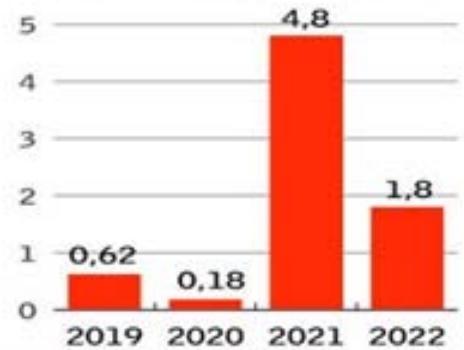
Crecimiento de la demanda
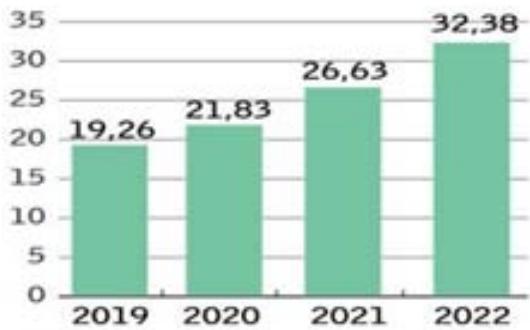
Participation annual ERNC
Generación por fuente total (en TWh)
<table><tr><td></td><td>2022</td><td>2021</td><td>Var. %</td></tr><tr><td>Eólica</td><td>8,8</td><td>7,2</td><td>22,4</td></tr><tr><td>Geotérmica</td><td>0,5</td><td>0,3</td><td>43,8</td></tr><tr><td>Hidráulica</td><td>20,1</td><td>16,3</td><td>23,2</td></tr><tr><td>Solar</td><td>14,1</td><td>10,5</td><td>33,4</td></tr><tr><td>Térmica</td><td>38,9</td><td>46,5</td><td>-16,3</td></tr></table>
Generación renovable no convencional (en TWh)
<table><tr><td></td><td>2022</td><td>2021</td><td>Var.%</td></tr><tr><td>Biomasa</td><td>1,51</td><td>1,63</td><td>-7,4</td></tr><tr><td>Eólica</td><td>8,75</td><td>7,15</td><td>22,4</td></tr><tr><td>Pasada (minihidro)</td><td>2,23</td><td>2,05</td><td>8,8</td></tr><tr><td>Solar</td><td>14,03</td><td>10,53</td><td>33,2</td></tr></table>
Generación térmica (en TWh)
<table><tr><td></td><td>2022</td><td>2021</td><td>Var.%</td></tr><tr><td>Biomasa</td><td>1,65</td><td>1,86</td><td>-11,3</td></tr><tr><td>Carbón</td><td>19,03</td><td>27,47</td><td>-30,7</td></tr><tr><td>Diésel</td><td>1,48</td><td>1,81</td><td>-18,2</td></tr><tr><td>Gas Natural</td><td>15,84</td><td>14,48</td><td>9,4</td></tr></table>
Chile is now in a strong position to cost effectively deal with many new threats to energy supply. In many regards, Chile having pioneered de-regulation in the sector, has achieved good levels of energy efficiency, and has a strong record of bringing private finance into the sector. It has done so through a judicious mixture of solid policy and a stable and predictable pricing framework.
With the newly emerged challenges of dealing with security concerns and the environment, the country will need to turn to the same innovation and introduce policy adjustments as it has done in the past. In doing so, it will be able to continue on its solid track record while integrating these new issues, embarking on a new energy chapter by integrating the requirements stemming from its membership in OECD, and further the policy and technical development for its decarbonization efforts.
While the thrust of concerns relates to growing public good externalities in the energy sector (for Chile and most other countries) of environmental impacts and security of supply concerns, addressing those concerns should still be possible within the current investment framework of the country. This can be achieved by ensuring that:
- The playing field for investment remains level (any regulations are applied across the board) while still ensuring that flexibility is built in to the system (to cope with pricing shifts and other shocks);
- Any legitimate additional costs of compliance to environmental standards can be recouped through output prices;
- Consultation between the public and private sectors would always precede any policy decisions.
## VI. THE WAY FORWARD IN AN UNCERTAIN WORLD
First things first, last things later
Looking beyond the various issues mentioned above, if there is one broad lesson to be learned, it is the need to recognize that major imbalances and associated adjustment policies can be extremely disruptive. In fact, they are ultimately a sign of failure – i.e., the inability to foresee structural changes and adapt to them through deliberate changes in incentive structures and investment solutions, to adapt to emerging societal and technological requirements. Meeting the challenge of the unpredictable seldom comes from “pushing harder” or “changing faster”, but from learning to recognize the need to redesign in a timely fashion.[7]
The deeply alluring command and control ways of forcing change can just as easily produce costly and misguided investment decisions. A more open and flexible approach to constant and organic adaptation
through open competition and entrepreneurship might on the whole be a more effective way of mobilizing skills, innovation, funding and technology to respond to emerging needs. If properly designed such changes could provide a framework of certainty and stability that are crucial to promote the path of growth, without prejudice to the introduction of some innovations, included much needed promotion of free competition and entrepreneurship for innovation in productive activities.
In the end, much of the complexity of policy design in relation to energy stems from a multiplicity of objectives. Ultimately, when designing policies experience suggests the following factors to merit special consideration to untangle the conflicts that tend to arise from the various objectives normally being sought:
- Efficient resource allocation, which requires that both producers and users of energy face prices that reflect its scarcity value—which for nonrenewable resources stems not only from direct production costs but also the opportunity cost of present consumption in terms of future consumption foregone—and any associated externalities. When externalities spill across national borders, however, they create an important distinction between global and national perspectives on efficiency: they matter for the former, but not the latter.
- Competitiveness concerns, with a fear of disadvantageing domestic producers in world markets, have increasingly become important in designing fiscal measures bearing on energy.
- Terms of trade considerations also arise in shaping fiscal policies toward energy, particularly as hydrocarbons constitutes among the largest balance of payments in most countries. Accounting for nearly 45 percent of global oil demand, for example, the G7 collectively is likely to have significant power in the world market: measures to restrict demand may bring about a reduction in world oil prices that raises their citizens' welfare, in effect transferring to them part of the resource rent that suppliers of oil would otherwise enjoy. The converse of any such gain, however, is a corresponding loss to oil exporting countries.
- Revenue concerns and interactions with the wider tax system, more generally, may affect both the choice of instrument and the level at which it is set.
- Minimizing costs of compliance and administration, to enterprises and governments respectively, is a standard principle of public policy design, though it has received little distinct attention in relation to energy issues.
Finally, the issue of coherence across policies has become a major challenge in many countries. It is not uncommon to find an array of subsidies, grants, tax
interventions, etc. that are being applied with little attention to coherence, and often producing conflicting signals. Indeed, concern over environmental effects has spawned many complex, distorting and conflicting policies. Countries should avoid such tendencies. The directness, simplicity and market orientation of Chile's approach to business and key sectors (as energy) stand it in good stead to avoid such pitfalls.
Above all, the environmental aspects need proper mainstreaming, as it is an issue that goes well beyond the energy sector.[8] Whatever the organizational set-up, a strategic framework on environmental and climate change for a country's engagement may need to be developed to:
1) Make effective climate action -- both adaptation and mitigation -- part of core development efforts (rather than reactive clearance arrangements for individual projects, which may be contentious, time-consuming and expensive);
2) Address the ensuing incremental resource requirements through up-scaling of existing innovative instruments for finance, beyond the prevailing project-by-project approach, which has had high transaction costs and consequently limited application for widespread impact programs on a larger scale;
3) Develop market friendly policies aiming at reflecting in prices and incentives externalities, and more broadly create an enabling environment for leveraging private sector investment and finance; and
4) Set up policy research, scanning international experiences, knowledge management and capacity building to facilitate development of policies and adaptation of climate-friendly technologies to local environments.
With a more structured approach to issues as suggested above, it should be possible to consider "over the horizon" issues. This should enable countries focus on emerging issues and poise themselves in a timely and systematic manner for emerging technologies, market and other disruptions to allow a coherent way of anticipating, inevitable changes in a cost effective and manageable manner.
Generating HTML Viewer...
References
10 Cites in Article
Miguel Schloss (2021). Unknown Title.
Miguel Schloss (2023). Changing the Conversation on Energy Transition -Aligning Interests or Mandating Actions to Combat Climate Change in Challenging Times.
The Role of Multilateral Banks in Closing the Climate and Energy Transition Finance Gap.
Geoffrey Heal (2017). Endangered Economics.
Miguel Schloss (2023). Editorial Acadeḿica Espanõla.
(2023). Unknown Title.
C Colum,Lea Booth (2023). Solar Panels Are Three Times More Carbon-Intensive Than IPCC Claims; Public Substack.
Annie Dufey (2023). Lecciones que Se Desprenden del Proceso de la Política Energética de Largo Plazo-Energía 2050.
Vinod Thomas (203). Risk Resilience in the Era of Climate Change.
Miguel Schloss (2023). The Elephant in the Room; Preaching or Working on Climate Change.
No ethics committee approval was required for this article type.
Data Availability
Not applicable for this article.
How to Cite This Article
Dr. Miguel Schloss. 2026. \u201cEnergy Transition in Unsettled Times\u201d. Global Journal of Science Frontier Research - H: Environment & Environmental geology GJSFR-H Volume 23 (GJSFR Volume 23 Issue H6): .
Explore published articles in an immersive Augmented Reality environment. Our platform converts research papers into interactive 3D books, allowing readers to view and interact with content using AR and VR compatible devices.
Your published article is automatically converted into a realistic 3D book. Flip through pages and read research papers in a more engaging and interactive format.
Our website is actively being updated, and changes may occur frequently. Please clear your browser cache if needed. For feedback or error reporting, please email [email protected]
Thank you for connecting with us. We will respond to you shortly.